CEX vs DEX vs Hybrid Exchanges 2026: The Complete Comparison
Editorial independence & fact-check disclosure: ChainGain does not receive affiliate commission from Binance, Coinbase, Kraken, Bybit, Uniswap, Curve, PancakeSwap, SushiSwap, Hyperliquid, dYdX, Loopring, Vertex, or any exchange named in this comparison. Trading volumes and DEX market share verified 2026-05-27 via CoinGecko’s CEX & DEX Trading Activity Report 2026 and DefiLlama. Fees and regulatory status change weekly — verify each exchange’s current site and your local regulator before depositing.
Key Takeaways
- Three architectures, not two — Centralized exchanges (CEX: Binance, Coinbase, Kraken), decentralized exchanges (DEX: Uniswap, Curve, PancakeSwap), and a fast-growing hybrid category (Hyperliquid, dYdX v4, Loopring, Vertex) combining off-chain orderbook UX with on-chain settlement.
- DEX spot share doubled to 13.6% in January 2026 per CoinGecko’s annual report, and DEX perpetuals share grew 5x to 10.2% — CEXs still dominate, but the gap is closing faster than at any point since 2020.
- Real 2026 fees: CEX 0.05-0.20% maker/taker; DEX 0.30% liquidity-pool fee plus $5-50 Ethereum mainnet gas or $0.10-2 on Layer 2; hybrids 0.02-0.10% with on-chain settlement costs absorbed into validator rewards.
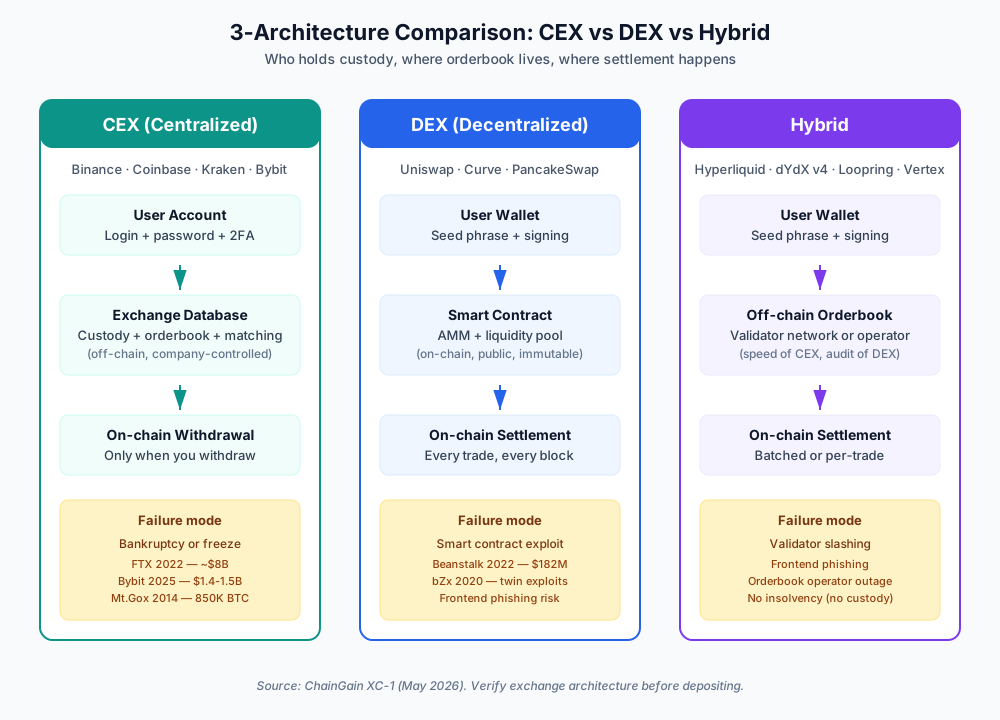
- Failure modes differ by architecture: CEXs go bankrupt (FTX, ~$8B customer shortfall, Nov 2022) or get hacked (Bybit, $1.4-1.5B, Feb 2025); DEXs lose to smart contract exploits (Beanstalk, $182M, April 2022); hybrids carry validator-slashing and frontend phishing risk.
- Regulatory exposure: US SEC dismissed its Coinbase case in February 2025; EU MiCA takes full effect on 1 July 2026 (transitional grandfathering ends); Japan FSA, Korea ISMS, and Singapore MAS continue distinct licensing regimes that affect which exchanges serve you.
- The persona test: day traders under $10K usually win with a regulated CEX (fee + speed); long-term holders should use self-custody plus a DEX for entry/exit; privacy-first users go DEX-only with hardware-wallet signing; institutions and yield seekers increasingly route to hybrids for fee efficiency.
- No exchange type is risk-free. Diversifying across at least one CEX (fiat ramp) plus self-custody plus one DEX or hybrid is the practical 2026 default for active crypto users.
The honest answer to “CEX or DEX?” in 2026 has changed, and most articles you will read on this question were written before the change.
The change is the rise of a third architecture. Every “CEX vs DEX” guide published before 2024 framed crypto trading as a binary choice — your keys on Binance or your keys on Uniswap. The 2025-2026 reality is a three-way decision: pure CEX, pure DEX, or a hybrid like Hyperliquid (10.2% of all perpetuals volume in January 2026, up 5x in two years) or dYdX v4 (migrated to its own Cosmos chain in November 2023). Hybrids let you keep custody of your assets while trading on an orderbook that feels like a CEX. Most beginner guides still pretend they do not exist.
This guide compares the three architectures on eight axes with 2026 fee data, walks through four working hybrid examples, maps the failure modes with verified loss events on each side, summarizes the post-MiCA regulatory landscape across six regions, and ends with a persona decision tree that 0 of the top 5 Google results for “cex vs dex 2026” currently provide.
CEX vs DEX vs Hybrid: TL;DR for 2026
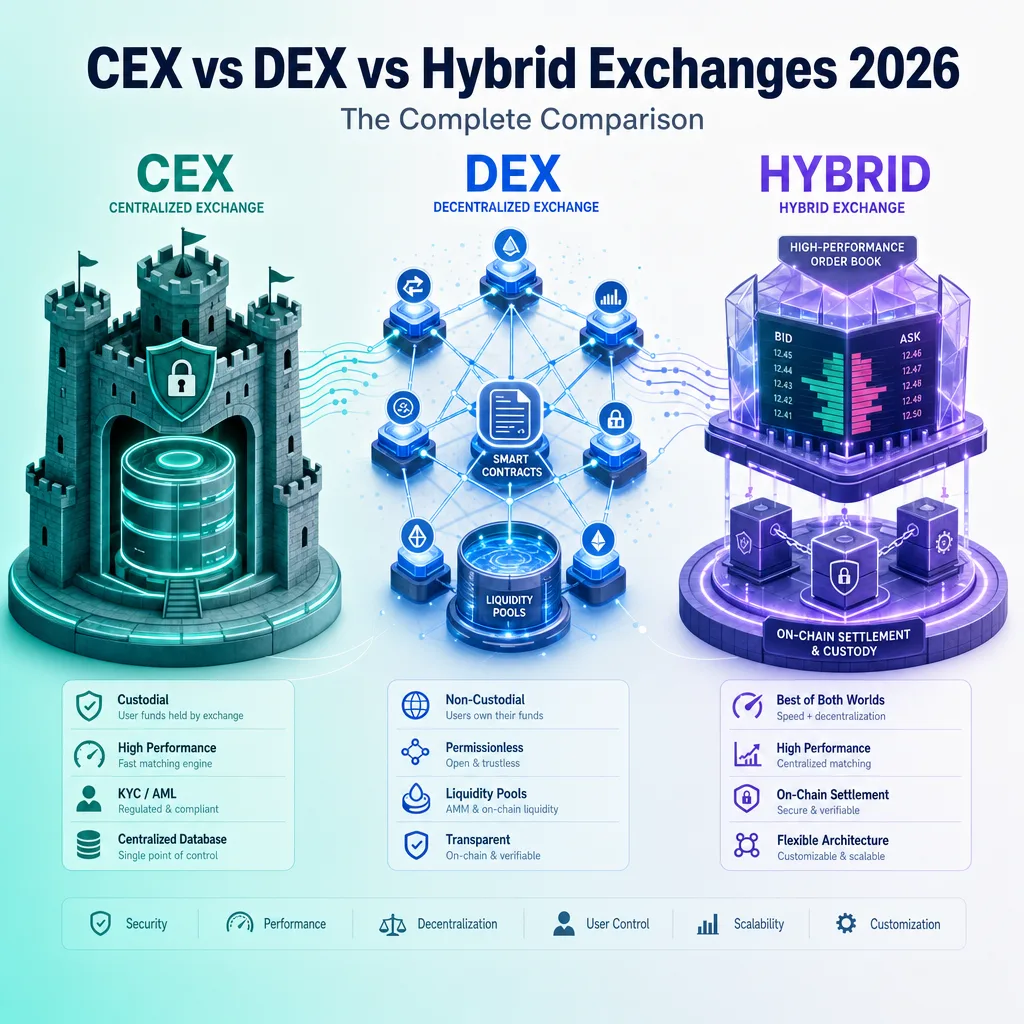
Centralized exchanges (CEX) hold your crypto and match your orders off-chain — they are crypto’s equivalent of a stockbroker. Decentralized exchanges (DEX) let you trade from your own wallet via smart contracts and liquidity pools — they are closer to a market-maker on autopilot. Hybrid exchanges combine an off-chain (or on-validator) orderbook with on-chain settlement — they aim to give you CEX-style UX without surrendering custody.
If you are a beginner who wants to convert $100-$1,000 of fiat to crypto, you almost certainly want a regulated CEX (Coinbase, Kraken, or a regional equivalent). If you are managing $10,000+ long-term or trading exotic tokens, you need to understand DEXs and self-custody. If you are paying for trading frequency (perpetuals, leverage, arbitrage), a hybrid like Hyperliquid or dYdX v4 often wins on fee-per-trade economics. The rest of this guide explains why and when to switch between them.
💡 Before you pick an exchange, compare the real all-in cost (trading, spread, funding and withdrawal) with our free Crypto Exchange Fee Calculator — no-KYC and major venues, no signup.
What Is a Centralized Exchange (CEX)?
A centralized exchange is a custodial trading venue operated by a company — Binance, Coinbase, Kraken, Bybit, OKX, Bitget — that holds your crypto in its own wallets, runs an internal off-chain orderbook to match buyers and sellers, and processes withdrawals on request. Functionally, it operates like a stockbroker plus a bank deposit account: you give them money, they record balances in a database, and they execute trades against other users on their platform.
CEXs dominate spot trading volume — roughly 86% of global spot volume in early 2026, per CoinGecko’s 2026 report. The reasons are practical: fiat on-ramps (debit card, bank wire, SEPA, PIX) require regulated entities; deep liquidity in major pairs (BTC/USDT, ETH/USDT) requires institutional market makers; and the support team handling a failed trade or a stuck withdrawal requires a company someone can sue. Five of the top ten exchanges by volume in 2026 are CEXs that pre-date 2020.
The cost is custody. When you deposit USDT on Binance, the blockchain shows the USDT in a Binance-controlled wallet — you have a database entry promising you can withdraw, not the asset itself. This is fine until the exchange becomes insolvent (FTX, November 2022) or freezes your account for compliance review. See our deep dives on why USDT gets frozen and the AML score drift that triggers most platform-level freezes.
What Is a Decentralized Exchange (DEX)?
A decentralized exchange is a smart contract — or set of smart contracts — that lets users swap tokens directly from their own wallets without an intermediary holding the assets. The two leading designs are automated market makers (AMMs) like Uniswap V4, Curve, and PancakeSwap, which use liquidity pools and a pricing formula (the simplest is x·y=k for Uniswap V2), and on-chain orderbook DEXs like Serum’s successors on Solana, which more closely mimic CEX matching logic but require fast block times to be usable.
DEX spot volume reached 13.6% of total spot trading in January 2026 per CoinGecko, up from roughly 7% in late 2023, with parallel growth visible in DefiLlama’s live DEX volume tracker. The perpetuals (perp) story is more dramatic: DEX perpetuals share grew 5x to 10.2% over the same window, driven primarily by Hyperliquid, which alone now ranks in CoinGecko’s Top 10 for perps volume. The growth driver is simple: an investor or DAO holding $500K of treasury crypto often cannot tolerate the bankruptcy risk of a CEX after watching FTX, Celsius, and BlockFi fail.
DEXs solve the custody problem but introduce three new ones: gas fees (Ethereum mainnet $5-50 per transaction; Layer 2s like Arbitrum, Base, and Optimism reduce this to $0.10-2), slippage (the gap between expected and actual execution price, especially painful on thin pools), and smart-contract risk (a bug in the AMM logic can drain the entire pool — see the DeFi risk matrix for verified loss events). The infrastructure underneath also matters; our on-chain tracking tools guide explains how every DEX trade is publicly observable.
What Is a Hybrid Exchange? The 2026 Convergence Story
A hybrid exchange is an architecture that pairs CEX-style orderbook UX (sub-second latency, conditional order types, perpetuals with leverage) with DEX-style self-custody (you sign trades from your own wallet; settlement is on-chain or on a public validator network you can audit). The category did not meaningfully exist in 2020 — it became commercially significant in 2024-2025. The four most-used examples in 2026 are Hyperliquid, dYdX v4, Loopring, and Vertex Protocol.
Hyperliquid runs its own L1 blockchain (HyperBFT consensus — Hyperliquid’s proprietary BFT-derived validator protocol) with the orderbook itself executed by validator nodes. Trades settle on-chain inside a single block, but the matching engine achieves CEX-comparable latency. In January 2026, Hyperliquid sat in CoinGecko’s Top 10 list for perpetuals volume, alongside three other DEXs (PancakeSwap, Uniswap, and one rotating fourth) — the first time DEXs took multiple Top 10 slots since on-chain trading began.
dYdX v4 launched on November 13, 2023, migrating from a StarkEx Layer-2 to its own sovereign Cosmos appchain. Validators run the orderbook in memory and post matched trades to the chain. The frontend and indexer remain off-chain (necessary for sub-100ms quote updates), but custody and settlement are on dYdX’s own chain. The protocol publishes its codebase and validator set in the official dYdX v4 documentation, so a sophisticated user can verify execution.
Loopring is the longest-running hybrid: a ZK-rollup (zero-knowledge proof rollup) Layer 2 on Ethereum — a design that batches many trades off-chain and submits a cryptographic proof to Ethereum mainnet, inheriting Ethereum’s security without each trade touching the main chain. Its design specifies theoretical throughput up to 2,025 TPS on-chain (or 16,400 TPS in off-chain data availability mode); practical sustained throughput tracks actual DEX usage, which has declined since peak 2022 activity. Loopring serves spot trading and a payments layer; its perpetuals market is smaller than dYdX or Hyperliquid but its security model is the most mature.
Vertex Protocol deployed on Arbitrum in April 2023. It runs a 15-30ms off-chain orderbook with an on-chain AMM as failsafe — so a Vertex outage cannot freeze the market; price discovery falls back to the AMM. Vertex Edge (launched 2024) unifies liquidity across Arbitrum and Sonic deployments, making it the first cross-chain hybrid.
The defining feature these share: users keep custody of collateral. A hybrid cannot run off with your funds the way Mt.Gox or FTX did, because the funds never sit in a hybrid-controlled hot wallet. The exchange can still be exploited (a frontend phishing attack signs malicious approvals; a validator quorum could in theory censor your withdrawal), but it cannot become insolvent in the bank-deposit sense.
CEX vs DEX vs Hybrid: 8-Axis Comparison
The clearest way to sort the three architectures is on the eight axes that matter for a trading or investing decision. The table summarizes 2026 ranges; we expand each row with examples in the next two sections.
| Axis | CEX | DEX | Hybrid |
|---|---|---|---|
| Custody | Exchange holds keys | You hold keys | You hold keys |
| Typical fee (spot) | 0.05-0.20% maker/taker | 0.30% pool fee + gas $0.10-50 | 0.02-0.10% |
| Liquidity depth (major pairs) | Deepest globally | Deep on majors, thin on long tail | Growing fast on perps; thinner on spot |
| KYC required | Yes (almost always) | No (frontend may geo-block) | Partial (some have wallet-based screening) |
| Trade execution speed | Sub-100 ms | 1-15 sec (chain block time) | Sub-second (off-chain orderbook) |
| Regulatory exposure | High (SEC, FCA, BaFin, FSA) | Low at protocol level; frontend operators face geo restrictions | Mixed — orderbook operator faces some exposure |
| Token availability | ~200-600 listed | Thousands (anyone can list) | ~50-200 (validator-curated) |
| UX complexity | Low (web UI, mobile app) | Medium-high (wallet, gas, network selection) | Medium (wallet sign + familiar trade UI) |
The two axes that drive most architecture choices are custody (who holds the asset) and fee structure (where the cost lives). The next section quantifies fees against trade size, because the optimal architecture flips at certain dollar thresholds.
Real 2026 Fee Matrix: What You Actually Pay
The simple statement “DEXs are more expensive” is only true on Ethereum mainnet for small trades. The real picture depends on trade size, network, and how you price gas.
| Trade size | CEX (Binance, 0.10%) | DEX on ETH mainnet | DEX on Arbitrum/Base L2 | Hybrid (Hyperliquid/dYdX) |
|---|---|---|---|---|
| $100 | $0.10 (0.10%) | $15 gas* + $0.30 fee = 15.3% | $0.30 + $0.30 = 0.60% | $0.05 (0.05%) |
| $1,000 | $1.00 (0.10%) | $15 + $3 = 1.80% | $0.40 + $3 = 0.34% | $0.50 (0.05%) |
| $10,000 | $10.00 (0.10%) | $15 + $30 = 0.45% | $0.60 + $30 = 0.31% | $5.00 (0.05%) |
| $100,000 | $100 (0.10%) | $15 + $300 = 0.32% | $1 + $300 = 0.30% | $50 (0.05%) |
Two readings of this table matter. First, for trades under $500, an L2 DEX or hybrid wins; an Ethereum-mainnet DEX is catastrophic. The break-even point for choosing CEX over hybrid is usually not fee — it is the availability of fiat on/off ramps and exotic spot pairs.
Active traders should also account for spread and slippage, not just stated fees. Our order types guide explains why limit orders on a deep CEX often beat market orders on a thinner DEX even when the DEX has lower headline fees.
*Note on Ethereum mainnet gas: The $15 figure represents median May 2026 conditions. ETH L1 gas for a simple swap typically ranges $3-8 during off-peak hours and can spike to $30-80+ during high-congestion windows (large NFT mints, popular token launches). Check Etherscan’s live gas tracker before transacting; the percentage cost on a $100 trade can change by 10× depending on timing.
Liquidity, Volume & Market Share: The 2026 Numbers
The headline numbers from CoinGecko’s CEX & DEX Trading Activity Report 2026 tell the convergence story directly. Independent verification of these trends is available via DefiLlama’s chain-by-chain DEX dashboard.
| Segment | CEX share Jan-2024 | CEX share Jan-2026 | DEX share Jan-2024 | DEX share Jan-2026 |
|---|---|---|---|---|
| Spot | ~93% | 86.4% | ~7% | 13.6% |
| Perpetuals | ~98% | 89.8% | ~2% | 10.2% |
| Total trading volume (2 years) | Perps volume grew 75% | DEX perps volume grew 8x ($81.74B → $739.48B) | ||
Note on the 5x vs 8x figures: the Key Takeaways and the “Which is Better” body text describe DEX perps growth as 5x — this refers to percentage market share (from ~2% to 10.2%). Table 3’s 8x figure refers to absolute dollar volume ($81.74B → $739.48B, a derived figure from CoinGecko share data × reported total perps market size). Both are accurate measurements of the same underlying growth from different angles.
A few details that get lost in the headline percentages. CEX listing velocity is high — the most prolific CEXs listed close to 100 tokens monthly in 2025 — but that figure represents about 0.01% of all tokens created, so the long tail of tokens still lives almost exclusively on DEXs. Three DEXs (PancakeSwap, Uniswap, Hyperliquid) hold Top 10 ranks for spot or perpetuals volume; this is the first time DEXs occupied multiple Top 10 slots simultaneously.
The reason matters for picking your venue: if you want to trade the index of the top 50 tokens, every architecture has enough liquidity. If you want to trade altcoins outside the top 200, you will end up on a DEX because no CEX lists them. If you want institutional-grade BTC and ETH spot fills with a 0.5 bp spread, you are still buying on a CEX.
Failure Modes: 3-Way Honest Case Studies
Each architecture has failed in characteristic ways. The honest comparison is not “which one is safe” — none is — but “what type of failure can hit me here.” We document representative events with verified loss figures below.
| Event | Architecture | Date | Loss (USD) | Root cause | User recovery |
|---|---|---|---|---|---|
| Mt.Gox | CEX | Feb 2014 | ~850,000 BTC (~$473M at filing, $50B+ at 2025 prices) | Years of undetected hot-wallet theft + insolvency | Partial; payouts began 2024, still ongoing |
| FTX | CEX | Nov 2022 | ~$8B customer asset shortfall | Commingled customer funds with sister hedge fund | Partial; bankruptcy claims processed by Sullivan & Cromwell estate |
| Bybit hack | CEX | Feb 21, 2025 | $1.4-1.5B ETH/stETH | Lazarus Group exploit via malicious Safe{Wallet} JS | Bybit reimbursed users from reserves; 88.87% of funds traceable on-chain — see our Bybit forensics case study |
| Beanstalk Farms | DEX/DeFi protocol | Apr 17, 2022 | $182M (~$77M extracted, rest burned) | Flash-loan governance attack (Bip18/19) | None; protocol relaunched with new tokenomics |
| bZx twin exploits | DEX/DeFi protocol | Feb 14 + Feb 18, 2020 | ~$1M combined | Flash-loan oracle manipulation + reentrancy | Partial; protocol covered losses from insurance fund |
| Tornado Cash sanction | DEX/Protocol | Aug 2022 — Mar 2025 | Funds frozen, not stolen | OFAC sanction (lifted 2025) | Funds inaccessible for ~3 years until ruling reversal |
| Hybrid frontend phishing | Hybrid (industry-wide) | Various 2023-2025 | Tens of millions cumulative | Cloned frontend tricks user into signing malicious approval | None; signed transactions are irreversible |
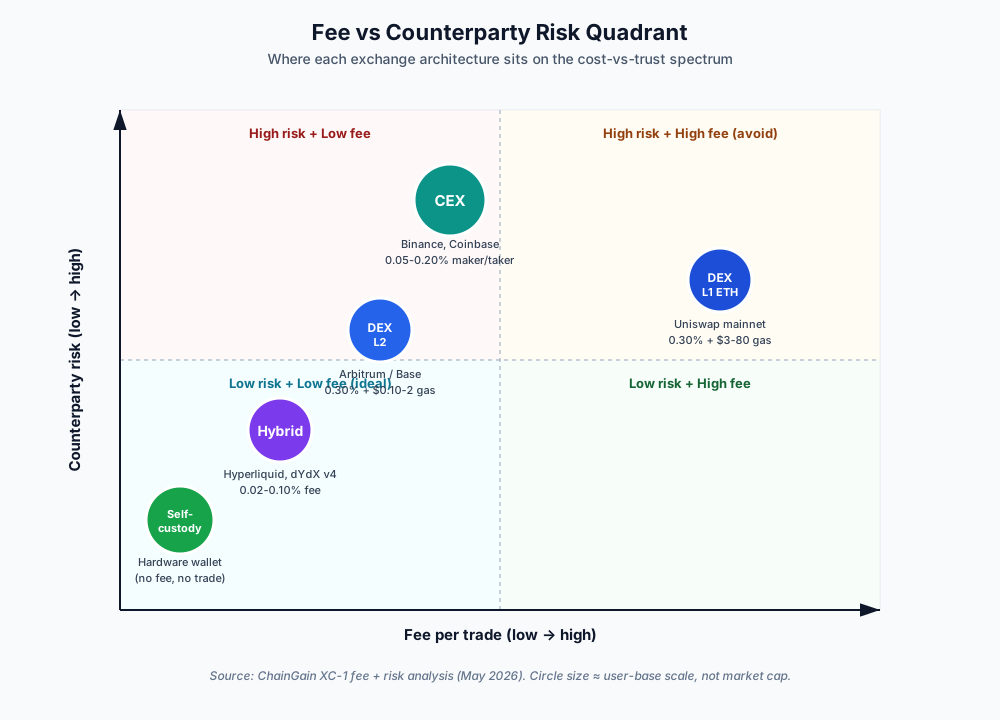
A pattern emerges. CEX failures are large and concentrated — one event takes down a billion dollars or more — but recovery via bankruptcy court is at least possible (Mt.Gox creditors are receiving distributions a decade later). DEX failures are smaller individually but recovery is rare because there is no entity to sue. Hybrid failures sit between — the validator network or orderbook operator can sometimes pause the system in time, but a signed malicious transaction is final on-chain.
If you trade or hold meaningful sums, our scam-detection guide covers the frontend phishing patterns that hit hybrid users hardest in 2024-2025. Industry-level loss tracking by Chainalysis annual crypto crime reports and Rekt News’ on-chain post-mortems are the canonical sources for verified incident figures.
Regulatory Map by Region: US, EU, Asia, LATAM
Regulation determines which exchange you are even allowed to use, what you can list, and what compliance burden the exchange passes back to you (KYC, source-of-funds questions, withdrawal screening). The picture in May 2026 looks like this.
United States. The SEC filed suit against Coinbase on June 6, 2023, alleging unregistered exchange and broker activity. On February 21, 2025, Coinbase announced that the SEC had agreed in principle to dismiss the action, ending nearly two years of litigation. The pending CLARITY Act and other 2025-2026 crypto legislation may move oversight of spot trading partially to the CFTC. For now, US users can trade on Coinbase, Kraken, Gemini, and a handful of regional CEXs; Binance.US operates under reduced functionality post-2023 settlement.
European Union. MiCA (Markets in Crypto-Assets Regulation) entered into force June 30, 2024 for asset-referenced and e-money tokens. The full framework became effective on December 30, 2024 with a transitional grandfathering period for existing providers (see the official ESMA MiCA implementation page). The full compliance deadline is July 1, 2026 (some member states — Netherlands, Latvia, Hungary, Slovenia, Finland — opted for shorter periods of six months from December 2024; Sweden’s deadline was September 30, 2025). After July 2026, any crypto-asset service provider operating in the EU must hold a CASP license; expect consolidation and some exits.
Japan. The Financial Services Agency (FSA) operates a strict registered-exchange regime; only FSA-licensed venues can serve Japanese users. The list as of 2026 includes bitFlyer, Coincheck, SBI VC Trade, GMO Coin, and DMM Bitcoin. Foreign exchanges (Binance, Bybit, OKX) cannot legally onboard Japanese users without FSA registration.
Korea. Information Security Management System (ISMS) certification plus real-name banking partnership is required. Five exchanges hold both: Upbit, Bithumb, Coinone, Korbit, Gopax. The Virtual Asset User Protection Act took effect July 19, 2024 and adds customer-asset segregation rules.
Singapore. The Monetary Authority of Singapore (MAS) issues Digital Payment Token (DPT) service licenses. Major holders include DBS Digital Exchange (institutional), Coinhako, Crypto.com SG, and Independent Reserve. MAS has been notably restrictive on retail marketing since 2022.
Latin America & Africa. Brazil’s CVM and Banco Central regulate crypto firms under Law 14.478 (2022); most major CEXs operate locally (Mercado Bitcoin, Foxbit, Bitso). Nigeria reopened crypto access in 2024 after the 2021 ban; the SEC now licenses Virtual Asset Service Providers. Argentina’s CNV registry, El Salvador’s bitcoin legal-tender framework, and South Africa’s FSCA crypto-asset license each add distinct rules. Most retail users in these geographies still route fiat through a regional CEX even when ultimately holding self-custody — see our USDT vs USDC remittance guide for corridor-specific cost analysis.
Which Exchange Type Fits Your Use Case? Persona Decision Tree
The right architecture depends on what you are doing with crypto, not on which type is theoretically “better.” We sort the most common cases into five personas. Our wallet decision framework pairs naturally with this — choice of exchange and choice of custody are entangled.
| Persona | Capital range | Primary architecture | Secondary | Why |
|---|---|---|---|---|
| Crypto beginner (first $100-$1,000) | under $1,000 | Regulated CEX | — | Fiat ramp + customer support outweighs custody risk at this size |
| Active day trader, retail | $1,000-$10,000 | CEX (low VIP) or Hybrid | L2 DEX for entries | Speed + low spread; hybrid wins on perps fee |
| Long-term holder (1-5 year horizon) | any size | Self-custody hardware wallet | L2 DEX or CEX for entry/exit only | Avoid sitting on a CEX balance sheet for years |
| DeFi yield farmer | $5,000+ | L2 DEX + DeFi protocols | CEX for fiat ramp | Yield primitives live on DEXs; see our DeFi guide |
| Privacy-focused user | any | DEX with hardware-wallet signing | — | KYC-free trade flow; verify geo-fencing of frontend |
| Perpetuals / leverage trader | $5,000+ | Hybrid (Hyperliquid, dYdX v4) | CEX perps (Bybit, Binance) | Fee economics favor hybrids above 100x daily volume |
| Institutional / corporate treasury | $100,000+ | Regulated CEX + qualified custodian | Hybrid for execution efficiency | Audit + insurance + reporting requirements |
One rule we have not seen elsewhere: if your annual trading volume is below your wallet balance, you should bias toward self-custody. If your annual volume is 5x your average wallet balance, the fee savings on a CEX or hybrid usually beats the custody risk. Our chart-reading guide for active traders pairs with this — the analytical setup you adopt should match the venue type.
Migration Scenarios: When to Move Between Exchange Types
Most experienced crypto users do not choose one architecture forever.
CEX → self-custody + DEX (graduation move). Triggered by a CEX freeze, a balance crossing a personal risk threshold (commonly $5,000-$10,000), or an FTX-style industry event. Steps:
- Install a hardware wallet (Ledger or Trezor — see our wallet framework for selection criteria).
- Generate seed phrase offline and record on paper or metal backup. Never screenshot or store digitally.
- Test the receive address with a small ($10-50) transfer first; verify funds arrive correctly.
- Withdraw in batches from the CEX over 3-7 days rather than a single large transaction; this reduces single-point-of-failure risk and creates audit trail.
- Reserve weekly trading capital only on the CEX; the bulk of the position now lives in self-custody.
- Test re-deposit to CEX with a small amount before you need to off-ramp; some CEXs flag external deposits for compliance review.
DEX-only → DEX + CEX for fiat (off-ramp need). Triggered by needing fiat back into a bank account. Most users underestimate how much friction this re-introduces in 2026: KYC, source-of-funds documentation, and bank scrutiny of the deposit. Plan two weeks for the off-ramp KYC, not two days.
CEX → Hybrid (trader optimization). Triggered by fee fatigue (paying $1,000+/month in spot fees) or a desire to leverage-trade without surrendering collateral custody. Hybrids work best for users who already understand wallet signing — onboarding from zero to dYdX v4 is steeper than zero to Coinbase.
Hybrid → DEX or CEX (reduced complexity). Triggered by validator outages, frontend instability, or the user deciding the saved fees do not justify the operational overhead. This direction is more common than discussions of hybrid usually admit; some retail traders return to a CEX after six months because checking validator status before each trade is exhausting.
Tax treatment changes with each migration. CEX withdrawals generally generate a 1099 in the US (and equivalents in other jurisdictions); DEX swaps each create a taxable event under most regimes; hybrid trades are treated as the underlying chain treats them. Our crypto tax guide walks through the 2026 reporting rules for each architecture.
How to Stay Safe Across All Three Types (Checklist)
The defensive practices that matter most differ by architecture, but a few habits cover the worst cases regardless of where you trade.
- On CEXs: enable hardware-token 2FA (not SMS); set withdrawal address allowlist; keep only 1-4 weeks of active trading capital on the platform; verify the exchange’s proof-of-reserves attestation date and auditor.
- On DEXs: bookmark official frontend URLs (Uniswap.org, app.uniswap.org); verify the URL on every visit (no clicking from Twitter/X DMs); revoke unused token approvals quarterly via revoke.cash; use a separate “DEX wallet” with limited balance.
- On hybrids: same frontend discipline as DEXs; verify the orderbook contract address on first deposit; understand whether your collateral is segregated per-user or pooled on the validator side.
- Across all three: write down the seed phrase for any self-custody wallet on paper or metal — never in a screenshot, cloud note, or email; test withdrawal flows with small amounts before moving significant balances; keep a separate “explorer” wallet you use for connecting to new dApps.
- Treat stablecoins as issuer risk, not exchange risk: a USDT or USDC freeze can happen on any architecture — see our analysis of centralized stablecoin risk. Diversifying across stablecoins matters more than diversifying across exchanges of the same architecture.
FAQ
Is it better to trade on a CEX or a DEX?
Neither is strictly better. CEXs win on fiat ramps, deep liquidity for major pairs, and customer support. DEXs win on custody, censorship resistance, and access to long-tail tokens. For most users below $10,000 in active capital, a regulated CEX is the simpler default; for users above that or with privacy needs, mixing DEX and self-custody becomes worth the friction.
Which is safer, CEX or DEX?
They fail differently. CEX risk is concentrated bankruptcy and hack risk (FTX $8B, Bybit $1.4-1.5B). DEX risk is smart-contract bugs and self-custody mistakes (Beanstalk $182M; lost seed phrases). “Safer” depends on which failure you are more equipped to defend against. A hardware wallet with verified backups is generally safer than any single exchange balance — but no platform or architecture is risk-free.
What is a hybrid exchange and why does it matter in 2026?
A hybrid exchange runs an orderbook off-chain (or on a public validator network) for CEX-style execution speed, while settlement and custody remain on-chain or under user control. Examples: Hyperliquid (own L1), dYdX v4 (Cosmos appchain), Loopring (Ethereum ZK-rollup), Vertex (Arbitrum). Hybrids matter in 2026 because they took a meaningful share of perpetuals volume (10.2% per CoinGecko) and demonstrated that you do not have to choose between CEX speed and DEX custody.
Can a DEX freeze my funds the way a CEX can?
A pure DEX cannot freeze your wallet — only the issuer of the underlying token can. USDT, USDC, and most centralized stablecoins maintain blacklist functions that operate at the token level regardless of which DEX you use. Bitcoin, ETH, and most non-stablecoin assets have no such kill switch. A DEX frontend can geo-block you, but a different frontend or a direct smart-contract call typically still works.
Are CEXs going to disappear because of DEXs and hybrids?
Probably not. CEXs still process roughly 86% of spot volume and 90% of perpetuals volume in 2026. They have an unbeatable advantage for new users (fiat ramps + customer support) and for institutional flow that requires KYC/AML for compliance. The shift is more nuanced: the experienced crypto user portfolio increasingly looks like “CEX for ramp + self-custody for storage + hybrid for active trading,” not “DEX replaces CEX.”
How does taxation differ across the three architectures?
In most jurisdictions, a trade is taxable regardless of where it executes — the IRS (US), HMRC (UK), and the Bundeszentralamt für Steuern (Germany) treat a CEX trade and a DEX swap identically for capital-gains purposes. The practical difference is reporting: CEXs issue 1099-B or equivalent statements, DEXs do not, so DEX traders must self-report from on-chain history. Our crypto tax guide covers the 2026 rules per major jurisdiction.
Is XRP traded on CEXs or DEXs?
Both. XRP has deep CEX liquidity (Bitstamp, Coinbase, Kraken, Binance) and also trades on the XRP Ledger’s built-in decentralized exchange protocol — the XRPL DEX has existed since 2012 and is one of the oldest non-Ethereum DEX environments. Most XRP volume still routes through CEXs because of fiat-pair availability, but the XRPL DEX is meaningful for advanced users.
Continue Learning
- USDT Frozen by Tether: Recovery Guide 2026 — Issuer-level freeze risk across CEX and DEX (EX-1)
- Why Crypto Got Frozen: AML Score Drift 2026 — Platform-level compliance freezes explained (EX-2)
- Blockchain Tracking Tools 2026 — How every DEX trade is publicly observable (EX-5)
- Onchain Hack Forensics: Bybit Case Study 2025 — Deep dive on the largest CEX hack of 2025 (EX-9)
- Crypto Wallet Decision Framework 2026 — Self-custody choice that pairs with each architecture (W-2)
- USDT vs USDC: Best Stablecoin for Remittances 2026 — Corridor cost analysis across both (KG-1)
- What Is DeFi? 2026 Beginner’s Guide — DEX as part of the broader DeFi stack (DF-4)
- Crypto Capital Gains Tax 2026 — Tax reporting differences across CEX, DEX, and hybrid (TR-Tax-1)

Editorial pen name · ChainGain
Alex Mercer is the editorial pen name used for ChainGain’s cryptocurrency education content. Articles are based on cited sources and reproducible comparisons. Editorial profile
Disclaimer: This article is independent. ChainGain does not receive affiliate commission for Binance, Coinbase, Kraken, Bybit, OKX, Bitget, Uniswap, Curve, PancakeSwap, SushiSwap, Hyperliquid, dYdX, Loopring, Vertex, or any exchange named in this guide. Fees, regulatory status, and exchange volumes were verified on 2026-05-27 via CoinGecko’s CEX & DEX Trading Activity Report 2026, DefiLlama, Etherscan, and each exchange’s official documentation — fees, KYC requirements, and regulatory status change weekly; verify current state on the exchange’s own site and your local regulator before depositing. Not investment advice: all exchanges carry risk including bankruptcy (FTX 2022, ~$8B), hacks (Bybit Feb 2025, $1.4-1.5B; Mt.Gox 2014, ~850K BTC), KYC freezes, smart-contract exploits (Beanstalk 2022, $182M; bZx 2020 twin exploits), validator slashing, and regulatory enforcement. Geographic restrictions: many exchanges block US/UK/sanctioned-jurisdiction users; verify your access and tax obligations before trading. Custody warning: CEX deposits = the exchange controls keys (you hold an IOU); DEX and hybrid trades = you control keys, but losing seed phrase = permanent loss with no recovery. Past failure examples (FTX, Mt.Gox, Bybit, Beanstalk, bZx, Tornado Cash) are historical; this does not imply current exchanges carry equivalent risk, but no exchange is risk-free.
The Crypto Exchange Guide Series
Our exchange comparison series: