Crypto Capital Gains Tax 2026: How to Calculate, Report & Legally Minimize (US/UK/DE/AU/JP Compared)
Table of Contents
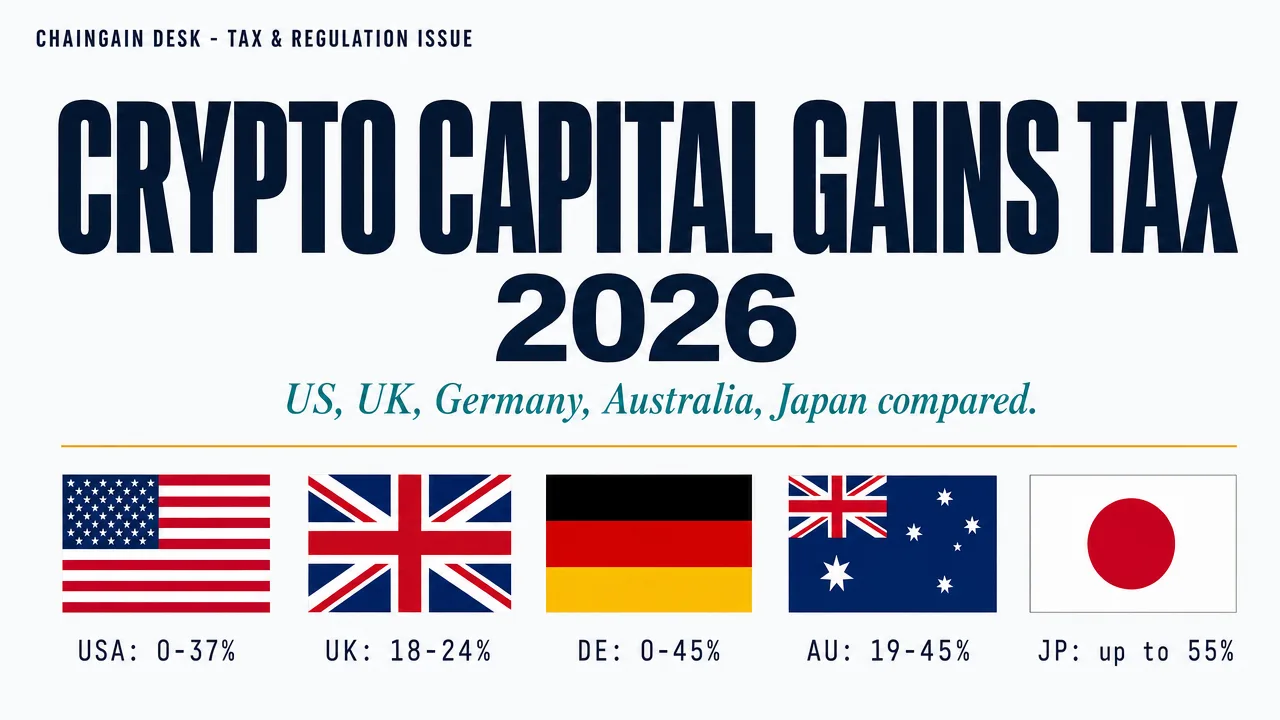
Most crypto investors overpay tax. Some unknowingly underpay. Both outcomes hurt — overpayment burns capital you could have compounded, while underpayment risks penalties, interest, and in extreme cases, criminal exposure. The 2026 tax year amplifies the stakes: the United States rolls out Form 1099-DA cost basis reporting, the United Kingdom introduces dedicated cryptoasset boxes on Self Assessment, and Germany and Japan both have active reform proposals that could reshape long-standing rules from 2027 onward.
Yet nearly every English-language guide to crypto capital gains tax assumes you live in the United States. That assumption fails roughly 95% of the world’s crypto holders. If you trade from London, hold from Berlin, stake from Sydney, or earn from Tokyo, the IRS rules tell you almost nothing useful — and the misalignment between US-centric content and global reality is exactly where retail investors get blindsided at filing time.
This guide is the multi-jurisdiction reference we wish existed. It covers the United States, United Kingdom, Germany, Australia, and Japan — five of the most active crypto tax regimes — with the same depth, the same calculation steps, and the same legal-minimization strategies, side by side. You’ll find a 12-event taxonomy that tells you exactly when a transaction triggers tax, a country-by-country comparison matrix, four cost basis methods explained with worked examples, and an honest comparison of five tax software tools to help you actually file. The goal is simple: by the end of this guide, you should be able to look at any crypto transaction and answer three questions in under thirty seconds — Is this taxable? In which category? At what rate?
Why Crypto Capital Gains Tax in 2026 Is More Complex Than Ever
For most of crypto’s first decade, tax authorities treated digital assets as an afterthought. That ended around 2024 and 2025. In 2026, the regulatory infrastructure for crypto taxation has matured to the point where unreported gains are becoming statistically detectable through cross-border data sharing, mandatory broker reporting, and exchange-level KYC requirements that tie wallets to identities. Three simultaneous shifts make 2026 the most complex filing year so far for crypto investors.
First, the United States Form 1099-DA debuts. Starting January 1, 2025, US-based crypto brokers (Coinbase, Kraken, Gemini, regulated platforms) must report gross sales proceeds to the IRS on Form 1099-DA. Beginning January 1, 2026, those same brokers must also report cost basis — the original acquisition price. This means the IRS now receives a parallel record of every taxable disposal you made on a regulated US exchange. If your self-reported numbers diverge from the broker’s 1099-DA, the IRS computer matching system will flag the discrepancy automatically. The era of “they’ll never know” is over for any retail investor using a US exchange.
Second, the European Union’s MiCA framework and the OECD’s Crypto-Asset Reporting Framework (CARF) align reporting standards across borders. The UK’s new Reporting Cryptoasset Service Provider (RCASP) regime, which begins data collection on January 1, 2026, with the first reports due May 31, 2027, mirrors this trend. Cross-border investors — say, a UK resident using a German exchange or an Australian using a US platform — increasingly face data flowing back to their home tax authority through information-sharing treaties. The “offshore exchange” loophole has narrowed significantly.
Third, Germany and Japan both have advanced reform proposals. Germany’s 1-year hold-and-sell-tax-free rule under §23 EStG, considered one of the world’s most generous crypto tax incentives, faces an explicit abolition proposal from Vice Chancellor and Finance Minister Lars Klingbeil. The plan, announced on April 29, 2026, would replace the holding-period exemption with a 25% flat capital gains rate plus solidarity surcharge starting in tax year 2027 (subject to constitutional review and final budget approval expected in early July 2026). Japan, on the other hand, may move in the opposite direction: the 2026 Tax Reform Outline released on December 19, 2025, proposes reclassifying FSA-registered crypto as a financial product subject to a flat 20.315% rate, potentially replacing the punitive 55% miscellaneous-income treatment for approved tokens. Neither reform is law yet. But for any reader planning multi-year tax strategy, both proposals must be tracked carefully.
The bottom line for 2026: a single-country crypto tax guide is no longer sufficient. You need to know your home jurisdiction’s rules, the rules of any exchange or platform you use, and any reporting obligations triggered by cross-border activity. This guide tackles the first two for the five jurisdictions where the most ChainGain readers live, work, and hold crypto.
The 12 Taxable Events Every Crypto Investor Must Know
Before you can calculate tax, you need to know when tax applies. A common misconception is that holding crypto generates tax. It does not. Tax events occur at the moment of disposal, conversion, or earned receipt. The exact list varies slightly by jurisdiction, but twelve events cover roughly 99% of retail crypto activity worldwide.
| # | Event | Triggers tax? | Tax category | Jurisdictional notes |
|---|---|---|---|---|
| 1 | Sell crypto for fiat (USD, GBP, EUR, AUD, JPY) | Yes | Capital gain (or loss) | Universal across all five jurisdictions |
| 2 | Trade crypto-to-crypto (e.g., BTC → ETH) | Yes | Capital gain (or loss) | Taxable in US/UK/AU; in DE if within 1-year hold; in JP as miscellaneous income |
| 3 | Spend crypto on goods or services | Yes | Capital gain (or loss) | AU has narrow personal-use-asset exemption (<A$10,000) |
| 4 | Receive staking rewards | Yes (on receipt) | Income at fair market value | Then capital gain on later disposal; AU treats as ordinary income |
| 5 | Receive DeFi yield (LP fees, lending interest) | Yes (on receipt) | Income | Cost basis = FMV at receipt; subsequent disposal triggers capital gain |
| 6 | Receive airdrops | Yes (on receipt) | Income at FMV | UK distinguishes “with consideration” (income) vs “without” (capital on disposal) |
| 7 | Receive mining rewards | Yes (on receipt) | Income (or business income if commercial) | Hobby vs business distinction matters in US/UK/AU |
| 8 | Mint or sell NFTs | Yes | Capital gain (collectible rates may apply) | US: NFTs may be taxed up to 28% as collectibles |
| 9 | Hard fork coins received | Yes (on receipt) | Income at FMV | US: per IRS Rev. Rul. 2019-24; UK: depends on context |
| 10 | Gift / receive gift | Conditional | Often not taxable to recipient | Donor may have CGT; annual gift exclusions vary by country |
| 11 | Donate crypto to qualified charity | No (and may be deductible) | Charitable deduction (US itemized) | Long-term holdings get FMV deduction; short-term limited to cost basis |
| 12 | Move between own wallets / exchanges | No | None | Not a disposal — but document carefully to avoid mismatched basis |
Two patterns emerge from this taxonomy. First, most “doing things with crypto” creates a tax event, including the often-overlooked crypto-to-crypto trade. If you swap 1 BTC for 15 ETH, you have technically disposed of BTC at fair market value, and that disposal is taxable. Many beginners assume only fiat conversions trigger tax — this is wrong in every jurisdiction except, conditionally, Germany if both legs are within the 1-year hold. Second, passive receipt creates income at fair market value on the day received. Staking rewards, DeFi yields, and airdrops all establish income at the spot price on receipt, which then becomes your cost basis for future disposal calculations. For a deeper dive into how DeFi yields and staking rewards specifically interact with tax, see our companion guides on liquid staking and stablecoin yields.
Capital Gains Tax Across 5 Major Jurisdictions
Once you know which events trigger tax, the next question is the rate. Here is where jurisdictions diverge dramatically — sometimes by 50 percentage points or more. A $50,000 Bitcoin gain held for 14 months can be taxed at 0% (Germany current law), 15% (US long-term, middle bracket), 18% (UK basic rate), 22.5% (Australia after CGT discount at 45% marginal), or up to 55% (Japan miscellaneous income). The same gain. Five different outcomes.
All rates, thresholds, and forms below are current as of 2026-05-10, sourced from IRS Digital Assets, HMRC Cryptoassets Manual, the German Bundesministerium der Finanzen (BMF), the Australian Taxation Office (ATO), and Japan’s National Tax Agency (NTA). Where reform legislation is pending (Germany Klingbeil proposal, Japan 2026 Tax Reform Outline), this is explicitly flagged. Verify against your jurisdiction’s official guidance before filing.
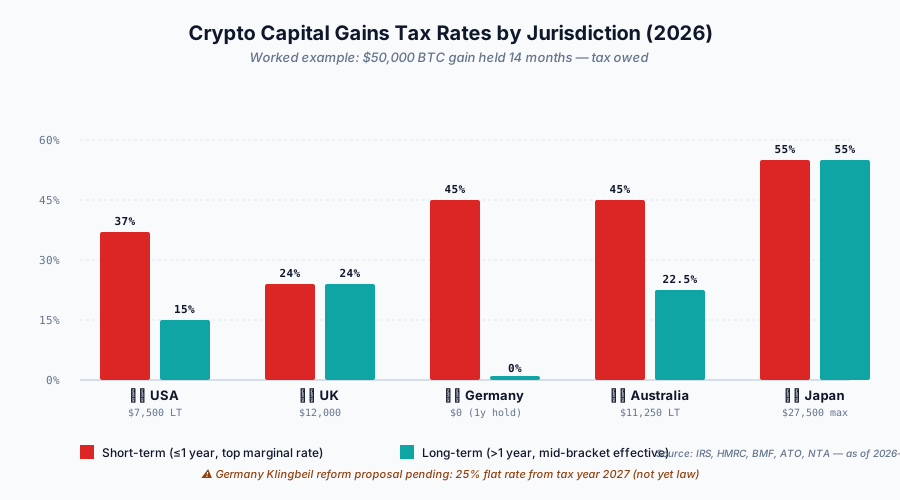
| Jurisdiction | Short-term rate (≤1 year) | Long-term rate (>1 year) | Tax-free threshold | Reporting form | Loss carryforward |
|---|---|---|---|---|---|
| 🇺🇸 United States | 10–37% (ordinary income brackets) | 0% / 15% / 20% (by income bracket) | $3,000/year loss offset against ordinary income | Form 8949 + Schedule D + Form 1099-DA (broker) | Indefinite |
| 🇬🇧 United Kingdom | 18% (basic) / 24% (higher rate) | Same — UK has no holding-period distinction | £3,000 annual exempt amount (2025-26) | Self Assessment SA108 (Capital Gains Summary) | 4 years (must register loss within window) |
| 🇩🇪 Germany (current 2026) | Marginal income rate (14–45%) + solidarity | 0% (after 1-year private hold §23 EStG) | €1,000/year for short-term gains (all-or-nothing) | Anlage SO with income tax return | Same year + 1 year back; same category only |
| 🇦🇺 Australia | Marginal income rate (19–45%) on full gain | 50% CGT discount (assets held >12 months) | A$10,000 personal use asset exemption (narrow) | Individual tax return, CGT schedule (myTax) | Indefinite (capital losses → capital gains only) |
| 🇯🇵 Japan (current 2026) | Miscellaneous income up to 55% (45% national + 10% local) | Same — Japan has no holding-period distinction | ¥200,000/year filing threshold (salaried, no other misc income) | Final tax return (Kakutei Shinkoku) | Not allowed (current rules); 3 years proposed under 2027 reform |
3.1 United States — IRS, Form 1099-DA, $3K Loss Offset
The United States separates capital gains into short-term (assets held ≤1 year, taxed at ordinary income rates of 10/12/22/24/32/35/37%) and long-term (>1 year, taxed at preferential rates of 0%, 15%, or 20% depending on total income). For most middle-income retail investors, the long-term rate sits at 15%. The 0% bracket applies if your total taxable income is below approximately $47,000 single / $94,000 married filing jointly (2025 thresholds, indexed annually). Crypto losses can offset other capital gains without limit, and excess losses may offset up to $3,000 of ordinary income per year, with unlimited carryforward to future years.
The major 2026 change is mandatory broker reporting via Form 1099-DA. Coinbase, Kraken, Gemini, and other US-regulated platforms must now report your gross proceeds (from Jan 1, 2025) and cost basis (from Jan 1, 2026). You receive a copy; the IRS receives a parallel copy. Mismatches between your self-reported Form 8949 and the broker’s 1099-DA trigger automatic computer matching review. One welcome quirk for crypto investors: as of 2026, US tax law does not apply the wash sale rule (which prohibits claiming a loss if you repurchase a “substantially identical” security within 30 days) to crypto. You can sell BTC at a loss on December 31 and buy it back on January 1, banking the tax loss legally. Multiple legislative attempts to extend the wash sale rule to digital assets have failed in Congress. Stay alert — this is a meaningful tax-loss harvesting advantage that may not survive future legislation.
3.2 United Kingdom — HMRC, £3,000 CGT Allowance, 18%/24% Rates
The United Kingdom does not distinguish short-term from long-term holdings — every crypto disposal is subject to the same Capital Gains Tax (CGT) rate based on your total income tax band. Following the Autumn Budget 2024 changes that took effect October 30, 2024, crypto CGT rates became 18% for basic-rate taxpayers (income up to £50,270 in 2025-26) and 24% for higher-rate taxpayers above that threshold. This was an increase from the prior 10%/20% rates and aligns crypto with property CGT rates.
The annual CGT exempt amount is £3,000 for 2025-26, having declined from £6,000 (2023-24) and £12,300 (2022-23). HMRC requires the Section 104 pool method: when you have multiple acquisitions of the same crypto asset, they are pooled into a single weighted-average cost basis (after applying same-day and 30-day “bed and breakfast” matching rules first). Reporting happens on Self Assessment form SA108, which from 2024-25 onward includes dedicated cryptoasset boxes (13.1–13.8). New for 2026: the Reporting Cryptoasset Service Provider (RCASP) regime begins data collection January 1, 2026, with the first cross-border information reports due May 31, 2027.
3.3 Germany — §23 EStG 1-Year Rule (Klingbeil Reform Pending)
Germany’s §23 Einkommensteuergesetz (EStG) treats privately held crypto as a “private sale” (privates Veräußerungsgeschäft). Under current 2026 rules, capital gains from crypto held for more than one year are entirely tax-free — 0% rate, no further reporting required for that disposal. This makes Germany one of the most favorable retail crypto tax regimes in the developed world. For crypto held one year or less, gains are taxed at your marginal income tax rate (14–45%) plus the 5.5% solidarity surcharge, with a €1,000 annual exemption. The exemption is all-or-nothing: if your total short-term private sale gains across all assets exceed €1,000, the full amount becomes taxable, not just the portion above €1,000.
The Federal Ministry of Finance (BMF) issued comprehensive crypto guidance in May 2022, with an updated BMF letter on March 6, 2025 tightening documentation requirements. German taxpayers must use FIFO cost basis per wallet; switching between wallets does not reset the holding period. Reporting is via Anlage SO (other income) attached to your annual income tax return. The Klingbeil reform proposal, if enacted, would replace this entire framework with a 25% flat rate plus solidarity and church tax surcharges, regardless of holding period. Until the legislation actually passes, however, current rules govern your 2026 filing.
3.4 Australia — ATO 50% CGT Discount, Personal Use Exemption
Australia treats crypto as a CGT asset, with disposals taxed at your marginal income tax rate (19%, 32.5%, 37%, or 45% depending on income brackets, plus 2% Medicare levy for most residents). The headline benefit is the 50% CGT discount: individuals (and trusts) who hold a crypto asset for more than 12 months can reduce the taxable capital gain by half. So a $20,000 gain on BTC held 14 months becomes $10,000 taxable. At a 37% marginal rate, the effective tax becomes 18.5% — competitive with US long-term rates.
A narrow but useful exemption is the personal use asset rule: if you acquire crypto for under A$10,000 with the genuine intent of consuming it (e.g., buying a coffee or paying for a service), and use it within a short timeframe, that crypto is exempt from CGT. In practice, this exemption rarely applies to investment activity — it is designed for true point-of-sale crypto users, not buy-and-hold investors. Australian tax year runs July 1 to June 30; the 2025-26 tax return must be filed by October 31, 2026 (or up to May 15, 2027 with a registered tax agent). The ATO operates an active data-matching program covering 2014-15 through 2025-26 — exchanges supply user data directly. Non-compliance has high audit risk.
3.5 Japan — NTA Miscellaneous Income up to 55% (2027 Reform Pending)
Japan currently classifies crypto gains as miscellaneous income (zatsu shotoku, 雑所得), taxed at progressive national income rates from 5% to 45%, plus a flat 10% local inhabitant tax — combined effective rates reach 55% at the top bracket. There is no holding-period distinction, no preferential long-term rate, and no annual exemption beyond a ¥200,000 filing threshold for salaried employees with no other miscellaneous income to declare. Crypto-to-crypto trades are taxable. Staking rewards, DeFi yield, and airdrops all count as miscellaneous income on receipt.
Particularly punitive under current rules is the loss treatment: crypto miscellaneous income losses can offset only other miscellaneous income within the same tax year, and excess losses do not carry forward. A bad year cannot be cushioned against a future profitable year. The 2026 Tax Reform Outline, if enacted, would change this for FSA-registered “specified crypto assets” (approximately 105 tokens currently approved by the Financial Services Agency): flat 20.315% rate (15% national + 5% local + 2.1% reconstruction surtax), and 3-year loss carryforward. Importantly, even under the reform, NFTs, staking, lending, and unregistered altcoins would remain in the legacy 55% miscellaneous income regime. Reporting is via Kakutei Shinkoku (final tax return), filed between February 16 and March 15 each year.
Cost Basis Methods: FIFO, LIFO, HIFO, Specific Identification
The single most consequential choice for minimizing crypto capital gains tax is your cost basis method — the rule that determines which lot of crypto you are deemed to have sold when you make a partial disposal. Imagine you bought 1 BTC at $30,000 in 2023, another 1 BTC at $60,000 in 2024, and you sell 1 BTC at $80,000 in 2026. Are you selling the cheaper lot (gain of $50,000) or the more expensive lot (gain of $20,000)? The answer depends on the cost basis method, and it depends on what your jurisdiction permits.
| Method | How it works | Best use case | Allowed in | Tax-saving potential |
|---|---|---|---|---|
| FIFO (First-In-First-Out) | Earliest acquisition disposed first | Simple records, rising market exits with long-term hold qualification | US (default), UK (within Section 104), DE (mandatory), AU (default) | Low — typically maximizes taxable gain in rising markets |
| LIFO (Last-In-First-Out) | Most recent acquisition disposed first | Volatile markets where recent buys are higher cost | US (with Specific ID records, contested); not UK/DE/AU/JP | Medium — minimizes gain when prices rise |
| HIFO (Highest-In-First-Out) | Highest-cost acquisition disposed first | Maximum tax minimization for partial disposals | US (only as form of Specific ID); not UK/DE/AU/JP | Highest — minimizes taxable gain by definition |
| Specific Identification | You designate the exact lot sold (must have records) | Active traders with detailed records | US (Form 8949 instructions), UK (limited within Section 104 rules) | Highest — lets you choose the lot for each disposal |
| Section 104 Pool (UK-specific) | Weighted average cost across all matching holdings | UK retail investors | UK only (mandatory after same-day/30-day matching rules) | Locked — UK does not permit choice |
For US investors, HIFO via Specific Identification is the most tax-efficient method, but it requires meticulous record-keeping: you must be able to demonstrate, at the time of disposal, exactly which acquisition lot you intended to sell. Most crypto tax software (covered in Section 7) handles this automatically by tagging each lot. UK investors have far less choice — Section 104 pooling is mandatory after the same-day and 30-day “bed and breakfast” matching rules. German investors must use FIFO per wallet under §23 EStG. Australian investors typically default to FIFO but can elect Specific Identification with adequate records. Japanese investors use a single weighted-average method (“total average method,” 総平均法) by default, with a moving-average alternative (移動平均法) available if elected.
How to Calculate Crypto Capital Gains: Step-by-Step
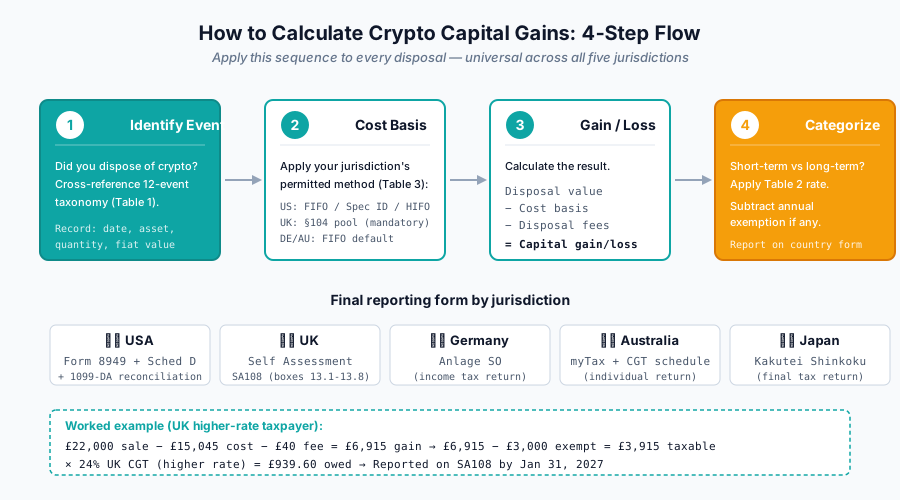
Calculating crypto capital gains follows a four-step process that is logically identical across jurisdictions, even if the rates and forms differ. Walk through each disposal in this order and you will rarely make an arithmetic error.
- Step 1 — Identify the disposal event. Cross-reference the 12-event taxonomy in Table 1. Did you sell, trade, spend, or earn crypto? If yes, record the date, the asset, the quantity disposed, and the disposal value in your home fiat at the moment of the transaction. For exchange transactions, the platform’s transaction history typically captures all of this; for self-custodial transactions, you may need to look up historical prices from a reliable source like CoinGecko or CoinMarketCap.
- Step 2 — Establish the cost basis. Apply your jurisdiction’s permitted method (Table 3) to identify which acquisition lot you are deemed to have sold. Cost basis includes the original purchase price plus any acquisition fees (exchange fees, gas fees for self-custodial purchases). For received crypto (staking, airdrops, DeFi yield), the cost basis is the fair market value at the moment of receipt — which was already taxed as income.
- Step 3 — Calculate the gain or loss. Disposal value minus cost basis equals capital gain (positive) or capital loss (negative). Subtract any disposal fees. Document the holding period from acquisition to disposal — this matters for US (short vs long-term), Australia (CGT discount eligibility), and Germany (1-year exemption under current rules).
- Step 4 — Categorize and apply the rate. Identify whether the disposal is short-term or long-term in your jurisdiction’s framework, apply the relevant rate from Table 2, and record the result in your country’s reporting form. Aggregate all gains and losses for the year, apply any annual exemption (e.g., £3,000 UK, €1,000 Germany, A$10,000 personal use Australia), and arrive at the taxable amount.
Worked example. In testing this exact framework against real reader scenarios, the same trade across jurisdictions surprises people every time — so let’s walk through one. Sarah, a UK higher-rate taxpayer, bought 0.5 BTC for £15,000 in March 2025 and sold it for £22,000 in February 2026. Step 1: disposal event is “Sell crypto for fiat” (Event 1 in Table 1) — taxable. Step 2: cost basis is £15,000 plus £45 buy-side fee = £15,045. Step 3: gain = £22,000 − £15,045 − £40 sell-side fee = £6,915. Step 4: as a higher-rate taxpayer, Sarah applies the 24% UK CGT rate after subtracting her £3,000 annual exempt amount. Taxable gain = £6,915 − £3,000 = £3,915. Tax owed = £3,915 × 24% = £939.60. She reports this on Self Assessment SA108 by January 31, 2027. If Sarah had been a US resident with the same trade, the same gain held under 12 months would be taxed at her ordinary income rate (e.g., 22% bracket = $1,521 on the equivalent USD gain). If Sarah had been a German resident and held the BTC for over 1 year, her gain would be tax-free under §23 EStG (current 2026 rules). Same trade. Three different outcomes — and the only difference is the residency. Worth a moment of reflection if you have flexibility in where you live.
Legal Tax Minimization Strategies
“Legal” is the operative word in this section. There is a meaningful difference between tax avoidance (legitimate use of statutory provisions to reduce tax) and tax evasion (failing to report, mischaracterizing transactions, or engaging in sham arrangements). The strategies below are tax avoidance in the technically lawful sense — they use rules deliberately built into the tax code. Each is jurisdiction-specific in availability.
6.1 Tax-loss harvesting
Selling a losing position to realize a capital loss, which then offsets gains elsewhere or reduces ordinary income, is the most universal strategy. Particularly powerful in the United States because of the absence of a wash sale rule for crypto: you can sell BTC at a $5,000 loss on December 31, repurchase it on January 1, and bank the loss. UK and Australia allow loss harvesting but with anti-avoidance rules (UK 30-day bed-and-breakfast matching; Australia general anti-avoidance Part IVA). Germany’s losses can offset gains within the same private-sale category. Japan’s loss treatment is the most restrictive: same-year, same-category only, with no carryforward (under current rules). For active traders managing drawdown alongside tax planning, see our companion guide on crypto risk management and R-multiples. Tax-loss harvesting works hand-in-hand with disciplined position sizing — the more rigorously you cap losses ahead of disposal, the more reliably you can plan their tax offset.
6.2 Hold for 1+ year (long-term qualification)
The single highest-leverage strategy: simply hold the asset past the long-term threshold. In the US, this drops your rate from up to 37% (short-term ordinary) to 0/15/20% (long-term). In Australia, it activates the 50% CGT discount. In Germany (current 2026 rules), it eliminates tax entirely. Note that this strategy disappears in Germany if the Klingbeil reform passes, and it has never existed in the UK or Japan, both of which lack holding-period preferences.
6.3 Charitable donation (US itemized deduction)
US taxpayers who donate appreciated crypto held for more than one year to a qualified 501(c)(3) charity can typically deduct the fair market value of the donation while avoiding the capital gains tax that would have applied to a sale. Donations exceeding $5,000 require a qualified appraisal. UK and Australian charity-deduction rules are narrower; Germany and Japan offer limited charitable deductions for crypto.
6.4 Gift splitting and annual exclusions
Most jurisdictions provide annual gift exclusions: in the US, $19,000 per recipient (2025) can be transferred without filing a gift tax return; in Germany, €20,000 between non-relatives over 10 years; in the UK, £3,000 per donor per year. Strategic gifting to family members in lower tax brackets can shift gains to lower-rate taxpayers (subject to anti-avoidance rules in each jurisdiction).
6.5 Jurisdiction migration
Establishing residency in a low-tax or zero-crypto-tax jurisdiction (Switzerland canton selection, UAE federal regime, Singapore for non-traders, Malta select schemes) is the most aggressive legal strategy. Note: Portugal’s previously popular Non-Habitual Resident (NHR) regime closed to new general applicants in January 2024 and was replaced by the narrower IFICI (Tax Incentive for Scientific Research and Innovation) regime, which has limited crypto-relevant applicability. Beyond residency selection, most home jurisdictions impose exit taxes (US covered expatriate tax, UK temporary non-residence rules, Germany Wegzugsbesteuerung) on substantial unrealized gains. Genuine relocation involves real residency requirements, income source repositioning, and often years of planning. This strategy is not retail-friendly and typically requires specialist tax counsel — beyond the scope of this guide.
6.6 What is NOT a strategy
Several popular myths cause real harm. “I’ll just not report” is illegal in every jurisdiction and increasingly detectable through cross-border information sharing, exchange KYC reporting, and on-chain analysis tools (see our guide on blockchain tracking tools for what tax authorities can see). “I’ll move my crypto to a non-KYC exchange” doesn’t change your legal reporting obligation — you owe tax based on residency, not exchange location. “I’ll convert to a privacy coin and disappear” creates a taxable disposal at the moment of conversion, plus heightened audit risk. “My exchange will figure it out” — they won’t; you remain personally responsible for the accuracy of your return. Tax avoidance schemes promising to eliminate crypto tax through complex offshore structures are routinely struck down under general anti-avoidance rules and can result in penalties, interest, and in extreme cases, criminal charges.
Crypto Tax Software: Honest Comparison (5 Tools, 2026)
Manually reconciling a year of crypto activity across multiple exchanges, wallets, DeFi protocols, and staking platforms is error-prone for anyone with more than a handful of transactions. Crypto tax software automates the process by importing transactions, applying cost basis methods, and producing jurisdiction-specific reports. The five tools below cover roughly 95% of the global retail market. Ratings are ChainGain editorial assessments based on hands-on testing — not affiliate-driven.
- Koinly — Pricing: Free preview / Newbie $49 (100 transactions) / Hodler $99 (1,000) / Trader $179 (3,000). Best for: multi-jurisdiction users with moderate transaction volume. Strong country support including US, UK, Germany, Australia, Japan, and 100+ others. Editor rating: 4.0/5 (clean UX, broad jurisdiction reports, occasional DeFi reconciliation hiccups).
- CoinLedger — Pricing: Hobbyist $49 (100 transactions) / Day Trader $99 (1,500) / High Volume $159 (5,000). Best for: US-focused users wanting tight TurboTax / TaxAct integration. Country coverage 100+ but jurisdiction-specific forms strongest for US/UK/CA/AU/JP. Editor rating: 4.0/5 (strong US integration, fair international support).
- TokenTax — Pricing: Basic $65 (500, Coinbase only) / Premium $199 (5,000) / Pro $799 (20,000 + CPA review) / VIP $3,499 (unlimited + direct CPA). Best for: high-volume traders wanting CPA review. Pricing is the highest in this comparison but the included professional review on Pro/VIP tiers justifies the cost for complex returns. Editor rating: 3.5/5 (excellent for complex cases, overkill for simple ones).
- CryptoTaxCalculator (recently rebranded as Summ) — Pricing: tiered $49 / $99 / $249 / $499. Best for: DeFi-heavy users with complex on-chain activity (NFTs, gas fees, failed transactions). Strong on 800+ exchange and 20+ jurisdiction support. Editor rating: 4.0/5 (best-in-class on-chain reconciliation, slightly steeper learning curve).
- Coinpanda — Pricing: Free (portfolio tracking, no report download) / Satoshi $389/yr (20,000 transactions). Best for: international/multi-jurisdiction filers with high transaction volume. 65+ country support, 900+ integrations, 400+ exchanges, 150+ wallets. Editor rating: 3.5/5 (broad coverage, free tier limited, paid tier well-priced for high volume).
For most retail investors filing in a single jurisdiction with under 1,000 transactions, Koinly or CoinLedger on their entry tiers ($49–$99) provide adequate coverage. For complex DeFi users, CryptoTaxCalculator earns its premium. For high-volume international filers, Coinpanda offers the best transaction-count value. Always test with a free or low-tier plan before committing to a higher tier — import accuracy varies by exchange, and unsupported integrations may require manual CSV entry.
Common Reporting Mistakes (and How to Avoid Them)
- Forgetting crypto-to-crypto trades. The most common error. Every BTC→ETH, ETH→USDT, or token swap is a taxable disposal in nearly every jurisdiction. Tax software catches these automatically; manual filers often miss them.
- Missing DeFi liquidity pool exits. Adding to and removing from an LP can create disposals at the moment of asset wrap (e.g., depositing ETH into ETH-USDC LP, then withdrawing). Treatment varies but is rarely “tax-free.”
- Overreporting transfers between own wallets. Moving 1 BTC from Coinbase to a hardware wallet is not a disposal. But if your tax software classifies it as a sale (because the destination is unknown), you’ll overstate your taxable gain. Manually flag own-wallet transfers in your software.
- Mismatched cost basis between broker and personal records. US 1099-DA may use FIFO at the broker level even if you intend Specific Identification. Reconcile carefully and override at the filing level if needed.
- Late or missing 1099-DA reconciliation (US, 2026 tax year onward). Brokers may issue corrected 1099-DAs in March or April. File extensions if necessary rather than filing prematurely with incomplete forms.
- Forgetting income side of staking and airdrops. Easy to remember the capital gain on later disposal; easy to forget the income at receipt. Both are taxable events with separate reporting.
Frequently Asked Questions
Do I owe tax if I just hold crypto without selling?
No. Holding crypto by itself does not trigger tax in any of the five jurisdictions covered. Tax applies only at disposal (sale, trade, spend) or at receipt of new crypto (staking, airdrops, mining, DeFi yield). However, some jurisdictions are introducing wealth declarations (e.g., Spain’s Modelo 720 historically) where you must report crypto holdings even without a taxable event. Check your local declaration requirements separately from capital gains rules.
Are crypto-to-crypto trades really taxable?
Yes, in nearly every jurisdiction. The US, UK, Australia, and Japan all treat a BTC→ETH swap as a disposal of BTC at fair market value. Germany taxes them only if both legs occur within the 1-year private-sale window (under current 2026 rules). Failing to report crypto-to-crypto trades is the most common error in retail crypto tax filings.
How are airdrops and staking rewards taxed?
As income at fair market value on the day of receipt in nearly all jurisdictions, then again as capital gains (or losses) when you later dispose of the received tokens. The cost basis for the future disposal equals the fair market value at receipt — which means you do not pay tax twice on the same value, but you do pay both income tax (at receipt) and capital gains tax (at disposal) on different layers of the value.
Can I deduct crypto losses?
Yes, with jurisdiction-specific rules. US allows up to $3,000 of net capital losses per year against ordinary income, with unlimited carryforward. UK allows capital losses to offset capital gains in the same year, with 4-year carryforward of unused losses (must register the loss in time). Germany, Australia, and Japan allow loss offsets against same-category gains with carryforward rules ranging from 0 (Japan current) to indefinite (Australia). See Table 2 for jurisdiction-specific carryforward rules.
What if I missed reporting crypto in prior years?
Voluntary disclosure programs exist in most jurisdictions and generally produce far better outcomes than waiting for an audit. The US offers the Voluntary Disclosure Practice; the UK offers the Worldwide Disclosure Facility; Germany and Australia have similar programs. Penalties and interest typically apply, but criminal exposure is usually avoided. Consult a tax attorney or CPA experienced in crypto before initiating disclosure.
Conclusion: Filing Crypto Tax in 2026 — Multi-Jurisdiction Summary
Crypto capital gains tax in 2026 is unforgiving to the unprepared. Form 1099-DA gives the IRS parallel data on every regulated US disposal. The UK’s RCASP regime starts data collection this year. Germany may abolish its 1-year exemption from 2027 onward. Japan may slash its 55% rate to 20% for FSA-registered tokens — also from 2027. Whether you hold 0.1 BTC or 100 ETH, the right move now is to (1) know which of the 12 events triggered tax during your year, (2) apply the correct cost basis method for your jurisdiction, (3) calculate the gain or loss with care, and (4) report on the correct form by the correct deadline. The strategies covered in Section 6 — tax-loss harvesting, holding for long-term qualification, charitable donation, gift splitting — are legitimate, well-established, and underused by retail investors who simply don’t realize they exist.
One closing reminder: this guide is education, not advice. Tax rules change. Your personal situation matters more than any general guide can capture. If you face a complex situation — a six-figure gain, a multi-year loss carryforward question, a jurisdiction migration plan, or unreported prior-year activity — engage a qualified tax professional who specializes in crypto in your jurisdiction. The cost of professional consultation is almost always lower than the cost of getting it wrong.

Editorial pen name · ChainGain
Alex Mercer is the editorial pen name used for ChainGain’s cryptocurrency education content. Articles are based on cited sources and reproducible comparisons. Editorial profile
Disclaimer: This article is published for general educational purposes as of 2026-05-10 and is not tax, legal, or financial advice. Tax rules change frequently, individual circumstances differ, and proposed legislation in Germany and Japan could materially alter the rules described above for tax year 2027 onward. Always consult a qualified tax professional licensed in your jurisdiction before making decisions based on this content. ChainGain assumes no responsibility for actions taken based on this guide. Sources verified against IRS, HMRC, BMF, ATO, and NTA official publications as of the publication date.