How to Bridge to Layer 2 Safely in 2026 (Arbitrum, Base & Optimism)
Last updated: June 6, 2026
Editorial independence & fact-check disclosure: ChainGain does not receive affiliate commission from Arbitrum, Base, Optimism, Across, Hop, Stargate, Circle, Bungee, Jumper, or any bridge, aggregator, or protocol named in this guide. Hack figures were cross-checked against Chainalysis, Elliptic, and published post-mortems; fees and withdrawal times were sampled from L2BEAT, protocol docs, and chain explorers on 2026-06-06. Bridge fees move hour to hour — always read the live quote before you sign. This is educational content, not financial, tax, or legal advice.
Key Takeaways
- Cheapest is almost never the native bridge for small transfers. A third-party bridge or aggregator (Across, Stargate, a Bungee/Jumper route) moves ~$1,000 to Arbitrum, Base, or Optimism for roughly $0.30–$3 in 25 seconds to a few minutes. The official native bridge costs only Ethereum L1 gas (~$5–40, occasionally higher) but is the slow, trustless option.
- “Safest” and “cheapest” pull in opposite directions. Native bridges are the most trust-minimized but make you wait 7 days to withdraw back to Ethereum (optimistic rollups). Third-party bridges are fast but add a trust assumption — their smart contracts and relayers are exactly what got drained in the biggest hacks.
- Bridges are the single most-exploited part of crypto. Cross-chain bridges have lost roughly $4 billion across ~50 incidents since 2021 — about 40% of all Web3 theft — including Ronin (~$568M), Wormhole ($326M), BNB Token Hub ($566M minted), Nomad ($190M), and Harmony ($100M).
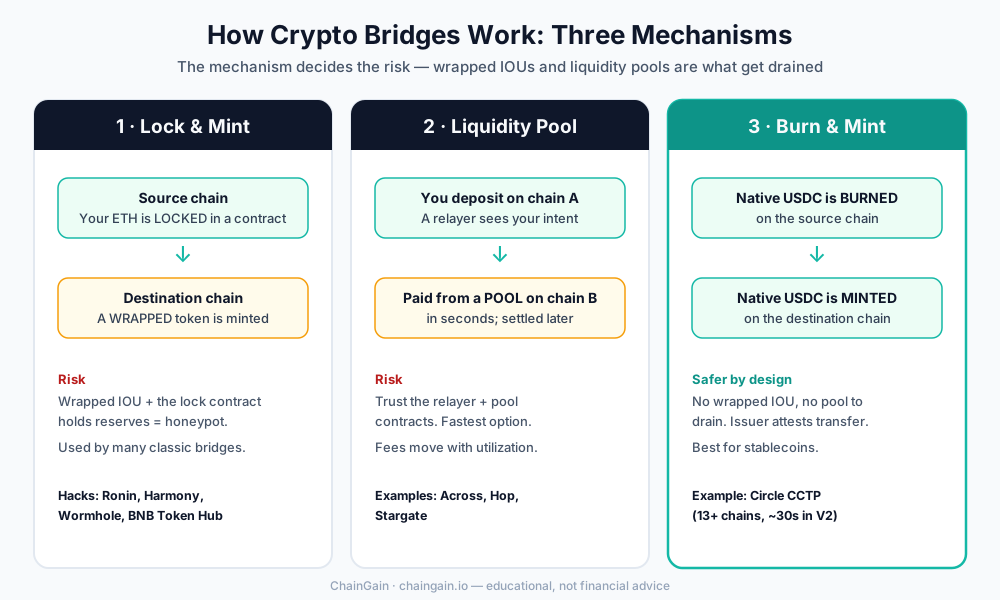
- For stablecoins, Circle CCTP is usually the safest cheap route. It burns native USDC on one chain and mints it on another (no wrapped IOU, no third-party liquidity pool), across 13+ chains for about $0.30–$1 plus gas, with ~30-second fast transfers in V2.
- Most “hacks” trace to four boring failures: compromised validator/multisig keys (Ronin, Harmony), unaudited or mis-initialized contracts (Nomad), forged proofs (BNB Token Hub), and custody collapse (Multichain, where the CEO’s arrest — not a hacker — froze user funds).
- You do not need a bridge as often as you think. If your funds are on a centralized exchange, withdrawing directly to Arbitrum or Base is frequently cheaper and simpler than bridging from mainnet — many exchanges support native L2 withdrawals for ~$0.10–1.
- The biggest avoidable loss is an approval, not a hack. Bookmark bridge URLs, never reach them through a search ad, and use revoke.cash to revoke stale token approvals after you bridge.

That includes a 7-day wait staring at a pending Arbitrum withdrawal, a $0.40 Across transfer that landed in 25 seconds, and roughly $1,200 that got stuck when the Multichain bridge collapsed in 2023 after its CEO was arrested.
Here is the honest tension every “best bridge” guide skips: the cheapest route and the safest route are rarely the same one, and the right answer depends on how much you are moving, how fast you need it, and how much trust you are willing to take on. The protocol blogs and bridge tools each push their own product; the security explainers list vulnerabilities but never tell you what to actually click.
This guide does both. We compare real per-route costs and times to Arbitrum, Base, and Optimism, map the $4 billion of bridge hacks to the specific failures that caused them, give you a decision framework for native vs third-party, and walk through bridging step by step without getting phished. Every fee figure is dated and volatile — treat them as ballparks and read the live quote.
What is a bridge, and do you actually need one?
TLDR: A bridge moves value between chains using one of three mechanisms — lock-and-mint, burn-and-mint (Circle CCTP), or a liquidity pool with a relayer (Across). But first ask whether you need one: if you’re buying fresh, most centralized exchanges withdraw directly to Arbitrum, Base, or Optimism for a flat fee, skipping bridge risk entirely. You only need a bridge for assets already on Ethereum.
A crypto bridge moves value from one blockchain to another — for example, taking ETH on Ethereum mainnet and making it usable on Arbitrum, a Layer 2 that settles back to Ethereum. Because no token literally “crosses” chains, a bridge does one of three things under the hood: it locks your asset on the source chain and mints a representation on the destination (lock-and-mint), it burns and re-mints a native version (burn-and-mint, used by Circle CCTP), or it pays you out of a liquidity pool on the other side while a relayer settles up later (the model behind fast bridges like Across).
Before you bridge, ask whether you need to at all. If you are buying crypto fresh, many centralized exchanges let you withdraw directly to Arbitrum, Base, or Optimism for a flat fee — no mainnet round-trip, no bridge risk. If you already hold assets on Ethereum and want cheaper transactions, then yes, you bridge to an L2. New to how these chains differ? Our Layer 2 explainer compares Arbitrum, Optimism, Base, and zkSync on fees and failure modes, and once your funds arrive, buying ETH cheaply on a DEX is the natural next step.
The cheapest way to bridge to Arbitrum, Base & Optimism in 2026
TLDR: For transfers under ~$5,000, a fast third-party bridge or aggregator (Across, Stargate, CCTP) is the cheapest and quickest way in — about $0.30–$3 in under a minute — while the official native bridge charges only Ethereum L1 gas ($5–$40) but is slower. For stablecoins specifically, Circle CCTP usually wins on safety-per-dollar because it mints native USDC with no pool to drain.
For most users moving under ~$5,000, a fast third-party bridge or aggregator is the cheapest and quickest way in — often $0.30–$3 total in under a minute. The official native bridge only charges Ethereum L1 gas, but that gas (~$5–40, spiking higher when mainnet is busy) is usually more than a relayer fee, and the native route is slower. The table below compares the same ~$1,000 transfer; figures were sampled on 2026-06-06 and move constantly.
| Route to L2 | Type | Typical cost (~$1,000) | Speed | Trust model |
|---|---|---|---|---|
| Official native bridge (Arbitrum/Base/OP portal) | Lock-and-mint | ~$5–40 (L1 gas only) | Minutes in; 7 days out | Trust-minimized (rollup security) |
| Across | Intent + relayer | ~$0.30–3 | ~25 sec–5 min | Relayer + optimistic settlement |
| Stargate (LayerZero) | Liquidity pool | ~$1–3 (0.01–0.06% + msg fee) | ~2–10 min | Pool + LayerZero messaging |
| Circle CCTP (USDC only) | Burn-and-mint | ~$0.30–1 + gas | ~30 sec (V2 fast) | Circle attestation (issuer) |
| Hop Protocol | AMM + bonders | ~0.01–0.04% + gas | ~5–15 min | Pool + bonders (low liquidity in 2026) |
Two practical notes. First, for stablecoins specifically, Circle CCTP usually wins on safety-per-dollar because it mints native USDC rather than a wrapped IOU — there is no liquidity pool to drain and no bridge-issued token to de-peg. Second, Hop still works but its liquidity has thinned out (total value locked, or TVL, in the low millions in 2026), so spreads widen on larger transfers; treat it as a small-transfer option. For the difference between native and bridged USDC, see our USDT vs USDC guide.
Native vs third-party bridges: the trade-off that decides everything
TLDR: The choice that matters most isn’t the fee — it’s trust versus speed: a native bridge inherits the rollup’s security but makes you wait out a 7-day exit window, while a third-party bridge fronts you liquidity instantly but adds the contracts and relayers attackers target. Move large, patient capital through the native bridge; move small or time-sensitive amounts third-party; and for stablecoins, prefer CCTP regardless of size.
Native bridges are the safest and slowest; third-party bridges are the fastest and add trust. That single trade-off should drive your choice more than the headline fee. A native (canonical) bridge is run by the rollup itself and inherits the chain’s security — but withdrawing back to Ethereum from an optimistic rollup means waiting out a 7-day fraud-proof window. A third-party bridge skips the wait by fronting you liquidity on the destination, which means you are now trusting its contracts, relayers, or validators — the exact components attackers target.
| Factor | Native bridge | Third-party bridge / aggregator |
|---|---|---|
| Trust assumption | Lowest (rollup security) | Higher (extra contracts + relayers) |
| Speed in | Minutes | Seconds to minutes |
| Speed out (L2→L1) | 7 days (optimistic) / hours (ZK) | Minutes |
| Cost | L1 gas only (~$5–40) | Small relayer/pool fee (~$0.30–3) |
| Best for | Large amounts; no rush; max safety | Small/medium amounts; speed; getting out fast |
Our rule of thumb: move large, patient capital with the native bridge; move small or time-sensitive amounts with a reputable third-party route — and for stablecoins, prefer CCTP regardless of size. If you only have funds on a centralized exchange, the cheapest path is often to skip bridging entirely (covered below).
Are crypto bridges safe? The $4 billion hack history
TLDR: Bridges are the single most-exploited part of crypto — roughly $4 billion lost across about 50 incidents since 2021, nearly 40% of all Web3 theft — because each one must hold large reserves on both sides, making it a honeypot. The biggest failures (Ronin ~$568M, Wormhole $326M, Nomad $190M) ranged from stolen validator keys to forged proofs, and Multichain’s ~$125M loss came from a custody collapse, not even a hack.
Bridges are the single most-exploited part of crypto: roughly $4 billion lost across about 50 incidents since 2021, close to 40% of all Web3 theft. The reason is structural — a bridge has to hold or control large reserves on both sides, which makes it a honeypot. Knowing how the big ones failed tells you what to check before trusting any bridge.
| Incident | Amount | Date | Root cause |
|---|---|---|---|
| Ronin Network | ~$568M (often cited $625M) | Mar 2022 | 5 of 9 validator keys compromised (Lazarus Group) |
| BNB Token Hub | $566M minted ($137M exfiltrated) | Oct 2022 | Forged proof (relayer/AVL-tree flaw) |
| Wormhole | $326M | Feb 2022 | Signature verification spoof (covered by Jump) |
| Nomad | $190M | Aug 2022 | Faulty upgrade set trusted root to zero (replayable) |
| Multichain | ~$125M | Jul 2023 | Custody collapse after CEO arrest (not a classic hack) |
| Harmony Horizon | ~$100M | Jun 2022 | 2 of 5 multisig keys compromised (Lazarus Group) |
The Multichain case is the one most lists get wrong: there was no clever exploit. The team’s CEO was arrested, police took custody of the keys and hardware wallets, and ~$125M drained to unknown addresses while no one could intervene. It is the clearest argument for trust-minimized, non-custodial routes — a bridge is only as safe as whoever holds its keys. For how investigators actually trace these flows, see our on-chain hack forensics breakdown.
How do bridges actually get hacked?
TLDR: Almost every bridge loss comes down to four screenable failure modes: compromised validator or multisig keys (Ronin, Harmony), unaudited or misconfigured contracts (Nomad’s zeroed trust-root, copied by 88% of the drainers), forged proofs or messaging flaws (BNB Token Hub), and operator or custody collapse (Multichain). You don’t need to read Solidity — L2BEAT’s risk ratings and DeFiLlama tell you whether a bridge is battle-tested.
Almost every major bridge loss comes down to four failure modes — and you can screen for all of them before you click.
- Compromised keys (validators / multisig). Ronin and Harmony were not smart-contract bugs — attackers stole the private keys controlling the bridge. Check: is the bridge run by a tiny multisig, or does it inherit rollup security? Fewer trusted signers = more key risk.
- Unaudited or mis-configured contracts. Nomad’s upgrade set a trusted root to zero, making every fake message provable; 88% of the drainers were copycats. Check: recent audits, a bug-bounty program, and time in production.
- Forged proofs / messaging flaws. BNB Token Hub let an attacker forge a proof and mint 2M BNB. Check: how does the bridge verify messages — light client, oracle, or a small committee?
- Custody / operator collapse. Multichain shows that a centralized operator is a single point of failure even with no exploit. Check: who can pause or drain the bridge, and what happens if they vanish?
None of this requires reading Solidity. L2BEAT publishes a risk rating for canonical bridges, and DeFiLlama tracks third-party bridge volume and TVL — two minutes there tells you whether a bridge is battle-tested or brand-new.
How to bridge USDC or ETH safely, step by step
TLDR: The mechanics are simple; the safety is in the habits: reach the bridge by bookmark (never a search ad), pick the route for your size (CCTP for stablecoins, Across for small fast ETH, the native portal for large transfers), and approve only the exact amount. For any new bridge or large transfer, send a $10 test first, then revoke the approval at revoke.cash afterward.
The mechanics are simple; the safety is in the habits.
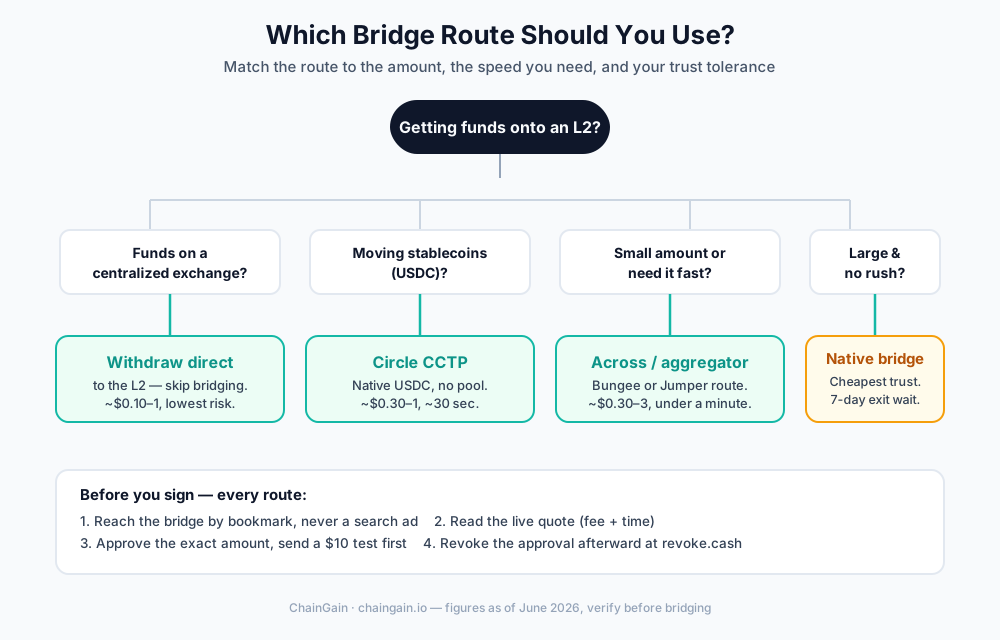
- Reach the bridge by bookmark, never by search. Phishing clones buy ads and rank for “[bridge] official.” Type the URL or use a saved bookmark; cross-check the domain on DeFiLlama or the chain’s official ecosystem page.
- Pick the route for your size. Stablecoins → Circle CCTP. Small/fast ETH → Across or an aggregator. Large, patient transfers → the native portal.
- Connect a wallet with transaction simulation (e.g., Rabby or MetaMask’s preview) so you see exactly what you are signing. Our wallet framework covers which wallets simulate by default.
- Read the live quote — fee, estimated time, and amount received. If the route cannot fill at your price, it will say so; do not raise slippage blindly.
- Approve the exact amount, not “unlimited.” If the bridge asks for a token approval, set it to the transfer amount.
- Send a small test first for any new bridge or large transfer — $10 confirms the route works before you commit four figures.
- Revoke the approval afterward at revoke.cash so a stale allowance cannot be abused later.
How long does it take — and why native withdrawals take 7 days
TLDR: Bridging into an L2 takes seconds to minutes; the 7-day wait only applies to native withdrawals out of optimistic rollups (Arbitrum, Optimism, Base), where a fraud-proof window must close before funds finalize on Ethereum. ZK rollups settle faster (zkSync Era ~3 hours), and a third-party ‘fast withdrawal’ bridge will front you the funds in minutes for a fee.
Bridging into an L2 takes seconds to minutes on any route. Bridging out on a native bridge is where the 7 days come from. Arbitrum, Optimism, and Base are optimistic rollups: they assume transactions are valid and leave a 7-day challenge window for anyone to submit a fraud proof. Native withdrawals to Ethereum cannot finalize until that window closes — it is a security feature, not a bug.
ZK rollups settle faster because they post a cryptographic validity proof instead of waiting for challenges: zkSync Era finalizes in roughly ~3 hours, Polygon zkEVM in about 30–60 minutes, and Starknet up to ~8 hours. If you need to exit an optimistic L2 quickly, a third-party “fast withdrawal” bridge fronts you the funds in minutes for a fee — you are paying to skip the 7-day wait, and trusting that bridge to do it.
Bridge vs CEX withdrawal: which is cheaper and safer?
TLDR: If your money is already on a centralized exchange, withdrawing directly to the L2 is usually the cheapest and lowest-risk way there (~$0.10–$1, no bridge contract involved) — you only trust the exchange you already use. Bridging from mainnet instead means paying L1 gas plus bridge risk. The rule: fund an L2 by exchange withdrawal when you can, and bridge only when your assets are already on-chain.
If your money is already on a centralized exchange, withdrawing directly to the L2 is usually the cheapest and lowest-risk way to get there — no bridge contract involved. Major exchanges support native withdrawals to Arbitrum, Base, and Optimism for roughly $0.10–1, and the only trust assumption is the exchange you already use. Bridging from mainnet, by contrast, means paying L1 gas plus taking on bridge risk.
The catch is the reverse trip and self-custody. Pulling funds off an exchange to your own wallet is the point of using an L2 in the first place — you control the keys. Just remember the exchange is its own counterparty risk (frozen accounts, withdrawal pauses), which we cover in why crypto gets frozen and in our CEX vs DEX comparison. Rule of thumb: fund an L2 by exchange withdrawal when you can; bridge when your assets are already on-chain.
How to avoid bridge scams and protect your wallet
TLDR: The realistic 2026 threat isn’t a fake bridge interface — it’s phishing around the edges: lookalike URLs, malicious approvals, and fake ‘verify your wallet’ or ‘sign in’ pop-ups. Never reach a bridge through a search ad, remember a bridge needs a transaction signature (never your seed phrase or an OAuth login), and simulate every transaction before signing.
In 2026 the realistic threat is not a fake bridge front-end — it is phishing around the edges: fake login prompts, malicious approvals, and lookalike URLs. There is no documented mass fake-bridge-UI campaign, but generic OAuth and wallet-connect phishing is rampant (consumer-protection regulators have warned about lookalike “sign in with Google/Microsoft” screens in 2026). The defenses are the same ones that protect any on-chain action:
- Never reach a bridge through a search ad. Ads are the #1 vector for clone sites. Bookmark the real URL.
- Be suspicious of any “verify your wallet” or “sign in” pop-up that appears mid-bridge. A bridge needs a transaction signature, not your seed phrase or an OAuth login.
- Approve exact amounts and revoke later with revoke.cash — and beware phishing clones of revoke.cash itself; type the URL.
- Simulate before signing. A wallet that previews the outcome catches the “you are about to send everything” transactions before they execute.
For the full phishing playbook — address poisoning, drainer kits, and fake support — see how to spot and avoid crypto scams.
The best bridge aggregators in 2026
TLDR: Aggregators don’t run their own bridge — they scan many and route through the cheapest or fastest, which is exactly what a beginner wants. The two consumer front-ends worth knowing are Bungee (Socket) and Jumper (LI.FI, with $20B+ in cumulative volume); among single bridges, Across leads on speed-to-cost for ETH, Stargate on large stablecoin moves, and Circle CCTP on USDC.
Aggregators do not run their own bridge — they scan many bridges and route your transfer through the cheapest or fastest one, which is exactly what a beginner wants. The two consumer front-ends worth knowing are Bungee (the consumer UI for Socket) and Jumper (the consumer UI for LI.FI, with $20B+ in cumulative bridge volume as of mid-2026, across dozens of chains). Both show you the quoted output before you sign, so you can compare routes in one place.
Among single bridges, Across is the standout for speed-to-cost on ETH and major tokens (intent-based, ~25-second fills), Stargate shines for large stablecoin moves where its flat basis-point fee beats percentage models, and Circle CCTP remains the cleanest USDC route. Whatever the aggregator recommends, the safety rules above still apply — the route is only as trustworthy as the underlying bridge it picks.
Bottom line: the right bridge for your situation
There is no single “best bridge,” only the right route for the job:
- Moving stablecoins (any size): Circle CCTP — native USDC, no pool to drain.
- Small/medium ETH, need it fast: Across or an aggregator (Bungee/Jumper) — ~$0.30–3, under a minute.
- Large amount, no rush, max safety: the native portal — cheapest trust, slowest exit.
- Funds on an exchange: withdraw directly to the L2 — skip bridging entirely.
- Getting out of an optimistic L2 fast: a fast-withdrawal bridge to skip the 7-day wait (for a fee).
Whatever you choose, bookmark the URL, read the live quote, send a test transaction, and revoke approvals afterward. The cheapest bridge that loses your funds is the most expensive one there is.
Frequently Asked Questions
Is it safe to bridge crypto to Layer 2?
Bridging is reasonably safe if you use a battle-tested route and basic hygiene, but bridges are the most-hacked part of crypto (~$4B lost since 2021). Prefer native bridges or burn-and-mint routes like Circle CCTP for large amounts, reach the site by bookmark, and revoke approvals afterward.
What is the cheapest way to bridge to Arbitrum or Base?
For ~$1,000, a fast third-party bridge or aggregator (Across, Stargate, Bungee/Jumper) typically costs $0.30–$3 and arrives in under a minute — usually cheaper than the native bridge, whose only cost is Ethereum L1 gas (~$5–40). For USDC, Circle CCTP is ~$0.30–1 plus gas.
Why does withdrawing from Arbitrum take 7 days?
Arbitrum, Optimism, and Base are optimistic rollups with a 7-day fraud-proof window. Native withdrawals to Ethereum cannot finalize until the window closes. You can skip it with a fast-withdrawal bridge for a fee, or use a ZK rollup (zkSync ~3 hours) where finality is faster.
What is the difference between a native and a third-party bridge?
A native (canonical) bridge is run by the rollup and inherits its security, but is slower to exit (7 days). A third-party bridge fronts you liquidity for speed, adding a trust assumption in its contracts and relayers — the components most often exploited.
Do I even need a bridge?
Often not. If your funds are on a centralized exchange, you can usually withdraw directly to Arbitrum, Base, or Optimism for ~$0.10–1, skipping bridge risk entirely. You only need a bridge when assets are already on-chain and you want to move them between networks.
What is Circle CCTP and why is it considered safer?
CCTP (Cross-Chain Transfer Protocol) burns native USDC on the source chain and mints native USDC on the destination — there is no wrapped token and no liquidity pool to drain. It supports 13+ chains for about $0.30–1 plus gas, with ~30-second fast transfers in V2.
How do I avoid bridge scams?
Never reach a bridge through a search ad; bookmark the real URL and verify it on DeFiLlama. Reject any “sign in” or “verify wallet” pop-up that asks for more than a transaction signature, approve exact amounts, and revoke stale approvals at revoke.cash.
Which bridge aggregator is best for beginners?
Bungee (Socket) and Jumper (LI.FI) are the leading consumer aggregators — they compare many bridges and show the quote before you sign. They are a good default because they route to the cheapest or fastest underlying bridge automatically, but the usual safety checks still apply.
Continue Learning
Bridging is one step in moving and using crypto on Layer 2. These guides cover the rest of the stack:
- Layer 2 Explained 2026 (Arbitrum vs Optimism vs Base vs zkSync) — the chains you are bridging to, compared on fees and failure modes.
- Cheapest & Safest Way to Buy ETH with Stablecoins on a DEX — what to do once your funds land on an L2.
- CEX vs DEX vs Hybrid Exchanges 2026 — whether to bridge or just withdraw from an exchange.
- USDT vs USDC: Which Stablecoin to Bridge — native vs bridged stablecoins explained.
- Crypto Wallet Decision Framework — pick a wallet that simulates transactions before you sign.
- How to Spot and Avoid Crypto Scams — the full phishing and approval-drainer playbook.
- On-Chain Hack Forensics — how stolen bridge funds are actually traced.

Editorial pen name · ChainGain
Alex Mercer is the editorial pen name used for ChainGain’s cryptocurrency education content. Articles are based on cited sources and reproducible comparisons. Editorial profile