Layer 2 Explained 2026: Arbitrum vs Optimism vs Base vs zkSync (Real Fees, Real Use Cases, Real Failure Modes)
Editorial independence & fact-check disclosure: ChainGain does not receive affiliate commission from Arbitrum, Optimism, Base, zkSync, Matter Labs, Offchain Labs, OP Labs, Coinbase, or any Layer 2 named in this guide. Total Value Locked (TVL) figures verified 2026-05-28 via L2BEAT and DeFiLlama. Fee data sourced from L2Fees.info on 2026-05-27. Incident history cross-checked with Arbitrum status page, Blockworks reporting, and official L2 docs. L2 economics shift weekly — check L2BEAT and the official bridge before depositing.
Key Takeaways
- Layer 2 = off-chain Ethereum computation with on-chain settlement. Transactions are bundled off-chain into batches, then posted to Ethereum mainnet for final security. Result: $0.02-0.30 per swap (vs $1-5 on Ethereum L1 after EIP-4844) and sub-second to single-digit-second confirmation.
- Two architectures dominate. Optimistic Rollups (Arbitrum, Optimism, Base) assume validity by default and rely on a 7-day fraud-proof challenge window for native withdrawals. ZK Rollups (zkSync Era, Starknet, Polygon zkEVM) post cryptographic validity proofs each batch — faster native withdrawals (hours to ~1 day), but smaller ecosystems today.
- Real 2026 TVL ranking (L2BEAT, May 2026): Arbitrum $16.9B (40-44% market share), Base $12.8B, Optimism $1.91B, zkSync Era $404M. Optimistic rollups hold roughly 80% of all L2 TVL; ZK rollups roughly 20%.
- 2026 swap fees (L2Fees.info, May 2026): Arbitrum $0.05-0.30, Base ~$0.02 USDC transfer / ~$0.18 swap, Optimism ~$0.09 transfer / ~$0.18 swap, zkSync ~$0.07 per transaction. Ethereum L1 ~$1.10-5.48 per operation. EIP-4844 (March 2024) cut L2 data costs 50-90%.
- Failure modes differ by chain: Arbitrum 7-hour hardware failure with failed backup (Jan 2023) plus minor batch-poster and traffic incidents; Optimism 7-day exit is a design feature, not a bug; Base ran on Optimism’s OP Stack until February 2026, when it pivoted to an independent “base/base” stack while staying in the OP Superchain; zkSync Era discovered a critical prover bug in December 2023 that could have allowed a $1.9B drain — ChainLight reported it before any exploit.
- Bridges are the highest-risk vector. Since 2021, cross-chain bridge hacks total over $1.95B: Poly Network ($612M, Aug 2021), Ronin Network ($600M, Mar 2022), Wormhole ($320M, Feb 2022), Multichain ($231M, Jul 2023), Nomad ($190M, Aug 2022). Native rollup bridges are slower but trustless; third-party liquidity bridges (Across, Stargate) are faster but carry counterparty risk.
- Persona test: micro trades under $1,000 lean to zkSync (cheapest gas), $1,000-$10,000 trades favor Arbitrum (deepest liquidity), consumer and social apps fit Base (Coinbase ecosystem), serious long-term DeFi splits between Arbitrum and Optimism (depth plus maturity), new crypto users typically arrive on Base via Coinbase.
Every “Layer 2 explained” article still circulating online was either written before EIP-4844 cut L2 data costs by 50-90% (so the fees are obsolete), authored by a single chain’s foundation or a CEX content team (so the comparison is one-sided), or sourced exclusively from architecture whitepapers (so the failure history is missing). None of the three top organic results for “arbitrum vs optimism vs base vs zksync” in May 2026 disclose the December 2023 zkSync prover bug, the February 2026 Base/OP Stack split, or the verified TVL numbers from L2BEAT — and none give you a decision tree by trade size.
This guide compares the four most-used Layer 2 networks on eight axes with May 2026 fee data, explains Optimistic versus ZK rollups using analogies you can repeat to a non-technical friend, walks through the documented failure of each chain in chronological order, maps the $1.95B-plus history of bridge hacks since 2021, and ends with a persona decision tree that 0 of the top 5 Google results currently provide.
Arbitrum vs Optimism vs Base vs zkSync: TL;DR for 2026
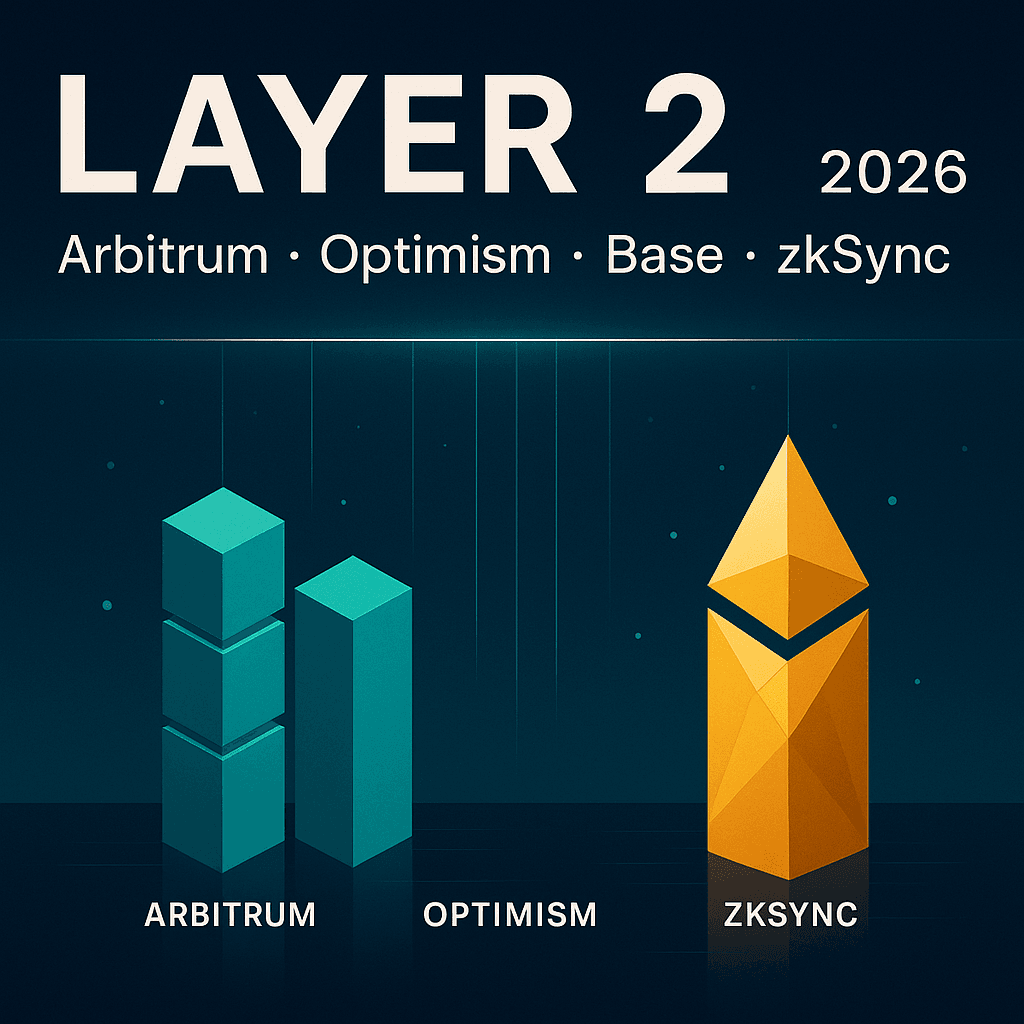
Arbitrum holds the most liquidity ($16.9B TVL, May 2026) and is the default home of serious DeFi — GMX, Camelot, Aave v3, Uniswap, Curve all have deep deployments there. Base is the consumer L2 ($12.8B TVL), incubated by Coinbase, and as of February 2026 runs on its own independent stack. Optimism ($1.91B TVL) is the governance-and-OP-Stack pioneer and home to Synthetix and Velodrome (the latter merging with Base’s Aerodrome in Q2 2026). zkSync Era ($404M TVL) is the most active general-purpose ZK rollup but has a thin DeFi ecosystem; its strength is cheap micro-transactions, not deep liquidity.
If you swap less than $1,000 at a time and want the lowest absolute gas cost, zkSync Era is hard to beat ($0.02-0.10 per transaction). If you swap $1,000-$10,000 and need real liquidity for a token that is not WBTC or USDC, Arbitrum is almost always the answer. If you are onboarding a non-crypto-native friend through Coinbase and want one-click bridging, Base is the path of least resistance. If you are a DeFi power user managing yield positions across Aave, Velodrome, and Synthetix, you will end up on Optimism whether you planned to or not.
What Is a Layer 2 Blockchain?
A Layer 2 (L2) is a separate blockchain that processes transactions independently but settles its state to Ethereum mainnet (Layer 1) for final security. Instead of every transaction running through Ethereum directly — with the gas costs and throughput limits that implies — L2s batch hundreds or thousands of transactions off-chain, compute the resulting state changes, and then post either compressed transaction data (Optimistic rollups) or a cryptographic validity proof (ZK rollups) back to Ethereum.
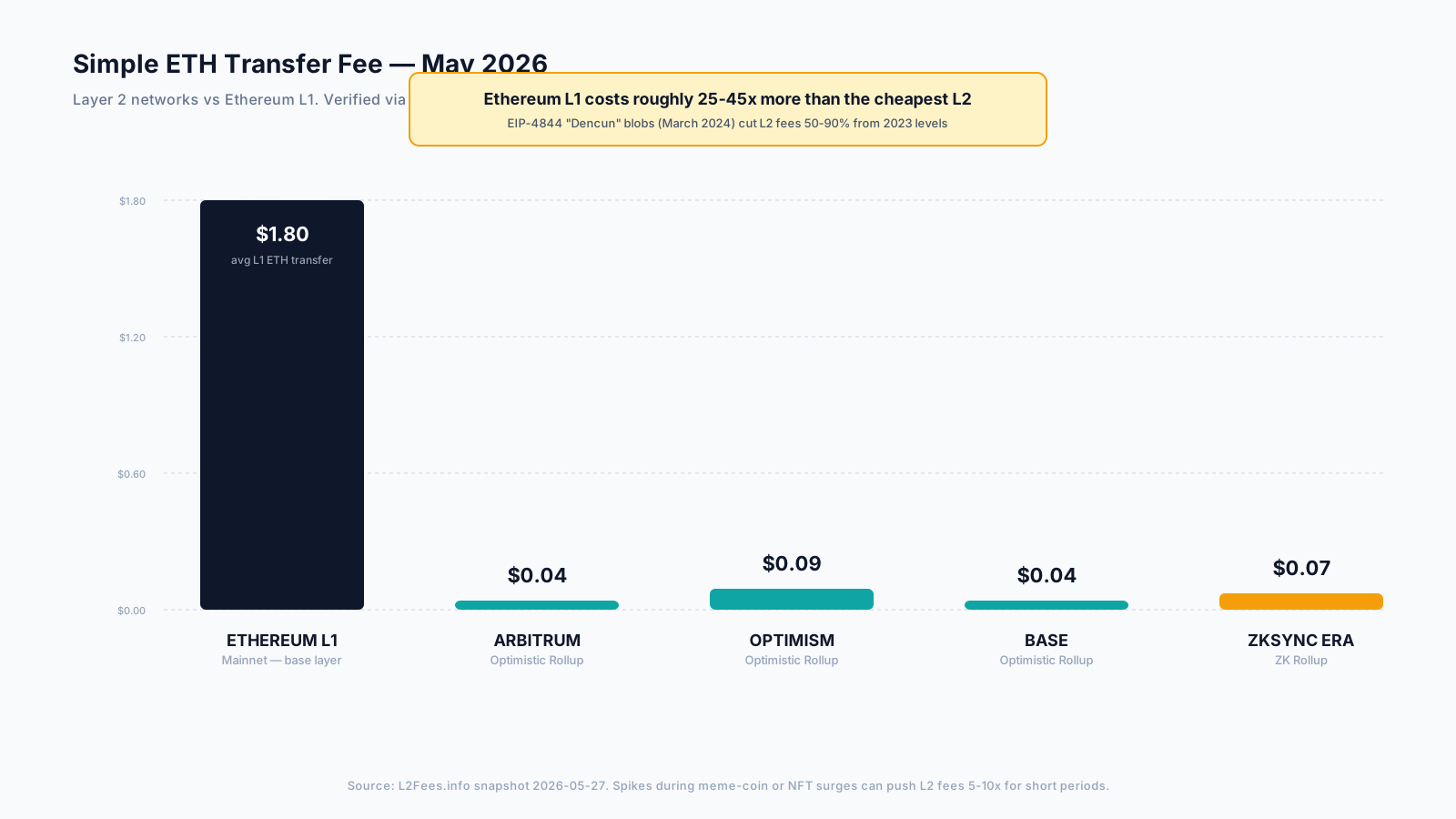
The economic effect is enormous. A simple ETH transfer on Ethereum mainnet costs roughly $1.10-$5.48 in May 2026 (heavy congestion periods can spike higher). The same transfer on Base costs about $0.02. A Uniswap swap costing $5-$15 on Ethereum L1 will run $0.05-$0.30 on Arbitrum, $0.18 on Optimism or Base, and ~$0.07 on zkSync Era. EIP-4844 (the “Dencun” upgrade in March 2024) introduced “blob” data storage that cut L2 publication costs 50-90% — the cheap L2 era you experience in 2026 dates from that single upgrade.
L2s do not replace Ethereum; they extend it. Your funds on Arbitrum are ultimately secured by Ethereum’s validator set, because the state of Arbitrum has to be re-verifiable on Ethereum. The trade-off is that you accept the L2’s specific risks — sequencer downtime, bridge delays, smart-contract bugs in the rollup code — in exchange for fees that make $5 or $50 swaps actually viable.
Of the roughly 73 active rollups tracked by L2BEAT in May 2026, the top four by usage and recognition are Arbitrum, Optimism, Base, and zkSync Era. Combined L2 TVL across all rollups is approximately $48B, with Optimistic rollups holding around 80% of that figure and ZK rollups about 20%.
Optimistic vs ZK Rollups Explained (With Analogies)
The two L2 architectures answer the same question — “how do we let Ethereum trust that a batch of off-chain transactions is valid?” — in opposite ways.
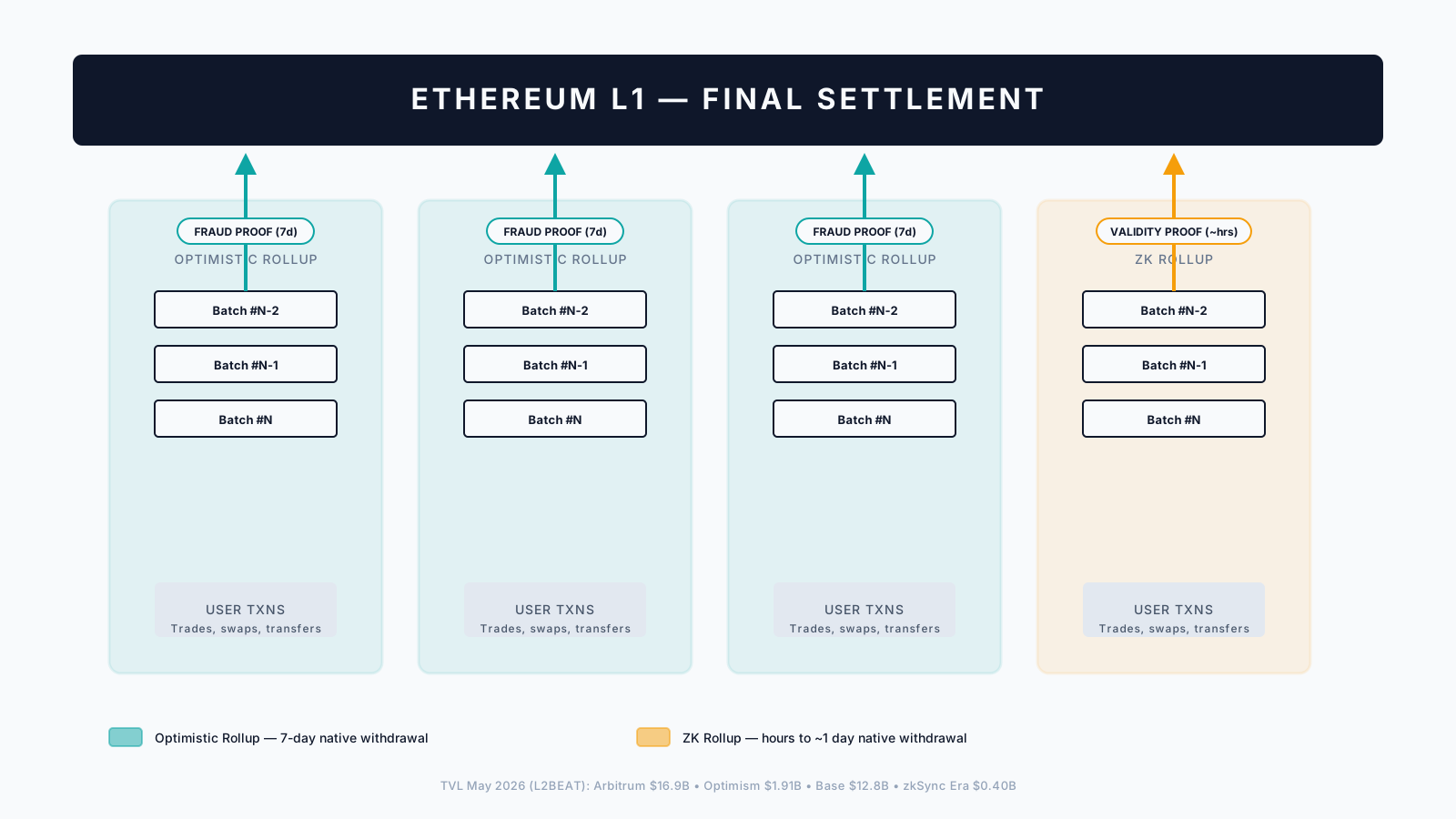
Optimistic rollups are “innocent until proven guilty.” Arbitrum, Optimism, and Base all assume each transaction batch is valid by default and post it to Ethereum without proof. For a 7-day “fraud-proof challenge window,” anyone running a validator can submit a fraud proof if they spot an invalid state transition. If no challenge arrives, the batch finalizes. The trade-off is that native withdrawals from an Optimistic L2 back to Ethereum mainnet take a full 7 days, because Ethereum cannot release funds until the challenge window closes.
ZK rollups are “proven valid by math.” zkSync Era, Starknet, and Polygon zkEVM compute a zero-knowledge cryptographic proof (a SNARK or STARK) for every batch they submit. The proof attests, without revealing the underlying transactions, that the new state was reached by valid execution of valid signatures. Ethereum verifies the proof in a single small calculation. Because the math itself is the guarantee, there is no challenge window — native withdrawals on a ZK rollup typically settle in hours to about one day.
The everyday consequence: if you ever need to move a large position from an L2 back to Ethereum L1 directly (not via a third-party bridge), an Optimistic rollup will make you wait a full week. A ZK rollup will make you wait hours. Most people never feel this directly because they use third-party “fast bridges” like Across, Stargate, or Connext that offer 15-minute exits on Optimistic chains via liquidity provider networks — but those bridges introduce their own counterparty and smart-contract risks.
Both architectures inherit Ethereum’s underlying validator security. The choice between them is not “which is safer” but “which trade-off pattern fits your withdrawal cadence and ecosystem depth.”
The Four Major Layer 2s in 2026
Arbitrum — The DeFi Heavyweight
Arbitrum, built by Offchain Labs, is the most-used Optimistic rollup and the home of serious Ethereum DeFi in 2026. Its fraud-proof system is unusual: instead of a single-round dispute, Arbitrum uses an interactive bisection protocol that progressively narrows the disputed execution to a single instruction. In practice this means more efficient on-chain dispute resolution, at the cost of more complex client software.
TVL on Arbitrum sits at $16.9B in May 2026 — roughly 40-44% of the total L2 market by itself. Active protocols include GMX (the dominant perpetuals DEX), Camelot (the largest Arbitrum-native AMM), Aave v3 (Arbitrum hosts approximately $1.24B of Aave’s total deposits), Uniswap v3 and v4, Curve, Pendle, and Synthetix. If you are using a DeFi product that exists on multiple chains, the Arbitrum deployment usually has the deepest liquidity.
Trade-offs to know: Arbitrum’s sequencer (the system that orders transactions before posting them to Ethereum) is still operated by Offchain Labs, although decentralization is on the roadmap. The native bridge enforces the 7-day withdrawal window. Arbitrum suffered a 7-hour outage in January 2023 when a hardware failure coincided with a failed backup failover, plus a roughly one-hour batch-poster bug in June 2023 and a three-hour congestion event during the Inscriptions traffic surge in December 2023. None of those events caused fund loss.
Optimism — The OP Stack Originator
Optimism, built by OP Labs, pioneered the modular L2 toolkit that Base and dozens of other chains have adopted — the OP Stack. Its fraud-proof system is simpler than Arbitrum’s: a single-round dispute that posts the disputed transition directly to Ethereum for re-execution.
TVL on Optimism is approximately $1.91B in May 2026, which surprises people accustomed to thinking of Optimism as a major chain. Substantial DeFi presence persists — Synthetix (which originated on Optimism), Aave, Uniswap, and Velodrome — but a meaningful share of activity has migrated to Base or Arbitrum since 2024. Velodrome is scheduled to merge with Base’s Aerodrome in Q2 2026 into a unified “Aero” token, which will further reshape Optimism’s DEX landscape.
The defining feature of Optimism is the OP Stack and the Superchain vision: a shared sequencing layer and bridge across multiple L2s built on the same code, with retroactive public goods funding (“RetroPGF”) as a coordination mechanism. As an end user, this matters if you value Ethereum-aligned governance and open-source coordination. As a trader, the practical difference between Arbitrum and Optimism in 2026 is mostly which DeFi protocols’ deployments you want to access.
Base — The Consumer L2 (and Now an Independent Stack)
Base is Coinbase’s Layer 2, launched in August 2023 on the OP Stack and now ($12.8B TVL, May 2026) the second-largest L2 by liquidity. Base’s positioning is consumer-first: lowest fees among the major L2s for simple transfers (~$0.02 for a USDC transfer), tight integration with Coinbase’s existing 100M+ user base, and a strong base of consumer-facing apps in social, gaming, and memecoins.
The most significant development on Base in 2026 is governance, not technology. In February 2026, Coinbase announced that Base would move off the OP Stack and onto an independent “base/base” stack while remaining a member of the OP Superchain. That migration ends three years of dependency on Optimism’s codebase and gives the Base team direct control over node software, fee mechanics, and roadmap timing. As of May 2026, the migration is in progress; for end users it is essentially invisible.
Base operates a single, Coinbase-controlled sequencer — a meaningful trust assumption that you should not overlook if you hold significant assets there. Like other Optimistic rollups, Base inherits the 7-day native bridge delay. The dominant DEX is Aerodrome (Q2 2026 merger with Velodrome pending), with about $1.3B TVL and roughly 60% of Base’s DEX volume.
zkSync Era — The General-Purpose ZK Rollup
zkSync Era, built by Matter Labs, is the most general-purpose of the ZK rollups but also significantly smaller than the Optimistic incumbents. TVL is $404M in May 2026 — an order of magnitude below Optimism, two orders of magnitude below Arbitrum. The ecosystem is real but thin: there is no GMX-tier perpetuals venue, no Aave-scale lending market, and Solidity contracts must be recompiled with zkSync’s custom LLVM-based compiler (zksolc) because the chain runs a non-EVM-equivalent custom virtual machine (EraVM).
What zkSync Era does well is cheap, near-finality transactions for individuals: a swap or transfer costs roughly $0.07, with no 7-day withdrawal window for native exits.
The defining incident in zkSync Era’s history is the December 2023 prover bug, discovered by the security firm ChainLight before any exploit. The bug would have allowed an attacker to forge state transitions and potentially drain up to $1.9B in protocol-secured assets. ChainLight reported it through proper channels, Matter Labs patched it, and zkSync Era subsequently added a deliberate block-execution delay as a defense-in-depth measure. There was no loss of user funds — but the incident is the clearest illustration in production that ZK rollups depend on the correctness of their prover circuits, not just their cryptography.
8-Axis Comparison: Arbitrum vs Optimism vs Base vs zkSync
Direct comparison on the dimensions that affect a real 2026 trader or DeFi user:
| Axis | Arbitrum | Optimism | Base | zkSync Era |
|---|---|---|---|---|
| Architecture | Optimistic, interactive (bisection) fraud proofs | Optimistic, single-round fraud proofs | Optimistic, “base/base” stack (from Feb 2026) | ZK Rollup, custom EraVM via zksolc/LLVM |
| 2026 swap fee | $0.05-0.30 | ~$0.18 swap / ~$0.09 transfer | ~$0.18 swap / ~$0.02 USDC transfer | ~$0.07 transaction |
| TVL (May 2026) | $16.9B | $1.91B | $12.8B | $404M |
| Native bridge withdrawal | 7 days | 7 days | 7 days | Hours to ~1 day |
| Sequencer status | Operated by Offchain Labs (centralized, decentralization on roadmap) | Operated by OP Labs (centralized, Superchain decentralization vision) | Operated by Coinbase (centralized, single-entity) | Operated by Matter Labs (centralized) |
| Documented incident history | Jan 2023 7h hardware failure; June 2023 batch-poster bug ~1h; Dec 2023 traffic surge ~3h | No major incidents publicly disclosed; design-imposed 7-day exit is intentional | No major incidents since Aug 2023 launch; Feb 2026 stack pivot (operational only) | Dec 2023 critical prover bug ($1.9B potential, caught pre-exploit by ChainLight) |
| Ecosystem strength | Strongest DeFi (GMX, Aave, Camelot, Uniswap, Curve) | Strong specialty DeFi (Synthetix, Velodrome, Aave) — merger Q2 2026 | Strongest consumer apps (Aerodrome dominant DEX, Coinbase integration) | Thin ecosystem; no major DeFi flagship |
| Best user UX for | Mid-to-large DeFi positions and multi-protocol strategies | Synthetix/Velodrome users, OP-aligned governance participants | Coinbase users, consumer apps, lowest-fee USDC payments | Cheapest micro-transactions, ZK-curious early users |
The most important row is “TVL” — not because TVL is everything, but because deep liquidity is what makes a $5,000 swap actually execute at the quoted price rather than slipping 1-3% into thin pools. On Arbitrum or Base, $5,000-$50,000 swaps in major pairs slip a few basis points. On Optimism, you should check the specific pool. On zkSync Era, you will almost certainly need to use a bridge to route through Arbitrum or Ethereum L1 for anything past $10,000 unless your token has a specific zkSync DEX with meaningful depth.
Real 2026 Fees: What L2 Transactions Actually Cost
Fees on L2s have two components: the execution cost on the L2 itself (cheap, because the L2 charges minimally) and the data-publication cost back to Ethereum L1 (the historically expensive part, dramatically reduced by EIP-4844 blobs in March 2024). The numbers below come from L2Fees.info snapshots in May 2026 and represent typical conditions; spikes during meme-coin or NFT surges can push fees 5-10x for short periods.
| Operation | Ethereum L1 | Arbitrum | Optimism | Base | zkSync Era |
|---|---|---|---|---|---|
| ETH transfer | ~$1.10-2.50 | ~$0.04 | ~$0.09 | ~$0.04 | ~$0.07 |
| USDC transfer (ERC-20) | ~$2.50-5.48 | ~$0.06 | ~$0.10 | ~$0.02 | ~$0.07 |
| Uniswap-style swap | ~$5-15 | ~$0.05-0.30 | ~$0.18 | ~$0.18 | ~$0.07 |
| NFT mint (simple) | ~$5-30 | ~$0.15-0.50 | ~$0.20 | ~$0.15 | ~$0.10 |
| DeFi vault deposit (Aave-style) | ~$8-25 | ~$0.20-0.40 | ~$0.25 | ~$0.25 | ~$0.15 (where available) |
For a $1,000 swap, Ethereum L1 takes 0.5%-1.5% in gas; Arbitrum takes 0.005%-0.03%; zkSync Era takes about 0.007%. Below roughly $200 of trade size, even L2 gas starts to become a noticeable fraction of the value moved, which is why Base’s $0.02 USDC transfer is genuinely useful for everyday payments and why zkSync Era has a structural advantage on micro-transactions specifically.
Failure Modes — The Honest History of Each Chain
Every L2 has had incidents. The honest comparison is not “which chain has had zero problems” (none) but “what kinds of failures has each chain demonstrated, and how does each kind affect you as a user?”
Arbitrum (January 2023, 7-hour outage): A hardware failure on the sequencer infrastructure coincided with a failed automatic failover to backup systems. Transactions paused; user funds were never at risk because the rollup’s state was already secured by Ethereum, but new trades could not be submitted for 7 hours. Two smaller incidents followed: a batch-poster bug in June 2023 (~1 hour interruption) and a traffic surge during the Inscriptions wave in December 2023 (~3 hours of degraded service). None of these caused fund loss.
Optimism (no major incident, by design): Optimism’s most-discussed “failure mode” is actually a design feature — the 7-day fraud-proof challenge window that forces native withdrawals to wait. It is not a bug, but if you are unprepared for it, it feels like one. Plan to use a third-party bridge (Across, Hop, Stargate) for any time-sensitive exit, and understand that those bridges carry their own smart-contract and counterparty risks.
Base (centralized sequencer, no major incident): Base has not suffered a publicly disclosed outage since launch in August 2023. The major risk to acknowledge is structural rather than historical: Base’s sequencer is operated by Coinbase. If Coinbase’s infrastructure has a problem, Base has a problem — this is a single-point-of-failure that does not exist on chains with decentralized sequencer roadmaps further along. The February 2026 pivot from the OP Stack to “base/base” was an operational transition, not an incident.
zkSync Era (December 2023, $1.9B potential prover bug): The security firm ChainLight discovered a flaw in zkSync Era’s prover circuit that could have allowed an attacker to forge a validity proof for an invalid state transition. Up to $1.9B of protocol-secured assets were theoretically exposed. ChainLight reported the bug through Matter Labs’ bug-bounty channel, the fix was deployed before any exploitation, and zkSync subsequently introduced a deliberate block-execution delay to give security monitoring more time. No user funds were lost. The incident is the clearest production reminder that ZK rollups depend on the correctness of their prover code, not just their cryptography — and that responsible disclosure pipelines matter as much as the math.
The pattern across all four chains: sequencer-side incidents pause activity but do not lose funds because Ethereum L1 is the ultimate state record. Bridge incidents (covered next) are the opposite — they can permanently lose user funds, which is why bridges deserve a dedicated section.
Bridge Risk: The $1.95B+ History You Need to Understand
The most consistent way to lose money on Layer 2s is not picking the wrong L2 — it is using the wrong bridge. Since 2021, cross-chain bridge hacks have caused approximately $1.95B in losses, often through smart-contract bugs or compromised signing keys that have nothing to do with the underlying chains’ security.
| Bridge | Date | Loss | Cause |
|---|---|---|---|
| Poly Network | August 2021 | ~$612M | Smart contract vulnerability; most funds eventually returned by hacker |
| Ronin Network (Axie Infinity) | March 2022 | ~$600M | Compromised validator keys (5 of 9 nodes) |
| Wormhole | February 2022 | ~$320M | Signature verification bypass; Jump Crypto restored funds |
| Multichain (Anyswap) | July 2023 | ~$231M | CEO key compromise (single-signer custody) |
| Nomad | August 2022 | ~$190M | Initialization bug; chaotic “open-source” drain |
Two structural categories of bridge risk to internalize:
Native rollup bridges (e.g., Arbitrum bridge, Optimism bridge, Base bridge, zkSync bridge): trustless in the sense that funds are secured by Ethereum L1 once the rollup’s fraud-proof or validity-proof system finalizes. The cost is time — 7 days for Optimistic native exits, hours to a day for ZK. Funds are not at risk to a hack of the bridge itself, because the bridge is just a smart contract enforcing the rollup’s state transitions.
Third-party liquidity bridges (Across, Hop, Stargate, Connext): fast (typically 5-15 minutes) but introduce trust assumptions in the bridge’s smart contracts, liquidity providers’ counterparty solvency, and in some cases the bridge operator’s signing keys. The four bridge hacks above were all third-party bridges, not rollup-native bridges. If a third-party bridge is a few months old, or has a small TVL, or has not been audited by multiple reputable firms, the speed gain is rarely worth the risk for sums above a few hundred dollars.
Practical rule: use third-party bridges for small, time-sensitive moves; use the native rollup bridge (and tolerate the wait) for any sum you would be unhappy to lose.
Persona Decision Tree: Which Layer 2 Fits You?
The right L2 is determined less by raw performance than by what you actually do with crypto. Four common personas, with the practical 2026 default for each.
Persona 1 — The micro-transaction user (swaps under $1,000, frequent transfers): zkSync Era is structurally cheapest, and the thin DeFi ecosystem is less relevant when your trades fit inside a single liquid pool. Base is the second choice if you already hold assets on Coinbase, because the bridge friction is minimal. Avoid Optimism for this profile — the fees are not bad, but the deep-liquidity advantage that justifies Optimism does not apply at this size.
Persona 2 — The $1,000-$10,000 trader (active swapping in major pairs): Arbitrum is almost always the answer. Deep liquidity on every pair that matters, fees that are negligible at this size, and the largest selection of DEX aggregators tuned for Arbitrum routing. If your specific token has more liquidity on Base, route there instead — but check the actual liquidity, not the marketing.
If you are sending or receiving stablecoins for remittance rather than trading, the calculator below estimates the all-in cost across alternative routes, including L2 paths.
Persona 3 — The consumer-app user (social, gaming, memecoins, one-click onboarding): Base wins on the strength of Coinbase integration. Bridging fiat directly from a Coinbase account to Base is essentially frictionless; consumer apps (social platforms, NFT mints, gaming experiments) cluster on Base in 2026 precisely because the onboarding pipeline is so smooth. The trade-off you accept is reliance on a single-entity sequencer.
Persona 4 — The long-term DeFi user (yield, lending, perpetuals, multi-protocol strategies): Arbitrum and Optimism split this market in 2026. Arbitrum is the default for perpetuals (GMX), top-of-stack lending (Aave v3), and most major AMMs. Optimism is the default for Synthetix-derived assets and Velodrome (until the Q2 2026 Aerodrome merger reshapes that picture). Most serious DeFi users end up on both, bridging between them as opportunities shift.
A practical pattern many advanced users adopt: hold the bulk of stablecoins on Arbitrum, route Coinbase fiat through Base for cheap deposits, use Optimism for protocol-specific positions, and only touch zkSync Era for experiments or micro-transactions. There is no rule that says you must commit to one L2.
How to Bridge to a Layer 2 (Practical Steps)
The first time you bridge from Ethereum L1 to an L2 is the only step that is structurally awkward; after that, hopping between L2s is straightforward.
- From a CEX (Coinbase, Kraken, Binance) directly to L2: All four chains in this guide have direct CEX withdrawal support in 2026. Coinbase supports Base, Arbitrum, Optimism, and zkSync Era native deposits; Kraken and Binance support Arbitrum and Optimism widely. This is the simplest path: withdraw USDC or ETH on the L2 network of your choice and skip the bridge entirely. Verify the destination address is correct and the network is selected before confirming — the most common new-user mistake is sending to the right address on the wrong network.
- From an Ethereum L1 wallet (native rollup bridge): Visit the official bridge for the L2 you want — bridge.arbitrum.io, app.optimism.io/bridge, bridge.base.org, portal.zksync.io — connect your wallet, select the asset, confirm the transaction. Deposits typically arrive in 10-20 minutes. Withdrawals back to L1 using the native bridge take 7 days (Optimistic chains) or hours to a day (zkSync Era). For sums above a few thousand dollars, this is the safest path.
- From an Ethereum L1 wallet (third-party fast bridge): Across, Stargate, Hop, and Connext offer 5-15 minute exits, including direct L2-to-L2 hops. Use these for amounts you would be comfortable losing if the bridge had a bug. Check the bridge’s TVL and audit history before trusting it with significant funds.
- Between two L2s: Either use a third-party bridge (fast, costs a small spread) or route through Ethereum L1 via two native bridges (slow, costs L1 gas plus 7-day withdrawal on the originating Optimistic chain). For most users, the third-party bridge is the right answer for sub-$10,000 transfers, with the caveat above about bridge risk.
Frequently Asked Questions
Is Layer 2 safer than Ethereum L1?
Not safer, differently safe. L2 funds are ultimately secured by Ethereum’s validator set, but you accept the L2’s specific risks — sequencer downtime (Arbitrum 2023), prover bugs (zkSync 2023), centralized sequencer single points of failure (Base), and the smart-contract risk in the rollup itself. Ethereum L1 has none of those risks but charges 50-200x more per transaction. The right framing is “different risk profile at a much lower cost,” not “more or less safe.”
Which Layer 2 has the lowest fees in 2026?
zkSync Era is consistently cheapest for simple transactions (~$0.07). Base is cheapest specifically for USDC transfers (~$0.02). Arbitrum has slightly higher fees but the lowest effective cost for trades over $1,000 because deep liquidity prevents slippage that would otherwise eat the gas savings.
Why does Base depend on Coinbase if it is supposed to be decentralized?
Base is a Layer 2, not a fully decentralized blockchain. Its sequencer is operated by Coinbase, which means Coinbase orders the transactions before they are posted to Ethereum. Until decentralized sequencing ships across the OP Superchain, Base inherits whatever operational risks Coinbase’s infrastructure has. The state of Base is still secured by Ethereum (you cannot lose funds to a Coinbase outage in the long run), but you can certainly be locked out of new trades during one.
Can I move funds directly from Arbitrum to Optimism without going through Ethereum?
Yes, via third-party bridges like Across, Stargate, Hop, or Connext, which offer direct L2-to-L2 transfers in 5-15 minutes. The alternative is two native-bridge hops through Ethereum L1, which is slow (7-day withdrawal from the Optimistic source chain) and expensive (you pay L1 gas twice). For small or time-sensitive moves, third-party bridges are the practical default; for large moves, native bridging through L1 is safer despite the wait.
What happened with the zkSync prover bug, and is my money safe there?
In December 2023, the security firm ChainLight discovered a critical flaw in zkSync Era’s prover circuit that could have allowed an attacker to forge a validity proof, potentially draining up to $1.9B in protocol-secured assets. ChainLight reported it through proper channels before any exploit. Matter Labs patched the bug and added a block-execution delay as a defense-in-depth measure. No user funds were lost. The incident illustrates that ZK rollups depend on the correctness of their prover code, not just the underlying math; user safety in 2026 is functionally restored, but the lesson is that ZK rollup security depends on the prover circuit being bug-free.
Why are Layer 2 fees so much lower than Ethereum L1?
Two reasons. First, L2s execute transactions off-chain and only post compressed data or validity proofs back to Ethereum, so the L1 cost is amortized across hundreds or thousands of transactions per batch. Second, EIP-4844 (the Dencun upgrade in March 2024) introduced “blob” data storage, a dedicated cheaper data type for L2 publication. Together these cut effective L2 fees 50-90% from where they sat in 2023.
Should beginners start on a specific Layer 2?
For most beginners onboarding through a CEX in 2026, Base is the path of least friction — particularly if you already use Coinbase. Base’s USDC transfers are cheap, the wallet experience is simple, and the bridge from Coinbase fiat to Base is effectively a one-click flow. The trade-off is reliance on a single sequencer; for funds above what you would be comfortable losing to an extended outage, learn to use Arbitrum or Optimism native bridges too.
Continue Learning
L2s are infrastructure — they shape where you trade, but not what kind of exchange you choose. These guides explain the rest of the stack:
- CEX vs DEX vs Hybrid Exchanges 2026 — the three architectures L2 DEXs and hybrids actually represent.
- What Is DeFi? A 2026 Beginner’s Guide — the financial layer that lives on top of L2s.
- Liquid Staking 2026 (Lido vs Rocket Pool vs Frax) — the dominant LST/LRT activity on Arbitrum and Optimism.
- Liquid Restaking 2026 (EigenLayer vs Symbiotic vs Karak) — restaking primitives now bridging Ethereum to L2s.
- DeFi Vaults 2026 (Yearn vs Beefy vs Convex vs Pendle) — the yield routers now multi-chain across L2s.
- USDT vs USDC: The Best Stablecoin for Remittances (2026) — the cheapest L2 path for sending stablecoins internationally.
- Crypto Wallet Decision Framework 2026 — how to pick a wallet that handles all four L2s without re-key drama.
- On-Chain Hack Forensics — Bybit Case Study — how the chain settles when a high-value exchange or bridge fails.
- USDT Frozen by Tether (Recovery Guide 2026) — what happens when an asset issuer freezes funds on an L2.
- Is Crypto Legal? Global Regulation Guide — how SEC, MiCA, and Asia-Pacific rules treat L2 activity.
- Crypto Order Types Explained — the language of trading on every L2 DEX.
- How to Read Crypto Charts — reading the markets that live on L2 perpetuals venues.

Editorial pen name · ChainGain
Alex Mercer is the editorial pen name used for ChainGain’s cryptocurrency education content. Articles are based on cited sources and reproducible comparisons. Editorial profile
Disclaimer: This article is educational and does not constitute investment, tax, or legal advice. Layer 2 networks, fees, sequencer status, and DeFi protocol availability change quickly; verify current state on L2BEAT, the official L2 documentation, and your chosen bridge before depositing significant amounts. Past incident-free periods do not guarantee future safety, and bridge risks are particularly fluid in 2026. Trade only what you can afford to lose.
The Layer 2 Guide Series
Our full Layer 2 series: