Cheapest & Safest Way to Buy ETH with Stablecoins on a DEX (2026): Real Fees, Gas Without ETH & Scam Defense
Editorial independence & fact-check disclosure: ChainGain does not receive affiliate commission from Uniswap, CoW Swap, 1inch, Curve, Circle, Coinbase, or any DEX, aggregator, wallet, or protocol named in this guide. Fee figures were sampled from L2Fees.info and chain explorers on 2026-06-02. Sandwich-attack rates come from EigenPhi research. Gas-abstraction details are sourced from Circle, and phishing-loss figures from the US Secret Service, the UK National Crime Agency, and Cryptopolitan reporting (2026). On-chain fees, gas-abstraction terms, and contract addresses change weekly — verify on the official protocol site and a block explorer before you swap.
Key Takeaways
- Swap on a Layer 2, not Ethereum mainnet. A $1,000 USDC→ETH swap costs roughly $0.02–$0.30 in gas on Base, Arbitrum, Optimism, or zkSync Era, versus $5–$15 on Ethereum L1. On L2, gas is about 0.01–0.05% of a $1,000 trade; on L1 it is 0.5–1.5%.
- The “no ETH for gas” trap has four fixes. Pay gas in USDC with Circle Paymaster (~10% gas surcharge, live on 7 chains incl. Arbitrum and Base), use a gasless EIP-7702 wallet (live since the Pectra upgrade, May 7 2025), withdraw a tiny amount of ETH from a CEX directly to the L2, or use a gasless aggregator (CoW Swap or 1inch Fusion).
- Intent-based aggregators are the safest route. EigenPhi measured sandwich attacks on just 0.7% of CoW Swap trades versus 2.7% on 1inch and 1.9% on Matcha (2022 data); industry-wide sandwich losses fell to roughly $2.5M per month by late 2025 as flow moved to protected routes.
- Swap native USDC, not bridged USDC.e. Native USDC (issued via Circle’s CCTP) is 1:1 redeemable at Circle and has the deepest liquidity; bridged USDC.e/USDbC adds a bridge-trust layer. Arbitrum got native USDC in June 2023; Base launched with it in 2023.
- The biggest 2026 risk is phishing, not fees. Fake Uniswap Google ads stole over $400,000 (a single ~$385,000 hit in early March 2026), and the US Secret Service’s Operation Atlantic (April 9, 2026) froze about $12M across 20,000+ approval-phishing victim wallets in 30+ countries. Approve exact amounts and revoke at revoke.cash.
- Set slippage 0.1–0.5% for liquid stable→ETH pairs. For trades over ~$10,000, default to an intent-based or gasless route to neutralize MEV; for smaller liquid swaps, slippage is negligible.
- Pick your route by trade size. Under ~$200, a CEX buy then withdraw to an L2 is often simplest; $200–$10,000, swap native USDC on an L2 DEX through an aggregator; over $10,000, prioritize deep liquidity and MEV protection over the headline gas number.
We have swapped more than $30,000 of USDC and USDT into ETH across Ethereum mainnet and all four major Layer 2 networks since 2021. The cheapest, safest way to turn stablecoins into ETH in 2026 is not a single app — it is a small set of habits that together cut the cost by 95% and remove the two ways beginners actually lose money.
Every “cheapest way to buy ETH with stablecoins” result still circulating is missing something. The swap widgets (Paybis, Swapzone, Rubic, SimpleSwap) are conversion forms, not explanations. The listicles rank centralized exchanges and never reach the actual DEX swap. Even Circle’s own learn pages stop at “how to get USDC” — they never connect their own Paymaster to the problem you actually have. None of them fuse the real per-route cost, the “I only hold USDC and have no ETH for gas” problem, MEV protection, and the approval-phishing defense into one place.
This guide does. We compare the all-in cost of the same $1,000 USDC→ETH swap on mainnet versus four L2s, solve the gas chicken-and-egg four different ways, show how intent-based DEXs neutralize sandwich attacks using EigenPhi’s own numbers, and walk through the exact approve-and-revoke routine that would have stopped most of the 20,000+ victims in Operation Atlantic. If you only have a minute, the next section is the whole answer.
The Fastest Answer: Cheapest & Safest USDC→ETH Route in 2026
TLDR: The cheapest, safest USDC-to-ETH route in 2026: hold native USDC on a Layer 2 (Base or Arbitrum), swap through an intent-based aggregator (CoW Swap or 1inch Fusion) that shields you from MEV, and pay gas without ETH via Circle Paymaster or a tiny CEX buffer. That keeps a $1,000 swap under ~$0.30 all-in versus $5–$15 on mainnet, while removing sandwich bots and approval-phishing.
For most people in 2026, the cheapest and safest way to turn stablecoins into ETH is this: hold native USDC on a Layer 2 (Base or Arbitrum), swap through an intent-based aggregator (CoW Swap or 1inch Fusion) that shields you from MEV, and cover gas without owning ETH using Circle Paymaster or a tiny CEX-funded ETH buffer. That keeps a $1,000 swap under roughly $0.30 all-in, versus $5–$15 on Ethereum mainnet — while removing the two real loss vectors for beginners: sandwich bots and approval-phishing.
The rest of this guide explains why each part of that sentence matters, what it actually costs on each chain, and how to execute it without signing your wallet away. If you are still deciding where to trade in the first place — a centralized exchange, a decentralized exchange, or a hybrid — start with our CEX vs DEX vs Hybrid Exchanges 2026 comparison, then come back here for the execution details.
The $1,000 Swap: What USDC→ETH Really Costs
TLDR: The number that decides where you swap is the all-in cost of a $1,000 trade — pool fee plus gas plus slippage. Every major Layer 2 comes in well under a dollar (~$0.52–$3.30), while Ethereum mainnet runs $5.50–$18, or 15–50× more. zkSync has the cheapest gas, Base the cheapest transfers, and Arbitrum the deepest liquidity.
The single number that decides where you should swap is the all-in cost of moving $1,000 of stablecoins into ETH: the DEX pool fee, plus gas, plus slippage. Here is what that costs across Ethereum L1 and the four major Layer 2s, using L2Fees.info and explorer data sampled on 2026-06-02. These are typical conditions; meme-coin or NFT surges can push any of them 5–10x for short windows.
| Route | Pool fee | Gas (per swap) | Slippage (liquid pair) | All-in on $1,000 |
|---|---|---|---|---|
| Ethereum L1 (Uniswap) | 0.05% stable / 0.30% std | ~$5–15 (spikes higher) | <0.1% | ~$5.50–18 |
| Arbitrum | 0.05–0.30% | ~$0.05–0.30 | <0.1% | ~$0.55–3.30 |
| Base | 0.05–0.30% | ~$0.02–0.18 | <0.1% | ~$0.52–3.18 |
| Optimism | 0.05–0.30% | ~$0.18 | <0.1% | ~$0.68–3.18 |
| zkSync Era | 0.05–0.30% | ~$0.07 | 0.1–0.5% (thinner) | ~$0.57–3.07 |
| + Circle Paymaster (gas in USDC) | same as chain | chain gas +~10% | same | adds only cents |
| CEX buy + withdraw to L2 | ~0.1% taker | ~$0 (Arbitrum withdraw often free) | n/a | ~$1 taker fee + 0.1–0.5% CEX spread (exchange-dependent) |
The headline lesson: on a $1,000 trade, every L2 costs well under a dollar in gas, while Ethereum mainnet costs 15–50x more. Curve’s stableswap pools charge as little as 0.04%, and Uniswap’s 0.05% tier is built specifically for stable pairs — so for stable→ETH the pool fee is a few cents either way, and gas is what separates the chains. zkSync Era has the cheapest gas, Base the cheapest transfers, and Arbitrum the deepest liquidity (which matters more than gas once your trade is large). For a deeper breakdown of the chains themselves, see Layer 2 Explained 2026.
One nuance the swap widgets never mention: below roughly $200 of trade size, even L2 gas becomes a noticeable fraction of the value moved, which is why for very small amounts a CEX buy-and-withdraw can quietly beat a DEX swap. We return to that in the decision-by-size section.
“I Only Have USDC and No ETH for Gas” — 4 Ways to Solve It
TLDR: The classic chicken-and-egg — needing ETH for gas but holding only stablecoins — has four real fixes in 2026: Circle Paymaster (pay gas in USDC, ~10% surcharge, live since January 2025 on seven networks), an EIP-7702 gasless wallet (since the May 2025 Pectra upgrade), a few dollars of dust ETH withdrawn from a CEX, or a gasless aggregator like CoW Swap or 1inch Fusion.
This is the question that sends beginners to Reddit: you need ETH to pay gas, but you only hold stablecoins, and you cannot buy ETH on-chain without already having ETH for gas. It is a genuine chicken-and-egg, and in 2026 there are four real ways out of it.
| Method | Need ETH? | Extra cost | Where it works | Beginner difficulty |
|---|---|---|---|---|
| Circle Paymaster (pay gas in USDC) | No | ~10% of gas (cents) | Arbitrum, Base, Ethereum, OP, Polygon, Avalanche, Unichain | Easy–Medium |
| EIP-7702 gasless EOA (Pectra) | No | varies by wallet/sponsor | EIP-7702-enabled wallets | Medium (support growing) |
| Withdraw dust ETH from a CEX to the L2 | Yes (tiny) | ~$0 (Arbitrum often free) | all major L2s | Easy |
| Gasless aggregator (CoW Swap / 1inch Fusion) | No | built into the spread | Ethereum + major L2s | Easy |
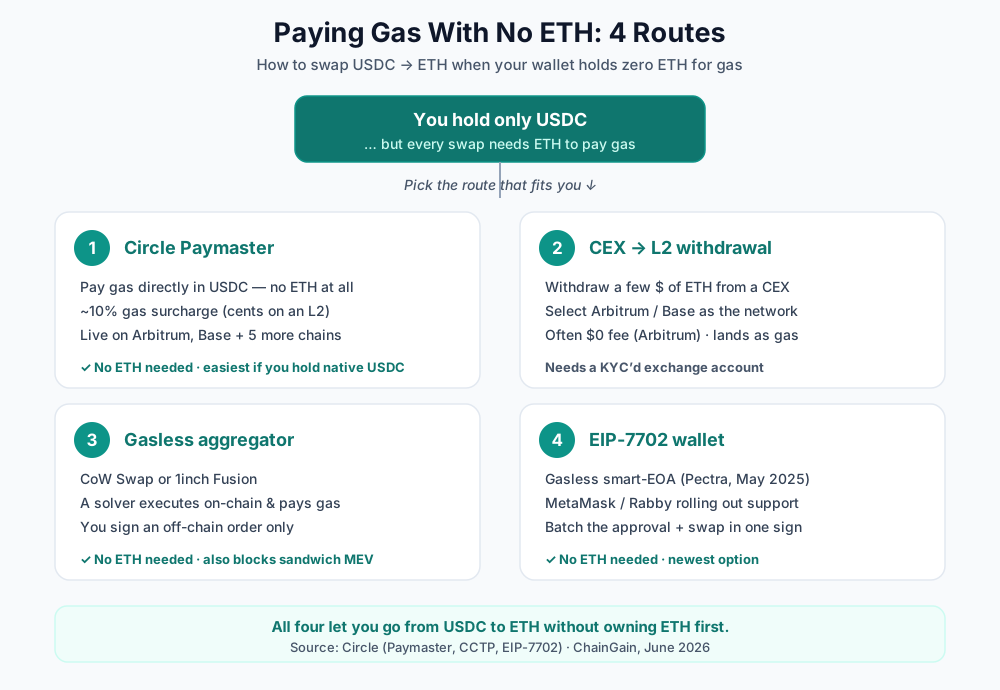
1. Circle Paymaster. Circle’s Paymaster lets you pay transaction gas in USDC with zero ETH in your wallet. It launched on January 23, 2025 on Arbitrum and Base and, as of mid-2026, runs on seven networks (Arbitrum, Avalanche, Base, Ethereum, OP Mainnet, Polygon PoS, and Unichain). The fee is about 10% of the underlying gas cost — on an L2 where gas is a few cents, that surcharge is a fraction of a cent. This is the cleanest fix if you hold native USDC and never want to touch ETH.
2. EIP-7702 gasless wallets. The Pectra upgrade (live May 7, 2025) shipped EIP-7702, which lets an ordinary externally-owned account (your normal MetaMask-style address) temporarily borrow smart-wallet powers — including paying gas in USDC and batching approvals with swaps — without deploying a separate contract wallet. Major wallets including MetaMask and Rabby have begun rolling out EIP-7702 support — check your wallet’s release notes — and where it exists it makes “swap from a USDC-only wallet” a one-signature action.
3. Withdraw a little ETH from a CEX directly to the L2. The lowest-tech fix: on Coinbase, Binance, OKX, Kraken, or Bitget, withdraw a few dollars of ETH and select Arbitrum or Base as the network. Arbitrum withdrawals are frequently zero-fee, and the ETH lands as native gas you can spend on dozens of swaps. Then buy the rest of your ETH with your USDC on the DEX. The only catch is that withdrawals require a KYC’d exchange account.
4. A gasless aggregator. CoW Swap and 1inch’s Fusion mode let a third party (a “solver” or “resolver”) execute your trade on-chain and pay the gas, recovering it from the trade itself. You sign an off-chain order; you never hold ETH and never broadcast a transaction. This doubles as your MEV protection, which is the next section.
Native USDC vs Bridged USDC.e: Which One to Swap
TLDR: Not all USDC is the same token: native USDC (minted via Circle’s CCTP) is always 1:1 redeemable at Circle and sits in the deepest pools, while bridged USDC.e (Arbitrum) or USDbC (Base) carries a third-party bridge’s trust assumption and trades thinner. Always hold and swap native USDC — convert any bridged version first.
Not all USDC is the same token, and swapping the wrong one costs you liquidity and adds risk. Native USDC is issued directly on each chain through Circle’s Cross-Chain Transfer Protocol (CCTP), which burns USDC on the source chain and mints it on the destination — so it is always 1:1 redeemable at Circle and sits in the deepest pools. Bridged USDC (labeled USDC.e on Arbitrum, USDbC on Base) was created by a third-party bridge before native USDC existed; it carries that bridge’s trust assumption, cannot be redeemed directly at Circle, and usually trades in thinner pools.
Arbitrum received native USDC in June 2023 (the old bridged token was renamed USDC.e), and Base launched with native USDC in 2023. The practical rule: always hold and swap native USDC. If you end up with USDC.e or USDbC after bridging, swap it to native USDC first, or use an aggregator that routes through native pools automatically. For the broader question of which stablecoin to hold in the first place, see USDT vs USDC and Stablecoin Types 2026.
Picking a DEX or Aggregator — and How They Block Sandwich Attacks
TLDR: A sandwich attack is a bot front-running your public-mempool swap so you silently receive less ETH. The structural defense is intent-based exchanges that never broadcast your trade: EigenPhi measured sandwich attacks on just 0.7% of CoW Swap trades versus 2.7% on 1inch and 1.9% on Matcha. Use CoW Swap or 1inch Fusion for large or MEV-sensitive swaps.
A sandwich attack is the most common way to quietly lose money on a DEX. A bot watches the public mempool for your pending swap, buys the same asset just before you (pushing the price up), lets your trade execute at the worse price, then sells immediately after — pocketing the difference. You do not get hacked; you just receive less ETH than you should have, and the loss is invisible unless you measure it.
The defense is structural. Intent-based exchanges never broadcast your trade to the public mempool, so there is nothing to front-run. EigenPhi’s research found sandwich attacks hit just 0.7% of CoW Swap trades, versus 2.7% on 1inch and 1.9% on Matcha — and CoW’s total measured sandwich losses were about $0.13M, far below comparable venues. (Those percentages are from EigenPhi’s 2022 dataset; importantly, industry-wide sandwich losses have since fallen to roughly $2.5M per month by late 2025, down from significantly higher levels in 2024 (per EigenPhi on-chain data), as more volume moved to protected routes and EIP-4844 reshaped the fee market.)
| Venue | Sandwiched (EigenPhi 2022) | How it protects you | Gasless? | Best for |
|---|---|---|---|---|
| CoW Swap | 0.7% of trades | Batch auctions + uniform clearing price; off-chain order, no mempool exposure; free on failed trades | Yes | Large or MEV-sensitive swaps |
| 1inch (Fusion mode) | 2.7% (classic) | Dutch-auction resolvers execute and pay gas; native MEV protection in Fusion | Yes (Fusion) | Broad multi-chain routing |
| Matcha (0x) | 1.9% | RFQ + AMM routing; slippage is user-set, so protection depends on your settings | Partial | Quote-first comparison |
| Uniswap (direct) | ~1.26% | Set tight slippage (0.1–0.5%) and use a private RPC; otherwise mempool-exposed | No | Simple, deeply liquid swaps |
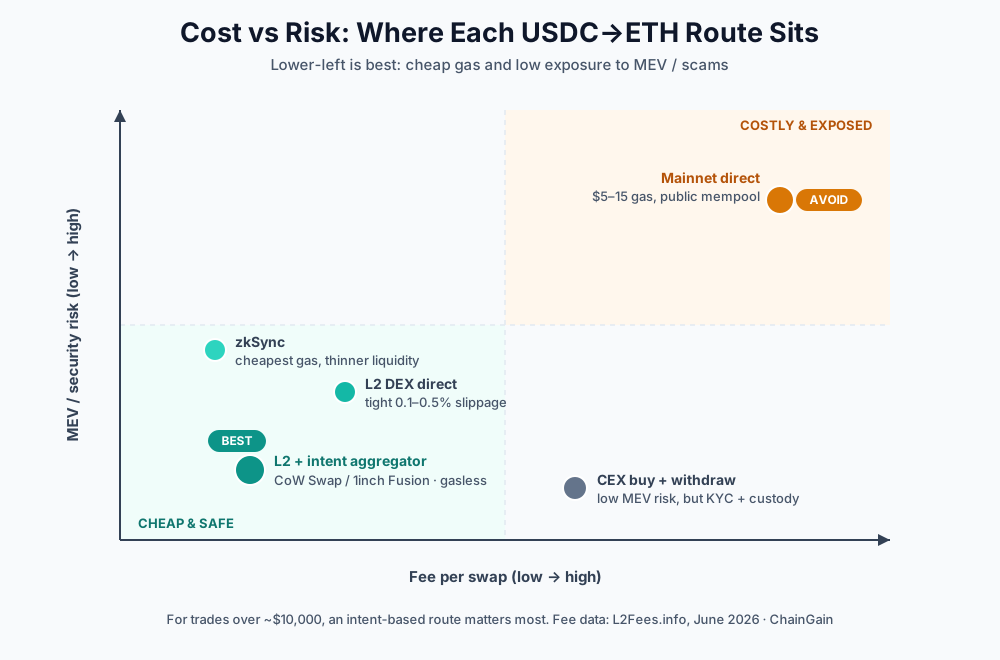
How the protection actually works. CoW Swap collects orders and settles them in batches at a single uniform clearing price, so there is no transaction-ordering advantage for a bot to exploit; you sign an off-chain intent and a solver competes to fill it. 1inch Fusion uses a Dutch auction where the acceptable price decreases over time until a resolver fills it, again on-chain and gas-free for you. The practical rule for 2026: for any swap over ~$10,000, default to an intent-based route; for smaller liquid swaps, a direct DEX with 0.1–0.5% slippage and a 5–10 minute deadline is fine. Because every DEX trade is permanently visible on-chain, you can verify your own execution later — see Blockchain Tracking Tools 2026. And if the difference between market and limit orders is new to you, Crypto Order Types Explained covers how DEX swaps differ from CEX order books.
Safest Execution: Fake Frontends, Token Approvals & revoke.cash
TLDR: Two attacks empty self-custody wallets, and both are avoidable: fake DEX frontends in Google ‘Sponsored’ ads (one campaign stole $400,000+, including a single ~$385,000 theft in March 2026) and unlimited token approvals (the US Secret Service’s April 2026 Operation Atlantic found 20,000+ victim wallets and froze ~$12M). Bookmark real URLs, approve only exact amounts, and revoke at revoke.cash.
Cheap is worthless if you get drained. In 2026 the two attacks that empty self-custody wallets are fake DEX frontends and malicious token approvals — and both are entirely avoidable.
Fake frontends via Google Ads. A long-running campaign has placed fake Uniswap ads at the top of Google search for over a year, stealing more than $400,000 — including a single ~$385,000 theft in early March 2026, during a broader phishing-ad spike (March 13–30) that took $1.27M. The fix is a habit: never click a “Sponsored” result for a DEX or wallet. Legitimate DeFi protocols generally do not run Google ads. Bookmark the real URL (app.uniswap.org, cow.fi, app.1inch.io), and cross-check any address through DeFiLlama. Our guide to spotting crypto scams covers the full pattern.
Malicious token approvals. Before a DEX can move your USDC, you sign an “approval.” The danger is that many dApps request unlimited, perpetual approval — one signature that lets the contract move that token from your wallet forever, with no further key or seed needed. If the contract is malicious, upgraded, or later exploited, it can drain that token at any time. This is exactly what the US Secret Service’s Operation Atlantic targeted: announced April 9, 2026, it was the first coordinated multinational action against approval-phishing, identifying 20,000+ victim wallets across 30+ countries and freezing about $12M (per the US Secret Service announcement of April 9, 2026, the operation disrupted $45M+ in fraud and 120+ scam domains overall).
Three rules neutralize it:
- Approve exact amounts, not “unlimited.” Most wallets let you edit the approval amount to the size of your trade. It costs one extra approval next time; it is worth it.
- Revoke approvals you no longer need at revoke.cash. It supports 100+ chains and shows every standing approval on your wallet. Phishing clones of revoke.cash exist — bookmark the real one and never reach it through an ad or DM.
- Use transaction simulation. Wallets like Rabby and MetaMask now preview what a transaction will actually do before you sign, flagging drainer patterns.
There is no recovery path if a drainer succeeds: once tokens leave your wallet through a malicious approval, no exchange, issuer, or law enforcement can reverse the transfer.
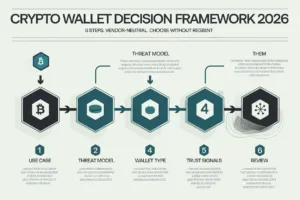
If an issuer or law-enforcement action ever freezes a token you hold, the recovery path is different from a hack — see USDT Frozen by Tether for how issuer-level freezes work, which applies on a DEX just as it does on a CEX. And because self-custody means no password reset, choose your wallet deliberately: our Crypto Wallet Decision Framework covers the trade-offs.
DEX vs Buying ETH on a CEX and Withdrawing — Decision by Trade Size
TLDR: Which route wins depends on trade size and whether KYC is acceptable: under ~$200, buying ETH on a CEX and withdrawing to an L2 avoids gas as a percentage; from $200–$10,000, an L2 DEX swap of native USDC is cheapest and KYC-free; over $10,000, prioritize deep liquidity (Arbitrum) and MEV protection over the headline gas number.
Whether a DEX makes sense depends entirely on how much you are moving and whether KYC is acceptable to you.
| Trade size | Best route | Why |
|---|---|---|
| Under ~$200 | CEX buy + withdraw ETH to an L2 (or just hold the L2 USDC) | DEX gas is a noticeable % only at micro size; the CEX path avoids it and solves gas at once |
| $200–$10,000 | L2 DEX swap, native USDC, via an aggregator | Cheapest all-in, self-custody, no KYC; gas is negligible at this size |
| Over $10,000 | L2 DEX with deep liquidity (Arbitrum) + intent-based MEV protection | Slippage and MEV matter far more than the headline gas number at this size |
The deciding factor for many readers is custody, not cost. If you cannot or will not complete KYC, the DEX path is the only one that works — and the cost difference is trivial on an L2. If you already hold a verified CEX account and you are moving a small amount, buying ETH there and withdrawing to Base or Arbitrum is genuinely simpler. For the full architectural comparison of custodial versus non-custodial trading, see CEX vs DEX vs Hybrid Exchanges 2026.
Step-by-Step: Swap USDC→ETH Safely on a Layer 2
TLDR: The safe routine in six steps: get native USDC onto an L2, solve gas first (Circle Paymaster, an EIP-7702 wallet, dust ETH, or a gasless aggregator), open the real DEX URL (never a ‘Sponsored’ link), set slippage to 0.1–0.5% and approve only your exact trade size, route trades over ~$10,000 through CoW Swap or 1inch Fusion, then revoke the approval at revoke.cash afterward.
- Get native USDC onto an L2. Withdraw USDC from a CEX and select Arbitrum or Base as the network, or move existing USDC across chains with Circle CCTP. Confirm it is native USDC, not bridged USDC.e/USDbC.
- Solve gas before you swap. Either enable Circle Paymaster (pay gas in USDC), use an EIP-7702 gasless wallet (MetaMask and Rabby have early support), withdraw a few dollars of ETH from the CEX as a gas buffer, or plan to use a gasless aggregator in step 5.
- Go to the real DEX. Type or bookmark the official URL — never a Google “Sponsored” link. Cross-check via DeFiLlama if unsure.
- Connect, set slippage, approve an exact amount. Set slippage to 0.1–0.5% for liquid pairs and a 5–10 minute deadline. When approving USDC, edit the allowance to your trade size rather than “unlimited.”
- Use an intent/gasless route for large trades. For anything over ~$10,000, swap through CoW Swap or 1inch Fusion to avoid sandwich attacks and pay no separate gas.
- Confirm, then revoke. After the swap settles, visit revoke.cash and remove the USDC approval you just granted if you will not reuse it soon.
If you are weighing a stablecoin swap against simply sending stablecoins to someone abroad, the calculator below estimates the all-in cost across alternative routes, including L2 paths.
Methodology & Sources
Gas and fee figures were sampled from L2Fees.info and chain explorers on 2026-06-02; these fluctuate with network congestion, so treat them as typical-condition snapshots and check the live source before a large swap. Gas-abstraction details (Circle Paymaster fee, supported chains, launch date; CCTP; EIP-7702) come from Circle’s official documentation. Sandwich-attack rates are from EigenPhi (2022 dataset, with later trend context). Pool-fee tiers are from Curve and Uniswap documentation. Phishing-loss figures are sourced to the US Secret Service and the UK National Crime Agency (Operation Atlantic, April 2026) and Cryptopolitan’s reporting on fake Uniswap ads. Aggregator mechanics are from CoW Protocol and 1inch documentation. Crypto fees, gas-abstraction terms, and contract addresses change weekly — verify before you transact.
Frequently Asked Questions
What is the cheapest way to swap USDC to ETH in 2026?
Swap on a Layer 2 rather than Ethereum mainnet. On Base, Arbitrum, Optimism, or zkSync Era, a $1,000 USDC→ETH swap costs roughly $0.02–$0.30 in gas plus a 0.04–0.30% pool fee — well under a dollar all-in. The same swap on Ethereum L1 costs $5–$15 in gas. Base and zkSync Era have the cheapest gas; Arbitrum has the deepest liquidity, which matters more once your trade exceeds ~$10,000.
How do I pay gas if I only have USDC and no ETH?
Four ways: (1) Circle Paymaster lets you pay gas in USDC with no ETH (~10% gas surcharge, live on Arbitrum, Base, and five other chains); (2) an EIP-7702 gasless wallet (live since the Pectra upgrade, May 2025); (3) withdraw a few dollars of ETH from a CEX directly to the L2 as a gas buffer (Arbitrum withdrawals are often free); or (4) use a gasless aggregator like CoW Swap or 1inch Fusion, where a solver pays the gas and recovers it from the trade.
Is it safer to swap on a DEX or buy ETH on a CEX and withdraw?
Neither is strictly “safer” — they carry different risks. A CEX requires KYC and holds your keys until you withdraw, but shields you from approval-phishing and MEV. A DEX is self-custodial and KYC-free, but you are responsible for avoiding fake frontends and malicious approvals. For trades under ~$200, the CEX-buy-and-withdraw path is often simpler and cheaper; for $200–$10,000, an L2 DEX swap with native USDC is cheapest; over $10,000, prioritize liquidity and MEV protection.
What is the safest DEX to swap stablecoins to ETH?
Intent-based aggregators are structurally safest because they never expose your trade to the public mempool. EigenPhi measured sandwich attacks on only 0.7% of CoW Swap trades, versus 2.7% on 1inch classic and 1.9% on Matcha. CoW Swap and 1inch Fusion are the strongest defaults for MEV-sensitive or large swaps. Whatever you use, reach it through a bookmarked URL — never a Google “Sponsored” ad.
How do DEX aggregators protect me from sandwich attacks?
CoW Swap batches orders and settles them at a single uniform clearing price, so there is no transaction-ordering advantage for a bot to exploit, and you sign an off-chain intent that never hits the public mempool. 1inch Fusion uses a Dutch auction where resolvers compete to fill your order on-chain and pay the gas. Both remove the front-running surface that a direct AMM swap exposes. For direct swaps, tight slippage (0.1–0.5%) and a private RPC are the manual equivalents.
Should I swap native USDC or bridged USDC.e?
Always native USDC. Native USDC is issued through Circle’s CCTP, is 1:1 redeemable at Circle, and trades in the deepest pools. Bridged USDC.e (Arbitrum) and USDbC (Base) come from third-party bridges, add a bridge-trust assumption, cannot be redeemed directly at Circle, and usually have thinner liquidity. If you end up with the bridged version, swap it to native USDC first.
What slippage should I set when swapping stablecoins to ETH?
For liquid stable→ETH pairs on a major L2, set slippage to 0.1–0.5% with a 5–10 minute deadline. Liquid pairs rarely move enough to need more, and tight slippage limits how much a sandwich bot or volatility can cost you. On thinner chains like zkSync Era, or for large trades, check the quoted price impact before confirming and consider an intent-based route instead of raising slippage.
What are token approvals and how do I revoke them?
An approval is a signature that lets a DEX contract move a specific token from your wallet. The risk is “unlimited” approvals, which grant perpetual access — a major vector in the approval-phishing that Operation Atlantic targeted in April 2026 (20,000+ victim wallets). Approve only the exact amount you are swapping, and periodically review and revoke standing approvals at revoke.cash (it covers 100+ chains). Bookmark the real revoke.cash — phishing clones exist.
Continue Learning
Buying ETH with stablecoins is one move in a larger stack. These guides cover the rest of what you need to trade safely on Layer 2:
- Layer 2 Explained 2026 (Arbitrum vs Optimism vs Base vs zkSync) — the chains your swap actually runs on, compared on fees and failure modes.
- CEX vs DEX vs Hybrid Exchanges 2026 — the three exchange architectures and when each fits.
- What Is DeFi? A 2026 Beginner’s Guide — the financial layer a DEX swap plugs into.
- USDT vs USDC — which stablecoin to hold and swap, and why native matters.
- Stablecoin Types 2026 — what actually backs the dollar you are swapping.
- Cheapest Blockchain for USDT Transfers 2026 — the fee math for sending stablecoins, not just swapping them.
- Crypto Wallet Decision Framework 2026 — picking a self-custody wallet that handles every L2.
- How to Spot and Avoid Crypto Scams 2026 — the fake-frontend and drainer patterns in depth.
- Blockchain Tracking Tools 2026 — how to verify your own on-chain swap after the fact.
- USDT Frozen by Tether (Recovery Guide 2026) — what happens when an issuer freezes a token you hold.
- Crypto Order Types Explained — how DEX swaps differ from CEX order books.

Editorial pen name · ChainGain
Alex Mercer is the editorial pen name used for ChainGain’s cryptocurrency education content. Articles are based on cited sources and reproducible comparisons. Editorial profile
Disclaimer: This article is educational and does not constitute investment, tax, or legal advice. DEX fees, gas-abstraction terms, slippage conditions, and smart-contract addresses change quickly; verify the current state on the official protocol site, a block explorer, and revoke.cash before swapping significant amounts. Self-custody means there is no password reset — losing your seed phrase or signing a malicious approval can mean permanent, unrecoverable loss. Past incident-free periods do not guarantee future safety. Trade only what you can afford to lose.
Part of ChainGain’s What Are Stablecoins? USDT, USDC, DAI Explained Simply (2026) guide series.