How to Transfer USDT to a Bank Account: Step-by-Step Guide (2026)
Disclosure: This article may contain affiliate links. We earn a commission at no extra cost to you. Our editorial policy ensures all recommendations are based on genuine analysis.
You have USDT sitting in your wallet, but your rent, groceries, and bills need to be paid in local currency. Converting Tether (USDT) to cash in your bank account is straightforward once you know the steps — but picking the wrong network or platform can cost you 5–10× more in fees than necessary.
In this guide, I walk you through the entire process: choosing the cheapest network, selecting the right conversion method, and withdrawing fiat to your bank.
What you will learn:
- The 4-step process to move USDT from any wallet to your bank account
- Which blockchain network saves you the most on fees (hint: it is not Ethereum)
- Real fee breakdowns for $100, $500, and $1,000 transfers
- Country-specific off-ramp options for 10+ countries
- Security practices to protect your funds during withdrawal
Beginner
What Is a USDT Off-Ramp?
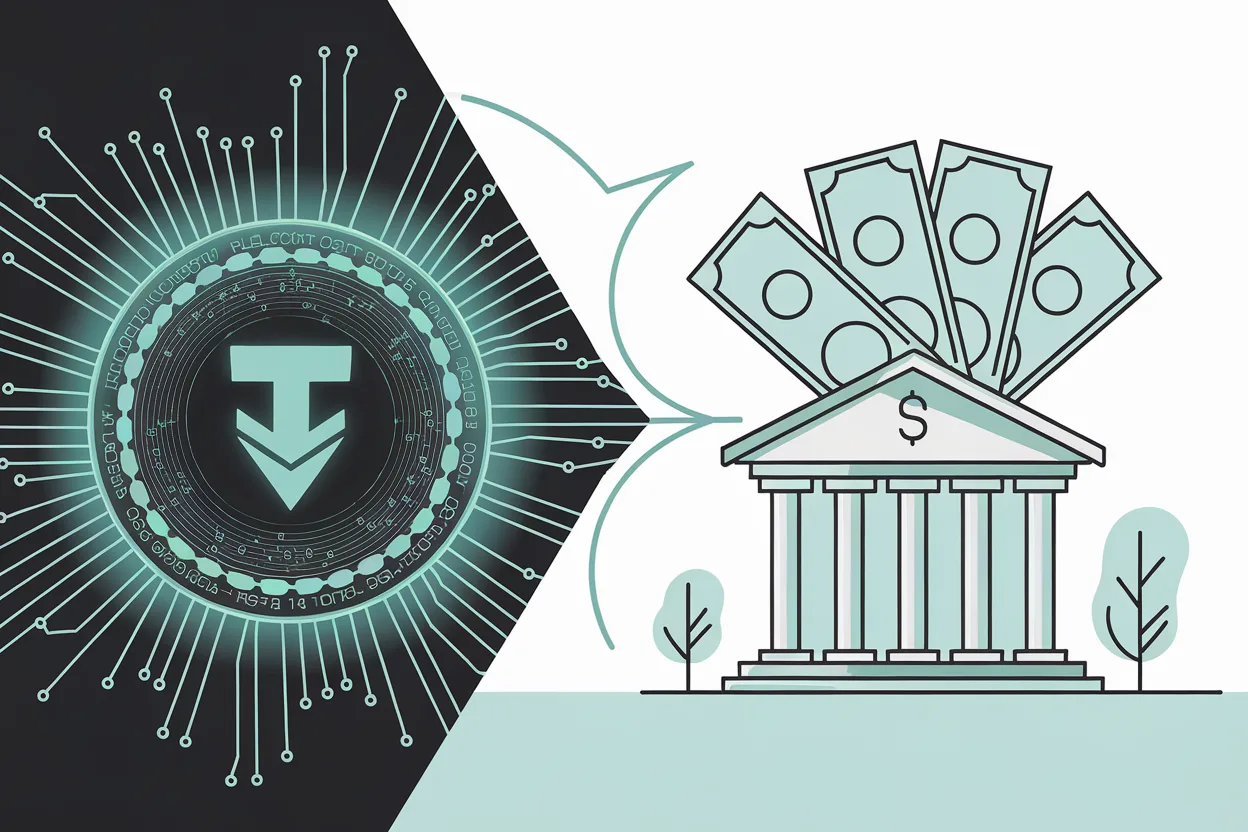
A USDT off-ramp is any service that converts your Tether (USDT) stablecoin into fiat currency — dollars, euros, pesos, naira, or any government-issued money — and deposits it into your bank account. Think of it as the exit from the crypto highway back to the traditional banking road.
USDT is the world’s most traded stablecoin with a market capitalization exceeding $143 billion as of early 2026. It is pegged 1:1 to the US dollar, meaning 1 USDT ≈ $1.00. This peg makes it the preferred stablecoin for international transfers and trading — but eventually, most people need to convert it to spendable cash.
There are three main off-ramp methods:
| Method | Best For | Total Fees | Speed |
|---|---|---|---|
| CEX Withdrawal | Most users, best rates | 0.1–1.5% | 1–3 business days |
| P2P Trading | Countries with limited banking | 0–0.5% | 15–60 minutes |
| Crypto Debit Card | Daily spending, ATM access | 0.9–2.5% | Instant (card) / 1 day (ATM) |
For a detailed comparison of all five off-ramp methods including OTC desks and DeFi off-ramps, see our complete Crypto Cash Out Guide. This article focuses specifically on the USDT-to-bank workflow that most people need.
Step 1 — Choose the Right Network for Your USDT
USDT exists on multiple blockchains, and the network you use determines your transfer fee. This is the single biggest factor in how much you will pay — picking the wrong network can turn a $0.10 fee into a $15 one.
| Network | Fee Range | Speed | Exchange Support | Verdict |
|---|---|---|---|---|
| Tron (TRC-20) | $0.10–$1.00 | 1–5 min | All major CEXs | Best choice |
| Solana (SPL) | < $0.01 | < 1 min | Most CEXs | Cheapest, growing support |
| BSC (BEP-20) | $0.05–$0.50 | 1–3 min | Most CEXs | Good alternative |
| Polygon | < $0.01 | 1–3 min | Growing | Cheap but less universal |
| Ethereum (ERC-20) | $5–$20+ | 5–15 min | All CEXs | Avoid for small amounts |

My recommendation: Use Tron (TRC-20) for transfers over $50 — it has universal exchange support and consistently low fees. For very small amounts, Solana is even cheaper but not every exchange supports USDT deposits via Solana yet. Avoid Ethereum unless you are moving $5,000+ where the $15 fee becomes negligible.
For a deeper comparison of blockchain networks for sending money, see our Best Blockchain for Sending Money guide.
Step 2 — Deposit USDT to an Exchange
Once you have chosen your network, send your USDT from your personal wallet (Trust Wallet, MetaMask, Ledger, etc.) to a centralized exchange that supports fiat withdrawal in your country.
- Log in to your exchange account (Binance, Bybit, OKX, Kraken, or a local exchange)
- Go to Deposit and select USDT as the asset
- Select the same network you are sending from (e.g., TRC-20). Critical: mismatched networks = lost funds
- Copy the deposit address exactly — or scan the QR code
- Send a small test transaction first ($5–$10) to verify the address is correct
- Send the full amount once the test arrives (usually 1–5 minutes on TRC-20)
Warning: Always double-check the network. Sending TRC-20 USDT to an ERC-20 address (or vice versa) will result in permanent loss of funds. There is no undo button in crypto.
Exchange minimum deposits: Most exchanges accept USDT deposits as low as 0.1 USDT (OKX) to 1 USDT (Binance, Bybit). There is usually no deposit fee from the exchange side — you only pay the blockchain network fee from your wallet.
If you are specifically sending USDT internationally before cashing out, our How to Send USDT Abroad guide covers cross-border transfer details.
Step 3 — Convert USDT to Local Currency
With USDT in your exchange account, you now need to convert it to fiat. There are three ways to do this, depending on your exchange and country:
Option A: Spot Trading (Best Rate)
Go to the exchange’s spot market and sell USDT for your local currency (USD, EUR, BRL, INR, NGN, etc.). This gives you the market rate with the lowest spread.
- Binance: 0.1% trading fee (0.075% with BNB discount)
- Bybit: 0.1% maker / 0.1% taker
- OKX: 0.08% maker / 0.1% taker
- Kraken: 0.16% maker / 0.26% taker
Option B: P2P Trading (Best for Restricted Countries)
Peer-to-peer trading connects you directly with buyers who pay via bank transfer, mobile money, or other local payment methods. This is often the only option in countries where exchanges do not support direct fiat withdrawal.
- Binance P2P: 0% taker fee, 0.15–0.35% maker fee. Supports 100+ fiat currencies and 700+ payment methods
- OKX P2P: 0% fee for both parties
- NoOnes: 0.5–1% trading fee, strong in Africa and Latin America
Important: Paxful shut down in November 2025, and LocalBitcoins closed in February 2023. If you used these platforms before, switch to Binance P2P, OKX P2P, or NoOnes.
For P2P safety best practices, read our P2P Trading Safety Guide.
Option C: Auto-Convert (Simplest)
Some exchanges offer one-click conversion where you simply select “Sell USDT” and choose your fiat currency. The exchange handles the trade at a slightly wider spread (typically 0.5–1.5% more than spot). Convenient for small amounts under $200.
Step 4 — Withdraw Fiat to Your Bank Account
Once your USDT has been converted to local currency, withdraw it to your bank:
- Go to Withdraw and select your fiat currency (USD, EUR, BRL, etc.)
- Add your bank account (first withdrawal requires bank verification — IBAN, account number, routing number)
- Enter the withdrawal amount
- Confirm via 2FA (SMS, email, or authenticator app)
- Wait for processing — domestic transfers take 1–2 business days; international wires take 1–5 business days
Processing times by method:
| Withdrawal Method | Processing Time | Typical Fee |
|---|---|---|
| SEPA (Europe) | 1 business day | Free–$1 |
| Faster Payments (UK) | Minutes–hours | Free–$2 |
| PIX (Brazil) | Seconds–minutes | Free–3 BRL |
| UPI/IMPS (India) | Minutes | Free |
| ACH (US/Canada) | 1–3 business days | Free–$5 |
| Wire Transfer (International) | 1–5 business days | $10–$25 |
| SBP (Russia) | 5–30 minutes | Free |
Fee Breakdown: What You Actually Pay
| Cost Component | $100 | $500 | $1,000 |
|---|---|---|---|
| Network fee (TRC-20) | $1.00 | $1.00 | $1.00 |
| Exchange trading fee (0.1%) | $0.10 | $0.50 | $1.00 |
| Fiat withdrawal fee (SEPA/domestic) | $0.00 | $0.00 | $0.00 |
| Total fees | $1.10 (1.1%) | $1.50 (0.3%) | $2.00 (0.2%) |
| You receive | $98.90 | $498.50 | $998.00 |
Compare that to traditional remittance: Western Union charges an average of 6.49% for $200 transfers (World Bank, 2025). A $500 bank wire costs $25–$50 in intermediary fees. The crypto path saves you $30–$60 on a $500 transfer. For a detailed comparison, see Crypto vs Western Union and Hidden Fees in Remittances.
Pro tip: If you convert via P2P, you may get a slightly better rate than spot (P2P sellers often offer 0.5–1% premium above market price in high-demand countries like Nigeria and Turkey), but the trade takes longer and carries counterparty risk.

Country-Specific Off-Ramp Guide
The best way to cash out USDT depends heavily on where you live. Here is a quick reference for our target markets — click the country-specific guide for detailed instructions:
| Country | Best Platform | Payment Rail | Notes |
|---|---|---|---|
| Brazil | Binance, Mercado Bitcoin | PIX (instant) | 90% of crypto volume uses USDT; PIX guide |
| India | Mudrex, WazirX, Binance P2P | UPI / IMPS | 1% TDS above 50K INR; India guide |
| Nigeria | Binance P2P, NoOnes | Bank transfer / Mobile money | CBN 500K NGN/week limit; Nigeria guide |
| Philippines | Coins.ph, Binance P2P | GCash / Bank transfer | GCash added USDC support 2025; Philippines guide |
| Turkey | BtcTurk, Binance TR | Bank transfer / Papara | High crypto adoption driven by inflation |
| Russia | Bybit P2P, OKX P2P | SBP / T-Bank | P2P dominant; SBP settlements in 15–30 min |
| Indonesia | Indodax, Binance, MEXC | Bank transfer (IDR) | Local exchanges convert IDR automatically |
| Vietnam | Binance P2P, OKX P2P | Bank transfer / VNPAY | #5 in global crypto adoption |
| Pakistan | Binance P2P | Bank transfer / JazzCash | P2P is primary method; no licensed exchanges |
| Kenya / Ghana | Binance P2P, NoOnes | M-Pesa / Bank transfer | M-Pesa integration growing in Sub-Saharan Africa |
| Europe (EU) | Kraken, Binance, Bybit | SEPA (instant) | MiCA regulated; SEPA usually free |
| Japan | bitFlyer, Coincheck | Bank transfer (JPY) | JFSA licensed exchanges only |
| South Korea | Upbit, Bithumb | Bank transfer (KRW) | Real-name verified bank account required |
For countries not listed above, Binance P2P is usually available and supports 100+ fiat currencies. Check your local regulatory requirements — our global crypto regulation guide covers 30+ countries.
Crypto Debit Cards: Spend Without Converting
If you do not want to go through the exchange withdrawal process, crypto debit cards let you spend USDT directly or withdraw cash from ATMs. The card automatically converts your USDT to the local currency at the point of sale.
Top cards for USDT in 2026:
| Card | Conversion Fee | ATM Fee | Cashback | Availability |
|---|---|---|---|---|
| Bybit Card | 0.9% | 2% above 100 EUR/mo | 2–10% | EEA, UK |
| Crypto.com | 0% | Free up to $200–$1,000/mo | 1–5% | 130+ countries |
| Nexo | 0.2% (EEA/UK) | Varies | Up to 2% | EEA, UK, select |
Crypto debit cards are ideal for everyday spending but less efficient for large withdrawals due to ATM limits and conversion fees. For amounts over $500, the CEX withdrawal method is almost always cheaper.
Security Tips for USDT Withdrawals
Converting USDT to fiat involves real money leaving the crypto ecosystem. Protect yourself:
- Enable withdrawal whitelisting — Most exchanges let you pre-approve specific bank accounts. Any new withdrawal address triggers a 24–48 hour security hold
- Use 2FA on everything — Authenticator app (Google Authenticator or Authy), not SMS. SMS-based 2FA is vulnerable to SIM swapping. See our crypto security guide
- Send a test withdrawal first — Before withdrawing your full balance, send a small amount ($10–$50) to confirm your bank details are correct
- Keep records for tax purposes — Converting USDT to fiat is a taxable event in most countries. Record the date, amount, exchange rate, and fees. Our crypto tax guide explains the details by country
- Prepare Source of Funds documentation — For large withdrawals (typically above $10,000), your exchange or bank may ask where the crypto came from. Keep transaction records, pay stubs, or trading history ready. Our cash-out guide covers AML compliance in detail
Common Mistakes to Avoid
- Mistake 1: Using Ethereum (ERC-20) for small transfers — paying $15 to move $100 makes no sense
- Mistake 2: Sending to the wrong network — mismatched networks mean permanent fund loss
- Mistake 3: Ignoring tax obligations — USDT-to-fiat is taxable even if USDT is a stablecoin
- Mistake 4: Using the exchange “Convert” feature for large amounts — the spread is 0.5–1.5% higher than spot trading
- Mistake 5: Not verifying bank details before withdrawing — some exchanges lock withdrawals if the name on the bank account does not match the exchange account
Frequently Asked Questions
How long does it take to transfer USDT to a bank account?
The total process takes 1–3 business days end-to-end. The blockchain transfer is fast (1–5 minutes on TRC-20), and the exchange conversion is instant. The main delay is the fiat bank withdrawal, which depends on your country’s payment rails. Domestic transfers via PIX (Brazil), UPI (India), or SBP (Russia) arrive in minutes. International wire transfers take 1–5 business days.
What is the cheapest way to convert USDT to cash?
The cheapest route is: send USDT via TRC-20 ($1 fee) to a CEX, sell at spot price (0.1% fee), and withdraw via a free domestic payment rail (SEPA, PIX, UPI, etc.). Total cost: under 0.3% for a $500 transfer. P2P trading can be even cheaper (0% exchange fee) but takes more time and carries counterparty risk.
Is converting USDT to fiat a taxable event?
Yes, in most countries. Even though USDT is pegged to $1, selling it for fiat is treated as a disposal of a crypto asset. Small variations in purchase vs. sale price can create a capital gain or loss. Record all conversions and consult a tax professional for your jurisdiction. See our crypto tax guide for country-specific rules.
Can I transfer USDT directly to my bank without an exchange?
Not directly. Banks do not accept cryptocurrency deposits. You need an intermediary — a centralized exchange, a P2P trader, or a crypto debit card — to convert USDT to fiat first. Some fintech services (like certain payment apps in Brazil or the Philippines) are starting to integrate crypto-to-fiat conversion, but they still use exchange infrastructure behind the scenes.
Which USDT network should I use?
TRC-20 (Tron) for most users — it offers the best balance of low fees ($0.10–$1), fast confirmation (1–5 minutes), and universal exchange support. Solana is cheaper but not all exchanges support USDT deposits on Solana. Avoid ERC-20 unless you are transferring $5,000+, as the $5–$20 gas fee is prohibitive for smaller amounts.
Continue Learning
Remittance Cluster:
- Crypto vs Bank Transfers: Remittance Cost Guide
- How to Send USDT Abroad: Step-by-Step
- Stablecoin Remittances Explained
- Crypto Cash Out & Off-Ramp Guide — broader overview of all off-ramp methods
- USDT vs USDC: Best Stablecoin for Remittances
- Stablecoin vs Bitcoin for Sending Money
- Best Blockchain for Sending Money
Country Guides:
- Philippines · Nigeria · India · Brazil
Related:

Editorial pen name · ChainGain
Alex Mercer is the editorial pen name used for ChainGain’s cryptocurrency education content. Articles are based on cited sources and reproducible comparisons. Editorial profile
Disclaimer: This article is for informational purposes only and does not constitute financial, tax, or legal advice. Cryptocurrency prices are volatile, and converting crypto to fiat involves risks. Always verify current fees on official exchange websites before transacting. Consult a qualified professional for tax advice specific to your jurisdiction.