Stablecoin vs Bitcoin: Which Is Better for Sending Money Abroad? (2026)

Editorial pen name · ChainGain
Alex Mercer is the editorial pen name used for ChainGain’s cryptocurrency education content. Articles are based on cited sources and reproducible comparisons. Editorial profile
You want to send $500 to family overseas. A friend tells you to use Bitcoin. Another friend says “no, use stablecoins.” Both swear their method is cheaper and faster. So which is it?
Most online guides skip the honest comparison.
In this guide, I compare Bitcoin and stablecoins (USDT/USDC) head-to-head across the five factors that matter for remittances: price volatility, network fees, speed, receiver experience, and regulatory acceptance. By the end, you will know exactly which to use for your situation — and why.
The Short Answer
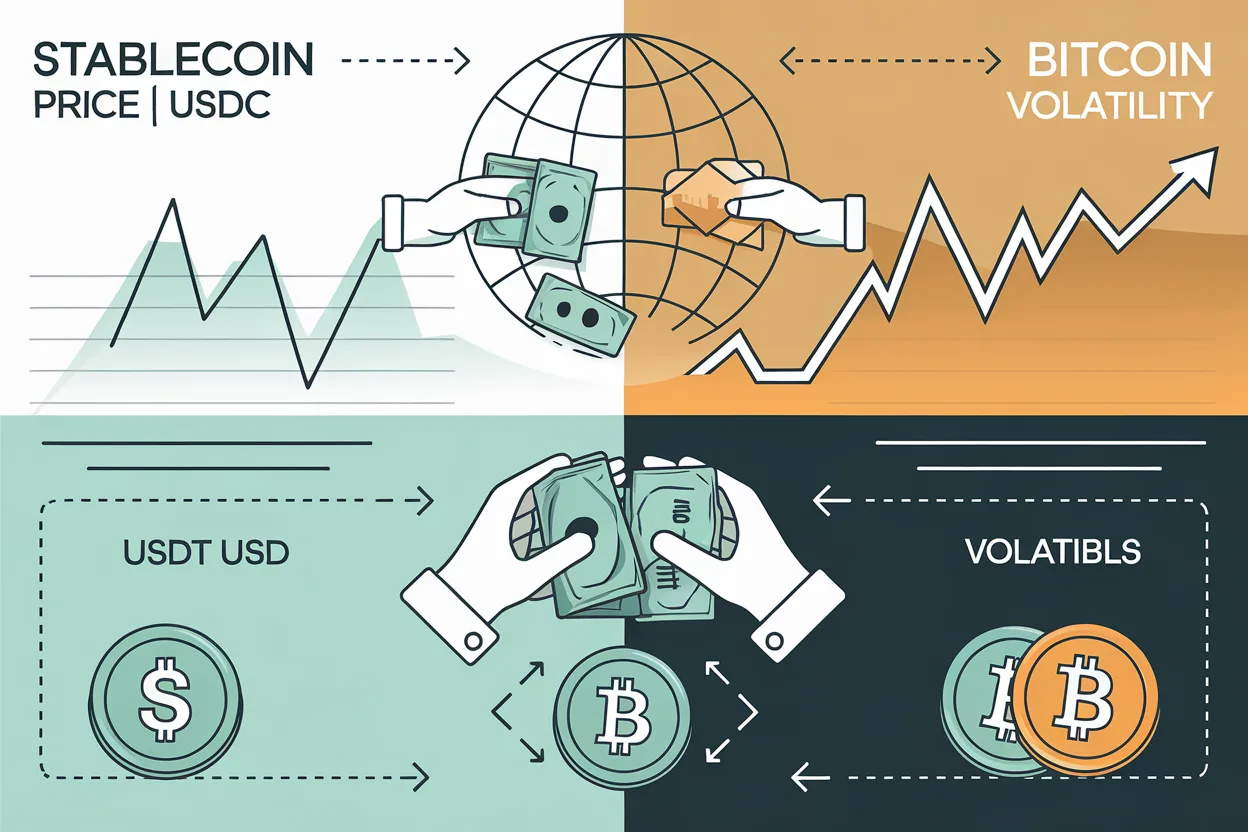
For most remittance users, stablecoins (USDT or USDC) are the better choice. They offer predictable value, lower fees on small transfers, and dramatically easier cash-out in the currencies your recipient actually needs. Bitcoin’s price volatility — roughly 46% annualized as of 2026 — can erase your recipient’s value overnight.
Bitcoin still wins in a few specific scenarios: very large transfers (over $100,000), censorship-resistant corridors (Venezuela, Iran, authoritarian capital controls), and El Salvador where Bitcoin is legal tender. For everyday $100-$5,000 family remittances, stablecoins are the pragmatic choice.
Here is the 30-second verdict:
| Factor | Bitcoin (BTC) | Stablecoin (USDT/USDC) |
|---|---|---|
| Price Stability | Volatile (~46% annual) | Stable (1:1 USD peg) |
| Network Fee (small transfer) | $0.15–$3 on-chain | $0.01–$0.30 (TRC-20/Solana) |
| Speed | ~10 min (on-chain) / seconds (Lightning) | Seconds to 3 min |
| P2P Liquidity (emerging) | Moderate | Deep (USDT dominant) |
| Censorship Resistance | Strongest (decentralized) | Moderate (issuer can freeze) |
| Legal Tender Status | El Salvador (since 2021) | None, but broadly accepted |
Why People Consider Bitcoin for Remittances
Before stablecoins became the dominant crypto for sending money abroad, Bitcoin was the only option. It still has legitimate strengths that make people consider it today:
- True decentralization. No company issues Bitcoin. No single entity can freeze your wallet, reverse your transfer, or comply with a sanctions request on your transaction. For users fleeing authoritarian regimes or capital controls, this is a genuine advantage.
- Universal recognition. Bitcoin is the most recognized cryptocurrency on Earth. Every exchange lists it. Every Bitcoin ATM sells it. Every P2P platform offers it. You do not need to explain “what is a stablecoin” to a recipient unfamiliar with crypto.
- Lightning Network speed. Via the Lightning Network, Bitcoin can settle in under a second with sub-cent fees. As of 2026, the Lightning Network has approximately 2,759 BTC of public capacity (around $205M), processing 8+ million transactions monthly.
- Legal tender in El Salvador. Since September 2021, Bitcoin has been legal tender in El Salvador alongside the US dollar. Salvadoran workers abroad can send BTC directly to family who can spend it at any business.
- Scarcity hedge. For savers in high-inflation economies (Argentina, Turkey, Venezuela, Nigeria), Bitcoin’s fixed 21 million supply is philosophically attractive compared to inflating fiat.
These strengths are real. But for the specific job of moving $500 from Manila to Lagos on Tuesday, they often fail to outweigh Bitcoin’s core weakness: volatility.
Head-to-Head: The Five Remittance Factors
Let us compare Bitcoin and stablecoins on the factors that actually determine remittance outcomes. I will pick a clear winner on each dimension so you can decide based on what matters to you.
1. Price Volatility — Stablecoin Wins (Dominant)
This is the single biggest difference, and the reason stablecoins exist. A stablecoin is designed to maintain a 1:1 peg with the US dollar. A Bitcoin is priced by a global market and fluctuates constantly.
Consider a real scenario. You send $500 of Bitcoin to your mother in Lagos on Monday morning. She is busy and cannot cash out until Wednesday afternoon. In that 48-hour window, Bitcoin can easily move 5-10%. Your $500 could become $450 — or $550 — before she touches it.
As of 2026, Bitcoin’s 30-day annualized volatility sits around 46%. That means even a one-week delay in cash-out can produce swings of 5-15% in either direction. For family-support remittances, this is not acceptable. Your recipient relies on the exact amount you intended to send.
A stablecoin like USDT or USDC removes this risk entirely. Send $500, and $500 arrives (minus tiny network fees). If your recipient cashes out today, next week, or next month, the dollar value does not change. Stablecoins are sometimes described as “digital dollars on crypto rails” — that is exactly what they are.
Winner: Stablecoin, decisively. For any remittance where your recipient expects a specific dollar amount, stablecoins are the only rational choice.

2. Network Fees — Stablecoin Wins for Small Transfers
Network fees are what you pay the blockchain to process your transfer. They vary by network, not by the coin you send. Here is how the two stack up for a typical remittance:

| Method | Fee for $500 | Fee for $50,000 |
|---|---|---|
| Bitcoin on-chain | $0.15–$3 | $0.15–$3 (flat) |
| Bitcoin Lightning | Under $0.01 | Limited by channel capacity |
| USDT on TRC-20 | $0.09–$0.30 | $0.09–$0.30 (flat) |
| USDC on Solana | Under $0.01 | Under $0.01 |
| Stablecoin on Ethereum (ERC-20) | $3–$15 | $3–$15 |
Bitcoin on-chain has a flat fee regardless of amount — great for $50,000 transfers, poor for $50 transfers. Sending $50 with a $2 fee is a 4% cost. Sending $50,000 with the same $2 fee is 0.004%.
Stablecoins on TRC-20 or Solana are nearly free at every transfer size. This makes them superior for the 95% of remittances under $5,000.
Bitcoin Lightning is an interesting middle ground: near-zero fees, instant settlement. But it has meaningful limitations. Lightning channel capacity is currently around 2,759 BTC total globally — plenty for retail transfers, but thin in many remittance corridors where few receivers have Lightning wallets. Exchanges like Strike have improved this with integrated Lightning, but availability is still uneven outside the US, UK, and El Salvador.
Winner: Stablecoin. For $100-$5,000 transfers, TRC-20 USDT or Solana USDC wins on pure fee economics. Bitcoin on-chain only becomes competitive at $10,000+.
3. Speed — Roughly Tied (Lightning vs Solana)
Transfer speed measures when your recipient can access the funds. Here both coins have modern and traditional options:
- Bitcoin on-chain: A Bitcoin transfer is “confirmed” after one block (~10 minutes) and considered final after six confirmations (~60 minutes). For remittances where speed matters, this is slow.
- Bitcoin Lightning: Sub-second settlement. When both sender and receiver use Lightning-compatible wallets, it is faster than any payment network including card rails.
- USDT on TRC-20: Under 1 minute from send to recipient wallet. Tron settles in approximately 3 seconds.
- USDC on Solana: Under 5 seconds. Solana has sub-second block times.
- Stablecoin on Ethereum: Around 2-5 minutes for full finality.
All of these are dramatically faster than traditional remittance services. A Western Union transfer can take minutes to days depending on the payout method. A SWIFT bank wire takes 1-5 business days. Even the slowest crypto option beats these.
Winner: Tie. Bitcoin Lightning and Solana-based stablecoins are both sub-second. Regular Bitcoin on-chain (10 minutes) loses to most stablecoin networks (under 1 minute), but both are far faster than any legacy alternative.
4. Receiver Experience — Stablecoin Wins
“Receiver experience” is the question: how easily can your family member turn this crypto into the local money they need? This is where the two differ dramatically.
With stablecoins, especially USDT, your recipient has three easy options:
- P2P cash-out: Sell USDT on Binance P2P, Bybit P2P, or OKX P2P for local currency (NGN, PHP, INR, BRL, TRY, etc.). In Nigeria, Philippines, India, and Brazil, there are hundreds of active buyers offering local bank transfer, mobile money, or cash. Typical completion time: 5-30 minutes.
- Direct exchange withdrawal: If the recipient has a local exchange account, they can deposit USDT and withdraw fiat via bank wire. This is common in Kenya (Luno), Brazil (Mercado Bitcoin), and Vietnam.
- MoneyGram cash pickup (USDC on Stellar): Through the MoneyGram + Stellar integration, your recipient can pick up physical cash at 350,000+ locations globally with just an ID — no wallet or exchange account required.
With Bitcoin, the cash-out paths exist but are narrower:
- Local exchange sale: Recipient sells BTC on their local exchange for local currency. Available but has KYC requirements and bank account dependencies.
- Bitcoin P2P: Buyers exist on Paxful, Binance, and LocalCoinSwap. Generally 5-10x thinner liquidity than USDT P2P in emerging markets as of 2026.
- Bitcoin ATMs: Physical machines that dispense cash for BTC. Fees are brutal (6-15% per transaction) and availability is limited. Not recommended for regular remittances.
- Direct spending: In El Salvador or Bitcoin-friendly retailers, the recipient can spend BTC directly without converting. This works only in specific geographies.
The deeper issue is that Bitcoin’s price volatility infects the cash-out experience. Even if your recipient sells BTC immediately, they do so at whatever price the market offers that minute — which may be 3% lower than the price when you sent it. Stablecoins eliminate this timing risk.
Winner: Stablecoin, decisively. USDT P2P depth in emerging markets is roughly 10x deeper than Bitcoin P2P. For recipients who need a specific dollar amount in local currency, stablecoins are vastly more practical.
5. Regulatory and Censorship Factors — Split Decision
Regulation is where Bitcoin has a genuine, unique advantage. Let us be honest about both sides:
Bitcoin’s strengths:
- No issuer to sanction. No company can freeze your BTC wallet. No government can order Tether or Circle to reverse your transaction, because there is no Tether or Circle in the Bitcoin network.
- Censorship resistance. If you are a journalist in a dictatorship, a family sending money out of Venezuela, or anyone affected by capital controls, Bitcoin’s lack of a central authority is a real feature, not a theoretical one.
- Legal tender in El Salvador. Salvadorans abroad can send BTC directly to family who can receive it without any conversion step.
Stablecoin concerns:
- Issuer controls. Tether and Circle can (and do) freeze USDT/USDC addresses flagged by law enforcement or sanctions lists. If your recipient’s wallet gets mistakenly flagged, access can be cut off until you prove legitimacy.
- Regulatory dependency. Stablecoin issuers operate under banking laws. If Circle loses its license or Tether faces regulatory action, existing coins could lose their peg.
- MiCA restrictions. In the EU, USDT is not fully MiCA-compliant and has been restricted on some exchanges. USDC is compliant but subject to stricter KYC.
Stablecoin strengths:
- Established regulatory status. The US GENIUS Act (signed into law in 2025) created a federal framework for stablecoin issuers. USDC is fully compliant and formally recognized as a payment instrument.
- Bank-friendly. Most banks and fintechs will work with stablecoin on-ramps and off-ramps. Bitcoin still faces friction at many retail banks.
Winner: Split. For censorship resistance and authoritarian regimes, Bitcoin wins. For regulated corridors and everyday compliance-friendly remittances, stablecoins (especially USDC) win.
When Bitcoin Is Actually the Better Choice
Despite stablecoins winning most remittance scenarios, there are specific situations where Bitcoin is genuinely superior:
- You are sending $50,000 or more. At large sizes, Bitcoin’s flat on-chain fee ($0.15-$3) becomes negligible as a percentage, while P2P spreads on stablecoin cash-out can total 0.5-2%. For a $100,000 transfer, a 1% P2P spread is $1,000 — far more than any Bitcoin network fee.
- Your recipient is in El Salvador. Bitcoin is legal tender. Your recipient can spend BTC directly at thousands of businesses or convert to USD at any Chivo wallet location. No P2P needed.
- You are sending under capital controls. If your home country has strict outbound remittance limits (Venezuela, Argentina historically, Nigeria’s CBN restrictions), Bitcoin’s censorship resistance becomes practically important. Stablecoins can be frozen by issuers at the behest of regulators; Bitcoin cannot be.
- Your recipient already uses Bitcoin and trusts it. If your sister in Buenos Aires has been holding BTC as inflation protection and prefers to receive BTC (not USD-equivalent stablecoins), give her what she wants.
- You are using a Lightning Network wallet like Strike and so is your recipient. In this setup, you get near-zero fees and instant settlement, often with built-in currency conversion. This is very competitive with stablecoins for small transfers in supported corridors.
When Stablecoins Are the Clear Winner
For the vast majority of remittance users, stablecoins win. Choose USDT or USDC when:
- You send $100 to $10,000 regularly. This is the sweet spot where stablecoin fees and stability beat Bitcoin’s volatility risk.
- Your recipient cashes out via local P2P. USDT P2P liquidity on Binance, Bybit, and OKX is 5-10x deeper than Bitcoin P2P in Nigeria, Philippines, India, Brazil, Turkey, and Kenya.
- Your recipient does not speak crypto. “Send me $500” is easy to understand. “Send me $500 worth of Bitcoin but sell immediately so the price does not change” is not.
- Delays in cash-out are likely. If your recipient might wait 24+ hours before converting, Bitcoin’s volatility can erase meaningful value.
- You are sending from or to the EU, UK, US, or Japan. In regulated markets, USDC offers full compliance with clear tax treatment.
- You want to use MoneyGram pickup without a crypto wallet on the receiver side. USDC on Stellar + MoneyGram unlocks 350,000 cash-pickup locations with no crypto knowledge required.
Real-World Corridor Examples

| Corridor | Amount | Best Choice | Reason |
|---|---|---|---|
| US → Philippines (GCash) | $500 | USDT TRC-20 | Deep PHP P2P, sub-$1 fee |
| Germany → Nigeria | $300 | USDT TRC-20 | Largest NGN P2P liquidity |
| UK → Kenya (M-PESA) | $200 | USDT or USDC | P2P → M-PESA is fast |
| US → El Salvador | $400 | Bitcoin (Lightning) | Legal tender, Strike integration |
| US → Argentina | $1,000 | USDT | Hedge against ARS inflation |
| Business → Vendor (UAE) | $100,000 | Bitcoin on-chain | Flat fee, no P2P spread drag |
| Humanitarian (sanctioned country) | Any | Bitcoin | No issuer to freeze funds |
Decision Framework: A Simple Question Tree
Use this flow to pick the right option for your next transfer:
- Is your recipient in El Salvador or holds BTC as savings? → Use Bitcoin (Lightning if possible).
- Is the transfer over $50,000 and do you have time for it to settle? → Bitcoin on-chain is fee-efficient.
- Is censorship resistance essential (sanctions, capital controls)? → Use Bitcoin.
- None of the above? → Use a stablecoin (USDT on TRC-20 for most emerging markets, USDC on Solana or Base for developed markets).
If you are sending to Nigeria, the Philippines, India, Brazil, Turkey, Kenya, or most of Southeast Asia, USDT on TRC-20 is the default pragmatic answer. If you or your recipient are in the EU, UK, US, or Japan and care about compliance, USDC is the cleaner choice. Bitcoin is a niche winner, not a general-purpose remittance tool in 2026.
FAQ
Is Bitcoin faster than stablecoins for remittances?
Only on Lightning Network. Regular Bitcoin on-chain takes ~10 minutes for first confirmation and ~60 minutes for full settlement. Stablecoins on TRC-20 settle in under 1 minute, and on Solana in under 5 seconds. Bitcoin Lightning is sub-second but requires both sender and receiver to use Lightning-compatible wallets.
Are stablecoin fees really lower than Bitcoin fees?
For transfers under $10,000, yes. USDT on TRC-20 costs $0.09–$0.30 per transfer regardless of size. Bitcoin on-chain fees average around $0.15–$3, which is a larger percentage on small amounts. For transfers over $50,000, the fee comparison gets closer because Bitcoin’s fee is flat, while stablecoin cash-out may carry a P2P spread.
Can the issuer freeze my stablecoins?
Yes. Both Tether and Circle have built-in freeze functionality and have used it at the request of law enforcement. As of 2026, over $2 billion of USDT has been frozen in various enforcement actions. For regular users, this risk is theoretical. For users concerned about sanctions or capital controls, Bitcoin’s lack of a central issuer is a genuine advantage.
Is it legal to use Bitcoin or stablecoins for remittances?
In most countries, yes — but reporting requirements vary. The US requires reporting of crypto transactions on tax returns. The EU’s MiCA regulation requires licensed exchanges. In some countries (India, Pakistan, China), crypto trading is restricted or ambiguous. Always check your home and destination country’s rules before sending. ChainGain’s global regulation guide covers 30+ countries.
What happens if Bitcoin crashes while my transfer is pending?
The recipient receives whatever BTC you sent, which is now worth less in USD. Example: you send $500 of BTC. During a 20-minute delay, BTC drops 5%. Your recipient now holds $475 worth of BTC. This is the core reason stablecoins dominate remittances — they remove this timing risk.
Which is safer in the long run: Bitcoin or stablecoins?
Both have risks. Bitcoin’s price can drop significantly. Stablecoin issuers could face regulatory action or lose their peg. Historically, USDT and USDC have maintained their pegs with only brief de-pegs. Bitcoin’s long-term price trend has been upward, but with 50%+ drawdowns. For remittance purposes (short-term transfer, not long-term holding), stablecoins carry less risk.
Continue Learning
Remittance Cluster:
- Crypto vs. Bank Transfers: Remittance Cost Guide (2026) — the full 20-corridor comparison
- Best Blockchain for Sending Money: Fee Comparison (2026)
- USDT vs USDC: Which Stablecoin Is Best for Remittances?
- How to Send USDT Abroad: Step-by-Step Guide (2026)
- Crypto vs. Western Union: Which Is Cheaper?
- Stablecoin Remittances Explained
- Hidden Fees in Remittances: What Banks Don’t Tell You
Country Guides:
- Philippines · Nigeria · India · Brazil
Related:
Disclaimer: This article is for educational purposes only and does not constitute financial advice. Cryptocurrency values, network fees, and regulatory status can change rapidly. Always verify current information before sending funds. Data sourced from CoinGecko, 1ML Lightning Network, World Bank Remittance Prices, and Tether/Circle transparency reports.
Part of ChainGain’s What Are Stablecoins? USDT, USDC, DAI Explained Simply (2026) guide series.