Crypto vs Western Union: Which Is Cheaper? (2026 Data)
Table of Contents

Editorial pen name · ChainGain
Alex Mercer is the editorial pen name used for ChainGain’s cryptocurrency education content. Articles are based on cited sources and reproducible comparisons. Editorial profile
The answer to “which is cheaper?” depends on the exact corridor, amount, funding method, payout route and timestamp.
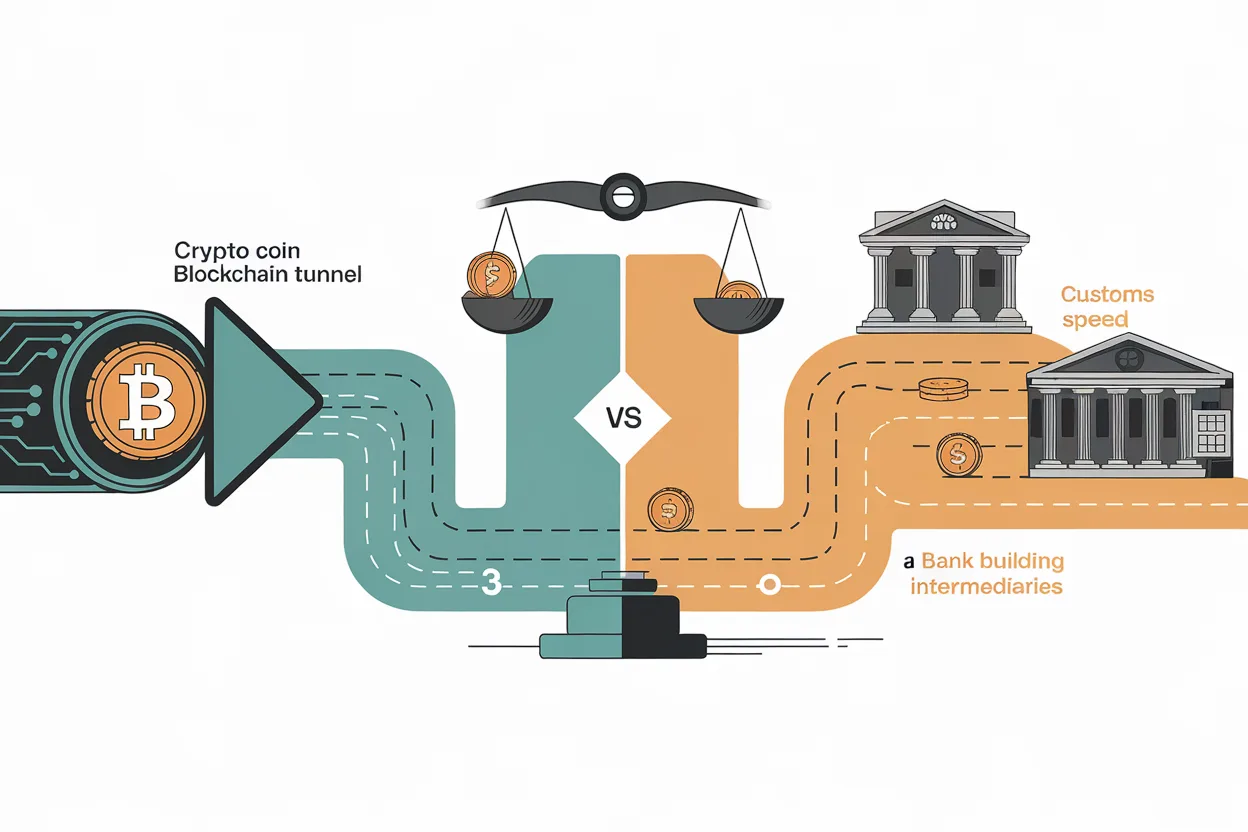
Western Union and stablecoin routes disclose costs differently. Western Union fees and exchange rates vary by channel and location, while a stablecoin route separates funding, trading, network and cash-out costs. A fair comparison reconstructs both delivered amounts at the same time.
This article compares disclosed historical assumptions across five corridors and provides a repeatable all-in-cost method. Requote both routes before sending.
Key Takeaways
- Western Union pricing is route-specific: fee, exchange rate, funding and payout channel can all change the result.
- A crypto network fee is not an all-in remittance price: include entry, withdrawal, network, off-ramp and local payout.
- World Bank Q3 2025: the global average cost of sending $200 was 6.36%.
- No fixed amount threshold selects a winner: reprice the exact route and recipient payout.
- Recovery differs: provider support may be available for a remittance, while an on-chain error can be irreversible.
Western Union and Crypto Expose Costs Differently
Western Union is a regulated money-transfer provider with route- and channel-specific pricing. A crypto route combines separate funding, token, blockchain and cash-out services.
| World Bank Q3 2025 category | Average cost | Worked cost on $200 |
|---|---|---|
| Global average | 6.36% | $12.72 |
| Digital remittance index | 4.59% | $9.18 |
| Digital-only MTO | 3.54% | $7.08 |
| Banks | 14.99% | $29.98 |
Category examples, not Western Union quotes. Source: World Bank Remittance Prices Worldwide, Q3 2025. Western Union’s estimator says fees and exchange rates vary by brand, channel and location and are subject to change.
The All-In Comparison Worksheet
| Cost or risk | Western Union evidence | Crypto evidence |
|---|---|---|
| Funding | Bank, card or cash quote | Fiat deposit or card fee |
| Conversion | Displayed FX rate and fee | Buy and sell spreads plus trading fee |
| Movement | Included in provider quote | Withdrawal and network fee |
| Recipient payout | Bank, wallet or cash-pickup amount | Off-ramp and local withdrawal |
| Recovery | Provider process and terms | Wallet, exchange and irreversible-transfer risk |
Four-Step Quote Test
- Request a Western Union quote for the exact amount, funding method and payout method.
- Price every leg of one lawful stablecoin route at the same timestamp.
- Compare recipient payout, delivery estimate, access and recovery—not advertised fees.
- Requote before sending because exchange rates, liquidity and provider availability move.
The BIS warns that stablecoin on- and off-ramp costs can erase the apparent network-fee advantage. Use the all-in cost guide and calculator methodology.
What Changes a Western Union Quote
Western Union states that fees and exchange rates vary by brand, channel and location. The sending country, recipient country, amount, funding method and payout method can each change the delivered amount. Online bank funding, card funding and agent cash are therefore separate products for comparison purposes.
The transfer fee is visible, but the exchange rate also matters. Calculate how much local currency the recipient receives, then compare that payout with a neutral reference rate only to understand the margin. The executable provider quote remains the value the recipient can actually collect.
Cash pickup adds location and identity constraints. A low displayed quote is unusable if the recipient cannot reach the location, lacks the required identification or faces a different local payout condition. Confirm the collection point and recipient requirements before funding.
What Changes a Crypto Quote
The sender’s acquisition price can differ from one dollar even for a dollar-referenced stablecoin. Card purchases, bank deposits and peer-to-peer payments have different charges and counterparty risks. Record the exact amount of token received after every fee.
Exchange withdrawal fees can exceed the blockchain’s base fee and can change independently. The sender and recipient must use the same supported token contract and network. A cheap but unsupported network is not an available route.
At exit, compare the price at which the recipient can actually sell, the platform fee, bank or e-money withdrawal and any minimum. A reference market price does not prove that a local buyer or regulated off-ramp offers the same rate.
Non-Price Differences
Cash access
Western Union may support cash pickup where a recipient does not use a bank or crypto provider. A stablecoin route requires compatible digital access and a lawful exit. Treat recipient access as a hard filter before comparing price.
Reversibility and support
A provider transfer may have a cancellation, complaint or investigation process under its terms. A confirmed blockchain transaction may be irreversible, and the exchange, wallet and token issuer have separate responsibilities.
Privacy and compliance
Both routes can require identity and transaction screening. Public blockchains expose transaction history, while providers retain customer and payment records. Neither route should be described as anonymous or free from compliance review.
Worked Comparison Template
Hypothetical example only: suppose a sender pays $500. Provider A shows a recipient payout of 28,000 units of local currency. A stablecoin route produces 28,200 after the documented buy, withdrawal, network, sell and local withdrawal costs. The modeled advantage is 200 local-currency units, but the decision should still consider delivery, recovery and recipient effort.
If the stablecoin sell quote falls before execution, or a provider adds a withdrawal fee, that advantage can disappear. Save the timestamp and re-run the calculation before sending. Never describe the hypothetical result as a transfer ChainGain completed.
Evidence Checklist
- Western Union timestamp, funding channel, payout method, fee, exchange rate and recipient amount.
- Crypto buy price, amount received, withdrawal fee, token contract and network.
- Recipient sell price, provider fee, withdrawal and final local payout.
- Provider legal entities, limits, delivery estimate and recovery terms.
- Clear labels for observed quotes, category benchmarks and worked examples.
Use the official Western Union estimator for the provider side and the off-ramp guide for the crypto exit.
August 2026 Benchmark: Compare Total Cost, Not the Headline Fee
TLDR: Western Union does not have one global percentage, and crypto does not have one all-in price. Compare final recipient payout from same-time quotes.
| Q3 2025 benchmark | Average cost | Cost on $200 |
|---|---|---|
| Global remittance average | 6.36% | $12.72 |
| Digital remittance index | 4.59% | $9.18 |
| Digital-only MTO | 3.54% | $7.08 |
| Banks | 14.99% | $29.98 |
Worked example, not a provider quote: the dollar amounts apply the World Bank’s Q3 2025 percentages to $200. They are category benchmarks, not Western Union prices. Western Union’s estimator notes that fees and exchange rates vary by brand, channel and location and may change without notice.
A crypto comparison must also include buy spread, trading fee, withdrawal fee, network fee, off-ramp spread and local withdrawal. The BIS 2026 report says on- and off-ramp costs can make the total stablecoin route as expensive as, or more expensive than, a bank transfer.
- Request a Western Union quote for the exact amount, funding method and payout method.
- Price every leg of one lawful crypto route at the same timestamp.
- Compare recipient payout, delivery estimate, error recovery and cash access.
- Requote immediately before sending because both FX and crypto liquidity can move.
Frequently Asked Questions
Is crypto always cheaper than Western Union?
No. Compare a current Western Union delivered-amount quote with the complete lawful crypto route.
What crypto costs are commonly omitted?
Funding, buy spread, trading, withdrawal, network, off-ramp spread and local withdrawal can all apply.
Can the recipient avoid handling crypto?
Only if a regulated provider handles conversion and payout. Confirm the exact service and terms rather than assuming a hidden crypto backend.
Which route has stronger consumer recourse?
A regulated remittance provider may offer support and complaint processes. On-chain transfers may be irreversible and use separate intermediaries.
How do I identify the cheapest route?
Use the same amount, timestamp, funding method and payout rail, then compare final spendable recipient amounts.
Continue Learning
- Crypto Remittance Costs: Complete 2026 Guide — corridor-specific fee comparisons for 20+ routes
- Best Blockchain for Sending Money: Fee Comparison (2026) — network-by-network breakdown
- How to Send USDT Abroad: Step-by-Step Guide — practical walkthrough with screenshots
- What Are Stablecoins? A Beginner’s Guide — understand the crypto behind remittances
- P2P Crypto Trading Safety Guide — avoid scams when buying and selling USDT