Ledger vs Trezor 2026: Long-Term Owner’s Honest Comparison (Not a ‘Best Of’ List)
Table of Contents
Last Updated: 2026-05-14
Most "Ledger vs Trezor" guides compare specs that stop mattering after week one. Screen size, supported coin counts, Bluetooth — interesting at unboxing, mostly irrelevant by month three. What actually matters after three years of ownership is the part nobody writes about: which firmware updates broke things, how each company handled security incidents, whether the recovery seed paper you stored in 2022 is still legible, and what happens when you email support at 11pm on a Sunday because something is wrong.
I added a Trezor Safe 5 in 2024 and a Ledger Nano S Plus in 2025 as test units. None of these were sent free; all were purchased at retail price. This guide is the honest comparison I wish existed when I was deciding which to buy a second time.
TL;DR honest verdict. Neither brand is the "winner." Ledger has stronger Secure Element certification across its current lineup and a more polished mobile experience, paid for with closed-source firmware you cannot audit and a 2020 customer database breach that still produces phishing attempts in 2026. Trezor has fully open-source firmware and the more flexible SLIP-39 Shamir recovery, paid for with a thinner app ecosystem, a discontinued flagship (Model T retired January 2026), and its own line of supply-chain incidents. The right device depends on what you are actually doing with it. The use-case matrix in Section 10 gives the explicit answer per persona.
Why "Best Of" Lists Get Hardware Wallets Wrong
Open any top-ranked "best hardware wallet 2026" article and you find a feature checklist: supported coin count, Bluetooth, touchscreen, price, 1–5 star rating. The implicit message is that hardware wallets are commodities differentiated by features. That framing is wrong, and it leads readers to buy the wrong device.
A hardware wallet is not a consumer gadget. It is a long-term custody decision — your single point of cold-storage failure for years. The questions that matter are not on the spec sheet: when this brand had a security incident, how did they handle it? When firmware needs a critical patch, do they push within 24 hours or 24 days? When the device dies in year four, can you actually get a replacement and restore from seed? When the company pivots its business model — say, by introducing a controversial cloud-recovery service — is that pivot one you can live with? Those questions require looking at each brand’s actual history. That is what this guide does — the spec sheet you need plus the long-term ownership reality nobody writes about. Neither brand is perfect: Ledger has had three significant security incidents since 2020; Trezor has had three of its own in the same period. The goal is not to crown a winner but to give you enough honest detail to pick the brand whose specific failure modes you can live with.
The 5 Models in 2026: Quick Spec Comparison
Five devices are worth comparing in 2026: three from Ledger (Nano S Plus, Nano X, Stax) and two current ones from Trezor (Safe 3, Safe 5), plus the Model T which Trezor discontinued in January 2026 and which I have included because many readers still own one and need to understand its current support status. Prices below are taken from each brand’s official shop on the day of publication; regional pricing varies and EU prices include VAT.
| Model | Secure Element | Screen / Input | Connectivity | Coin support | Firmware | Recovery | USD price (2026) |
|---|---|---|---|---|---|---|---|
| Ledger Nano S Plus | ST33K1M5, EAL6+ | 128×64 OLED, two physical buttons | USB-C only | 500+ native via Ledger Live, 5,000+ via integrations | Closed-source (proprietary OS, BOLOS) | BIP-39 (12/24 words) | $79 |
| Ledger Nano X | ST33, EAL5+ | 128×64 OLED, two physical buttons | USB-C and Bluetooth | 500+ native via Ledger Live, 5,000+ via integrations | Closed-source (BOLOS) | BIP-39 (12/24 words) | $149 |
| Ledger Stax | ST33K1M5, EAL6+ | 3.7" curved E Ink touchscreen | USB-C and Bluetooth, Qi wireless charging | Same as Nano X (via Ledger Live) | Closed-source (BOLOS) | BIP-39 (12/24 words) | $399 (includes Magnet Shell) |
| Trezor Safe 3 | Optiga Trust M V3, EAL6+ (NDA-free) | 0.96" monochrome OLED, two physical buttons | USB-C only | 8,000+ coins/tokens via Trezor Suite | Fully open-source (auditable on GitHub) | BIP-39 and SLIP-39 Shamir | ~$79 (subject to availability) |
| Trezor Safe 5 | Optiga Trust M V3, EAL6+ (NDA-free) | 1.54" color touchscreen with haptic feedback | USB-C only | 9,000+ coins/tokens (1,000+ on Bitcoin-only firmware) | Fully open-source | BIP-39 and SLIP-39 Shamir | $169 |
| Trezor Model T | No dedicated Secure Element (MCU only) | 1.54" color touchscreen | USB-C only | 1,800+ via Trezor Suite | Fully open-source | BIP-39 and SLIP-39 Shamir | Discontinued Jan 2026 — Legacy support until 2036 |
Two notes the table does not capture. First, the Nano S Plus, despite being entry-level, uses a higher-rated Secure Element (EAL6+) than the flagship Nano X (EAL5+). The Nano X is the older design; newer Nano S Plus and Stax use the ST33K1M5 at EAL6+. For new buyers in 2026 this matters: the "cheap" Ledger has the better chip rating, and the Nano X’s premium pays for Bluetooth and a slightly bigger battery, not stronger crypto hardware. Second, the Trezor Model T’s lack of a dedicated Secure Element is the biggest reason it was discontinued. Trezor announced retirement on January 8, 2026, and now sells the Safe 3 and Safe 5 in its place. If you own a Model T, firmware updates and Suite compatibility continue until 2036, but no new feature work will land — it is no longer my recommendation for new buyers.
For a broader overview of how these device categories fit into the wider hardware wallet landscape — Tangem cards, NGRAVE Zero, air-gapped designs — see our Hardware Wallets 2026 overview.
Security Architecture: The Honest Comparison
The deepest disagreement between Ledger and Trezor is architectural, not commercial. Ledger believes the primary defense is a certified Secure Element — a tamper-resistant chip with formal Common Criteria evaluation. Trezor (until the Safe series) believed the chip itself should be auditable open-source hardware: you cannot trust what you cannot verify. Both positions have merit, and the "right" one depends on what threat you are actually defending against.
Ledger’s case. Every Ledger device uses an STMicroelectronics ST33-family Secure Element rated EAL5+ (Nano X) or EAL6+ (Nano S Plus, Stax). These chips are certified to resist invasive physical attacks — chip decapping, side-channel analysis through power consumption monitoring, and fault injection via voltage glitching. The certification is real; it is the same evaluation framework used by payment terminals and government smartcards. If your threat model includes a competent attacker with physical access — customs seizure, hotel-room break-in, a $5 wrench attack followed by laboratory analysis — the EAL-certified chip is a meaningful defense.
The cost is the firmware around the chip. Ledger’s BOLOS operating system is not fully open-source. Parts have been published and the application SDK is open, but the core transaction-signing code remains proprietary. Ledger argues the Secure Element vendor’s NDA prevents full disclosure, but the result is the same: you cannot independently verify the firmware is doing only what it claims. You are trusting Ledger on reputation, not auditable source. This criticism has dogged the company since 2018 and became acute in 2023 when Ledger Recover revealed the firmware was capable of exporting an encrypted seed — a capability critics argued contradicted years of marketing that suggested the seed could never leave the device.
Trezor’s case. You should not have to trust a black box. The Model T and earlier Trezor One were built around general-purpose microcontrollers running fully open-source firmware auditable on GitHub. The threat model is software supply-chain attacks — malicious firmware, backdoored signing routines, compromised build pipelines — caught quickly when many independent reviewers can inspect the code. The approach also lowers trust requirements in the company itself: if Trezor were compromised, malicious code would be visible to outside reviewers. The cost of pure open-source is physical-attack resistance: a general-purpose microcontroller without a Secure Element is vulnerable to the chip-level attacks EAL5+/6+ chips are designed to resist. This gap motivated the 2024 Safe series, which adds an Infineon Optiga Trust M V3 Secure Element — also EAL6+ rated and notably NDA-free, letting Trezor keep the rest of the firmware fully open while gaining certified physical-attack resistance.
The honest takeaway. Both architectures have failure modes. Ledger’s closed firmware means you cannot verify what your device is signing — and the 2023 Recover controversy showed this trust gap is not theoretical. Trezor’s older open-source-only approach (Model T) widened the physical-attack surface — and a 2025 vulnerability disclosure made this concrete. In 2026 the architectural gap has narrowed: both flagships (Stax and Safe 5) use EAL6+ Secure Elements. The remaining difference is the firmware around the chip — closed in Ledger’s case, open in Trezor’s. If your threat model is dominated by physical attacks, both flagships are now adequate. If trust-the-vendor risk dominates, Trezor wins on auditability. If both matter equally, you are looking at a genuine trade-off rather than a clear winner.
Incident Timeline: What Actually Happened (2020–2026)
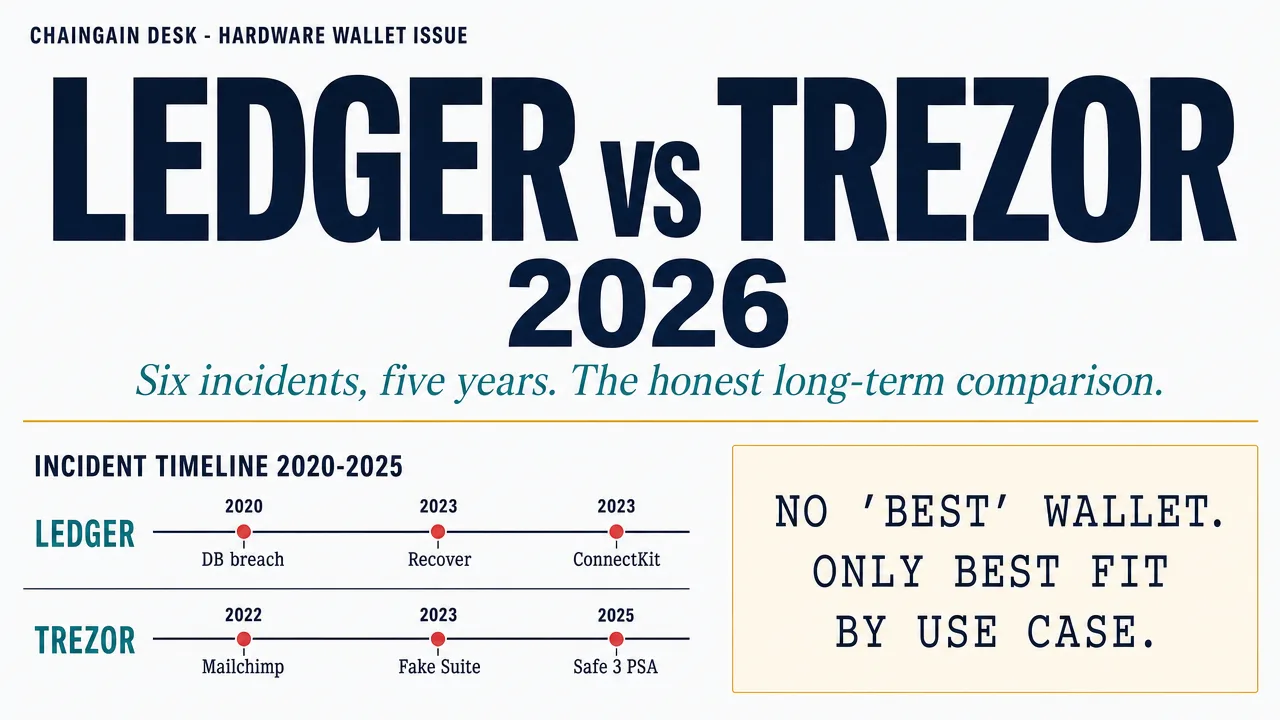
Every hardware wallet brand has incidents. The question is not whether they happen but how the company handles them. The six below are not exhaustive — three per brand, kept symmetric — but they materially affected user funds, user trust, or both, and every prospective buyer should know about them before paying for a device.

| Date | Brand | Incident | Mechanism | User funds at risk? | Resolution |
|---|---|---|---|---|---|
| Jun 2020 | Ledger | Customer database breach | Attacker accessed Shopify e-commerce API; 1.1M email addresses and ~272K full records (names, phone, postal addresses) exfiltrated | No direct on-device funds at risk; exposed identity data still fueling targeted phishing in 2026 | Public disclosure and notification; no on-chain funds drained directly via this breach |
| Apr 2022 | Trezor | Mailchimp phishing campaign | Mailchimp breach Mar 26, 2022; attackers sent fake "Trezor Suite" emails Apr 3 directing users to a counterfeit app | Yes — users who installed the fake Suite and entered their seed had funds drained | Trezor publicly disclosed within hours; counterfeit infrastructure taken down; ~100+ victim reports |
| May 2023 | Ledger | Ledger Recover service controversy | Announced cloud-based seed recovery ($9.99/mo) splitting an encrypted seed into three shards (Ledger, Coincover, independent provider). Critics argued this contradicted "the seed never leaves the device" marketing | No direct funds at risk; controversy concerned firmware’s capability to export an encrypted seed | Public backlash delayed launch; shipped Oct 2023 as opt-in only; trust damage to "seed never leaves" positioning remained |
| Jun 2023 | Trezor | Fake Trezor Suite app on official stores | Counterfeit "Trezor Suite" apps distributed on both Apple App Store and Google Play Store, mimicking legitimate branding | Yes — users who connected the fake app and entered their seed lost funds | Both apps removed after Trezor reported them; security alerts refreshed; desktop client renamed |
| Dec 2023 | Ledger | ConnectKit JS supply-chain attack | Former Ledger employee’s npm account phished; malicious @ledgerhq/connect-kit v1.1.5–1.1.7 injected the Angel Drainer wallet drainer into any dApp pulling the latest version | Yes — ~$600K drained across affected dApp interactions in the ~40-minute window before mitigation | Malicious versions yanked within ~40 min; clean v1.1.8 published ~5 hours after; npm secured; post-mortem published |
| Mar 2025 | Trezor Safe 3 | Physical supply-chain vulnerability disclosed by Ledger Donjon | Ledger Donjon (Ledger’s security research division — not Trezor) disclosed a physical-tampering vulnerability affecting the Trezor Safe 3. Trezor Safe 5 reportedly unaffected; independent verification recommended | Conditional — exploitation required physical access; no remote vector disclosed | Trezor acknowledged; mitigations issued; users advised to source only from official channels and verify packaging |
Two things stand out when you put the six incidents side by side. First, the failure modes differ structurally. Ledger’s three are dominated by trust-perimeter failures — customer database, npm package, cloud service controversy — sitting outside the device but affecting users through ecosystem attack surface. Trezor’s three are dominated by impersonation and physical-tampering vectors that exploit the open-source brand and external supply chain. Neither pattern is "worse" in the abstract; they are different. Second, both companies disclose. Public post-mortems exist for every incident — Ledger published a CEO statement on the 2020 customer-data breach and a CEO/COO statement on the December 2023 ConnectKit attack within hours; Trezor blogged the 2022 Mailchimp phishing within the same week. The alternative — quiet handling, no disclosure — is a worse signal than the existence of incidents, and both brands pass this test.
One clarification on the 2025 Trezor Safe 3 entry: it was disclosed by Ledger Donjon, Ledger’s internal security research arm, not by Trezor. The disclosure originated in Ledger Donjon’s published research; some news coverage framed it as a "Trezor incident" without noting the disclosing party. Ledger Donjon does legitimate competitor-device research, but framing matters: this is one vendor’s lab publishing about another vendor’s device, and Trezor Safe 5 is reportedly outside the disclosed attack’s scope. For context on how on-chain forensics untangles incidents once funds move, see our Bybit hack forensics case study.
Day-to-Day Experience: After Week 1 vs Year 3
In week one, every hardware wallet feels similar — unbox, set up, write down the seed, install the companion app, send a test transaction. The differences only show after months, compounding across years. Below is the honest year-three view per brand.
Ledger after three years
Ledger Live has improved the most. The 2022 version had rough edges — clunky portfolio views, slow account discovery, awkward fiat conversions — that 2025 and 2026 releases largely smoothed. Today it is the best mobile hardware-wallet companion app on the market, with iOS and Android at feature parity with desktop. What has not improved is the closed-source critique: every firmware update requires trusting Ledger is shipping what they claim. The 2023 Recover controversy did not change my behavior (I never enabled it), but it permanently altered my mental model: the firmware is capable of exporting an encrypted seed if the user opts in, and that capability cannot be removed by refusing to use it.
Trezor after three years
Trezor Suite is functional but less polished than Ledger Live. Desktop is more responsive than mobile, and Trezor’s mobile coverage has historically been weaker — the iOS app has limited functionality versus desktop. This is the price of an open-source-first design: smaller app-side engineering budget in exchange for auditable firmware. The firmware experience itself has been excellent across three years — updates are infrequent but well-documented, and security researchers usually publish independent reviews within days. I have not had a single firmware issue on the Model T or Safe 5. The Safe 5’s newer touchscreen is more responsive than the Model T’s, with haptic feedback that genuinely helps transaction confirmation. The 2026 reality check: Model T is now discontinued, so new Trezor buyers should buy Safe 5 (or Safe 3 if budget-constrained), not Model T from third-party resellers.
Recovery & Backup: BIP-39 vs SLIP-39 Shamir Trade-offs
Most reviews mention recovery seeds in passing — "write down 24 words and store them safely." What they rarely surface is that the two brands offer materially different recovery models. Trezor supports both BIP-39 (the standard 12/24-word mnemonic) and SLIP-39 (Shamir Secret Sharing). Ledger supports only BIP-39 in device firmware. This single difference, more than anything else on the spec sheet, is the most underrated factor in the Ledger-vs-Trezor decision for serious holders.
BIP-39: the universal standard
BIP-39 is the universal standard: 12 or 24 words from a defined wordlist deterministically derive every account on every supported coin. Strengths: well-audited and portable across brands — a Ledger seed restores on Trezor, and vice versa. You are not locked into one brand’s hardware to access funds. Weakness: BIP-39 is a single-shard secret. Whoever holds the words holds full custody. Standard mitigations — split storage, metal plates, the optional 25th-word passphrase — have known trade-offs and none provide cryptographic threshold security.
SLIP-39: Shamir’s secret sharing, native
SLIP-39 is Trezor’s native Shamir Secret Sharing. Instead of one 24-word backup, you create N shares with a threshold of K — say, five shares with a three-of-five threshold. You can lose two shares and still recover; any single share alone reveals nothing about the master seed. This is mathematically guaranteed by Shamir’s 1979 scheme, not a Trezor implementation trick.
For long-term holders SLIP-39 is a meaningful upgrade. Give one share to a family member, one to a bank safe-deposit box, keep one at home, hand one to a lawyer, keep one with you. Lose any two — fire, theft, your own death — and the remaining three reconstruct the seed. BIP-39 has no native equivalent. The trade-off is portability: SLIP-39 shares cannot be restored on a non-SLIP-39 wallet (today, primarily Trezor; Keystone in some modes; Coldcard does not). Many users (myself included) split this: long-term cold storage in SLIP-39 on Trezor; active accounts in BIP-39 on either brand for cross-brand fallback.
One non-obvious finding from three years of paper seed storage: write recovery in pencil, not ink. Ballpoint and gel pens fade unpredictably; pencil graphite on archival paper remains legible essentially indefinitely. Metal plates (Cryptosteel, Billfodl, hand-stamped steel) are the upgrade path — worth $50–100 for any seed protecting more than a few thousand dollars. Store the plate separately from the device.
3-Year Total Cost of Ownership
Sticker price is misleading. A hardware wallet is a multi-year purchase, and the real cost includes replacement units, recovery hardware, and subscription services. Below is a realistic three-year TCO across three buyer profiles. Numbers in USD; EU pricing runs slightly higher due to VAT.
| Cost line | Budget (Nano S Plus or Safe 3) | Standard (Nano X or Safe 5) | Premium (Stax or Safe 5 + extras) |
|---|---|---|---|
| Initial device | $79 | $149–$169 | $399 (Stax) / $169 (Safe 5) |
| Backup device (recommended for $10k+ holdings) | $79 (second Nano S Plus or Safe 3) | $79 (cheaper second unit) | $149 (second flagship-class unit) |
| Metal seed backup plate | $30–$50 | $50–$100 | $100–$150 (multiple plates for SLIP-39 shares) |
| Ledger Recover subscription (Ledger only, optional) | $0 (do not subscribe) | $0 or $9.99/month = $360 over 3 years | $0 or $360 |
| One replacement (battery, screen, RMA out of warranty) | $79–$149 (full replacement) | $79–$169 | $169–$399 |
| Year-3 firmware-driven hardware refresh (optional) | $0 (skip if device still supported) | $0–$169 | $0–$399 |
| Realistic 3-year TCO | $190–$280 | $280–$420 (+$360 if Recover) | $650–$1,000 |
The biggest hidden cost on the Ledger column is Ledger Recover. At $9.99/month, three years is $360 — more than an entry-level Nano S Plus. The service is optional and I do not subscribe, but if you do, treat it as a TCO line item, not a small add-on. Trezor has no equivalent recurring subscription: Suite is free, and SLIP-39 backup is included.
The other line that matters is the backup device. For any holding above five figures, a second hardware wallet of the same brand in a different physical location is strongly recommended. Same brand, because cross-brand restore creates ambiguity about which seed is canonical. Different location, because the whole point is to survive a single physical event (fire, theft, flood). Adding a second device costs $79–$169 — well worth it. For a structured framework on multi-device setups, see our Crypto Wallet Decision Framework.
Customer Support Reality
The experiences differed, and enough similar accounts from other long-term holders make me comfortable generalizing modestly.
Ledger support
The first-line response was scripted “try a different cable, port, computer” — necessary triage but slow if you have already tried all of that. Once past triage the path was clear: out of warranty by a few months, so a 15% discount on a Nano X replacement rather than a free swap. Total elapsed time about eight business days. Acceptable, not exceptional. One caveat: the June 2020 customer database breach generated years of phishing in which scammers impersonated Ledger support to extract recovery seeds, so real Ledger support has been calibrated to never ask for any portion of your recovery phrase. The rule is correct, but it also means real support cannot help with any issue that requires examining your seed.
Trezor support
My Model T touchscreen-drift case was diagnosed as out-of-warranty with a similar resolution offer (discount on Safe 5 rather than free swap); total elapsed time about ten business days. The technical exchange was more substantive — the engineer asked for diagnostic logs from Suite, which you can only ask when the firmware is open enough for users to retrieve useful debugging output. The Trezor community layer is genuinely active: the subreddit and official forum see consistent volunteer help from long-term users, filling gaps official support cannot cover (detailed firmware-update troubleshooting that requires command-line tools, for example).
EU vs US response times. Both brands are EU-headquartered (Ledger in France, Trezor in the Czech Republic) and prioritize EU tickets slightly over rest-of-world. Filing from outside the EU, expect 24–48 hours longer on first response. Neither brand offers a paid "premium support" tier that bypasses queues — a gap an enterprise-focused competitor could exploit.
Which One Actually Wins (By Use Case)
The right hardware wallet is not a property of the device but of the relationship between the device’s strengths and your specific use case. Below is the matrix I would hand to friends asking which to buy.

| Use case | Recommended device | Why | Alternative if budget-constrained |
|---|---|---|---|
| Long-term cold storage (BTC/ETH HODL) | Trezor Safe 5 | SLIP-39 Shamir backup is the single most valuable feature for multi-decade storage; open-source firmware reduces vendor trust requirements; EAL6+ Secure Element matches Ledger’s physical defense | Trezor Safe 3 |
| Active DeFi user (multi-chain, frequent signing) | Ledger Nano X | Ledger Live ecosystem and EVM-app integrations are smoother day-to-day; Bluetooth helps when signing from mobile WalletConnect flows; you accept the closed-firmware trade-off in exchange for ecosystem polish | Ledger Nano S Plus (no Bluetooth, but same EAL6+ chip) |
| Multi-sig setup (Sparrow / Specter, Bitcoin-only) | Trezor Safe 5 | Open-source firmware reduces correlated-vendor risk in a multi-sig quorum; Bitcoin-only firmware option strips attack surface; mixes well with Coldcard or Foundation Passport for vendor diversity | Trezor Safe 3 paired with a Coldcard Mk4 |
| Travel-heavy / mobile-first | Ledger Nano X | Bluetooth + iOS/Android parity in Ledger Live makes airport-and-hotel signing genuinely workable; small form factor; battery lasts weeks on standby | Ledger Nano S Plus (USB-C only; OTG cable needed) |
| Privacy / open-source insistence | Trezor Safe 5 | Fully auditable firmware; NDA-free Secure Element; transparent build pipeline; this is the only major-brand option for users who refuse closed-source firmware on principle | Trezor Safe 3 |
Three caveats. First, "recommended" means "I would buy this for myself in this use case in May 2026." If you already own the "wrong" brand, you do not necessarily need to switch — both brands are adequate for most purposes and the cost of switching (re-installing apps, re-deriving accounts, moving funds, restoring from seed) is non-trivial. Switch only if your use case changed materially or a specific feature gap is hurting you. Second, if you are still choosing between hot and cold storage in the first place, see our EVM browser wallets 2026 comparison and the broader best crypto wallets by persona guide — many readers do not need a hardware wallet for low five-figure holdings. Third, the "privacy / open-source insistence" row is the only near-monopoly answer: if you cannot accept closed firmware, Trezor is the only major brand in 2026 that fits. Ledger does not currently fit this constraint and has shown no signs of fully open-sourcing BOLOS.
Frequently Asked Questions
Is Ledger still safe to use after the 2020 customer database breach?
Yes, for on-device custody. The 2020 incident exposed a customer database, not the device — no seeds, private keys, or funds were exposed directly. What was exposed was emails, names, phone numbers, and postal addresses for ~272,000 customers, and those records still fuel targeted phishing six years later. Practical implications: assume your contact details are public, never enter your seed into anything that asks for it, and treat any unsolicited "Ledger support" outreach as phishing by default.
Is Trezor’s open-source firmware enough by itself, without a Secure Element?
For the Model T, my honest answer is "no, not in 2026." It uses a general-purpose microcontroller without dedicated tamper-resistant hardware, and physical-attack vectors that EAL chips resist are real if your threat model includes hands-on adversaries. This is why Trezor moved to the Safe series — Safe 3 and Safe 5 add an Optiga Trust M V3 Secure Element while keeping firmware fully open-source. If you hold significant funds on a Model T with any physical-attack exposure, upgrading to a Safe 5 is worth the cost.
Can I use a hardware wallet for DeFi (Uniswap, Aave, etc.)?
Yes — both brands integrate with WalletConnect, MetaMask hardware mode, Rabby, and Frame, covering most DeFi front-ends. Ledger Live has a native DeFi tab and direct swap support; Trezor Suite focuses on basic send/receive and you typically connect to DeFi through MetaMask or Rabby. For active DeFi the Nano X is smoother day-to-day; for occasional DeFi the Safe 5 is fully workable.
How does multi-sig setup compare across the two brands?
Trezor has a slight edge in 2026 because its open-source firmware reduces correlated-vendor risk in a multi-sig quorum. A typical setup uses one Trezor, one Coldcard, and one Foundation Passport — three vendors so a single vendor compromise cannot affect more than one signer. Ledger fits via Sparrow, Specter, or Casa, but pairing two Ledgers is the wrong pattern from a vendor-diversity standpoint. For meaningful value, plan vendor diversity from day one.
When should I upgrade my hardware wallet?
Three triggers, in priority order. First, when the current device loses firmware support — the Model T is patched until 2036 but receives no new features. Second, when security architecture changes (moving to Bitcoin-only firmware practices or multi-sig requiring vendor diversity). Third, when holdings outgrow the setup — a Nano S Plus is fine for $5K, less fine for $500K. Do not upgrade just because a new model looks shiny; seed migration carries small but real risk.
Should I buy a Ledger Recover subscription?
For most users, no. Recover adds a third-party recovery surface — encrypted shards held by Ledger, Coincover, and an independent backup provider — that does not exist if you maintain your own paper or metal seed backup well. If you genuinely cannot store a physical backup (frequent relocation, no safe-deposit-box access), Recover may make sense. For everyone else, $360 over three years exceeds the cost of an additional hardware wallet plus a metal plate — a more robust setup at lower cost.
Conclusion: The Honest Verdict
Hardware wallets are not commodity gadgets. They are multi-year custody decisions, and the right one depends on which trade-offs you can live with — not which has more features on a spec sheet. Ledger gives you EAL6+ Secure Element across the current lineup, the best mobile companion app on the market, and a Bluetooth-enabled flagship that travels well — at the cost of closed-source firmware and the lingering shadow of the 2020 breach and 2023 Recover controversy. Trezor gives you fully open-source firmware, SLIP-39 Shamir Backup no other major brand offers natively, and a transparent build pipeline — at the cost of a thinner mobile experience, a recently discontinued flagship (Model T), and its own impersonation incidents in 2022 and 2023.
For long-term cold storage above five figures, the SLIP-39 capability and open-source firmware tip the verdict to the Trezor Safe 5. For active DeFi use and travel, the Ledger Nano X is materially smoother and worth its higher trust assumption. For privacy maximalists, only Trezor fits. For first-time buyers protecting small four-figure holdings, either brand’s entry-level model — Nano S Plus or Safe 3 — is fine. Neither brand is the “winner”; they are different bundles of trade-offs, and your use case picks the bundle. One closing reminder: this article earns no affiliate commission on either brand. If another hardware wallet article ever feels like it is herding you toward a specific buy, check whether the publisher discloses an affiliate relationship — most do not, and the framing of their recommendations changes accordingly.

Editorial pen name · ChainGain
Alex Mercer is the editorial pen name used for ChainGain’s cryptocurrency education content. Articles are based on cited sources and reproducible comparisons. Editorial profile