Crypto Remittances to Africa: Fees, Speed, and Best Methods (2026)
Disclosure: This article may contain affiliate links. We earn a commission at no extra cost to you. Our editorial policy ensures all recommendations are based on genuine analysis.
Sub-Saharan Africa pays more for remittances than anyone else on earth — a problem that crypto remittances to Africa are rapidly solving. The World Bank’s Q1 2025 data shows an average cost of 8.78% to send $200 to the region — nearly triple the 3% UN target. For a continent that receives over $120 billion annually in remittances, that adds up to roughly $10 billion lost to fees every year.
Crypto remittances have changed that equation. In 2025, Sub-Saharan Africa became the world’s third-fastest-growing crypto region, processing $205 billion in on-chain value. Much of that flow went to remittances — stablecoins sent from Europe, North America, and the Gulf, converted to local currency through mobile money rails like M-Pesa and MTN Mobile Money.
In this guide, I walk through the entire Africa crypto remittance landscape: costs by corridor, mobile money integrations, top platforms, country-by-country methods, and the regulatory landscape.
What you will learn:
- Why African remittance costs are the world’s highest, and how crypto cuts them by 70-85%
- Which crypto corridors work for which African countries
- How mobile money (M-Pesa, MTN MoMo) integrates with USDT for last-mile delivery
- Top remittance platforms: Yellow Card, Kotani Pay, Binance P2P, VALR
- Country-specific regulatory and payment rail details for 8+ African markets
Beginner
Key Takeaways
- Africa pays the highest remittance fees: Sub-Saharan Africa averages well above the global 6% — crypto can cut the cross-border leg to about 1%.
- Biggest corridors by inflow: Egypt $22.7B (Gulf states), Nigeria $19.8B (US/UK/Canada), Kenya $4.94B, Ghana $4.8B — the four largest African receivers.
- USDT dominates African remittances: Deepest P2P liquidity and widest acceptance — most Africa corridors run on USDT, not USDC.
- Mobile money is the last-mile key: M-Pesa, MTN MoMo and similar let recipients turn USDT into spendable local cash without a bank account.
- How crypto changes the math: The cross-border USDT transfer is near-free and instant; the cost shifts to the local off-ramp spread (about 1-2%).
- Mind regulation and AML: Rules differ by country and changed in 2026 — verify exchange access, keep records, and expect AML scrutiny on large flows.
- Common mistakes to avoid: Wrong-network sends (permanent loss), low-liquidity P2P (wide spreads), and skipping recipient mobile-money setup before sending.
For an all-in cost comparison across eight remittance corridors (crypto vs banks, at $200 and $1,000), see ChainGain’s Remittance Cost Report 2026.
The Africa Remittance Problem in Numbers
TLDR: Africa’s largest remittance recipients took in $19.8B–$22.7B each in 2024 (World Bank), and because the continent pays the world’s highest transfer fees, even small cost reductions translate into major savings.
Africa receives more remittances than most people realize. Here are the top recipient countries by 2024 inflows (World Bank data):
| Country | 2024 Inflows | Primary Corridors |
|---|---|---|
| Egypt | $22.7B | Gulf states (Saudi, UAE, Kuwait) |
| Nigeria | $19.8B | US, UK, Canada |
| Kenya | $4.94B | US, UK, Gulf, Germany |
| Ghana | $4.8B | US, UK, Nigeria |
| Senegal | $2.94B | France, Italy, Spain |
| Uganda | $1.49B | Kenya, US, UK |
| Tanzania | $757M | Kenya, US, UK |
Contrary to popular belief, Egypt — not Nigeria — is Africa’s #1 remittance destination. Most Egyptian inflows come from the Gulf states where millions of Egyptians work. For Sub-Saharan Africa specifically, Nigeria dominates with remittances arriving mainly from the US, UK, and Canadian diasporas.
Why Africa Pays So Much
TLDR: Africa’s remittance fees average above 8% — roughly $17–$20 on a $200 transfer — driven by limited banking access, FX monopolies, and thin corridor competition, all of which crypto can route around.
Three structural issues push African remittance costs above 8%:
- Correspondent banking decline — Since 2011, international banks have cut correspondent relationships with African banks by over 40% due to de-risking. Fewer banks = higher monopoly pricing for the ones that remain.
- Exclusive partnerships — Many African governments granted single-provider monopolies to legacy operators like Western Union and MoneyGram. In some corridors, these operators have 70%+ market share.
- Currency conversion markups — Banks and MTOs typically add 2-4% to exchange rates on top of stated fees. This invisible cost is often larger than the visible fee. Our Hidden Fees in Remittances guide breaks down the full picture.
The result: a Nigerian or Ghanaian family receiving $200 from abroad typically gives up $17-$20 before the money lands. For families living on remittances, this is a painful tax on survival.
How Crypto Changes the Math
TLDR: A crypto remittance to Africa typically costs 0.5–2% end-to-end (about $2–$4 on a $200 transfer to Nigeria) versus $14+ through traditional channels — a 70–90% cost cut when the off-ramp is done right.
A crypto remittance to Africa typically costs 0.5-2% end-to-end, depending on the off-ramp method. Here is the cost math for a $200 transfer from the US to Nigeria:
| Method | Total Cost | Receiver Gets | Speed |
|---|---|---|---|
| Bank wire (SWIFT) | $20-25 (10-12%) | $175-180 | 3-5 days |
| Western Union | $14-18 (7-9%) | $182-186 | Hours–1 day |
| Wise / WorldRemit | $8-12 (4-6%) | $188-192 | Minutes–1 day |
| Crypto (USDT TRC-20 → P2P) | $2-4 (1-2%) | $196-198 | 15-60 minutes |
| Crypto (Yellow Card API) | $3-4 (1.5-2%) | $196-197 | Minutes |
The savings compound with larger amounts. On a $1,000 transfer to Kenya, crypto saves $60-80 per transaction compared to banks. For a family receiving monthly support, that is $700-$1,000 saved per year.

Why USDT Dominates African Remittances
TLDR: USDT on Tron (TRC-20) dominates African remittances — stablecoins are now over 40% of Sub-Saharan crypto activity (Chainalysis) — because it holds a stable $1 value, settles in minutes, and costs under $1 in network fees.
Across African crypto remittance flows, USDT (Tether) on the Tron network (TRC-20) is the clear winner. According to Chainalysis, stablecoins now account for over 40% of crypto activity in Sub-Saharan Africa. Three reasons USDT won:
- Low fees: TRC-20 transfers cost $0.10-$1.00 regardless of amount. Ethereum (ERC-20) costs $5-$20 — prohibitive for typical $50-$200 remittances.
- Stablecoin peg: Recipients do not want exposure to Bitcoin’s 40%+ annual volatility. USDT stays at $1.
- Deep P2P liquidity: Binance P2P Africa has thousands of local traders offering NGN, KES, GHS, ZAR, and UGX markets 24/7.
For a detailed stablecoin comparison, see our USDT vs USDC for Remittances guide. If you want to understand why stablecoins beat Bitcoin for sending money, our Stablecoin vs Bitcoin article covers the volatility math.
Mobile Money Integration: The Last-Mile Key
TLDR: Mobile money is Africa’s last-mile key: most recipients lack bank accounts but use wallets like M-Pesa (60M+ users) or MTN Mobile Money (70M+), so the best crypto routes cash out directly to mobile money.
Here is what makes Africa unique: most recipients do not have bank accounts, but nearly everyone has mobile money. M-Pesa alone has 60+ million active users across Kenya, Tanzania, and beyond. MTN Mobile Money serves 70+ million users across 17 countries.
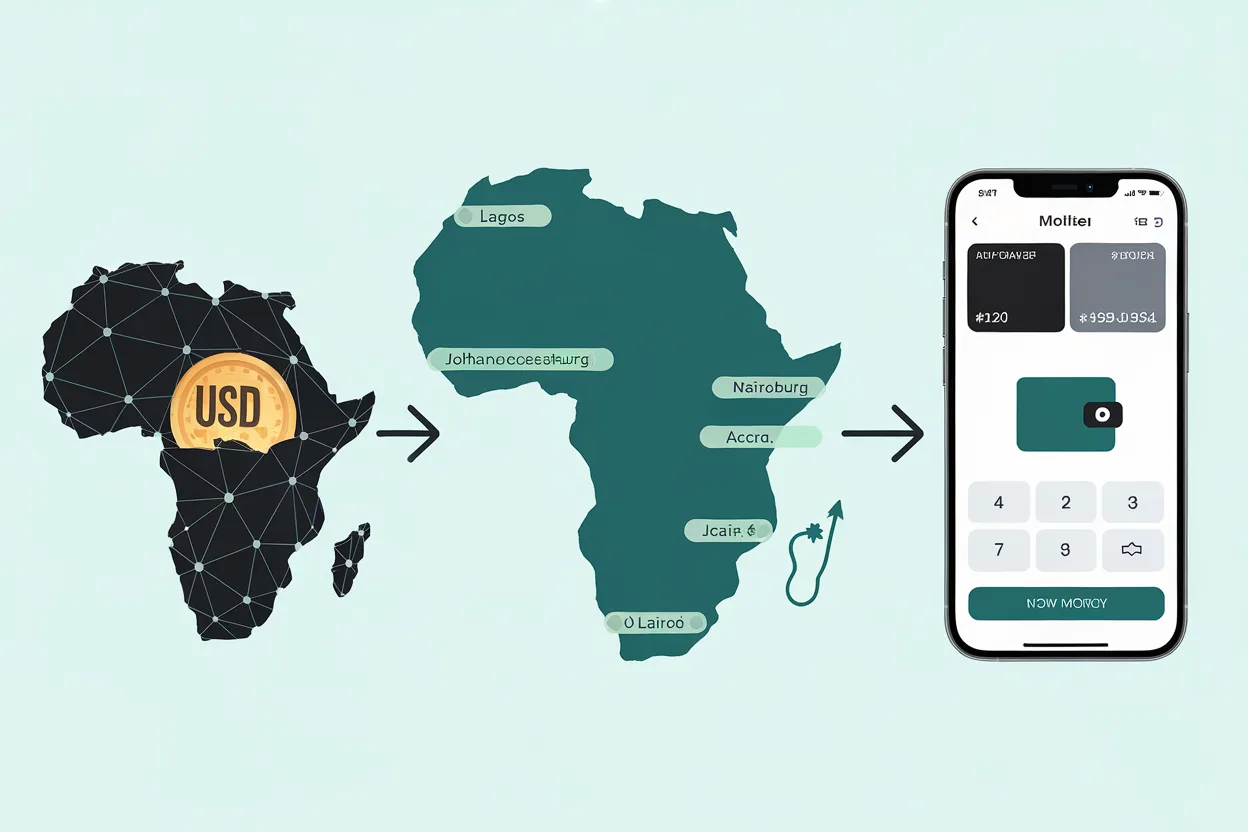
Modern crypto platforms have integrated directly with mobile money rails so USDT arrives as Kenyan shillings on M-Pesa, or as Ghanaian cedis on MTN MoMo:
| Mobile Money | Countries | Crypto Integration | Status (2026) |
|---|---|---|---|
| M-Pesa | Kenya, Tanzania | Kotani Pay, Yellow Card, Binance P2P | Active |
| MTN Mobile Money | Ghana, Nigeria, Uganda, Rwanda +11 others | VALR + Onafriq (April 2026), Binance P2P | Active |
| Airtel Money | 14 African countries | Planned/Exploratory | Coming 2026 |
| Orange Money | Francophone West Africa | Binance P2P, local exchanges | Active (P2P) |
| MoMo (Mobile Money Global) | Multiple | Yellow Card | Active |
Step-by-Step: Sending USDT to Africa
TLDR: Sending USDT to Africa is a simple flow — buy USDT, send via TRC-20 (under $1 fee), have the recipient sell on a local P2P exchange, and cash out to mobile money — with funds usually arriving in under an hour.
- Buy USDT on an international exchange — Binance, Coinbase, Kraken, or Bybit. Use a bank transfer or debit card. Fee: 0.1-1%.
- Send via TRC-20 — Select Tron network when withdrawing. Fee: $1. Avoid ERC-20 (Ethereum) which costs $5-$20.
- Recipient converts via P2P or platform — Three options:
- Binance P2P: recipient finds a local buyer paying in NGN/KES/GHS/UGX via bank or mobile money
- Yellow Card: direct crypto-to-mobile-money delivery in 20+ African countries
- Local exchange: VALR (South Africa), Yellow Card (multi-country), Kotani Pay (M-Pesa)
- Money arrives in bank or mobile money — Typical arrival time: 15-60 minutes for P2P, seconds for direct platform rails like Yellow Card.
Important: Always verify the receiver’s identity and test with a small amount ($10-$20) first. P2P counterparty risk is real — use only verified traders with 100+ completed trades and 95%+ success rates. Our P2P Safety Guide covers the full checklist.
Top Crypto Remittance Platforms for Africa
TLDR: Yellow Card is Africa’s largest licensed crypto exchange (20+ countries), but the best platform depends on your corridor — compare Yellow Card, Binance P2P, and local off-ramps on fees (0–2%), payout speed, and mobile-money support.
1. Yellow Card (Continental Coverage)
Lagos-based Yellow Card is the largest licensed African crypto exchange, operating in 20+ countries including Nigeria, Kenya, Ghana, Uganda, Tanzania, South Africa, and Cameroon. Yellow Card offers a remittance API used by businesses and a direct consumer app with crypto-to-mobile-money payouts. Fees: 1-2% depending on corridor and volume.
2. Binance P2P (Volume Leader)
Binance P2P has the deepest liquidity for every major African currency. Fees are 0% for takers and 0.15-0.35% for makers. Payment methods include bank transfer, M-Pesa, MTN MoMo, Orange Money, and dozens of local options. Binance also launched “One Click Buy/Sell” in Ghana, Tanzania, Uganda, and Zambia for simpler flows.
3. Kotani Pay (M-Pesa Specialist)
Kotani Pay specializes in crypto-to-M-Pesa integration across East Africa. Backed by Tether (which invested in October 2025), Kotani Pay provides the infrastructure layer for stablecoin-to-mobile-money conversion. Used by other remittance apps as a back-end.
4. VALR (South Africa Focus)
VALR is South Africa’s largest licensed crypto exchange. In April 2026, VALR partnered with Onafriq (formerly MFS Africa) to enable mobile money funding across MTN markets — a major expansion for West and Central Africa coverage.
5. Chipper Cash (Consumer App)
Chipper Cash is a pan-African fintech with crypto features available in Uganda. It focuses on cross-border consumer payments and has limited but growing crypto functionality. Not yet a full crypto remittance solution but improving.

Country-by-Country Guide
TLDR: Each African market has its own rails and rules: Nigeria and Kenya offer deep P2P liquidity and instant mobile-money cash-out, while smaller markets may need a regional exchange — always check local off-ramp options first.
Each African country has its own payment rails, regulatory stance, and currency dynamics. Here is the quick reference for the top markets:
| Country | Best Method | Payment Rails | Notes |
|---|---|---|---|
| Nigeria | Binance P2P, Yellow Card | NGN bank transfer | SEC-licensed exchanges required; see Nigeria guide |
| Kenya | Kotani Pay, Binance P2P | M-Pesa (60M+ users) | New VASP regs 2026; 3% tax on digital assets |
| Ghana | Binance P2P, Yellow Card | MTN MoMo, Vodafone Cash | VASP Bill passed; VARO established 2026 |
| South Africa | VALR, Binance, Luno | EFT bank transfer | FSCA licenses 310+ CASPs; most regulated market |
| Uganda | Binance P2P, Chipper Cash | MTN MoMo, Airtel Money | Regulatory gray area; high mobile money adoption |
| Tanzania | Binance P2P, Yellow Card | M-Pesa, Tigo Pesa, Airtel Money | Growing market; mobile money dominant |
| Senegal | Binance P2P | Orange Money, Wave | Francophone; CFA franc; Wave is major disruptor |
| Egypt | P2P only (informal) | Bank transfer / Instapay | Crypto prohibited by CBE; high legal risk |
| Ethiopia | No safe option | Telebirr (mobile money) | NBE crypto ban; framework coming mid-2026 |
Regulatory Landscape (2026 Snapshot)
TLDR: African crypto regulation is evolving fast in 2026 — several major markets now license exchanges while others stay restrictive — so always use a platform registered in the recipient’s country to avoid frozen funds.
African crypto regulation is evolving rapidly. Here is where each major market stands:
| Country | Status | Key Regulation |
|---|---|---|
| South Africa | Licensed | FSCA licenses 310+ CASPs as of March 2026 |
| Nigeria | Regulated | SEC DAX licensing; CBN lifted banking ban late 2023 |
| Ghana | Regulated (new) | VASP Bill 2026; VARO established; 11 companies in sandbox |
| Kenya | In transition | Draft VASP Regulations 2026; 3% digital asset tax |
| Uganda | Gray area | No specific crypto law; warnings issued but not enforced |
| Egypt | Prohibited | CBE blanket prohibition; penalties up to EGP 10M + prison |
| Ethiopia | Banned | NBE ban on birr P2P; national framework expected mid-2026 |
For detailed country-by-country legal status of all 30+ countries we cover, see our Global Crypto Regulation Guide.
Critical warning: Do not attempt crypto remittances to Egypt or Ethiopia until the legal landscape clarifies. The penalties are real and severe. Use traditional channels (bank wire, Instapay, official MTOs) for these corridors.
Security and AML Considerations
TLDR: Larger African transfers draw extra AML scrutiny, so use a licensed exchange, keep transfers documented, and expect identity checks above ~$10,000 — cutting corners risks frozen funds, not just higher fees.
Sending larger amounts to Africa triggers more AML (anti-money-laundering) scrutiny than most corridors. Protect yourself:
- Keep records — Source of funds documentation becomes critical at $10,000+. Save pay stubs, tax returns, or transaction history from the sender side. Our Cash-Out Guide covers the AML checklist in detail.
- Use licensed platforms when available — Yellow Card (multi-country), VALR (South Africa), and registered SEC DAX operators in Nigeria reduce compliance risk.
- P2P traders: verify 100+ trades — Binance P2P lets you filter by trade volume and success rate. Never trade with unverified new accounts.
- Test with small amounts — Send $10-$20 first to verify the receiver’s wallet or mobile money number before sending the full amount.
- Tax obligations — Both sender (in some jurisdictions) and receiver (Kenya 3% tax, Nigeria CGT) may owe tax. Our Crypto Tax Guide covers the rules by country.
Common Mistakes to Avoid
TLDR: The costliest mistakes are using the wrong network (USDT on Ethereum instead of TRC-20 can cost $15+ in fees), skipping P2P seller ratings, and ignoring local off-ramp spreads that can quietly add 15%.
- Mistake 1: Using ERC-20 for small amounts — $15 Ethereum gas on a $100 transfer eats 15% of the money
- Mistake 2: Sending BTC to African recipients — they need stable value, not Bitcoin volatility
- Mistake 3: Trading P2P without escrow — always use Binance P2P or Yellow Card escrow, never direct bank transfer to strangers
- Mistake 4: Attempting crypto in Egypt or Ethiopia — severe legal consequences
- Mistake 5: Ignoring mobile money — for Kenya/Tanzania/Ghana/Uganda recipients, mobile money is faster and cheaper than bank rails
Africa Remittance Platforms Head-to-Head (2026)
TLDR: For most people the safest pick across Nigeria, Kenya, Ghana and francophone Africa is Yellow Card — the only licensed stablecoin on/off-ramp at scale, with upfront spread-based pricing and no counterparty-freeze risk. Raw P2P (NoOnes, or Binance counterparties) can be a little cheaper on USDT (TRC-20), but the saving comes with fraud and account-freeze exposure. M-Pesa and MTN MoMo are the cash-out destinations, reached through these platforms — not crypto wallets themselves.
| Platform | What it is | Africa coverage | Stablecoin / network | Cost (rough) | Off-ramp | Main strength | Main risk |
|---|---|---|---|---|---|---|---|
| Yellow Card | Licensed on/off-ramp app + API | ~20 countries (NG, KE, GH, CM, SN, CI, ZM…) | USDT, USDC, PYUSD; free transfers on Polygon/Solana/Celo/Stellar | Spread + ~1–2% deposit (varies by country) | Bank, 45 mobile-money rails, 25k cash agents | Only at-scale licensed VASP; transparent, escrow-free risk | Not always the cheapest on tiny trades |
| NoOnes | P2P marketplace (Paxful successor) | NG, GH, KE, EG + emerging markets | USDT (TRC-20), USDC, BTC… | Sell ~1%; cash-out ~3.5%+provider | Bank, M-Pesa/MoMo, cash, gift cards | 500+ local payment methods; tiered KYC for small trades | Open-marketplace P2P fraud (reversals, fake payment) |
| Binance P2P | Global exchange + P2P escrow | Continent-wide except native NGN (pair removed Feb 2024) | USDT (TRC-20/BEP-20/ERC-20), USDC… | 0% platform fee; cost = counterparty spread ~0.5–2% | Counterparty bank / mobile money | Deepest global liquidity | Bank-account freezing (tainted counterparty funds); regulatory hostility |
| Kotani Pay | B2B stablecoin↔mobile-money API (USSD) | KE, GH, ZM, ZA (expanding) | USDT, USDC, cUSD | B2B pricing (no public retail rate) | Mobile money over USSD (works on feature phones) | True last-mile / unbanked reach | Not a consumer app — used via other products |
| CoinCola | P2P + OTC + gift-card marketplace | Niche: Nigeria (NGN), Cameroon (XAF) | USDT (multi-network, TRC-20 most common) | 0% to take an offer; cost = spread | Bank, mobile money, gift cards | XAF/Cameroon + gift-card liquidity others lack | ⚠ Frequent frozen-account / stuck-withdrawal reports; thin regulation — use cautiously |
| M-Pesa | Mobile money (cash-out rail, not crypto) | Kenya core (~60M users) | None natively — holds KES | Safaricom KES withdrawal tariff | It is the cash-out endpoint | Instant, ubiquitous, trusted in Kenya | No native crypto rail in 2026 (ADI deal still rolling out) — reach it via Yellow Card/NoOnes/Kotani |
One pattern holds across every row: the off-ramp spread, not the on-chain network fee, is where the real cost lives. A USDT transfer on Tron costs cents to move; what varies — and what decides whether you actually beat a bank — is the local buy/sell spread when the recipient converts to naira, cedis or shillings. Independent 2026 data backs this up: stablecoins are now roughly three-quarters of Africa’s crypto-payment volume, and a USDT→KES→M-Pesa cash-out typically settles in under 15 minutes, so speed isn’t the bottleneck — the spread is.
Bottom Line: Best Platform by Use Case
TLDR: If you’re unsure, use Yellow Card — it’s the licensed, upfront, beginner-safe default across its ~20 countries. Choose a raw P2P route (NoOnes) only when you want maximum payment-method choice and are comfortable managing counterparty risk.
- Beginner-safest, any covered country → Yellow Card — the only at-scale licensed VASP with transparent pricing; the honest “if in doubt, use this” pick.
- Small Nigeria USDT→naira off-ramp → Yellow Card (licensed, no freeze/counterparty risk). Avoid relying on native Binance NGN — that pair was removed in 2024.
- Maximum payment-method choice in Nigeria/Ghana (P2P-comfortable) → NoOnes — 500+ rails, light KYC for small tickets; accept the standard P2P-fraud caution.
- Kenya USDT→M-Pesa, small amounts → off-ramp via Yellow Card or NoOnes into M-Pesa — Safaricom has no native crypto rail yet, so you route through a third party.
- Ghana USDT→MoMo → Yellow Card (consumer), or Kotani Pay if you’re using an app built on it.
- Francophone Africa / Cameroon (XAF) → Yellow Card for the safe licensed path; CoinCola only as a niche fallback, with eyes open to its freeze/withdrawal complaints.
- Lowest all-in fee where a liquid off-ramp exists → P2P USDT on TRC-20 (NoOnes or Binance counterparties), roughly 0.5–1.5% — but the off-ramp spread dominates and the saving carries counterparty/freeze risk.
- Large amounts or business payouts → Yellow Card OTC/API, or Kotani Pay’s B2B mobile-money rail — institutional-grade rather than open P2P order books.
Whichever you choose, the universal safety rule still applies: match the network on both ends and send a small test first — wrong-network sends, not volatility, are the single biggest way people lose money moving crypto across borders.
Frequently Asked Questions
What is the cheapest way to send money to Africa?
For most corridors (US/UK/EU → Nigeria, Kenya, Ghana, Uganda, Tanzania), the cheapest path is: buy USDT on a major exchange, send via TRC-20 (~$1 fee), and have the recipient convert via Binance P2P or Yellow Card. Total cost: 1-2%, compared to 8-10% for traditional bank wires. For South Africa, VALR is the most trusted licensed on/off-ramp.
Is crypto remittance legal in my African country?
Legal and regulated in South Africa, Nigeria, Ghana. In transition in Kenya. Gray area in Uganda, Tanzania. Prohibited in Egypt and Ethiopia — do not attempt. Always check current regulations before large transfers. Our Global Regulation Guide has the latest status.
How long does a crypto remittance to Africa take?
Blockchain transfer: 1-5 minutes on TRC-20 (Tron). Fiat conversion: 15-60 minutes via P2P, seconds-to-minutes via Yellow Card direct. Total end-to-end: typically under 1 hour — compared to 3-5 days for bank wires.
Can I send crypto directly to M-Pesa or MTN Mobile Money?
Not directly to the mobile money app, but several services (Kotani Pay, Yellow Card, Binance P2P) bridge the gap. You send USDT to their platform, and they deliver local currency straight to the recipient’s mobile money account. This is the fastest and most efficient method for East/West African recipients who do not have bank accounts.
What about exchange rate markups?
This is where crypto wins hardest. Banks and MTOs typically add 2-4% to the official exchange rate (this is the “hidden fee” most consumers miss). Crypto P2P uses live market rates with spreads under 0.5% in high-volume markets like Nigeria and Kenya. On a $500 transfer, that is $10-$20 saved on exchange rate alone, on top of the lower transaction fees.
Continue Learning
Remittance Cluster:
- Crypto vs Bank Transfers: Remittance Cost Guide
- Best Blockchain for Sending Money
- How to Send USDT Abroad: Step-by-Step
- Stablecoin Remittances Explained
- How to Transfer USDT to a Bank Account
- Crypto Cash Out & Off-Ramp Guide
- USDT vs USDC for Remittances
Country Guides:
- Nigeria · Philippines · India · Brazil
Related:

Editorial pen name · ChainGain
Alex Mercer is the editorial pen name used for ChainGain’s cryptocurrency education content. Articles are based on cited sources and reproducible comparisons. Editorial profile
Disclaimer: This article is for informational purposes only and does not constitute financial, tax, or legal advice. Cryptocurrency regulations in Africa are rapidly evolving; always verify current legal status in your country before transacting. Crypto remittances in prohibited jurisdictions (Egypt, Ethiopia) carry significant legal risk. Consult a qualified professional for advice specific to your jurisdiction. Sources: World Bank Remittance Prices Worldwide, Chainalysis 2025 Global Crypto Adoption Index.