Stablecoin ETF 2026: The 3 Categories Investors Confuse (Tokenized MMFs vs Equity ETFs vs Pending Direct Funds)
Disclosure: ChainGain may earn a commission when you sign up through partner links. This article is educational, not financial, tax, or legal advice. ETF and stablecoin investments carry capital, regulatory, and counterparty risk — consult a fiduciary advisor and tax professional for your situation. See our full disclosure and risk policy.
Key Takeaways
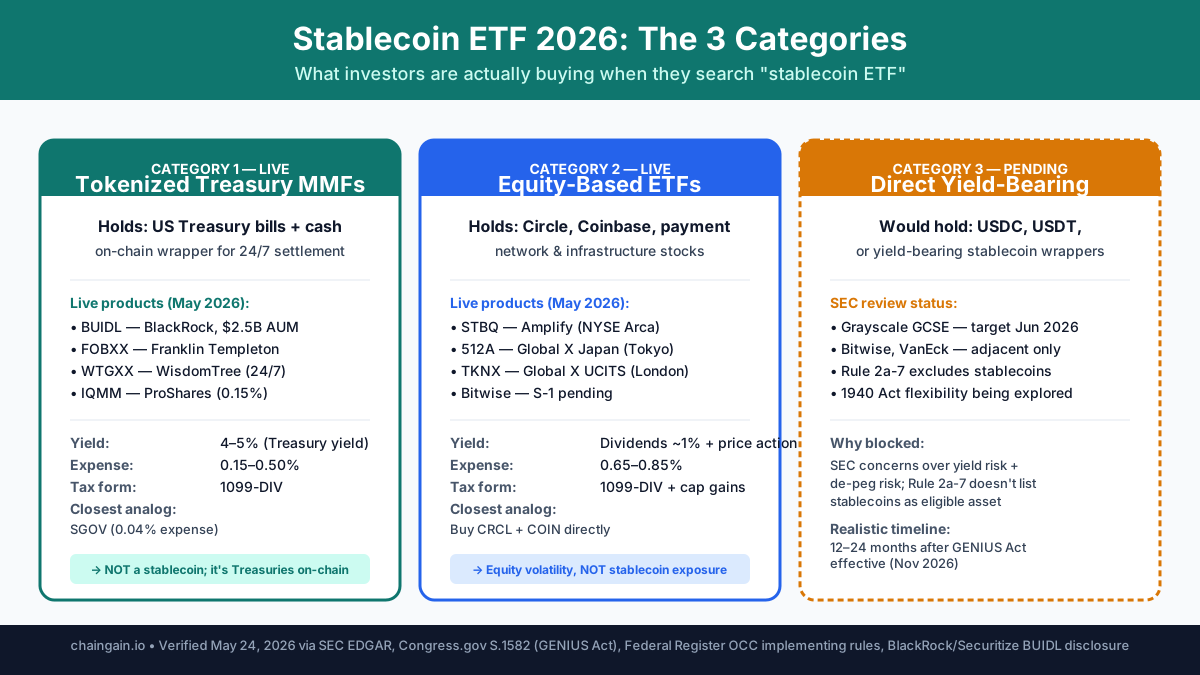
- There is no US-listed ETF that holds USDC or USDT directly — the SEC has not approved a direct yield-bearing stablecoin ETF as of May 2026. What investors are buying instead falls into three different categories.
- Category 1 — Tokenized Treasury MMFs are live: BlackRock BUIDL ($2.5B AUM), Franklin Templeton FOBXX, WisdomTree WTGXX (24/7 trading approved February 2026), and ProShares IQMM (0.15% expense, launched February 2026 under the GENIUS Act framework).
- Category 2 — Equity-Based Stablecoin ETFs hold company shares, not stablecoins: Amplify STBQ (live on NYSE Arca near $22), Global X 512A (Tokyo), Global X TKNX UCITS (London, April 2026 launch), and Bitwise’s pending Stablecoin & Tokenization filing.
- Category 3 — Direct Yield-Bearing Stablecoin ETFs remain SEC-pending due to yield-risk concerns; Grayscale’s GCSE filing currently targets June 2026.
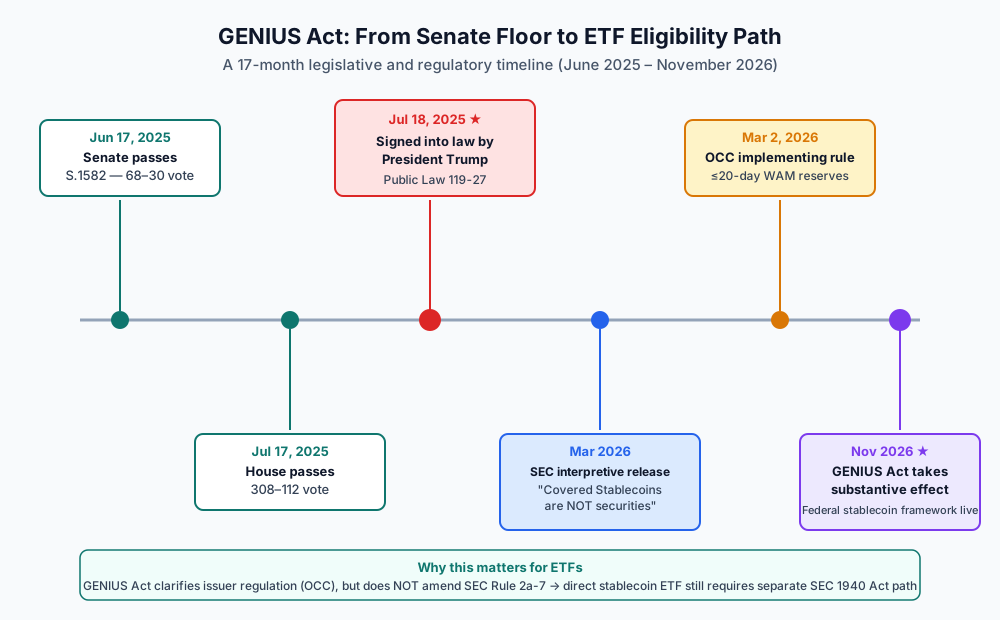
- The GENIUS Act (S.1582 / Public Law 119-27) was signed into law on July 18, 2025 and becomes effective in November 2026, creating a separate OCC framework for stablecoin issuers (20-day weighted-average-maturity rule) outside the SEC Money Market Fund Rule 2a-7.
- For most US retail investors, SGOV (iShares 0-3 Month Treasury ETF) at ~0.04% expense is the closest “boring alternative” to what people imagine a stablecoin ETF should be — and you should compare against it before paying 0.15–0.85% to a tokenized or equity-based product.
- The tax form matters: ETF distributions arrive as 1099-DIV (qualified or ordinary), DeFi stablecoin yield is typically self-reported as ordinary income, and the after-tax difference can swing 1–2% on a 5% yield depending on your bracket and state.
The landscape on May 24, 2026 looks nothing like the speculation we were reading 12 months ago — and it looks nothing like what most “Stablecoin ETF 2026” articles still describe.
Most coverage published right now treats “stablecoin ETF” as a single category. It is not. There are three structurally different things investors are calling by that name: tokenized money market funds backed by Treasuries, equity ETFs that hold the stocks of stablecoin issuers and payment processors, and the direct yield-bearing stablecoin funds that the SEC has not yet allowed. Conflating them is how readers end up buying exposure to Circle’s stock price when they thought they were buying USDC, or paying a 0.85% expense ratio for what amounts to a Treasury MMF they could replicate with SGOV at 0.04%.
This guide is structured around that confusion. We start by separating the three categories with concrete products and live tickers as of May 2026, then walk through how each category differs from simply holding USDC in a wallet or buying CRCL stock directly, and finish with a decision tree by investor profile. The data behind every dollar figure, expense ratio, and AUM number was verified against SEC EDGAR, the Federal Register, BlackRock’s BUIDL page, and Securitize.io between May 21 and May 24, 2026.
Quick Answer: What Counts as a “Stablecoin ETF” in 2026?
None of the products marketed as “stablecoin ETFs” in 2026 actually hold USDC or USDT inside the fund. The SEC has not approved a direct stablecoin-holding ETF, and under the current Money Market Fund Rule 2a-7 it cannot. What investors are actually buying breaks into three categories, each with a different risk and tax profile:
| Category | What the fund actually holds | Live examples | Expense ratio | Closest alternative |
|---|---|---|---|---|
| Tokenized Treasury MMFs | US Treasury bills, cash, repos — settled on-chain | BUIDL, FOBXX, WTGXX, IQMM | 0.15–0.50% | SGOV (~0.04%) |
| Equity-Based Stablecoin ETFs | Shares of Circle, Coinbase, payment networks, infra | STBQ, Global X 512A, TKNX, Bitwise filing | 0.50–0.85% | Direct CRCL + COIN purchase |
| Direct Yield-Bearing Stablecoin ETFs | USDC, USDT, or yield-bearing stablecoin wrappers | None live as of May 2026; Grayscale GCSE pending | n/a | Aave/Compound USDC yield |
Verified May 21–24, 2026 via SEC EDGAR, Congress.gov S.1582, Federal Register OCC implementing rule, and issuer disclosure pages.
Want to see how stablecoin movement costs compare against traditional rails? Use the calculator below before deciding whether a wrapper is worth the expense ratio:
Category #1 — Tokenized Treasury Money Market Funds (BUIDL, FOBXX, WTGXX, IQMM)
This is the category that has actually scaled. Tokenized Treasury money market funds hold US Treasury bills and overnight repos like a traditional MMF, but the fund shares are issued as tokens on a public or permissioned blockchain. Investors get money-market-style yield plus the ability to settle 24/7 in stablecoin-equivalent rails. BlackRock’s BUIDL alone passed $2.5 billion in assets under management in May 2026, distributing $4–8 million in monthly dividends, according to Securitize’s disclosures.
| Product | Issuer | Ticker / Symbol | AUM (May 2026) | Expense ratio | Access |
|---|---|---|---|---|---|
| BUIDL (USD Institutional Digital Liquidity Fund) | BlackRock / Securitize | BUIDL (token) | ~$2.5B | 0.20–0.50% | Qualified purchaser, $5M minimum |
| FOBXX (Franklin OnChain US Government Money Fund) | Franklin Templeton | FOBXX | $700M+ | 0.15% | Retail mutual fund + onchain rails |
| WTGXX (WisdomTree Government Money Market Digital Fund) | WisdomTree | WTGXX | ~$100M | 0.20% | Retail; 24/7 trading approved Feb 2026 |
| IQMM (ProShares GENIUS Money Market ETF) | ProShares | IQMM (NYSE) | Launching scale | 0.15% | Retail ETF via any broker, launched Feb 2026 |
What they actually hold: short-dated US Treasury bills (typically 1–3 month), overnight reverse repos, and cash. BUIDL custodied by BNY Mellon. Yields are essentially the SOFR / 1-month Treasury rate minus expenses, which puts them in the 4–5% range as of May 2026 depending on issuer.
Why this is not what most people imagine: a tokenized Treasury MMF is, economically, just a Treasury MMF. The on-chain wrapper adds 24/7 settlement and programmability for institutional treasury managers; it does not give you exposure to USDC, USDT, or stablecoin issuer profits. The closest non-tokenized alternative is iShares SGOV (0–3 Month Treasury ETF) at roughly 0.04% expense — an order of magnitude cheaper for the same Treasury exposure, if you do not need on-chain settlement.
Who actually benefits from the on-chain version: institutional treasurers who need to move yield-bearing collateral around DeFi protocols or settle outside banking hours, and qualified-purchaser HNW individuals who want programmable cash. For a US retail investor with no DeFi workflow, the tokenized version is a worse trade than SGOV.
Category #2 — Equity-Based Stablecoin & Tokenization ETFs (STBQ, Global X 512A, TKNX, Bitwise)
This is the category that dominated the “stablecoin ETF” AI Overview citations and most retail-press coverage in early 2026 — and it is the one most likely to be misunderstood. Equity-based stablecoin ETFs hold the publicly traded shares of companies that issue stablecoins, operate exchanges, or build payment infrastructure. They do not hold stablecoins. Your exposure is to the issuer’s stock price, which can fall while USDC stays at a dollar (and has).
| Product | Ticker / Listing | What it holds (representative) | Expense ratio | Live as of May 2026 |
|---|---|---|---|---|
| Amplify Stablecoin Technology ETF | STBQ / NYSE Arca | Circle (CRCL), Coinbase (COIN), Visa, Mastercard, infra plays | ~0.85% | Yes (~$21.92 in late May) |
| Global X Stablecoins & Tokenization ETF (ex-Japan) | 512A / Tokyo Stock Exchange | Equities benefiting from tokenization (ex-Japan index) | 0.65% | Yes (Japan retail) |
| Global X Stablecoin & Tokenisation UCITS ETF | TKNX / London Stock Exchange | UCITS-eligible equity basket; mirrors 512A methodology | 0.65% | Yes (Europe, launched April 16, 2026) |
| Bitwise Stablecoin & Tokenization ETF | S-1 pending | Equal-weight equities + crypto ETPs blend | TBD | SEC review |
Why these are not a substitute for owning a stablecoin: Circle (CRCL) went public on June 5, 2025 at $31 per share, opened at $82.84 the same day, hit an all-time high near $299 on June 23, 2025, and traded around $61.92 by February 2026 — a 79% drawdown from its peak inside eight months. The underlying USDC stayed at a dollar through that entire period. If you bought STBQ because you wanted “stablecoin exposure,” what you got was concentrated equity volatility in the issuer.
When equity-based ETFs make sense: when you have a thesis on the growth of the stablecoin economy itself — payment volume, on-chain settlement adoption, issuer profitability — and you want diversified exposure across issuers, exchanges, and payment networks rather than picking individual stocks. STBQ and the Global X products give you that thematic basket. They are not safer than holding USDC; they are a different investment entirely.
STBQ vs just buying CRCL + COIN directly: STBQ’s 0.85% expense ratio is reasonable for a thematic ETF, but if you only want exposure to Circle and Coinbase, you can buy both stocks for one-time commission costs (zero at most brokers) and avoid the ongoing fee. The ETF’s value is in the breadth of payment-infrastructure names you would not buy individually (Visa, Mastercard, smaller infra plays).
Category #3 — Direct Yield-Bearing Stablecoin ETFs (Still SEC-Pending)
This is the category most investors actually want and the one US regulators have not yet allowed. A direct yield-bearing stablecoin ETF would hold USDC, USDT, or similar dollar-pegged tokens and pass through the underlying Treasury yield (or DeFi yield) to ETF shareholders — with SEC oversight, broker access, and 1099-DIV tax reporting. As of May 24, 2026, there is no live US-listed product in this category.
What is in SEC review: Grayscale’s Stablecoin Ecosystem ETF (proposed ticker GCSE) has been amending its S-1 through 2025 and 2026; the latest Post-Effective Amendment pushed expected launch to June 2026 at the earliest. The structure proposed by Grayscale is a blend — it would hold stablecoins alongside equity exposure to the ecosystem — rather than a pure direct stablecoin fund. Other issuers (Bitwise, VanEck) have filed adjacent products but not pure stablecoin funds.
Why the SEC has been slow: the Money Market Fund Rule 2a-7 that governs traditional MMFs does not contemplate stablecoin holdings. Stablecoins are not the same as the eligible Treasury, repo, and commercial paper instruments that 2a-7 allows. To wrap stablecoins inside an SEC-registered fund, either Rule 2a-7 needs amendment or a new fund category must be created. The GENIUS Act addresses the issuer side of this gap by creating an OCC framework for federally regulated stablecoin issuers (Weighted Average Maturity ≤ 20 days for reserves), but it does not directly create a new ETF wrapper.
What changed with the SEC’s March 2026 guidance: in March 2026, the SEC released a landmark interpretive release on the application of federal securities laws to crypto assets, explicitly stating that “Covered Stablecoins” issued by qualified regulated entities do not involve the offer or sale of a security under standard conditions. This clears a major theoretical hurdle for direct stablecoin ETFs, but it does not change Rule 2a-7. Issuers are now working on filings that would use the SEC’s 1940 Act flexibility outside the MMF framework. Expect 12–24 months before the first pure direct stablecoin ETF launches in the US, if at all.
The GENIUS Act 2025-2026 — What the New Stablecoin Law Actually Changes
The Guiding and Establishing National Innovation for U.S. Stablecoins Act (S.1582 in the 119th Congress) passed the Senate 68–30 on June 17, 2025, cleared the House 308–112 on July 17, 2025, and was signed into law by President Trump on July 18, 2025 as Public Law 119-27. The substantive rules become effective in November 2026.
What the law does: creates a federal framework for “payment stablecoin” issuers, with the OCC as the primary federal regulator for nationally chartered stablecoin issuers and dual federal/state oversight permitted for smaller issuers. Issuers must hold reserves in high-quality liquid assets with a weighted average maturity not exceeding 20 days — tighter than the 60-day limit that applies to traditional money market funds under Rule 2a-7. Monthly attestations are required; annual audits for issuers above a size threshold.
What it does not do: it does not authorize SEC-registered ETFs to hold stablecoins. It does not preempt all state money-transmitter rules. It does not classify stablecoins as securities (which the SEC’s March 2026 guidance subsequently confirmed for “Covered Stablecoins”). It does not directly address yield-bearing stablecoins; the OCC and SEC have indicated that interest-bearing stablecoins fall outside the “payment stablecoin” definition and may require separate treatment.
| Topic | Pre-GENIUS Act (2024) | Post-GENIUS Act (Nov 2026 effective) |
|---|---|---|
| Federal regulator for issuers | Patchwork: state money transmitter, OCC sometimes, no federal floor | OCC primary for national charters; clear federal floor |
| Reserve composition rule | Issuer-defined (Tether held bills, gold, BTC; Circle held bills + cash) | High-quality liquid assets only; ≤ 20-day WAM |
| Attestation cadence | Quarterly (Tether), monthly (Circle), no federal mandate | Monthly attestation + annual audit (size-based) |
| Are stablecoins securities? | Ambiguous; case-by-case SEC enforcement risk | March 2026 guidance: “Covered Stablecoins” are NOT securities |
| Does it create a stablecoin ETF wrapper? | No | No; separate filings still required under SEC 1940 Act |
| Interest-bearing stablecoin allowed? | Gray area (USDY, sUSDe operate offshore or by accredited only) | Excluded from “payment stablecoin” definition; separate path needed |
The practical effect for the ETF question is narrower than the headlines suggest: GENIUS Act cleans up the issuer side (USDC and USDT will be operating under a clearer federal framework once effective in November 2026), but it does not create a new ETF wrapper for stablecoins themselves. That gap is what Grayscale GCSE and other 2026 filings are trying to fill from the SEC side.
How Each Category Compares to Just Holding USDC Direct (or SGOV)
This is the comparison most readers actually want. Below we line up the three ETF categories against the alternatives a self-directed investor can already access today: holding USDC in a wallet, lending USDC on Aave or Compound for DeFi yield, buying SGOV for short Treasury exposure, and buying CRCL stock for direct Circle issuer exposure.
| Vehicle | Yield (May 2026) | Tax form (US) | Custody | SEC regulation tier | Liquidity | Min amount | Counterparty layers |
|---|---|---|---|---|---|---|---|
| Direct USDC (self-custody wallet) | 0% (token itself) | n/a until disposed | You | Not a security under SEC March 2026 guidance | 24/7 on-chain | Any | Circle (issuer) + reserve custodians |
| USDC supplied to Aave / Compound | 3–6% variable | 1099-MISC or self-report (ordinary income) | You hold aUSDC | DeFi; outside SEC framework | 24/7 on-chain | Any | Circle + Aave smart contract + protocol governance |
| BUIDL (tokenized Treasury MMF) | 4–5% | 1099-DIV (qualified purchaser) | Securitize / BNY Mellon | 1940 Act fund (private placement) | 24/7 on-chain | $5M qualified purchaser | Treasury issuer + BlackRock + Securitize + BNY Mellon |
| IQMM / FOBXX / WTGXX (retail tokenized MMF) | 4–5% (ex expense) | 1099-DIV | Issuer custodian | 1940 Act registered fund | Market hours (ETF) or 24/7 (WTGXX) | Retail (any) | Treasury issuer + ETF issuer + custodian |
| SGOV (iShares 0–3 Month Treasury ETF) | ~3.9% (30-day SEC yield, May 2026) | 1099-DIV (state-tax-exempt for Treasury portion) | BlackRock / State Street | 1940 Act registered ETF | NYSE market hours | Retail (any) | Treasury issuer + BlackRock + State Street |
| STBQ (equity-based stablecoin ETF) | Dividends only (~1%); price-driven returns | 1099-DIV (qualified or ordinary) + capital gains | Amplify / custodian | 1940 Act registered ETF | NYSE Arca market hours | Retail (any) | ~30 equity issuers + ETF issuer + custodian |
| Direct CRCL or COIN stock | Dividends only or none | 1099-DIV + capital gains | Brokerage | 1933/1934 Act listed equity | NYSE market hours | 1 share | 1 issuer + brokerage |
| Direct yield-bearing stablecoin ETF (hypothetical) | ~4–5% net of expense | 1099-DIV (anticipated) | Future custodian | Not yet approved | n/a | n/a | Stablecoin issuer + ETF issuer + custodian + reserve assets |
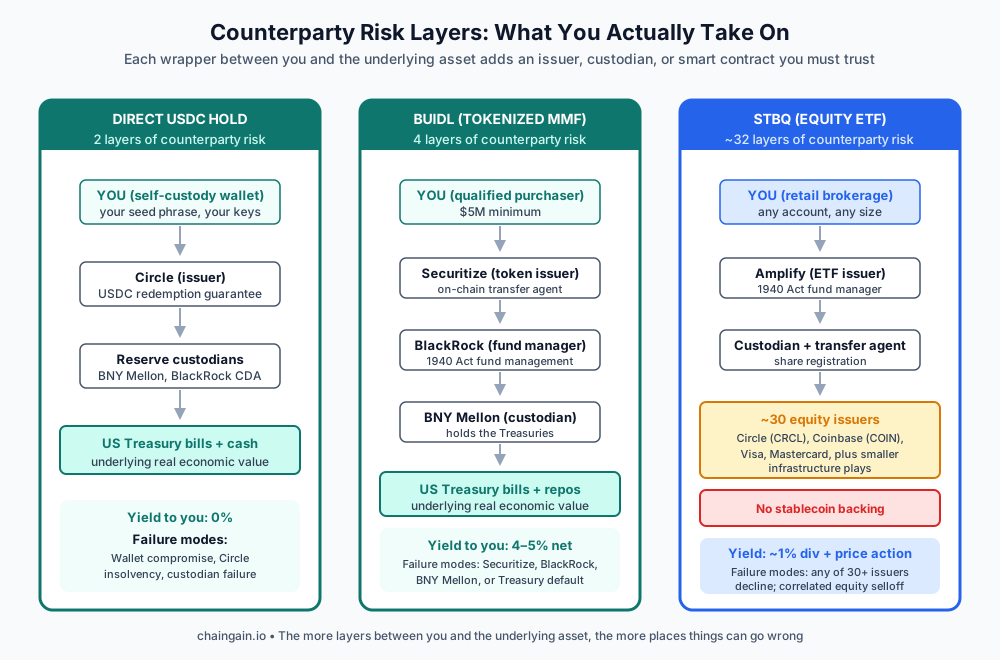
The honest takeaway from this table: if your goal is yield with US Treasury risk, SGOV is the closest thing to a “boring” stablecoin ETF and it has been live with full SEC oversight for years at a 0.04% expense ratio. Tokenized MMFs add 24/7 settlement and DeFi programmability at the cost of higher expense ratios (0.15–0.50%) and, for BUIDL specifically, a $5M qualified-purchaser minimum. Equity-based stablecoin ETFs are not yield products at all — they are thematic equity bets. And the direct yield-bearing stablecoin ETF most readers imagine when they Google this topic does not yet exist as a US-listed product.
Tax Treatment: Why the Vehicle Choice Can Cost You 1–2% After-Tax (US Focus)
The tax form matters more than most retail investors realize. On a 4.5% gross yield, the difference between qualified dividend treatment, ordinary dividend treatment, and self-reported DeFi income can move your after-tax return by 1–2 percentage points depending on your federal bracket and your state.
Three patterns matter for US filers (consult a CPA for your situation; nothing here is tax advice):
- ETF distributions from tokenized MMFs (BUIDL, FOBXX, IQMM): arrive on Form 1099-DIV as ordinary dividends. The Treasury-bill portion is typically exempt from state income tax in most states, the same way SGOV distributions are. Federal ordinary rate applies (10–37% bracket).
- DeFi stablecoin yield (Aave aUSDC, Compound cUSDC, Pendle PT-USDC): no 1099 is issued by the smart contract. You are responsible for self-reporting yield as ordinary income, and the underlying receipt token may trigger taxable events on protocol upgrades or migrations. State treatment is generally less favorable (no Treasury exemption).
- Equity-based stablecoin ETF distributions (STBQ): a mix of qualified and ordinary dividends from the underlying equities, plus realized capital gains when you sell. Qualified dividends (held > 60 days within a 121-day window around ex-dividend) get long-term capital-gains rates (0/15/20%). Most of STBQ’s growth thesis is unrealized capital appreciation, which is taxed at sale.
Worked example (2026 tax year, US single filer, $200,000 taxable income, 32% federal bracket, 5% state): a $100,000 position yielding 4.5% gross.
| Vehicle | Gross yield | Federal tax | State tax | After-tax yield |
|---|---|---|---|---|
| SGOV / IQMM (Treasury MMF) | $4,500 | $1,440 (32% ordinary) | $0 (Treasury-exempt) | $3,060 / 3.06% |
| Aave USDC DeFi yield | $4,500 | $1,440 (32% ordinary) | $225 (5% state) | $2,835 / 2.84% |
| BUIDL (qualified purchaser only) | $4,500 | $1,440 (32% ordinary) | $0 (Treasury-exempt) | $3,060 / 3.06% |
The 22-basis-point gap between SGOV and Aave (in this scenario) is the state-tax-exemption benefit of Treasury exposure — not insignificant on a six- or seven-figure cash sleeve. Equity ETF results depend entirely on price action and are not comparable to a yield calculation.
For broader crypto tax mechanics by jurisdiction (US, UK, Germany, Australia, Japan), see our Crypto Capital Gains Tax 2026 guide.
Decision Tree — Which Vehicle Matches Your Investor Profile?
The right answer depends on jurisdiction, account type, capital available, yield target, and whether you need on-chain settlement. The framework below maps each profile to its most defensible choice in May 2026.
| Investor profile | Primary recommendation | Why | What to avoid |
|---|---|---|---|
| US retail, taxable brokerage, < $100K cash sleeve | SGOV (or BIL / SHV) | 0.04% expense, 1099-DIV with Treasury state exemption, no on-chain workflow needed | Paying 0.15–0.85% for a wrapper you do not benefit from |
| US retail, IRA / Roth IRA | SGOV inside the wrapper | Tax shelter already; expense ratio is the only differentiator | Tokenized MMFs with $5M minimums (BUIDL inaccessible anyway) |
| US retail with crypto thesis on stablecoin economy | STBQ (or direct CRCL + COIN if you only want those two names) | Diversified equity exposure to the theme; not a yield play | Confusing this with stablecoin-direct exposure |
| HNW US ($5M+, qualified purchaser, needs on-chain rails) | BUIDL or FOBXX onchain rail | 24/7 settlement, programmable cash, institutional custody | Holding raw USDC without insurance for the same yield-less utility |
| EU retail (MiCA jurisdiction) | Global X TKNX UCITS or short EU Treasury ETFs | UCITS regulation; KIID disclosure; EUR settlement | Buying US-listed stablecoin ETFs that may have withholding tax friction |
| Emerging-market retail (no US/EU brokerage access) | USDC self-custody + Aave or Compound supply | Permissionless; no brokerage account needed; capital efficient | Buying ADR or international ETF wrappers via expensive brokers |
| Institutional treasurer needing on-chain settlement | BUIDL (or FOBXX rail) as cash leg | Yield plus 24/7 collateral movement for prime brokers and DEX prime services | Holding non-yielding stablecoins as primary treasury asset |
| DeFi-native investor, no traditional brokerage workflow | Direct USDC supply on Aave / Compound / Morpho | Highest variable yield; permissionless; no expense ratio | Wrapping into ETF for utility you do not need |
The pattern across these profiles: match the wrapper to your access constraints and tax situation, not to the marketing label. “Stablecoin ETF” sounds like one thing but is actually three categories, each of which is overkill or underkill depending on what you can already access.
Bottom Line — What We’d Pick (and What We’d Wait For)
For most US retail investors as of May 2026, the honest answer is that SGOV is the “stablecoin ETF” you actually want at the price you actually want it. A tokenized version adds 24/7 settlement at 5–10x the expense ratio; if you do not have a workflow that uses 24/7 settlement, you are paying for an option you will never exercise.
For HNW investors who do have DeFi or treasury workflows that benefit from on-chain settlement, BUIDL is the credible institutional choice and is the reason Securitize crossed $2.5B in AUM in early 2026. FOBXX (Franklin Templeton) is the closest retail-accessible analog with a lower minimum.
For investors with a thesis on stablecoin economy growth specifically, STBQ provides diversified equity exposure across issuers and payment networks — but understand you are buying equity volatility, not a stable wrapper. CRCL fell roughly 79% from its June 2025 peak by February 2026 while USDC stayed at a dollar; if that drawdown would have been intolerable, this category is not what you want.
For investors waiting for a true direct yield-bearing stablecoin ETF, the most realistic timeline is 12–24 months after the GENIUS Act becomes effective in November 2026 — with the most likely first product coming from Grayscale (GCSE) in a blended structure rather than a pure stablecoin holding. Until then, the cleanest direct exposure remains USDC plus Aave / Compound for yield, or USDC in a CeFi yield product if you can accept counterparty risk and KYC.
For comparing USDC against USDT specifically across these vehicles, see our USDT vs USDC: Best Stablecoin for Remittances deep dive. For the underlying stablecoin types (fiat-backed vs crypto-backed vs algorithmic vs CBDC), see Stablecoin Types 2026. For direct DeFi yield strategies on USDC and USDT, see Stablecoin Savings Rates 2026.
Frequently Asked Questions
Is there a US-listed ETF that holds USDC or USDT directly?
No. As of May 24, 2026, the SEC has not approved any ETF that holds USDC, USDT, or other dollar-pegged stablecoins as primary fund assets. The reason is structural: Money Market Fund Rule 2a-7 governs MMFs and does not include stablecoins as eligible holdings. The GENIUS Act addresses the issuer side of the equation (creating an OCC framework for federally regulated stablecoin issuers), but it does not amend Rule 2a-7 or create an SEC-registered stablecoin-holding fund category. Products marketed as “stablecoin ETFs” either hold tokenized Treasury bills (BUIDL, FOBXX, WTGXX, IQMM) or equity in stablecoin-economy companies (STBQ, Global X 512A, TKNX) — not stablecoins themselves.
How is BUIDL different from holding USDC in a wallet?
BUIDL is a tokenized money market fund that holds US Treasury bills and overnight repos and pays roughly 4–5% yield to qualified purchasers. USDC is a non-yielding token redeemable 1:1 for dollars; Circle keeps the yield from the reserve Treasuries. If you hold USDC, you earn 0% on the wrapper itself; if you hold BUIDL, you earn the Treasury yield minus 0.20–0.50% in fees. The trade-off is that BUIDL requires qualified-purchaser status ($5M minimum) and you accept BlackRock, Securitize, and BNY Mellon as additional counterparties, while USDC is permissionless but yieldless. For non-qualified retail investors who want the underlying Treasury yield, SGOV at ~0.04% expense is the right comparison — not BUIDL.
What is the difference between STBQ and just buying CRCL stock?
STBQ is a thematic ETF that holds roughly 30 publicly traded names benefiting from stablecoin and tokenization growth, including Circle (CRCL), Coinbase (COIN), Visa, Mastercard, and smaller infrastructure plays. Owning STBQ gives you diversified exposure to the theme at a 0.85% expense ratio. Buying CRCL stock directly gives you concentrated exposure to a single issuer at zero ongoing fee. CRCL fell roughly 79% from its all-time high between June 2025 and February 2026 while STBQ’s diversification would have softened that drawdown materially. If you only have a thesis on Circle specifically, direct CRCL is cheaper. If you want exposure across the theme, STBQ’s breadth is what you are paying for.
Does the GENIUS Act mean direct yield-bearing stablecoin ETFs are coming?
Indirectly, yes — but slowly. The GENIUS Act becomes effective in November 2026 and establishes a federal framework for “payment stablecoin” issuers under the OCC. Combined with the SEC’s March 2026 interpretive guidance that “Covered Stablecoins” are not securities, the legal pathway for a stablecoin-holding fund is clearer than it has been at any point since 2020. However, the SEC’s Money Market Fund Rule 2a-7 still does not allow stablecoin holdings, and the “payment stablecoin” definition in GENIUS Act explicitly excludes interest-bearing stablecoins. The most likely first products are blended funds like Grayscale’s GCSE (currently pending) and yield-bearing wrappers structured under SEC 1940 Act flexibility outside the MMF rule. Realistic timeline: 12–24 months after November 2026 for the first US-listed direct stablecoin ETF, with non-trivial regulatory risk that the first applications are denied or restructured.
Are international stablecoin ETFs (Global X Japan 512A, Global X Europe TKNX) safer than US ones?
Not necessarily safer, just differently regulated. Global X 512A is listed on the Tokyo Stock Exchange under Japan’s FIEA framework; TKNX is a UCITS fund listed in London. Both hold equities of stablecoin-economy companies (similar methodology to STBQ), so the underlying risk is equity price volatility, which is the same regardless of jurisdiction. The differences are practical: UCITS funds have specific diversification and liquidity rules that may be stricter than the US Investment Company Act; Japanese-listed ETFs may have different tax treatment for non-resident investors and may not be accessible to US persons under FATCA / IRS Section 1297 (PFIC) rules. For US persons, owning a foreign-listed ETF can trigger punitive PFIC tax treatment — consult a cross-border tax professional before buying.
What happens to my ETF shares if the underlying stablecoin de-pegs?
It depends on the category. For tokenized Treasury MMFs (BUIDL, FOBXX, etc.), the fund holds Treasury bills, not stablecoins, so a stablecoin de-peg has no direct effect on the NAV. For equity-based ETFs (STBQ), a USDC or USDT de-peg would likely crater the underlying issuer’s stock price — CRCL dropped ~10% in a single day during the March 2023 SVB-related USDC de-peg episode — so your ETF would mark down accordingly. For the hypothetical direct yield-bearing stablecoin ETF (none live as of May 2026), a de-peg would directly hit fund NAV in proportion to the depegged token’s weight. This is one reason the SEC has been cautious about direct stablecoin ETF approvals: the regulator views even short-duration de-peg events as material to NAV stability in a way that does not exist for short-Treasury MMFs.
Should I use a stablecoin ETF wrapper or just earn yield on Aave / Compound directly?
For DeFi-native investors who already use self-custody wallets and accept smart-contract risk, direct Aave or Compound supply currently yields 3–6% on USDC and USDT — comparable to a tokenized Treasury MMF after expenses, without the ETF wrapper’s 0.15–0.50% expense ratio. The trade-offs are that DeFi yield is variable rather than tracking the SOFR rate, you bear smart-contract and governance risk, and US tax treatment is less favorable (ordinary income with no state-Treasury exemption). For traditional brokerage-only investors who have never used a wallet, the wrapper buys you 1099-DIV reporting, qualified custodian protection, and zero smart-contract exposure at the cost of the expense ratio. The right answer is workflow-dependent, not yield-dependent — if you have to learn to use MetaMask just to access the yield, the wrapper is probably worth the spread.
Continue Learning
- USDT vs USDC: Best Stablecoin for Remittances 2026
- Stablecoin Types 2026: Fiat-Backed vs Crypto-Backed vs Algorithmic
- Stablecoin Savings Rates 2026: DeFi vs CeFi Yield
- Cheapest Blockchain for USDT Transfers 2026
- Crypto Capital Gains Tax 2026 (US / UK / DE / AU / JP)
- What Are Stablecoins? (Pillar Guide)
- USDT Frozen by Tether: Recovery Guide

Editorial pen name · ChainGain
Alex Mercer is the editorial pen name used for ChainGain’s cryptocurrency education content. Articles are based on cited sources and reproducible comparisons. Editorial profile
Methodology & sources: ETF status, tickers, expense ratios, and AUM figures verified May 21–24, 2026 via SEC EDGAR, Congress.gov S.1582 (GENIUS Act), Federal Register OCC implementing rules, BlackRock / Securitize BUIDL disclosures, Franklin Templeton FOBXX product page, ProShares IQMM prospectus, Amplify STBQ fact sheet, and Global X Japan 512A documentation. SEC March 2026 interpretive guidance analyses cross-referenced with Sidley Austin and Gibson Dunn legal alerts. Tether Q1 2026 attestation data from BDO. Circle CRCL share price history from public NYSE trading data. Not investment advice: ETFs and stablecoins carry market, regulatory, counterparty, and de-pegging risks. SEC review timelines and ETF launch dates change frequently — verify current status on SEC EDGAR before investing. Consult a fiduciary advisor and tax professional before making investment decisions. For non-US readers, local securities regulator rules may apply to ownership of US-listed stablecoin ETFs (including PFIC treatment for US persons holding foreign-listed analogs); consult a cross-border tax professional. This article is educational and not financial, tax, or legal advice.