Leverage, Margin & Liquidation Explained 2026: How Not to Get Liquidated
Editorial independence & risk disclosure: ChainGain may earn a commission if you open an account with some venues we mention (including Margex, BloFin, and dYdX) through partner links. We do not receive commission from Binance, Bybit, OKX, Coinbase, or Hyperliquid — they are named for comparison only. Leverage trading carries a high risk of losing your entire deposit, and in some cases more. This guide is educational, not financial advice, and is written to help you avoid liquidation — not to encourage leveraged trading. Figures were verified on 2026-06-09; leverage limits and margin rules change frequently and vary by region, so confirm current terms on each platform before trading.
Key Takeaways
- Liquidation is a forced closure, not a choice. When your losses eat into your margin until it falls below the exchange’s maintenance margin requirement, the platform automatically closes your position to stop the loss reaching its own balance sheet. You do not get a say in the timing or the price.
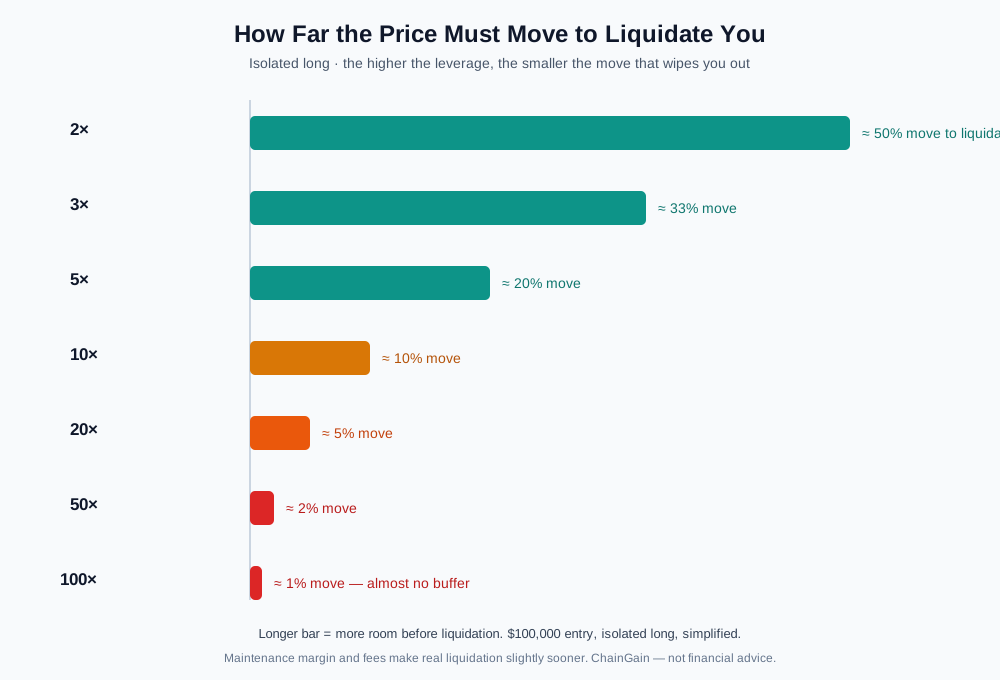
- Higher leverage means a closer liquidation price. On an isolated long, a 2× position survives a ~50% drop, but a 10× position is liquidated on a ~10% move, a 50× position on ~2%, and a 100× position on a ~1% move. Leverage does not just multiply gains — it shrinks the distance to wipeout.
- Isolated margin caps your loss; cross margin risks everything. Isolated margin only puts the collateral assigned to one position at risk; cross margin uses your entire account balance as backing, which delays liquidation but can drain the whole account at once.
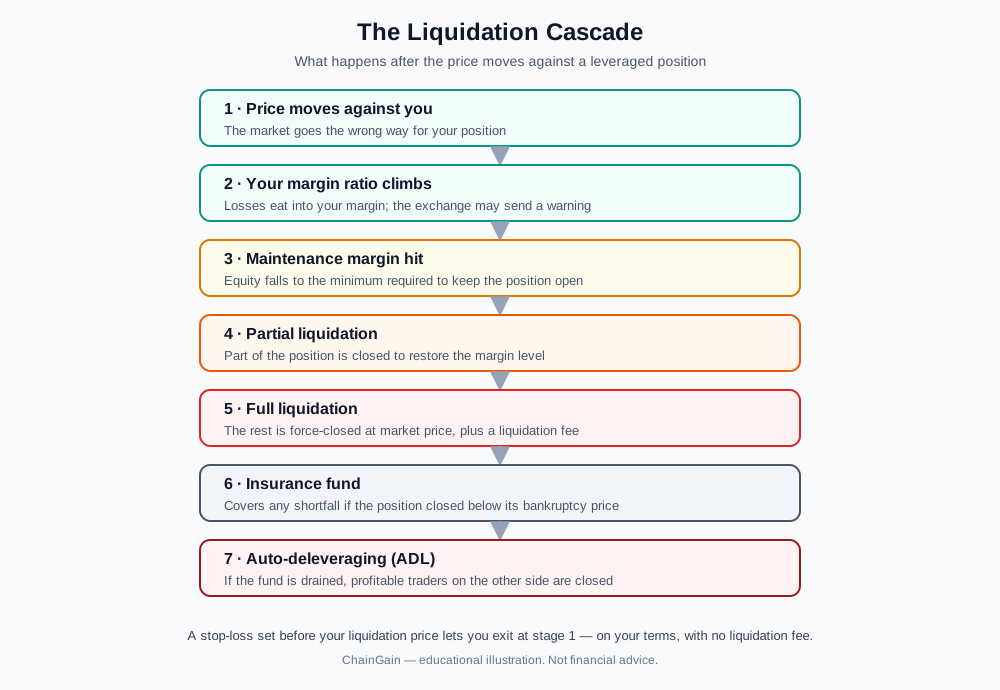
- Liquidation is a cascade, not a single event. It can run partial liquidation → full liquidation → the exchange’s insurance fund → auto-deleveraging (ADL), where even a profitable trader on the other side gets force-closed.
- Funding rates bleed leveraged positions toward liquidation. A perpetual position pays funding every 8 hours; in an active market (~0.05%/8h) that is roughly 55% annualized on the full notional — a cost that quietly pushes a position closer to its liquidation price the longer you hold it.
- Mass liquidation is real and recent. On 10–11 October 2025, about $19.37 billion in leveraged positions were liquidated across the market in roughly 24 hours, affecting an estimated 1.6 million traders — open interest fell ~27.5% in minutes. Leverage turns a normal dip into a chain reaction.
- You can avoid it. Use low leverage (2–5×), set a stop-loss before your liquidation price, prefer isolated margin, keep a margin buffer, and hold spot instead of perpetuals for long-term ideas. Most liquidations are avoidable risk-management failures, not bad luck.
The first time we got liquidated, the market barely moved. We were holding a 20× long on Margex, the price dropped about 4% on a quiet afternoon, and the position vanished — margin gone, with a small liquidation fee on top. The trade thesis was not even wrong; the leverage was.
Almost every “how to avoid liquidation” guide published in 2026 makes the same omission. It lists generic tips — “use a stop-loss,” “manage your risk,” “don’t over-leverage” — without ever showing you the one thing that makes liquidation predictable: the math.
This guide fixes that. We will define liquidation plainly, show you exactly how your liquidation price is calculated with a worked example at every leverage level, compare cross versus isolated margin, walk through what actually happens during a liquidation (including the insurance fund and auto-deleveraging that most traders never hear about until it hits them), and finish with a survival playbook. The goal is not to make you a leverage trader. It is to make sure that if you ever use leverage, you understand the trapdoor you are standing on.
The Fastest Answer: What Is Liquidation in Crypto?
TLDR: Liquidation is the forced closure of a leveraged position when your losses drop your margin below the maintenance level — the lender collecting before you can lose its money. At 10× you put up 10% and borrow the rest, so the thinner that buffer, the smaller the move that wipes it out. Spot positions bought with your own money can never be liquidated.
Liquidation is the forced closure of a leveraged position by an exchange when your losses reduce your margin below the required maintenance level. Because you borrowed funds to open a larger position than your own capital, the exchange closes the trade to prevent your loss from exceeding your collateral. You lose the margin backing that position — and at high leverage, it takes only a small price move against you to get there.
If you only remember one thing: leverage is borrowed size, and liquidation is the lender collecting before you can lose its money. A 10× position means you put up 10% and the exchange effectively covers the other 90%; the moment your 10% buffer is nearly used up by losses, the position is closed automatically. The higher the leverage, the thinner the buffer, and the smaller the move needed to wipe it out.
Liquidation only happens with leverage — margin trading or perpetual/futures contracts. If you buy crypto with your own money on the spot market and never borrow, you cannot be liquidated; your asset can fall in value, but no one force-closes it. That distinction is the single most important risk decision a beginner makes, and it is why this guide treats avoiding liquidation as mostly a question of whether and how much to use leverage at all.
💡 Before you pick an exchange, compare the real all-in cost (trading, spread, funding and withdrawal) with our free Crypto Exchange Fee Calculator — no-KYC and major venues, no signup.
Leverage and Margin: What You’re Actually Borrowing
TLDR: Leverage lets you control a position larger than your capital; margin is the collateral you post. Initial margin is your opening buffer (~10% at 10×, just 1% at 100×), while maintenance margin is the equity floor (~0.5% and up) that triggers liquidation when your losses reach it. The gap between the two — about 9–9.5% at 10× — is your survival room.
Leverage lets you control a position larger than your capital; margin is the capital you put up as collateral. Initial margin is what you need to open a position (roughly 1 ÷ leverage — 10% for 10×); maintenance margin is the minimum equity you must keep to hold it open. When your equity falls toward the maintenance margin, you are approaching liquidation.
There are two margin numbers that matter, and confusing them is where many beginners go wrong:
- Initial margin is the deposit required to open the position. At 10× leverage it is about 10% of the position’s value; at 20× it is 5%; at 100× it is 1%. This is your starting buffer.
- Maintenance margin is the minimum equity (often around 0.5% and up, rising with position size) you must maintain to keep the position open. When your losses erode your equity down to this floor, liquidation triggers.
The gap between your initial margin and the maintenance margin is your survival room. A 10× long opens with 10% margin and might liquidate when equity falls to, say, 0.5% — so the price can move against you by roughly 9–9.5% before the position is closed. Understanding this gap turns liquidation from a mystery into arithmetic, which is exactly what the next section does. (If the words “long,” “short,” and “market order” are new, our guide to crypto order types covers the basics first.)
How Your Liquidation Price Is Calculated (Real Math)
TLDR: For an isolated long, the liquidation price is roughly Entry × (1 − 1 ÷ leverage), so a 10× long at $100,000 liquidates near $90,000 — a 10% move. The arithmetic is the whole game: a 2× position survives a ~50% drop, but at 100× a mere 1% wobble wipes you out. Maintenance margin and fees make real liquidation hit slightly sooner.
For an isolated long, a simplified liquidation price is Entry Price × (1 − 1 ÷ leverage); for a short it is Entry Price × (1 + 1 ÷ leverage). So a 10× long entered at $100,000 has a liquidation price near $90,000 — a 10% move. Maintenance margin and fees make real liquidation happen slightly sooner than this simplified figure, but the pattern holds: the higher the leverage, the closer the liquidation price.
This is the number that competitor guides leave out, and it is the most useful thing in this article. The simplified formula assumes your only buffer is your initial margin (1 ÷ leverage). Real exchanges also require a maintenance margin and charge a small liquidation fee, so actual liquidation occurs a little before the simplified price — treat the table below as the optimistic edge, with real liquidation a touch closer to your entry.
Here is a $100,000 BTC long position with isolated margin, showing how far the price can fall before liquidation at each leverage level:
| Leverage | Initial margin | Approx. price move to liquidation | Simplified liquidation price (entry $100,000) |
|---|---|---|---|
| 2× | 50% | ~50% | ~$50,000 |
| 3× | 33% | ~33% | ~$67,000 |
| 5× | 20% | ~20% | ~$80,000 |
| 10× | 10% | ~10% | ~$90,000 |
| 20× | 5% | ~5% | ~$95,000 |
| 50× | 2% | ~2% | ~$98,000 |
| 100× | 1% | ~1% | ~$99,000 |
Read the third column slowly, because it is the whole game. At 100× leverage, a 1% move — the kind of wobble Bitcoin can do in minutes — liquidates you. At 5×, you have a 20% cushion, enough to survive ordinary volatility. This is why experienced traders treat very high leverage as a near-guaranteed liquidation over time: the price only has to breathe in the wrong direction once. The same math runs in reverse for shorts, where the liquidation price sits above your entry.
Cross Margin vs Isolated Margin: Which Is Safer?
TLDR: Isolated margin assigns fixed collateral to one position — if it liquidates, you lose only that margin and the rest of your account survives. Cross margin uses your whole balance as backing, which pushes the liquidation price further away but means a single bad trade can wipe the entire account. For beginners, isolated margin is almost always the safer default.
Isolated margin assigns a fixed amount of collateral to a single position — if it liquidates, you lose only that margin and the rest of your account is untouched. Cross margin uses your entire account balance as backing, which pushes the liquidation price further away (more buffer) but means a single bad trade can liquidate your whole balance. For beginners, isolated margin is almost always the safer default.
This choice is a setting on every margin and perpetual exchange, and it changes how liquidation behaves more than almost anything else. The trade-off is between containment and cushion:
| Isolated margin | Cross margin | |
|---|---|---|
| Collateral at risk | Only the margin assigned to that one position | Your entire account balance |
| Liquidation price | Closer (smaller buffer) | Further away (whole balance cushions it) |
| If it liquidates | You lose that position’s margin only; account survives | You can lose the entire account at once |
| Best for | Beginners; defined, capped risk per trade | Experienced traders; hedged or multi-position strategies |
| Main danger | Easier to liquidate a single position | One trade can drain everything |
The intuitive trap is that cross margin “feels safer” because the liquidation price is further away — your whole balance is propping the position up. But that is exactly the risk: cross margin does not reduce your chance of ruin, it concentrates it. A single violent move can liquidate a cross position and take the account with it. Isolated margin draws a line you cannot cross by accident: you decide in advance the maximum you can lose on that trade, and the platform enforces it. That is the same logic behind position sizing in our crypto risk management guide — decide your maximum loss before you enter, not during the panic.
Why Maintenance Margin Grows With Your Position Size
TLDR: Maintenance margin is a ladder, not a fixed number: a small position might need just 0.5%, but as you scale up the exchange moves you into higher tiers with stricter margins and capped leverage, because a giant position is hard to close in a thin market. dYdX v4 does this dynamically as open interest grows — so the leverage advertised on the homepage is only a best case for small positions.
Exchanges use tiered maintenance margins: the larger your position, the higher the maintenance margin rate and often the lower the maximum leverage allowed. A small position might require 0.5% maintenance margin, while a very large one requires several percent. This protects the exchange from being unable to liquidate huge positions without crashing the market — and it means your effective liquidation buffer shrinks as your size grows.
Maintenance margin is not a single fixed number; it is a ladder. Open a modest position and you might face a 0.5% maintenance requirement and full access to high leverage. Scale that position up and the exchange moves you into higher tiers with stricter maintenance margins and capped leverage, because a giant position is harder to close in a thin market without moving the price against itself.
Decentralized venues do a version of this dynamically. On dYdX (v4), the initial margin fraction rises automatically as open interest in a market grows, which effectively lowers the maximum leverage available when a market gets crowded — a built-in brake on system-wide risk. The practical takeaway for you is simple: the leverage number advertised on the homepage is a best case for small positions. Your real, usable leverage — and your real liquidation buffer — depends on how big you go.
What Actually Happens When You Get Liquidated
TLDR: Liquidation is usually a sequence, not one click: a margin warning (your last chance to add margin or cut size), then a partial liquidation to restore your margin ratio, then full liquidation at market plus a fee — with the insurance fund and ADL as backstops if a shortfall remains. A stop-loss placed before your liquidation price lets you exit at step one, on your own terms.
Liquidation is often a sequence, not a single click. As your equity nears the maintenance margin, the exchange may first close part of your position (partial liquidation) to restore a healthy margin level; if the price keeps moving, it closes the rest (full liquidation) and charges a liquidation fee. The remains of your margin absorb the loss, and you walk away with little or nothing of the original collateral.
Here is the chain of events, step by step:
- Margin warning. Your margin ratio climbs as losses mount. Many platforms send an alert and let you add margin or reduce the position — your last chance to act on your own terms.
- Partial liquidation. If you do nothing and the price keeps moving, the exchange may close a portion of the position to pull your margin ratio back from the brink.
- Full liquidation. If the move continues, the entire remaining position is force-closed at the market price, plus a liquidation fee. Your assigned margin (isolated) or account balance (cross) absorbs the loss.
- The backstop. If the market moved so fast that closing your position still left a shortfall, the exchange’s insurance fund covers the gap — and if that is not enough, auto-deleveraging kicks in (next section).
The crucial insight is that a stop-loss order, placed before your liquidation price, lets you exit at step one on your own terms — usually at a smaller loss and without the liquidation fee. Liquidation is the exchange’s risk control, not yours; a stop-loss is yours. We will come back to this in the survival playbook.
Insurance Funds and Auto-Deleveraging (ADL): The Hidden Backstop
TLDR: An insurance fund covers the shortfall when a liquidation can’t close at a good enough price; when it runs dry in extreme volatility, exchanges use auto-deleveraging (ADL) to force-close the most-leveraged profitable traders on the winning side. That means you can be right, profitable, and still closed out — as happened on the decentralized exchange Hyperliquid during the October 11, 2025 crash.
An insurance fund is a reserve an exchange keeps to cover shortfalls when a liquidation cannot be closed at a good enough price. When the insurance fund is depleted in extreme volatility, exchanges use auto-deleveraging (ADL): they force-close the positions of profitable traders on the opposite side, ranked by leverage and profit, to balance the books. ADL means you can be closed out even when your trade was right.
Most beginners never hear these two terms until one of them affects them. They are the layers beneath your own liquidation:
- Insurance fund. When a liquidated position is closed at a price worse than its bankruptcy price, the shortfall is paid from the exchange’s insurance fund rather than landing on other traders. The fund is built up over time from the surplus when liquidations close better than expected. In normal conditions, it quietly does its job and no one notices.
- Auto-deleveraging (ADL). In a fast crash, the insurance fund can run dry. When it does, the exchange force-closes the most-leveraged profitable traders on the winning side to absorb the loss. You can be holding a correct, profitable position and still be deleveraged — your profit capped and your trade closed against your will.
This is not theoretical. On 11 October 2025, during a market-wide crash, the decentralized exchange Hyperliquid triggered ADL for the first time in roughly two years, affecting around 20,000 traders. ADL is the system’s last line of defense, and it is a reminder that in extreme volatility, even being right is not a guarantee — which is the deepest argument for keeping leverage modest.
How Funding Rates Quietly Push You Toward Liquidation
TLDR: Holding a perpetual means paying (or receiving) a funding rate every 8 hours on your full position notional, not just your margin — at ~0.05%/8h, a $10,000 long bleeds about $105 a week (~55% annualized). Those payments come straight out of the margin keeping you alive, so a position flat on price can still drift toward liquidation. For multi-week ideas, spot has no funding clock and can’t be liquidated.
If you hold a perpetual futures position, you pay (or receive) a funding rate every 8 hours, calculated on your full position size — not just your margin. In an active market at ~0.05%/8h, a $10,000 perpetual long costs about $105 a week (~55% annualized). Those payments come out of your margin, steadily shrinking your buffer and pulling your effective liquidation price closer the longer you hold.
Funding is the mechanism that keeps a perpetual contract’s price tied to the spot price: when more traders are long than short, longs pay shorts, and vice versa. It is not the exchange taking a fee — it flows between traders — but to you, the holder of a leveraged position, it is a recurring cost that compounds every 8 hours and is deducted from the very margin that is keeping you alive. A position that looks flat on price can still drift toward liquidation purely from funding.
Two consequences for anyone using leverage. First, funding is charged on the full notional, so a 10× position pays funding on ten times your margin. Second, if your idea is a multi-week hold, a perpetual is usually the wrong tool — spot has no funding clock and cannot be liquidated. We break the funding math down further in our guide to the real all-in cost of crypto exchange fees; for liquidation purposes, just remember that funding is a slow leak in the buffer you are relying on.
How to Avoid Getting Liquidated: A Survival Playbook
TLDR: Most liquidations are preventable risk-management failures, not bad luck. The highest-impact levers: use low leverage (2–5×) so the price has room to move (a 5× position survives a 20% drop versus ~2% at 50×), set a stop-loss before your liquidation price, choose isolated margin, keep a margin buffer, and hold spot rather than perpetuals for long-term ideas.
The reliable ways to avoid liquidation are: use low leverage (2–5×) so the price has room to move, set a stop-loss before your liquidation price, choose isolated margin to cap the damage, keep a margin buffer instead of going all-in, take partial profits, and avoid holding perpetuals for long-term ideas. Most liquidations are preventable risk-management failures, not bad luck.
Here is the playbook, ordered by how much protection each lever gives you:
| Lever | How it protects you | Impact | Difficulty |
|---|---|---|---|
| Use lower leverage (2–5×) | Widens the price move needed to liquidate you — a 5× position survives a 20% drop vs ~2% at 50× | Highest | Easy |
| Set a stop-loss before the liq price | You exit on your terms at a smaller loss, with no liquidation fee | High | Easy |
| Use isolated margin | Caps your maximum loss to one position’s collateral | High | Easy |
| Keep a margin buffer | Spare margin lets the position survive volatility spikes and funding | High | Easy |
| Take partial profits | Reduces position size and the funding it pays | Medium | Easy |
| Monitor your margin ratio | Add margin or cut size before liquidation, not during it | Medium | Medium |
| Hold spot, not perps, for long ideas | Removes funding cost and liquidation risk entirely | Highest | Easy |
Notice that the two highest-impact levers — lower leverage and holding spot — both point the same way: the surest protection against liquidation is to use less leverage, or none. A stop-loss is essential, but it is a seatbelt, not a reason to drive faster. Build these into a written plan before you open a position, the same way you would size any trade in a proper risk-management framework. If you automate your trading, remember that a bot will execute leverage exactly as instructed — including straight into a liquidation — so the rules matter even more.
What Leverage Is Safe for a Beginner?
TLDR: For most beginners the safest leverage is none — spot trading can’t be liquidated. If you do use it, 2–5× gives the price a meaningful 20–50% buffer, while 20× and above leaves almost no room for normal volatility. The advertised 100× and 150× exist to generate trading volume and liquidations, not to help you: at 100× you’re betting a volatile asset won’t move 1% against you first.
For most beginners, the safest leverage is none — spot trading cannot be liquidated. If you do use leverage, staying at 2–5× gives the price meaningful room (a 20–50% buffer) before liquidation, while 20× and above leaves almost no margin for normal volatility. High leverage is not a faster path to profit; over time it is a near-certain path to liquidation.
The honest answer is uncomfortable for an industry that advertises 100× and 150× leverage: those numbers exist because they generate trading volume and liquidations, not because they help you. At 100×, you are betting that a famously volatile asset will not move 1% against you before it moves in your favor — a bet you will eventually lose by sheer probability.
If you are learning, a reasonable progression is: start on spot until you understand market behavior; if you move to leverage, begin at 2–3× with isolated margin and a stop-loss; and treat anything above 10× as a high-probability way to donate your margin to the market. The traders who survive are not the ones who use the most leverage — they are the ones who are still in the game next year because they were never liquidated. That long-term survival mindset matters for taxes too: realized liquidation losses may be deductible, a point we cover in our crypto capital gains tax guide.
Liquidation on a CEX vs a DEX (Margex, BloFin vs dYdX)
TLDR: Centralized exchanges like Margex and BloFin run liquidation through an internal engine with an insurance fund and offer high maximum leverage (up to ~100× on Margex, ~150× on BloFin), while dYdX (v4) liquidates on-chain, caps leverage near 20×, and raises margin as open interest grows. The mechanics and custody differ, but the core risk — a forced close when margin runs out — is identical.
Centralized exchanges (such as Margex and BloFin) run liquidation through an internal engine with an insurance fund, offering high maximum leverage (up to 100× on Margex, 150× on BloFin for major pairs). Decentralized perpetual venues like dYdX (v4) liquidate on-chain, cap leverage lower (around 20×), and raise margin requirements as open interest grows. The mechanics differ, but the core risk — a forced close when margin runs out — is identical.
Where you trade leverage changes how liquidation is handled, who holds your funds, and how much leverage you can even access. As of 2026-06-09 (always confirm current terms, as they change often):
| CEX (e.g. Margex, BloFin) | DEX (e.g. dYdX v4) | |
|---|---|---|
| Max leverage (major pairs) | Up to ~100× (Margex) / ~150× (BloFin) | ~20× |
| Maintenance margin | Tiered (from ~0.5%, rising with size) | Initial margin fraction rises with open interest |
| Liquidation engine | Internal, off-chain | On-chain, protocol-level |
| Insurance fund / ADL | Insurance fund, then ADL | Protocol backstop, then ADL |
| Custody of funds | Exchange holds your funds | You self-custody (non-custodial) |
The decentralized route keeps you in custody of your funds, which removes exchange-insolvency risk but shifts security entirely onto you (a self-custody wallet and its keys become your responsibility). It also tends to cap leverage lower — dYdX reduced its maximum to about 20× partly as a risk-control measure. A centralized venue offers higher leverage and a smoother experience but holds your funds and sets the rules. Neither removes liquidation risk; they only change who is holding the safety net. For a fuller comparison of custody and counterparty trade-offs, see our CEX vs DEX vs hybrid guide. Note that the Margex and BloFin figures here were drawn from each platform’s help documentation, as their main sites were not reachable to us at verification time — confirm current leverage and margin terms on the official site before depositing.
Can You Lose More Than Your Deposit?
TLDR: On most major exchanges, isolated margin and negative-balance protection mean you can’t lose more than the margin you committed — the insurance fund and ADL absorb any extreme shortfall. In the EU and UK this protection is mandatory for retail (ESMA even caps CFD-classified crypto leverage at 2:1), but on an unregulated offshore venue offering 100×+, none of it is promised and a violent gap could leave a negative balance.
On most major exchanges, isolated margin and negative balance protection mean you cannot lose more than the margin you committed — in extreme cases the insurance fund and ADL absorb the rest. In the EU and UK, negative balance protection is a regulatory requirement for retail clients on crypto derivatives classified as CFDs. On unregulated offshore venues, that protection is not guaranteed, so a violent gap could theoretically leave a negative balance.
The reassuring part: the entire liquidation system — maintenance margins, insurance funds, and ADL — exists precisely to stop losses from cascading beyond your collateral. With isolated margin, your defined risk is the position’s margin, full stop. With negative balance protection, even a wild gap should not leave you owing the exchange money.
The caution: these protections are strongest where regulation requires them. In the EU, the regulator (ESMA) caps retail leverage on CFD-classified crypto products at just 2:1 — far below the 30:1 that applies to major forex — and mandates negative balance protection; the UK’s FCA applies similar consumer protections, and in the US the CFTC has approved regulated crypto perpetuals with much lower leverage caps (around 10–20×). On an unregulated offshore exchange offering 100×+, none of that is promised — you are relying on the venue’s own insurance fund and policies. That regulatory gap is one more reason the leverage you can access offshore is not the leverage you should use.
The $19 Billion Lesson: October 2025
TLDR: On October 10–11, 2025, a sudden drop triggered roughly $19.37 billion in liquidations in about a day, hitting an estimated 1.6 million traders as open interest collapsed ~27.5% in minutes — with liquidations peaking near $10 billion per hour. It’s the clearest recent proof that high leverage turns an ordinary correction into a self-reinforcing cascade, and the most-leveraged positions are wiped out first.
On 10–11 October 2025, a sudden market drop triggered roughly $19.37 billion in liquidations across crypto in about a day, affecting an estimated 1.6 million traders, with open interest collapsing around 27.5% in minutes (per market liquidation data). It was the clearest recent demonstration that leverage turns an ordinary correction into a self-reinforcing cascade — each liquidation pushes the price further, triggering the next.
The event is worth understanding because it shows liquidation at the level of the whole market, not just one trader. When leverage across the system is high and a sharp move begins, the first wave of liquidations sells into a falling market, which drives the price lower, which liquidates the next tier of positions, and so on. Billions can be wiped out in minutes — at the peak of the October crash, liquidations ran at roughly $10 billion per hour. The traders hit hardest were, predictably, the most leveraged.
The lesson is not “the market is rigged.” It is that high leverage is fragile by design: it concentrates risk so tightly that a normal dip becomes an extinction event for over-leveraged positions. Every protection in this guide — low leverage, stop-losses, isolated margin, a buffer — is really a way of making sure you are not in the tier that gets liquidated first when, not if, the next cascade comes.
Frequently Asked Questions
What does it mean to get liquidated in crypto?
Getting liquidated means an exchange has automatically closed your leveraged position because your losses reduced your margin below the required maintenance level. You borrowed funds to open a larger position than your own capital, and the exchange closes the trade to stop the loss from exceeding your collateral. You lose the margin backing that position, plus a liquidation fee. It only happens with leverage — spot positions bought with your own money cannot be liquidated.
How do I calculate my liquidation price?
A simplified estimate for an isolated long is Entry Price × (1 − 1 ÷ leverage), and for a short it is Entry Price × (1 + 1 ÷ leverage). For example, a 10× long entered at $100,000 has a liquidation price near $90,000 (a 10% move). Real liquidation happens slightly sooner because of maintenance margin and fees, and most exchanges show your exact liquidation price when you open the position — always check it before confirming.
What leverage is safe for beginners?
The safest choice is no leverage — spot trading cannot be liquidated. If you do use leverage, 2–5× gives the price a 20–50% buffer before liquidation, while 20× and above leaves almost no room for normal volatility. High leverage like 50× or 100× is a near-certain path to liquidation over time because the price only needs to move 1–2% against you. Start low, use isolated margin, and always set a stop-loss.
What is the difference between cross and isolated margin?
Isolated margin assigns a fixed amount of collateral to one position; if it liquidates, you only lose that margin and the rest of your account is safe. Cross margin uses your entire account balance as backing, which moves the liquidation price further away but means a single bad trade can liquidate your whole account. For beginners, isolated margin is the safer default because it caps your maximum loss per trade.
Can you lose more than your deposit when trading with leverage?
On most major exchanges, isolated margin plus negative balance protection means you cannot lose more than the margin you committed, with the insurance fund and auto-deleveraging absorbing extreme shortfalls. In the EU and UK, negative balance protection is required for retail clients on crypto CFDs. On unregulated offshore venues offering very high leverage, that protection is not guaranteed, so in a violent gap a negative balance is theoretically possible.
What is auto-deleveraging (ADL)?
Auto-deleveraging is a last-resort mechanism exchanges use when a fast crash depletes the insurance fund. The exchange force-closes the positions of the most-leveraged profitable traders on the opposite side to balance the books. This means you can be closed out even when your trade was correct and in profit. It is rare but real — Hyperliquid triggered ADL during the October 2025 crash, affecting around 20,000 traders.
Does a stop-loss prevent liquidation?
A stop-loss placed before your liquidation price effectively prevents liquidation by closing the position on your own terms first — usually at a smaller loss and without the liquidation fee. It is not automatic protection, though: in a fast-moving or gapping market, a stop-loss can fill at a worse price than set (slippage). It dramatically reduces liquidation risk but does not eliminate the need for low leverage and a margin buffer.
How does the funding rate affect liquidation?
On perpetual futures, you pay a funding rate every 8 hours, calculated on your full position size and deducted from your margin. Because it shrinks the very margin keeping your position open, funding steadily pulls your effective liquidation price closer the longer you hold — even if the price itself does not move. In an active market, funding can cost roughly 55% annualized on the notional, which is why spot is usually cheaper for long-term holds.
Continue Learning
- Crypto Risk Management 2026 — Position sizing and stop-losses that keep you out of liquidation (TR-3)
- Crypto Order Types Explained 2026 — How to place the stop-loss and limit orders this guide relies on (TR-1)
- Crypto Exchange Fees 2026 — The full funding-rate math and the real cost of trading (XC-2)
- CEX vs DEX vs Hybrid Exchanges 2026 — Where to trade leverage and how custody differs (XC-1)
- Crypto Wallet Decision Framework 2026 — Self-custody for non-custodial perpetual trading (W-2)
- Crypto AI Trading 2026 — Why automated leverage needs even stricter rules (AI-4)
- Crypto Capital Gains Tax 2026 — How realized liquidation losses are treated for tax (TR-Tax-1)

Editorial pen name · ChainGain
Alex Mercer is the editorial pen name used for ChainGain’s cryptocurrency education content. Articles are based on cited sources and reproducible comparisons. Editorial profile
Disclaimer: This article is educational, not financial advice. ChainGain may earn a commission if you open an account with Margex, BloFin, or dYdX through partner links; we do not receive commission from Binance, Bybit, OKX, Coinbase, or Hyperliquid, which are named for comparison only. Leverage and margin trading carry a high risk of losing your entire deposit, and on unregulated venues potentially more. Liquidation can happen automatically and very quickly during volatile markets; funding costs accrue while leveraged positions are open. Leverage limits, maintenance margins, insurance-fund policies, and negative balance protection vary by platform and region and change frequently — always confirm current terms on the exchange’s own site, and verify your local availability and tax obligations, before trading. Figures including exchange leverage limits and the October 2025 liquidation totals were verified on 2026-06-09 against available sources; some derivatives venue figures were drawn from platform help documentation where official pages were unreachable and should be treated as approximate.