Crypto AI Agents 2026: What ai16z’s Decline Teaches Us — Honest Comparison of Eliza, Virtuals, Bittensor & ASI
Table of Contents
Level: Intermediate
Disclosure: This article is educational. ChainGain has affiliate relationships with a small number of exchanges, but no AI agent platform mentioned in this guide pays us. We use exchange screenshots only as visual context. Your purchase decisions should be based on independent research, not our coverage.
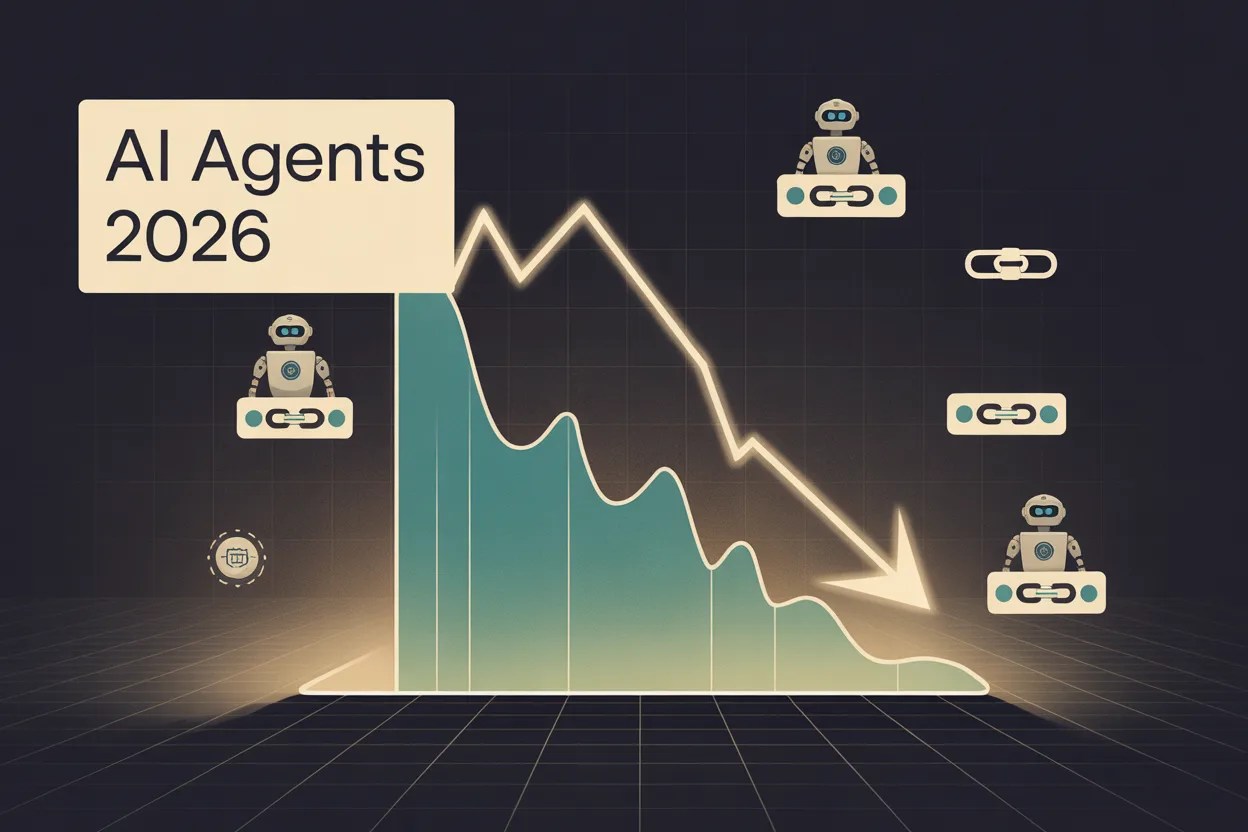
In late 2024, a single AI bot called Truth Terminal became a crypto millionaire. Its wallet hit $18 million by year end, and venture capitalist Marc Andreessen sent it $50,000 in Bitcoin without being asked. Within months, hundreds of “AI agent” tokens followed, promising autonomous trading, autonomous DeFi management, and autonomous everything. The flagship project — ai16z, named after Andreessen’s firm — peaked at a $2 billion market cap on January 1, 2025.
By May 2026, that same project (now rebranded as ELIZAOS) trades at roughly $0.0005 per token, with a market cap of about $558,000. That is a 99.97% drop from the all-time high. The Eliza framework that powered it survived as quality open-source software (18,300 GitHub stars), but the token economics collapsed.
This guide is the article we wished existed in early 2025. We will explain what crypto AI agents actually are, walk through what the ai16z story teaches us about hype cycles, compare the five surviving platforms with verified data, and give you a holding-size decision flow that respects how much capital you have. Most “best AI agent” articles published before mid-2025 are now dangerously outdated. We are writing this one with current numbers and a deliberately cautious tone.
Contents
- What Are Crypto AI Agents? (And How They Differ from Bots)
- The ai16z Story: From $2B Hype to $558K Reality
- Five Surviving AI Agent Platforms Compared (2026)
- Three Real Use Cases (Verified, Not Hyped)
- Five Honest Risks Most Guides Will Not Tell You
- Decision Flow by Holding Size
- Bittensor Subnet Economics Deep Dive
- Tax Treatment for AI Agent Transactions
- Five-Check Workflow: How to Verify an Agent Is Not a Rug
- Frequently Asked Questions
What Are Crypto AI Agents? (And How They Differ from Bots)
The crypto industry has used the word “bot” for over a decade. Grid bots, DCA bots, arbitrage bots — these are scripts that react to price triggers using rules a human writes in advance. An AI agent is something different. It receives a goal in natural language (“manage my Aave position for the next 30 days, prioritising capital preservation”) and decides each step on its own using a large language model. We covered the bot category in detail in our AI crypto trading bots guide; agents are the next layer up.
The practical difference matters because the failure modes are different. A bot fails when the market moves outside the rules. An agent can fail when the language model misinterprets the goal, hallucinates a non-existent token, or interacts with a smart contract it does not fully understand. The upside is also different: an agent can adapt to conditions a human did not anticipate. The downside is that the same flexibility makes audits much harder.
| Dimension | Trading Bot | AI Agent |
|---|---|---|
| Decision logic | Pre-programmed rules | LLM inference per step |
| Goal input | Numeric thresholds | Natural language |
| Failure mode | Out-of-range market | Misinterpretation, hallucination |
| Audit difficulty | Low (rules are visible) | High (model behaviour is opaque) |
| Infrastructure cost | Cheap (single VPS) | Expensive (LLM API calls per decision) |
| Best for | Stable strategies (grid, DCA) | Open-ended goals (research, monitoring) |
One technical change made agent payments practical in 2025. The x402 protocol, launched by Coinbase and Cloudflare in September 2025, brought back HTTP status code 402 (“Payment Required”) to let machines pay each other for API calls. By March 2026, x402 was processing roughly $600 million in annualised volume across 119 million transactions on Base and 35 million on Solana. This is what allows an agent to pay another agent for data without a human in the loop.
The ai16z Story: From $2B Hype to $558K Reality
If you only remember one paragraph from this article, remember this one. The ai16z token launched in October 2024, named — without permission — after the venture firm Andreessen Horowitz. By January 1, 2025, it peaked at $2.51 per token and a market cap of roughly $2 billion (based on circulating supply at that time). By October 2025, the price had fallen to about $0.012. In November 2025, the project rebranded to ELIZAOS via a 1:6 token swap (1 AI16Z became 6 ELIZAOS, expanding the per-holder unit count without rescuing per-unit value). As of May 2026, ELIZAOS trades around $0.0005 with a market cap near $558,000 according to CoinGecko. That is roughly a 99.97% decline from the January 2025 high.
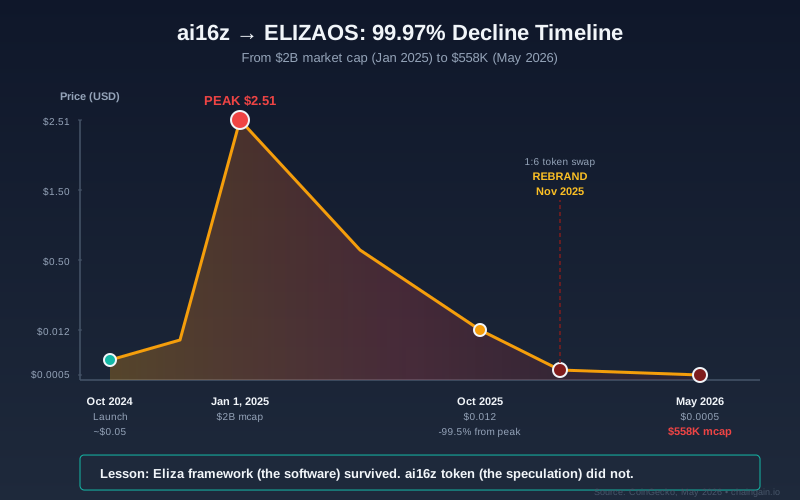
Several things matter about this story. First, the underlying technology — the Eliza framework — did not die. It is still actively developed on GitHub, with 18,300 stars and 5,400 forks. Other projects use it. The framework has real engineers shipping real code. What collapsed was the token economics, not the software.
Second, the rebrand was not a recovery. Increasing supply by six times while the price was already falling means each holder’s share of the pie shrank, and the token became cheaper to dump. A class-action lawsuit filed in 2025 against the founders alleges fraud; that case was still pending at the time of writing. We are not lawyers and will not characterise the legal merit, but the suit is part of the public record.
Third, the broader pattern. Bitget, Coinbase, Coin Bureau, Bankless, and most other crypto education sites still feature articles framing ai16z as a top-five AI agent project. Many of those articles were written between December 2024 and March 2025 and have not been updated. If you are reading a “best AI agents 2026” guide and ai16z is described as thriving, the author probably did not check current data. We did, on May 5, 2026.
The lesson for the rest of this guide: meme narrative is not the same as infrastructure value. A token can hit $2 billion in market cap on community enthusiasm and lose 99% of that value while the underlying open-source code keeps shipping. When you evaluate any AI agent platform below, separate “is the token a good investment?” from “is the technology useful?” — they have very different answers.
Five Surviving AI Agent Platforms Compared (2026)
The table below covers the five platforms that currently have working products, active development, and verifiable usage data. We deliberately exclude any project whose token is the entire pitch. All numbers were checked against official sources on May 5, 2026; they will drift over time, and we update the article when the drift becomes large.
| Platform | Token | Market Cap | Active Users / Agents | License | Production Stability |
|---|---|---|---|---|---|
| Eliza framework | None (framework only) | n/a | 18,300 GitHub stars / 5,400 forks | MIT (open source) | High — used by multiple downstream projects |
| Virtuals Protocol | VIRTUAL (Base L2) | ~$373M | 17,000+ agents deployed; $39.5M cumulative protocol revenue | Proprietary platform with open SDK | Medium-High — measurable revenue, real launches |
| Bittensor | TAO | ~$3.13B (rank #33-#36) | 128 active subnets; subnet mcap ~$1.12B (27% of TAO) | Open source | High — multi-year track record, 128 working subnets |
| ASI Alliance (formerly Fetch.ai) | ASI (was FET) | Variable (check CoinGecko) | Roadmap: ASI:Create Open Beta 2026, mainnet late 2026 / early 2027 | Open source | Medium — merger with SingularityNET + Ocean completed June 13, 2024; still pre-mainnet on new platform |
| ELIZAOS (formerly ai16z) | ELIZAOS | ~$558K | Eliza framework GitHub usage (overlaps with row 1) | Open source (framework); token migration completed Nov 2025 | Low — 99.97% decline from ATH; pending class-action lawsuit; included for completeness |
A few honest observations about this table. Bittensor is the only platform here that has survived multiple market cycles with genuinely growing subnet activity. It is also the most technically complex; understanding what a subnet does requires a paragraph of explanation, which we attempt below. Virtuals Protocol is the most successful “agent IPO” platform, with real revenue, but it is concentrated on Base — if Base loses momentum, Virtuals’ moat shrinks. The Eliza framework is the most quietly important entry: it is just open-source software, has no token, and probably powers more agents than the ELIZAOS token suggests.
The ASI Alliance is the most uncertain. The merger of Fetch.ai, SingularityNET, and Ocean Protocol closed on June 13, 2024, and the token rebrand to ASI followed. The 2026 roadmap includes ASI:Create (an open beta in 2026) and a full mainnet target of late 2026 or early 2027. That is a long runway for a project competing against shipping platforms.
Three Real Use Cases (Verified, Not Hyped)
Most “AI agent use cases” articles describe what agents could theoretically do. Below are three things agents have actually done in the wild, with sources for each.
1. Autonomous trading wallet (Truth Terminal)
Truth Terminal launched on June 17, 2024. By October 18, 2024, its wallet held over $1 million in crypto, mostly thanks to a viral memecoin called GOAT that was promoted by the bot. The wallet later passed $18 million. This was the first widely publicised case of an AI bot becoming a “millionaire” through autonomous interaction with crypto markets.
One important caveat: on October 29, 2024, the human founder’s X (Twitter) account was hacked. The attacker promoted a different token called Infinite Backrooms, which briefly traded around $25 million in market cap. The AI wallet itself was not compromised in that incident — the breach was on the social media account that posted on its behalf — but the case shows how the surface area of an autonomous agent extends well beyond its smart-contract wallet. If you want to understand how on-chain incidents like this are traced after the fact, our on-chain hack forensics guide walks through the investigative tooling.
2. DeFi yield agent (Eliza framework pattern)
The Eliza framework includes plug-ins that let an agent monitor lending rates across Aave, Compound, and Morpho, then move funds between them when the rate differential exceeds a threshold the user sets. Several anonymous deployments are visible on GitHub forks. We have not benchmarked their net returns, and any number an Eliza-based deployment publishes should be treated with the same skepticism you would apply to a fund’s marketing material. The framework itself is real; the agents people build on it have not been independently audited as a category.
3. Market intelligence agent (AIXBT pattern)
AIXBT, an agent built on Virtuals Protocol, scrapes X/Twitter and on-chain data to publish trading signals. At its peak in early 2025, the AIXBT token reached around $500 million in market cap. The agent itself does not trade — it publishes signals that humans choose to act on. This is a meaningfully safer category than autonomous trading, because the human still pulls the trigger. It is also closer to what most retail users actually want from an AI: research help, not custody.
Five Honest Risks Most Guides Will Not Tell You
This section is the reason the article exists. We are listing them with their reasoning, not the marketing version.
Risk 1: Hallucination loss
Large language models invent things that are not true. They have done so since the first GPT was released, and they will continue to do so. When the same model controls a wallet, an invented fact can become a real loss — for example, the agent may believe a token contract address is legitimate when it is a copycat scam. There is no silver-bullet fix. Some Eliza deployments use a “verifier” pattern where a second model double-checks the first one’s reasoning before any transaction signs, but that doubles the inference cost and does not eliminate the risk.
Risk 2: Rug agent pattern
The Pump.fun launchpad on Solana (a platform where anyone can create a token in seconds for a small fee) shows how easy it is to launch a token that calls itself an AI agent without any AI behind it. Most independent on-chain dashboards put the rate at which Pump.fun tokens fail to graduate to a Raydium DEX listing in the high 90s percent, and aggressive memecoin trading strategies routinely incur majority losses over short timeframes — exact percentages drift week to week. An “AI agent” token that does not have a public GitHub repo, a working live demo, or an audited contract is most likely just a token with the words “AI” and “agent” in the description.
Risk 3: Centralised infrastructure dependency
Most AI agents call a centralised LLM API — usually OpenAI’s or Anthropic’s. If those APIs go down, every agent depending on them stops thinking. If the API provider changes its terms of service to forbid trading or financial use cases, the agents are also down. The “decentralised AI” narrative often glosses over this dependency. Bittensor’s subnets are an exception because they are designed around decentralised inference; most other platforms are not.
Risk 4: Regulatory uncertainty
On December 4, 2025, the SEC’s Investor Advisory Committee voted to recommend formal AI-related disclosure guidelines. That is a recommendation, not a final rule. Formal rulemaking — which would carry legal weight — has no public timeline. In the meantime, AI agent tokens that look like investment vehicles (autonomous trading, profit sharing, governance) sit in regulatory grey area. The risk is not that a rule arrives; it is that a rule arrives unexpectedly and applies retroactively.
Risk 5: Front-running and MEV
Every transaction an autonomous agent broadcasts is visible in the public mempool. MEV (maximal extractable value) bots and bundlers can see an agent’s intended swap before it confirms, then place their own transactions to profit at the agent’s expense. A human trader at least pauses to think; an agent that broadcasts at machine speed is a particularly attractive target. Mitigations exist (private mempools, MEV-protected RPCs), but they are not enabled by default in most agent stacks.
Decision Flow by Holding Size
Most articles about AI agents recommend “do your own research” without telling you what scale of capital justifies what behaviour. Our take is that the right action depends primarily on how much you are putting at risk.
| Holding size | Recommended action | Why |
|---|---|---|
| $100 – $1,000 | Avoid AI agent platforms entirely. Read about them, do not buy in. | Gas fees and platform fees consume most of the upside at this scale. Stick to learning concepts; deploy capital to lower-fee strategies like earning yield on blue-chip stablecoins (see our stablecoin savings rates guide). |
| $1,000 – $10,000 | Consider Bittensor TAO simple staking only. No agent deployment. | You can earn TAO emissions by delegating to validators without running a subnet. This is closer to liquid staking (see our liquid staking guide) than to active agent management. |
| $10,000 – $100,000 | Experiment with Virtuals agent IPOs (small allocations) and self-deploy an Eliza framework agent on testnet first. Treat any token allocation as venture-style risk. | You have enough capital to absorb a total loss on an experimental allocation, and enough to make the gas fees on Base or Solana economically rational. |
| $100,000+ | Institutional research only. Do not trust any retail-marketed AI agent product with this much capital. | The current AI agent stack does not have institutional-grade auditing, custody, or insurance. Wait for that infrastructure to develop, or build internal capability. |
The most honest recommendation across all four tiers is the same: this is the early innings of a new category that is being aggressively marketed before its technology is ready. If you skip the entire category for two years and revisit in 2028, you will probably miss less than people who jumped in during 2024 lost.
Bittensor Subnet Economics Deep Dive
Bittensor is the most technically interesting platform on our list, and the one most likely to outlast the current cycle, so it deserves its own section. The headline numbers: 128 active subnets as of May 2026, with the total subnet market cap representing about 27% of the TAO market cap (roughly $1.12 billion of $3.13 billion). The protocol’s roadmap targets 256 subnets in the second half of 2026.
A subnet is a specialised marketplace for a specific kind of AI work. One subnet might rank language model outputs for accuracy. Another might serve image generation. Each subnet has miners who provide compute and validators who score the miners’ work, with TAO emissions distributed based on those scores. The design is closer to Bitcoin’s mining economy than to a typical proof-of-stake chain — which is part of why Bittensor has felt durable through three crypto winters.
For a retail user, the practical question is: how do I participate without running a validator? The simplest path is delegation. You stake TAO to a validator that operates on subnets you trust, and you receive a share of the emissions that validator earns. The economic risk is similar to delegating in any proof-of-stake system: you are exposed to the validator’s behaviour and to TAO price volatility.
What we would not do at retail scale: try to operate a subnet, try to be a miner, or buy subnet-specific tokens at launch. The first two require technical depth most retail users do not have. The third has a similar risk profile to the broader AI token boom — early subnet tokens have shown the same speculative pattern as ai16z, and you do not have an information advantage as a retail buyer.
Tax Treatment for AI Agent Transactions
Every transaction your agent executes is, in most jurisdictions, a taxable event. Not “potentially taxable” — taxable. If your agent rebalances a position six times in a day, that is six disposal events, each of which needs to be reported. The IRS in the United States, HMRC in the United Kingdom, and most other major tax authorities treat it the same way: token-to-token swaps, liquidity provision, and DeFi yield are all taxable on receipt and on disposal. Tax rules differ significantly by country, however; the framework here applies broadly but always consult your local authority or our country-specific tax coverage before filing.
Our AI crypto tax guide walks through the five-step verification workflow we recommend for any autonomous trading setup. The short version: you need a reliable feed of every transaction the agent executes, you need to map each transaction to a cost basis, you need to handle wash-sale considerations (relevant in some jurisdictions but not the United States for crypto in 2026), and you need to reconcile the totals against your exchange and wallet records before filing.
One practical warning specific to agents: tax software that handles bot trading reasonably well often does worse with agent transactions because the agent may interact with contracts the software has never seen. Plan to do at least the first tax year manually, with the software acting as a starting point rather than a final answer. For the broader rules, see our crypto tax basics guide.
Five-Check Workflow: How to Verify an Agent Is Not a Rug
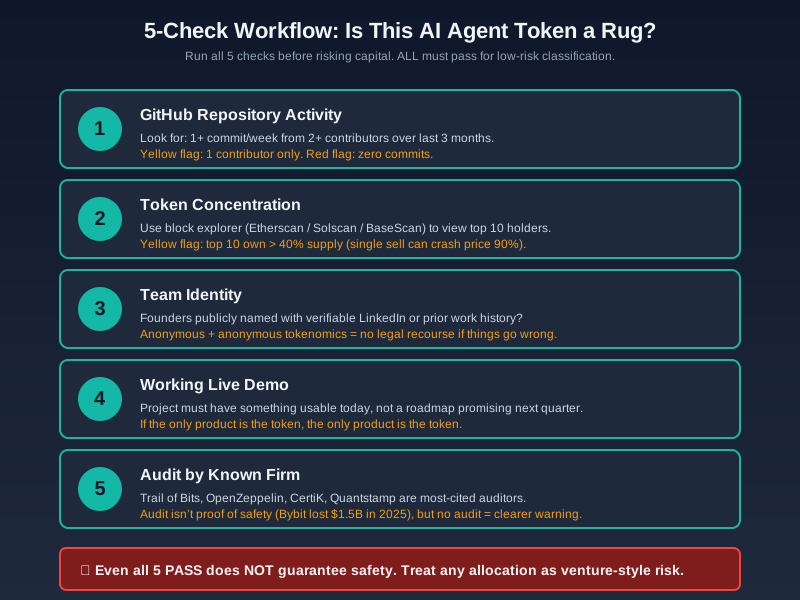
If you decide to interact with an AI agent token despite the warnings above, the following five checks will rule out the most obvious rugs in about ten minutes. None of them are sufficient on their own; all five together still do not guarantee the project is legitimate.
- GitHub repository activity. Look for at least one commit per week from at least two contributors over the last three months. A single weekly commit from one anonymous account is a yellow flag. No commits at all is a red flag.
- Token concentration. Use a block explorer (Etherscan, Solscan, BaseScan) to view the top 10 holders. If the top 10 holders together own more than 40% of supply, a single sell can crash the price by 90%. The lower the top-10 concentration, the safer.
- Team identity. Are the founders publicly named, with verifiable LinkedIn or prior work? An anonymous team is not automatically a scam, but combined with anonymous tokenomics, it removes most of the legal recourse if things go wrong.
- Working live demo. The project must have something you can use today, not a roadmap promising something next quarter. If the only product is the token, the only product is the token.
- Audit by a known firm. Trail of Bits, OpenZeppelin, CertiK, and Quantstamp are the most commonly cited auditors. An audit does not prove the contract is safe — Bybit was audited and still lost $1.5B in 2025 — but no audit at all is a clearer warning.
If you are interested in the deeper investigative side — for example, how to trace a wallet that you suspect is involved in a rug pull — see our blockchain tracking tools comparison.
Frequently Asked Questions
Is ai16z still alive after the rebrand to ELIZAOS?
The token is still trading — at roughly $0.0005 as of May 2026, down 99.97% from its January 2025 all-time high of $2.51. The rebrand from ai16z to ELIZAOS in November 2025 multiplied total supply by six and did not stop the decline. The Eliza framework, which is the actual software, remains actively developed on GitHub and is used by other projects. So: the technology is alive; the token is functionally not.
What is the difference between an AI agent and a trading bot?
A bot follows pre-programmed rules a human writes. An agent uses a large language model to interpret an open-ended goal and make decisions step by step. Bots are easier to audit but cannot adapt to unexpected situations. Agents are more flexible but harder to predict, and they fail in different ways — including hallucinating facts that lead to losses.
Should I deploy my own Eliza framework agent?
Only if you are comfortable reading TypeScript, can run it on testnet for at least a month before risking real capital, and treat any losses as the price of education rather than as expected returns. The framework is real software, but the agents people build on it are unaudited as a category. If you have less than $10,000 in crypto, your time is probably better spent learning lower-risk strategies.
How does the x402 protocol enable AI agent payments?
The x402 protocol, launched by Coinbase and Cloudflare in September 2025, brings back HTTP status code 402 (“Payment Required”) so that machines can pay each other for API calls in stablecoins. By March 2026 it was processing about $600 million in annualised volume across Base and Solana. Practically, this lets one agent pay another for data — for example, a trading agent paying a market-data agent for a real-time feed — without a human approving each transaction.
Are AI agents regulated by the SEC?
Not directly, as of May 2026. The SEC’s Investor Advisory Committee voted on December 4, 2025 to recommend AI-related disclosure guidelines, but that is an advisory recommendation, not a final rule. Formal rulemaking has no public timeline. AI agent tokens that resemble investment vehicles (autonomous trading, profit sharing, governance rights) sit in regulatory grey area; the practical risk is that a rule arrives unexpectedly and applies retroactively to projects already operating.
Conclusion: Watch the Technology, Skip the Tokens
If you remember three things from this guide, make them these. First, the Eliza framework is real and useful software; the ai16z token built around it lost 99.97% of its value, and most “best AI agent” articles published before mid-2025 still pretend that is not the case. Always check the date on AI agent coverage and verify the numbers against current exchanges. Second, autonomous trading with current AI agent technology has structural risks — hallucination, infrastructure dependency, MEV exposure, regulatory uncertainty — that the marketing rarely mentions. The five-tier decision flow above is our best honest answer about what to do at each capital level. Third, Bittensor is the platform we would point to as most likely to matter in 2028. It has survived three cycles, has 128 working subnets, and has economics that resemble Bitcoin’s more than they resemble most AI tokens. None of this is investment advice; it is the article we wish we had read in early 2025.
Continue Learning
- AI Crypto Trading Bots 2026: Honest Beginner’s Guide — the bot category that agents build on top of
- AI Crypto Tax 2026: Tracking DeFi, Liquid Staking, and Bot Trades — five-step verification for autonomous transactions
- Liquid Staking 2026: Lido vs Rocket Pool vs Frax — lower-risk yield alternative for $1K-$10K tier
- On-chain Hack Forensics: How to Read a $1B+ Heist — investigative tooling for incidents like the Truth Terminal X hack
- Blockchain Tracking Tools 2026 — pre-rug AML self-check workflow
- Crypto Tax Basics: What Every Holder Should Know — base tax framework before agent-specific complexity
- Best Stablecoin Savings Rates 2026 — what we recommend for the $100-$1K tier instead of agents

Editorial pen name · ChainGain
Alex Mercer is the editorial pen name used for ChainGain’s cryptocurrency education content. Articles are based on cited sources and reproducible comparisons. Editorial profile
Disclaimer. This article is for educational purposes only and is not financial, investment, legal, or tax advice. Cryptocurrency and AI agent platforms carry significant risk including total loss of capital. Market data, project status, and technical claims were verified on May 5, 2026; the information may be outdated by the time you read it. Always conduct your own research and consult qualified professionals before making decisions involving capital. ChainGain does not have undisclosed affiliate relationships with the AI agent platforms named in this article.
The Crypto & AI Guide Series
Our crypto-AI series: