Crypto Exchange Fees 2026: The Real All-In Cost of Trading
Editorial independence & fact-check disclosure: ChainGain may earn a commission if you open an account with some exchanges we mention (including Margex, BloFin, and dYdX) through partner links. We do not receive commission from Binance, Coinbase, Kraken, OKX, Bybit, MEXC, Crypto.com, Gemini, or Robinhood — they are named for comparison only. All fees were verified on 2026-06-05 against each platform’s official fee schedule. Fees change frequently — confirm current rates on the exchange’s own site before you trade.
Key Takeaways
- The headline fee is the smallest part. Real trading cost has six layers: the trading fee (maker/taker), the spread, funding rates (on perps/margin), withdrawal fees, deposit fees, and FX conversion. Most fee guides only show the first one.
- “0% commission” is usually the most expensive option. Robinhood and Coinbase’s simple Buy button charge 0% or a small flat fee but bake a 0.5%–2.5% spread into the price — 10–25× the cost of a 0.10% order on Binance for the same $1,000 round-trip.
- A $1,000 buy-and-sell round-trip costs roughly $1–$2 on MEXC/Binance/OKX (taker), $8 on Kraken Pro, $16 on Coinbase Advanced (entry tier), and $20–$50 on a “commission-free” app like Robinhood (about $30 on Coinbase’s one-click Buy) — same trade, up to 50× the cost.
- Funding rate is the fee nobody counts. Holding a $10,000 perpetual long for 7 days at a calm 0.01%/8h rate costs about $21 (~11% a year); in an active market at 0.05%/8h it is ~$105 in a week (~55% a year). No spot trade has this cost.
- The same USDT withdrawal can cost $0.30 or $30 depending on the network: TRC-20 (Tron) is typically under $2, while ERC-20 (Ethereum) often runs $10–$30. The asset is identical — only the rails differ.
- Maker beats taker. A limit order that adds liquidity (maker) is usually cheaper than a market order that removes it (taker) — on Coinbase Advanced the entry-tier gap is 0.60% vs 0.80%; learning to place limit orders is a free discount.
- Fee tiers and exchange tokens are real but conditional. Binance’s BNB discount (25%) and 30-day-volume VIP tiers genuinely lower costs, but the lowest published rates require volume most beginners will never hit — always read the entry threshold, not the floor.
We have placed thousands of trades across eight centralized exchanges and three derivatives venues since 2021 — and the single most expensive lesson was not a bad trade. The fee you can see is rarely the fee you pay.
Almost every “crypto exchange fees” guide published in 2026 makes the same omission: it lists each platform’s headline maker/taker percentage in a table and stops there.
This guide breaks crypto trading fees into the six layers that actually determine your cost, walks through what a $1,000 round-trip really costs on nine platforms, decodes funding rates with a worked example, compares withdrawal fees across networks, and ends with a checklist to cut your fees to the minimum. Every number was verified against official fee schedules on 2026-06-05.
The Fastest Answer: How Much Are Crypto Exchange Fees in 2026?
TLDR: On a professional exchange, spot trading fees run about 0.05%–0.80% per trade, so a buy-and-sell round-trip costs $1–$16 per $1,000 — but five more layers (spread, funding, withdrawal, deposit, and FX) can dwarf that. A ‘0% commission’ app is often the most expensive once its hidden spread is counted; a transparent 0.10% fee usually beats a 2% spread.
On a professional exchange, spot trading fees in 2026 run roughly 0.05%–0.80% per trade (maker/taker), so a typical buy-and-sell round-trip costs $1–$16 per $1,000 traded. But your true cost depends on five more layers — spread, funding, withdrawal, deposit, and FX — which can dwarf the trading fee. A “0% commission” app often costs the most once its spread is counted.
If you only remember one thing: the advertised fee is a marketing number, not your cost. A regulated exchange charging a transparent 0.10% taker fee is almost always cheaper than a “free” app charging a hidden 2% spread. The rest of this guide shows you how to see the whole bill — and how to shrink it.
For context on where you trade (and how custody differs), see our companion guide on CEX vs DEX vs hybrid exchanges; this article focuses purely on what each type costs.
The 6 Layers of Crypto Exchange Fees (Most Guides Show Only One)
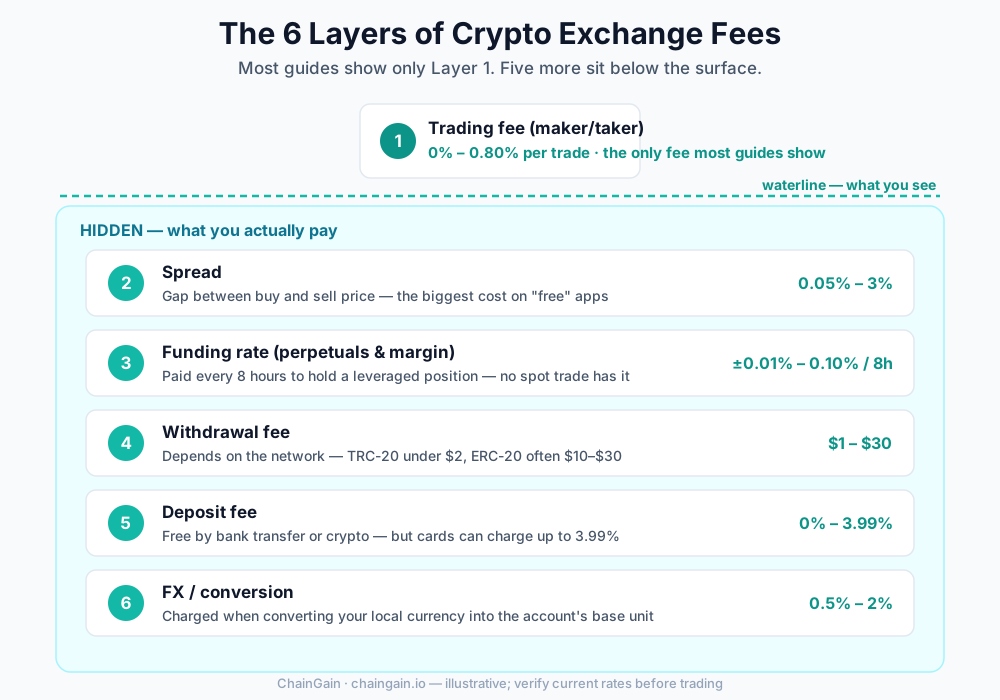
TLDR: Crypto trading has six fee layers, and a guide comparing only maker/taker percentages shows one-sixth of your real cost: the visible trading fee (0–0.80%), the hidden spread (~0.05% to 2–3%), funding rates on perps (±0.01–0.10% every 8h), withdrawal fees (under $1 to $30), deposit fees (0% by bank, up to ~3.99% by card), and FX conversion. The charges below the waterline are where most beginners overpay.
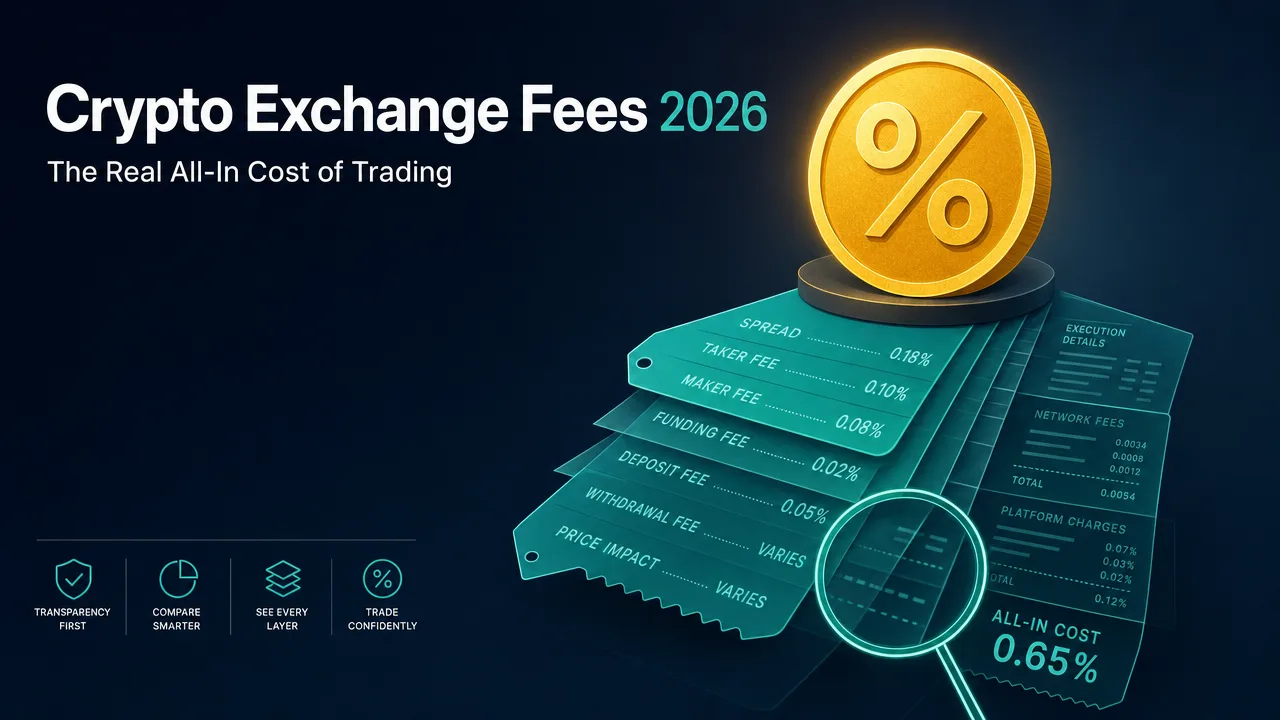
Crypto trading has six distinct fee layers. Trading fees and exchange-token discounts are visible; spread, funding rates, and FX conversion are usually invisible; withdrawal and deposit fees sit in between. A guide that only compares maker/taker percentages is showing you one sixth of your real cost.
Think of the headline maker/taker fee as the tip of an iceberg. Below the waterline sit five more charges that most beginners never add up. Here is the full structure, with typical 2026 ranges and how to reduce each.
| Fee layer | What it is | Typical 2026 range | Visible? | How to reduce it |
|---|---|---|---|---|
| 1. Trading fee | Maker/taker % charged per order | 0.00%–0.80% per trade | Yes | Use limit (maker) orders, fee tiers, exchange-token discount |
| 2. Spread | Gap between buy and sell price | ~0.05% (deep books) to 2–3% (retail apps) | Hidden | Use an order book / limit orders; avoid one-click “Buy” buttons |
| 3. Funding rate | Periodic payment to hold a perpetual/margin position | ±0.01%–0.10% every 8h (perps only) | Hidden | Hold spot instead; close perps before settlement; watch the rate |
| 4. Withdrawal fee | Cost to move crypto off the exchange | <$1 (TRC-20) to $10–$30 (ERC-20) | Semi | Choose a cheap network; batch withdrawals; self-custody less often |
| 5. Deposit fee | Cost to fund the account | 0% (bank/crypto) to ~3.99% (card) | Semi | Fund by bank transfer or stablecoin, not debit/credit card |
| 6. FX / conversion | Converting your local currency | ~0.5%–2% | Hidden | Deposit in the account’s base currency or a stablecoin |
The lesson from this table is simple: two exchanges can advertise the same 0.10% trading fee and still cost wildly different amounts once spread, withdrawal network, and deposit method are included. We will quantify each layer next, starting with the one you can actually negotiate.
Maker vs Taker Fees — and How to Pay the Lower One
TLDR: A maker order adds liquidity to the order book (a limit order that waits) and is charged less; a taker order removes it (a market order that fills instantly) and pays more — on Coinbase Advanced that’s 0.60% maker versus 0.80% taker at entry tier. Simply placing limit orders instead of market orders is the single easiest fee cut available, and it costs nothing.
A maker order adds liquidity to the order book (a limit order that waits to be filled); a taker order removes it (a market order that fills instantly). Exchanges charge takers more because takers consume liquidity. On Coinbase Advanced the entry-tier difference is 0.60% maker vs 0.80% taker — so simply using limit orders is a free discount.
Every order you place is either a maker or a taker. When you hit “buy at market,” you take an existing offer — you are a taker, and you pay the higher rate. When you place a limit order below the current price and wait, you add a new offer to the book — you are a maker, and you pay less (sometimes you even earn a rebate). Learning to use limit orders is the single easiest fee cut available, and it costs nothing. Our guide to crypto order types walks through exactly how to place one.
Here is how the major venues compare on spot maker/taker at their entry tier (what a normal user actually pays), with the lowest published tier and any token discount noted. These are the rates verified on 2026-06-05 against each platform’s official fee schedule (for example, Binance’s published fee schedule); high-volume floors require 30-day volumes most users never reach, so read the entry column first.
| Exchange | Entry maker / taker | Lowest published tier | Token discount |
|---|---|---|---|
| MEXC | 0.00% / 0.05% | 0.00% / 0.05% | MX token: 20%–50% |
| OKX | 0.08% / 0.10% | −0.005% / 0.02% (VIP8+) | OKB discount |
| Binance | 0.10% / 0.10% | 0.011% / 0.023% (VIP9) | BNB: 25% off (→0.075%) |
| Bybit | 0.10% / 0.10% | 0.00% / 0.03% (VIP1+) | — |
| Crypto.com | 0.25% / 0.50% | 0.00% / 0.04% ($10M+) | CRO staking |
| Kraken Pro | 0.25% / 0.40% | 0.00% / 0.05% ($500M+) | — |
| Coinbase Advanced | 0.60% / 0.80% | 0.00% / 0.04% ($100M+) | — |
| Gemini ActiveTrader | 0.60% / 1.20% | 0.00% / 0.02% ($50M+) | — (0% on select stablecoin pairs) |
Two takeaways. First, the spread between the cheapest entry-tier venue (MEXC, 0.05% taker) and the most expensive (Gemini, 1.20% taker) is 24×. Second, the published “0.00%” floors are real but conditional — Kraken’s 0% maker needs $500M in 30-day volume, which is institutional territory. For a beginner, the entry column is your reality.
The Hidden Spread: Why “0% Commission” Can Cost the Most
TLDR: ‘Commission-free’ apps like Robinhood, PayPal, and Coinbase’s one-click Buy charge little explicit fee but bake a 0.5%–3% spread into the quoted price — a fee in everything but name, and usually larger than a pro exchange’s visible fee. On small trades Coinbase’s one-click Buy can total 4%–6.5% all-in, versus a 0.05%–0.40% fee with near-zero spread on a real order book.
“Commission-free” platforms like Robinhood, PayPal, and Coinbase’s one-click Buy button charge little or no explicit fee but widen the spread — the gap between the price you buy at and the price you could sell at — by 0.5% to 3%. That spread is a fee in everything but name, and it is usually larger than the visible fee on a professional exchange.
The spread is the difference between the best buy price and the best sell price at any moment. On a deep order book (Binance BTC/USDT), that gap is a fraction of a basis point. On a retail “buy crypto” interface, the platform quotes you a price already marked up — you buy slightly high and sell slightly low, and the difference is the company’s revenue. Because it is embedded in the price rather than itemized on your receipt, most users never see it. You can learn to read the bid-ask gap yourself in our guide to reading crypto charts.
Here is the reality check, verified 2026-06-05:
- Robinhood Crypto: 0% commission, but a typical 1.0%–2.5% spread baked into the quote.
- PayPal / Venmo crypto: 0% “commission,” with a 1.5%–3.0% spread, and limited ability to withdraw to an external wallet.
- Coinbase one-click Buy: a flat fee ($0.99–$3.99) plus a ~0.50% spread — for small trades the all-in cost can reach 4%–6.5%.
- A pro order book (Binance, OKX, Kraken Pro): a visible 0.05%–0.40% fee and a near-zero spread.
The uncomfortable conclusion: the platform advertising “0% fees” to beginners is frequently the most expensive way to trade. The fee did not disappear — it moved somewhere you were not told to look.
The $1,000 Round-Trip: What Trading Actually Costs Across Exchanges
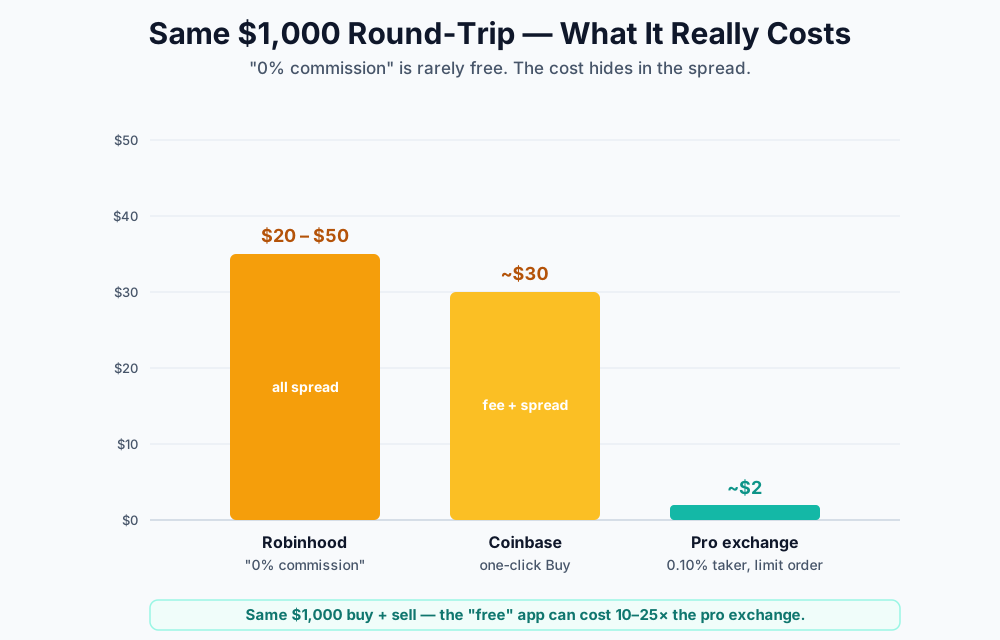
TLDR: Buying and selling $1,000 of BTC at entry-tier taker rates costs about $1 on MEXC, $2 on Binance or OKX, $8 on Kraken Pro, $16 on Coinbase Advanced, and $20–$50 on a ‘commission-free’ app once the spread is counted — the same trade at up to 50× the cost. Switching to limit (maker) orders cuts the pro-exchange numbers further.
A “round-trip” is buying $1,000 of crypto and later selling it — you pay a fee on both legs. At entry-tier taker rates, that round-trip costs about $1 on MEXC, $2 on Binance/OKX, $8 on Kraken Pro, $16 on Coinbase Advanced, and $20–$50 on a “commission-free” app once spread is included. Same trade, up to 50× the cost.
Headline percentages are abstract; dollars are not. Below is the all-in cost of buying $1,000 of BTC and selling it again, using the entry-tier rates above plus realistic spreads. We assume a taker (market) order on both legs, the most common beginner behavior.
| Platform | Trading fee (both legs) | Spread (both legs) | All-in round-trip cost |
|---|---|---|---|
| MEXC (taker 0.05%) | ~$1.00 | ~$0 | ~$1 |
| Binance (taker 0.10%, BNB) | $1.50–$2.00 | ~$0 | ~$2 |
| OKX (taker 0.10%) | ~$2.00 | ~$0 | ~$2 |
| Kraken Pro (taker 0.40%) | ~$8.00 | ~$0 | ~$8 |
| Coinbase Advanced (taker 0.80%) | ~$16.00 | ~$0 | ~$16 |
| Coinbase one-click Buy | ~$20 (flat + %) | ~$10 (0.5%) | ~$30 |
| Robinhood (0% commission) | $0 | $20–$50 (1–2.5%) | $20–$50 |
If you placed limit (maker) orders instead of market orders, the pro-exchange numbers fall further — on Binance a maker round-trip with BNB is about $1.50, and on Kraken a high-volume maker pays nothing. The “free” app, by contrast, has no maker option: you take the quoted spread every time. Over a year of regular trading, that difference compounds into hundreds of dollars — and faster still with an automated trading strategy, where every bot order pays the fee. Factor it into your position sizing and risk plan — fees are a guaranteed loss on every trade, unlike the trade outcome itself.
Funding Rates: The Fee Nobody Counts (Perpetuals & Margin)
TLDR: If you trade perpetuals or margin rather than spot, you pay (or receive) a funding rate every 8 hours on your full position notional: at a calm 0.01%/8h a $10,000 long costs ~$21 over a week (~11% a year), and in an active market at 0.05% it’s ~$105 (~55% annualized). It’s the fee every fee listicle omits, and it can quietly exceed your trading fee many times over.
If you trade perpetual futures or margin — not spot — you pay (or receive) a funding rate every 8 hours. It is calculated as your position notional × the funding rate per interval, settled at 00:00, 08:00, and 16:00 UTC. At a calm 0.01%/8h rate, a $10,000 long costs about $21 over 7 days (~11% a year). No spot position carries this cost.
Funding is the mechanism that keeps a perpetual contract’s price anchored to the spot price. When more traders are long than short, longs pay shorts; when the market flips, shorts pay longs. It is not charged by the exchange as profit — it flows between traders — but to you, the holder of a leveraged position, it is a real, recurring cost that compounds every 8 hours. This is exactly the fee that every “crypto exchange fees” listicle omits, and it is the one that can quietly exceed your trading fee many times over.
Here is the math worked out on a $10,000 perpetual position held for 7 days (21 funding intervals):
| Market condition | Funding rate / 8h | Cost over 7 days ($10,000 position) | Annualized if sustained |
|---|---|---|---|
| Calm | 0.01% | ~$21 | ~11% |
| Active / bullish | 0.05% | ~$105 | ~55% |
| Euphoric spike (rare, e.g. early 2026) | 0.10%+ | $210+ | 110%+ |
Two implications for beginners. First, leverage multiplies funding along with everything else — a 10× position pays funding on the full notional, not your margin. Second, if your thesis is “hold for weeks,” spot is almost always cheaper than a perpetual, because spot has no funding clock. Perpetual maker/taker fees themselves are low (typically 0.02% maker / 0.05%–0.06% taker on Binance, Bybit, OKX, BloFin and Margex), and the decentralized venue dYdX reportedly runs 0% maker/taker on its BTC and SOL markets following a 2026 governance vote (verify current rates on the official site before trading) — but the funding rate is where the real cost of holding leverage lives.
Withdrawal & Deposit Fees: Network Cost vs Exchange Markup
TLDR: Withdrawal fees depend mostly on the network you pick, not the exchange — sending USDT over TRC-20 costs under $2, while the same token over ERC-20 runs $10–$30, a 20× difference from one dropdown. Deposits are free by bank transfer or crypto but can cost up to ~3.99% by card, so never fund a trading account with a card if you can avoid it.
Withdrawal fees depend mostly on the blockchain you choose, not the exchange. Sending USDT over TRC-20 (Tron) typically costs under $2; the same USDT over ERC-20 (Ethereum) often costs $10–$30. BTC and ETH withdrawals are usually charged at or near network cost. Deposit fees are zero for bank transfers and crypto, but card deposits can cost up to ~3.99%.
This is the layer where users overpay without realizing they had a choice. When you withdraw USDT, the exchange asks which network to use — and that single dropdown can change your fee by 20×. The token is identical; only the rails differ. Choosing TRC-20 over ERC-20 for stablecoin transfers is one of the easiest savings in crypto, a point we cover in depth in our guide to the cheapest blockchain for USDT transfers.
| Asset / network | Typical withdrawal fee (2026) | Notes |
|---|---|---|
| BTC (Bitcoin) | $4–$8 (Binance 0.0002, Kraken 0.00015) | At or near network cost |
| ETH (ERC-20) | $5–$12 (Kraken ~0.0035 ETH) | Varies with gas |
| USDT — ERC-20 | $10–$30 | Most expensive rail |
| USDT — TRC-20 | under $2 | Cheapest rail |
Two more cost traps to avoid. On deposits, funding with a debit or credit card can cost up to ~3.99% versus 0% for a bank transfer or a crypto deposit — never fund a trading account with a card if you can avoid it. And note that most reputable exchanges (Coinbase, Kraken) pass withdrawal fees through at network cost, but some charge a markup, so compare the quoted fee against the live network cost before confirming a large transfer. If you withdraw to self-custody often, our wallet decision framework can help you decide how frequently it is worth paying that fee.
Fee Tiers & Token Discounts: Are They Worth It?
TLDR: Exchange-token discounts are usually worth it: Binance’s BNB discount cuts spot fees 25% (to 0.075%) at every tier with no volume requirement, so a small BNB balance pays for itself if you trade regularly. Volume-tier floors (0% maker at $100M–$500M of 30-day volume) are institutional-only — quote the entry tier, not the eye-catching floor, when comparing exchanges.
Volume tiers and exchange-token discounts are real savings, but conditional. Binance’s BNB discount cuts spot fees 25% (to 0.075%) for anyone holding BNB; that is worth it for active traders. Volume-tier floors (Kraken 0% maker at $500M, Coinbase 0% maker at $100M) require institutional turnover and are irrelevant to most users.
There are two ways exchanges reward you for trading more. The first is the 30-day volume tier: trade more, pay less. The second is holding the exchange’s native token (BNB, OKB, CRO, MX, KCS) for an automatic discount. Both are legitimate, but read the conditions:
- Exchange-token discount — often worth it. Binance’s 25% BNB discount applies at every tier with no volume requirement; if you trade regularly on Binance, holding a small BNB balance pays for itself quickly. The trade-off is exposure to the token’s price.
- Volume tiers — rarely reachable. The eye-catching “0.00% maker” rates require 30-day volumes ($100M–$500M) that no retail trader hits. Quote the entry tier, not the floor, when comparing exchanges.
- Staking tiers (Crypto.com CRO) — do the math. Locking thousands of dollars of a volatile token to unlock a fee discount only makes sense if your trading volume is high enough that the saved fees exceed the token’s price risk.
For most beginners: a token discount with no lock-up (BNB) is usually worth it if you trade actively; a discount that requires locking volatile capital or hitting institutional volume usually is not.
CEX vs DEX Fees: When On-Chain Is Cheaper
TLDR: A CEX charges a clean percentage with no gas; a DEX charges a pool fee (~0.30%) plus flat gas that doesn’t scale with size — $5–$50 on Ethereum mainnet but under $0.50 on a Layer 2. So DEX economics improve as trades get bigger: on mainnet a CEX wins below ~$500, but on an L2 the break-even drops under ~$50, and the DEX also saves the withdrawal fee while keeping you in custody.
Centralized exchanges charge a percentage trading fee but no gas; decentralized exchanges charge a liquidity-pool fee (often ~0.30%) plus network gas, which can be $5–$50 on Ethereum mainnet but under $0.50 on a Layer 2. For small trades a low-fee CEX usually wins; for self-custody swaps, a DEX on a Layer 2 is competitive and avoids withdrawal fees entirely.
The fee comparison between centralized and decentralized venues is not apples-to-apples. On a CEX you pay a clean percentage; on a DEX you pay a pool fee plus a flat gas cost that does not scale with trade size — so DEX economics improve as your trade gets bigger, and collapse on tiny trades where gas dominates. Layer 2 networks have changed this math dramatically: a swap that cost $30 in gas on Ethereum mainnet can cost a few cents on a Layer 2. We break down the cheapest and safest on-chain route in our guide to buying ETH with stablecoins on a DEX.
A practical heuristic: on Ethereum mainnet, gas typically exceeds a low-fee CEX’s fee for trades under roughly $500, so a CEX is simplest and cheapest for small amounts you will keep on the exchange. On a Layer 2 (Arbitrum, Base) the break-even drops below about $50, making a DEX competitive — and if you want to keep custody, the DEX also saves you the withdrawal step. The right answer depends on size, custody preference, and how often you move funds — not on a single “DEX is cheaper” headline.
How to Minimize Crypto Trading Fees (Checklist)
TLDR: To cut fees in order of impact: switch from market to limit orders (often a 20%–30% trading-fee cut for free), abandon the one-click ‘Buy’ button for the order book to avoid the spread, never fund with a card (~3.99%), and withdraw USDT over TRC-20 instead of ERC-20 to save $10–$28 a transfer. Hold spot rather than perps for long positions, and recheck rates before you commit.
To cut fees: place limit (maker) orders instead of market orders, trade on an order book rather than a one-click Buy button, fund by bank transfer or crypto (never card), withdraw stablecoins over TRC-20 rather than ERC-20, batch withdrawals, hold spot instead of perpetuals for long holds, and use an exchange-token discount only if it has no lock-up.
Here is the full checklist, ordered by impact for a typical trader:
- Switch from market to limit orders. You move from the taker rate to the maker rate and avoid taking the spread — often a 20%–30% cut on the trading fee for free.
- Abandon the “Buy” button. Use the exchange’s Advanced/Pro order book. The convenience interface’s spread is the most expensive fee most beginners pay.
- Never fund with a card. Use bank transfer or a crypto/stablecoin deposit to avoid the ~3.99% card fee.
- Choose the right withdrawal network. TRC-20 for USDT over ERC-20 saves $10–$28 per transfer; batch several withdrawals into one to pay the fee once.
- Hold spot, not perps, for multi-week positions. You eliminate the funding rate entirely.
- Use a no-lock-up token discount (e.g., BNB) if you trade regularly on that venue; skip discounts that require locking volatile capital.
- Recheck rates before you commit. Fee schedules change; the cheapest venue last quarter may not be cheapest today.
In combination, these seven changes routinely cut a casual trader’s all-in costs by half or more — not by chasing the lowest headline rate, but by removing the hidden layers that quietly add up.
Are Low-Fee & No-KYC Exchanges Safe?
TLDR: Low fees and ‘no-KYC’ access aren’t the same as safety: venues like Margex, BloFin, and dYdX offer competitive fees with optional verification, but a low number can also signal thinner liquidity, weaker compliance, or higher counterparty risk. Judge an exchange on its custody model, security and solvency track record, and liquidity first — then compare fees. A slightly higher fee on a venue you trust is cheaper than a ‘free’ one you don’t.
Low fees and “no-KYC” access are not the same as safety. Some reputable derivatives venues (such as Margex, BloFin, and dYdX) offer competitive fees with optional or no identity verification, but lower fees can also signal thinner liquidity, weaker compliance, or higher counterparty risk. Judge an exchange on custody, track record, and liquidity first — then on fees.
It is tempting to pick the exchange with the lowest number, but fees are only one axis. A venue with no KYC requirement may suit privacy-conscious users (and those outside heavily restricted regions), yet the same lack of oversight can mean less recourse if something goes wrong. Decentralized venues like dYdX keep you in custody of your funds, which removes exchange-insolvency risk but shifts the burden of security onto you. As of 2026-06-05, the published derivatives fees for Margex and BloFin we cite came partly from third-party fee aggregators because their official pages were not reachable to us at verification time, so treat those figures as approximate and confirm current rates and terms directly before depositing.
The framework we recommend: assess an exchange’s custody model, security and solvency track record, liquidity for the pairs you trade, and regulatory standing before you compare fees. A slightly higher fee on a venue you trust is cheaper than a “free” trade on one that freezes your withdrawal. Our CEX vs DEX vs hybrid comparison covers those safety axes in depth.
Frequently Asked Questions
How much are crypto exchange fees on average?
On a professional exchange, spot trading fees in 2026 typically range from 0.05% to 0.80% per trade (maker/taker), so a $1,000 buy-and-sell round-trip costs roughly $1 to $16. However, your true cost also includes spread, withdrawal, deposit, and (for leverage) funding fees, which can exceed the trading fee. “Commission-free” apps often cost the most once their 1%–3% spread is counted.
What is the difference between maker and taker fees?
A maker order adds liquidity to the order book — a limit order that waits to be filled — and is charged less. A taker order removes liquidity — a market order that fills instantly against existing offers — and is charged more. For example, Coinbase Advanced charges 0.60% maker vs 0.80% taker at its entry tier. Using limit orders is a free way to pay the lower rate.
Why does Coinbase charge so much?
Coinbase’s one-click “Buy” interface combines a flat fee ($0.99–$3.99) with an embedded spread of about 0.50%, which for small trades can total 4%–6.5%. Coinbase Advanced Trade, by contrast, uses an order book with entry-tier fees of 0.60% maker / 0.80% taker and minimal spread. Switching from the simple Buy button to Advanced Trade dramatically lowers your cost on the same platform.
Is “0% commission” crypto trading really free?
No. Platforms advertising 0% commission, such as Robinhood and PayPal, make money on the spread — the gap between buy and sell prices — typically 1%–3%. That embedded cost is usually larger than the visible 0.05%–0.40% fee on a professional exchange, making “free” trading frequently the most expensive option.
What is a funding rate and is it a fee?
A funding rate is a payment exchanged between traders holding perpetual futures positions, settled every 8 hours to keep the contract price aligned with spot. To a position holder it functions as a recurring cost: a $10,000 long at a 0.01%/8h rate costs about $21 over a week. Spot trades have no funding rate, so spot is usually cheaper for long-term holds.
What is the cheapest way to withdraw crypto from an exchange?
Choose the cheapest network for the asset. For USDT, the TRC-20 (Tron) network typically costs under $2, while ERC-20 (Ethereum) can cost $10–$30 for the identical token. BTC and ETH are usually charged near network cost. Batching multiple withdrawals into one transaction also reduces total fees.
Which crypto exchange has the lowest fees in 2026?
Among major venues at entry tier, MEXC (0% maker / 0.05% taker) and OKX (0.08% / 0.10%) are the cheapest for spot, while Binance becomes very cheap with the 25% BNB discount. For perpetuals, fees are low across Binance, Bybit, OKX, BloFin, and Margex, and dYdX offers 0% on BTC/SOL markets. Always compare the entry-tier rate plus your expected withdrawal and funding costs, not just the headline number.
Do I pay tax on crypto trading fees?
In most jurisdictions, trading fees are added to your cost basis or deducted from proceeds, which reduces your taxable capital gain — so keeping fee records can lower your tax bill. The exact treatment varies by country; see our crypto capital gains tax guide for the 2026 rules across major jurisdictions.
Continue Learning
- CEX vs DEX vs Hybrid Exchanges 2026 — Which exchange type fits you, and how custody differs (XC-1)
- Crypto Order Types Explained 2026 — How to place the limit orders that earn the maker rate (TR-1)
- Cheapest & Safest Way to Buy ETH on a DEX 2026 — On-chain swap fees and gas in practice (L2-2)
- Cheapest Blockchain for USDT Transfers 2026 — Cut withdrawal costs by choosing the right network (KG-7)
- Crypto Wallet Decision Framework 2026 — When self-custody is worth the withdrawal fee (W-2)
- Crypto Risk Management 2026 — Building fees into your position sizing (TR-3)
- Crypto Capital Gains Tax 2026 — How fees affect your cost basis and tax (TR-Tax-1)

Editorial pen name · ChainGain
Alex Mercer is the editorial pen name used for ChainGain’s cryptocurrency education content. Articles are based on cited sources and reproducible comparisons. Editorial profile
Disclaimer: This article is educational, not financial advice. ChainGain may earn a commission if you open an account with Margex, BloFin, or dYdX through partner links; we do not receive commission from Binance, Coinbase, Kraken, OKX, Bybit, MEXC, Crypto.com, Gemini, or Robinhood, which are named for comparison only. All fees were verified on 2026-06-05 against each platform’s official fee schedule where reachable; for Margex and BloFin, some figures were drawn from third-party aggregators because official pages were unavailable at verification time and should be treated as approximate. Fees, spreads, funding rates, and withdrawal costs change frequently and vary by region, volume, and market conditions — always confirm the current rate on the exchange’s own site before trading. Trading and leverage carry risk, including the total loss of capital; perpetual and margin positions can be liquidated, and funding costs accrue while positions are open. Verify your local availability and tax obligations before using any exchange.