Best Crypto Card 2026: Honest Comparison of Fees, Custody & Tax
Table of Contents
Independence disclosure: ChainGain does not receive affiliate commissions from Crypto.com, Coinbase, Nexo, Binance, or Wirex for sign-ups originating from this article. Custody disclaimer: every card in this comparison is custodial — the issuer holds your funds, not you. Verify before applying: fees, cashback rates, and supported regions change frequently. Re-check the official sites linked in each section before signing up.
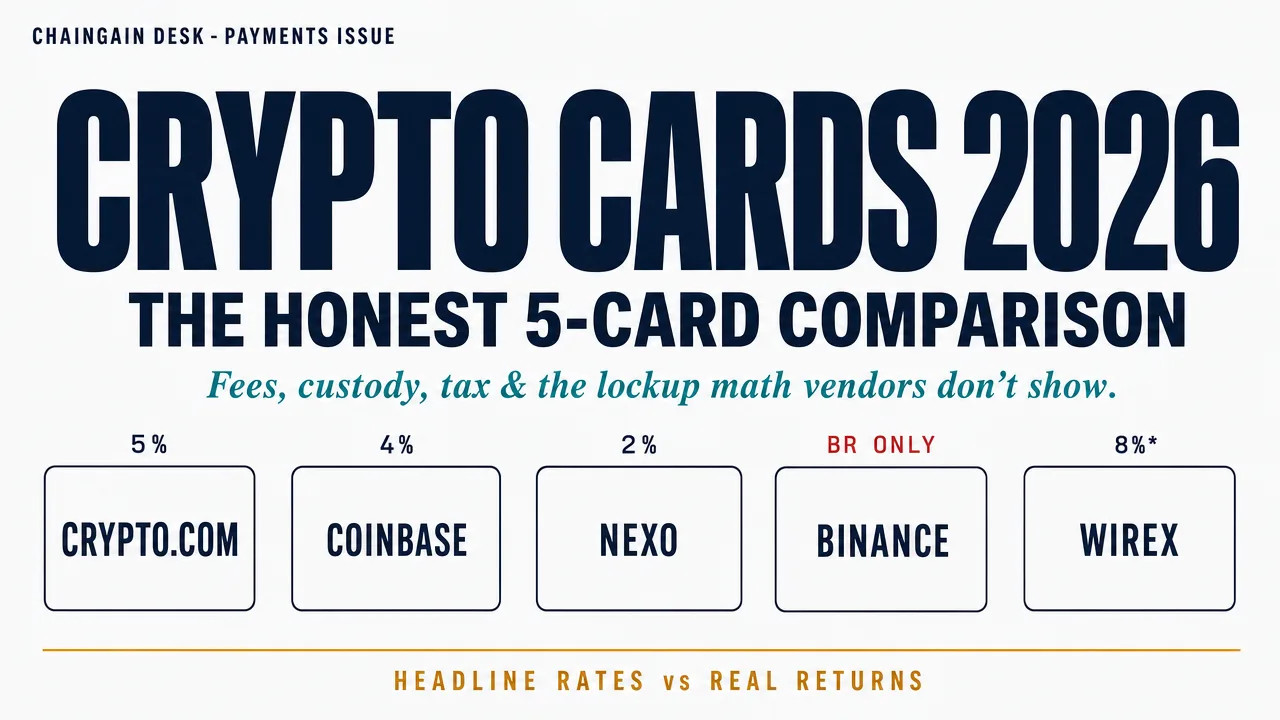
Most “best crypto card 2026” articles compare cashback rates and ignore the hard parts: where your money lives custody-wise, what happens at tax time, and what staking lock-ups actually cost you across a three-year horizon. The result is a marketing-led ranking that flatters whatever cashback headline reads highest this month, but tells you nothing about whether you should still be carrying the card after the next exchange incident.
This is a different kind of comparison. We look at five cards that dominate global search interest — Crypto.com Visa, Coinbase Card, Nexo Card, Binance Card, and Wirex Card — and we benchmark them across six axes: fee structure, custody and counterparty risk, past-incident disclosure, staking-lock-up opportunity cost, cashback tax treatment by jurisdiction, and geographic availability under the 2024–2026 regulatory shift. We pull every cashback number, lockup requirement, and ATM fee from each issuer’s own pricing page as of May 2026.
Three blunt findings up front: (1) Crypto.com replaced its old 180-day CRO staking model with a 12-month lockup in November 2024 — most third-party reviews still quote the old terms. (2) Binance Card has been discontinued in the EU, EEA, UK, US, and Canada since December 2023; the October 2025 “relaunch” is a Brazil-only Mastercard prepaid product. (3) Coinbase Card’s headline 4% cashback is rotational and US-only, and its 2.49% crypto-to-USD conversion fee silently erases the reward unless you spend stablecoins. Each of these facts changes the right card for you. None of them appears in the top SERP results.
What “Best Crypto Card 2026” Articles Don’t Tell You
Across roughly 11,000 words combined, zero of them disclose a past security incident, none model the opportunity cost of token lockups, and none compare cashback tax treatment between jurisdictions. CNBC briefly touches taxes in a single FAQ answer. MetaMask’s article gives a single paragraph to custody before pivoting back to promoting MetaMask Card.
What’s missing matters more than what’s present. A 5% cashback rate that requires you to lock $400,000 in a volatile token for twelve months is not “free money” — it is a leveraged bet on that token’s price, dressed up as a rewards programme. A “no foreign transaction fee” claim that conceals a 2.49% conversion spread is the same fee, relabelled. A card that operated in 30+ countries in 2022 and now exists only in Brazil tells you something about regulatory durability that a “Top 10” list will not. Honest comparison means showing the costs vendors prefer not to highlight.
How Crypto Cards Actually Work (Debit, Credit, Prepaid)
The phrase “crypto card” covers three distinct payment instruments with very different risk and tax profiles. Debit cards (Coinbase, Wirex Standard, Nexo Debit Mode) draw directly from a balance you already hold with the issuer — at the moment of purchase, your crypto or stablecoin is sold to fiat and the fiat is sent to the merchant. Prepaid cards (Crypto.com Visa, Binance Brazil) require you to load fiat or stablecoin onto a stored-value account before spending; the issuer custodies the balance. Credit cards (Gemini, Coinbase One Card, Nexo Credit Mode) extend a credit line denominated in fiat and pay rewards in crypto — your crypto holdings serve either as collateral (Nexo) or simply as a reward currency (Gemini).
The tax consequence is asymmetric. Every debit-card swipe is a disposal event — selling crypto for fiat triggers a capital gain or loss in most jurisdictions (US, UK, Germany, Australia, Japan all treat it this way). A credit-card swipe is not a disposal; it is a fiat-denominated purchase whose crypto rewards are usually classified as income or rebate at the moment of receipt. If you spend appreciated bitcoin on groceries through a debit card every week, you are creating a year-end tax-return nightmare. We cover this asymmetry in detail in our Crypto Capital Gains Tax 2026 guide.
The Five Cards Compared: Fee Structure
Numbers below were pulled from each issuer’s official terms page in May 2026. Crypto.com pricing references Singapore tier amounts because Singapore is the most transparent regional disclosure available; the structure (tier names, lockup periods, rebate percentages) is consistent globally even if absolute amounts vary by region. Coinbase Card numbers are US-specific. Nexo numbers are EEA/UK. Binance Brazil is the only Binance Card currently live. Wirex covers EEA/UK/APAC.
| Card | Lock-up required | Monthly fee | Cashback (top tier) | FX markup | ATM free / fee |
|---|---|---|---|---|---|
| Crypto.com Visa (Ruby Steel) | ~SG$650 CRO, 12-month lockup | SG$5.99/mo or SG$59.90/yr | 2% in CRO, capped SG$25/mo | Variable by jurisdiction | SG$400/mo free, then ~2% |
| Crypto.com Visa (Obsidian) | ~SG$650,000 CRO, 12-month lockup | Included with stake | 5% in CRO, uncapped | Variable by jurisdiction | SG$1,000/mo free |
| Coinbase Card (US debit) | None | $0 | Up to 4% rotating (US-only, in-app) | $0 (but 2.49% conversion fee on crypto spend) | $0 Coinbase fee; operator fees apply |
| Nexo Card (Platinum) | NEXO tokens for tier; $5,000+ portfolio | $0 | 2% in NEXO or 0.5% in BTC | 0.2% EEA / 2% non-EEA (weekday) | €2,000/mo free, then 2% (min €1.99) |
| Binance Card (Brazil only) | None for base; BNB stake for boosts | $0 | Up to 2% in BNB, capped 250 BRL/mo | Per Mastercard standard | Brazil-only fee schedule |
| Wirex Card (Elite) | 7.5M WXT, 180-day lock | €29.99/mo (Elite plan) | Up to 8% in WXT | Per Mastercard standard | $200/mo free, then 2% |
| Wirex Card (Standard free) | None | $0 | 0.5% in WXT | Per Mastercard standard | $200/mo free, then 2% |
What this table reveals: the headline cashback numbers (5%, 8%, 4%) all require either a large token lockup, a monthly subscription fee, or a US residency. The cards with no lockup and no monthly fee — Coinbase Card debit and Wirex Standard — cluster around 0.5%–4% effective return, and Coinbase’s 4% is offset by a 2.49% conversion fee on every non-stablecoin swipe. The realistic everyday cashback after fees, lockups, and FX is closer to 0.5% to 2% for most users, not the marketing headlines.
Custody — Who Actually Holds Your Money?
Every card in this comparison is custodial. When you load your Crypto.com Visa, your CRO and any preloaded fiat sit on Crypto.com’s balance sheet. When Coinbase Card spends from your USDC balance, that USDC is held in Coinbase’s custody accounts. There is no version of any of these products where you keep your own private keys to the spending balance. That distinction is the single most important risk consideration, and it is also the one most third-party reviews skip.
The implications became concrete in 2022. On 13 July 2022, Celsius Network filed for Chapter 11 bankruptcy with approximately $4.7 billion in user assets frozen — users who had treated Celsius as a savings account discovered they were unsecured creditors. Four months later, on 11 November 2022, FTX collapsed with roughly $8 billion in misappropriated customer funds; Sam Bankman-Fried was sentenced to 25 years in prison on 28 March 2024. Neither Celsius nor FTX issued one of the five cards in this comparison. But both incidents are the right mental model for the question, “What happens if my card issuer fails?”
Crypto-card issuers typically rely on a network of e-money licences, regional banking partners, and BIN sponsors. Your fiat balance sits with the BIN sponsor (often FDIC-insured in the US, or covered by EU deposit-guarantee schemes up to local limits). Your crypto balance sits with the issuer’s custody arrangement, which may or may not be segregated, may or may not be insured, and is almost never covered by the same protections as fiat. If you would not be comfortable keeping a five-figure balance on an exchange overnight, you should not be comfortable carrying a five-figure spending balance on a card issued by that exchange. For self-custody alternatives, see our wallet selection by persona guide and our hardware wallet comparison.
Past Incidents Timeline
The five issuers in this comparison have a non-trivial incident history. We are not claiming any current issuer is unsafe; we are showing the pattern of disclosures so you can price the risk yourself.
| Issuer | Date | Event | Magnitude / outcome | Card user impact |
|---|---|---|---|---|
| Crypto.com | 17 Jan 2022 | 2FA bypass exploit, unauthorised withdrawals from 483 accounts | $34M total ($15M ETH + $19M BTC + ~$66k other); fully reimbursed via WAPP programme | None direct; demonstrated incident-response capability |
| Binance | Dec 2022 onwards | Visa and Mastercard ended global card partnerships | Card discontinued in EU/EEA/UK on 20 Dec 2023; never available in US/Canada | Cardholders in 30+ countries lost access; refunds were not issued at scale |
| Nexo | Nov 2023 | SEC + state regulators settlement for unregistered Earn Interest Product offering | $45M total ($22.5M SEC + $22.5M state); Earn Interest Product wound down for US users | Card itself unaffected (separate product); reputational ripple |
| Binance | Oct 2025 | Card relaunched in Brazil only, as Mastercard prepaid | Up to 2% BNB cashback, capped 250 BRL/mo; no announced expansion | Available only to Brazil residents as of May 2026 |
| Wirex | Various | Network and partner-bank transitions (Visa → Mastercard principal membership) | Card remained functional through transition; current Mastercard network | Periodic re-issuance to cardholders |
| Coinbase | Various | Intermittent outages during 2024–2025 market volatility events | Card spending and ATM withdrawals briefly degraded during platform-wide incidents | Short-duration unavailability during high-volume hours |
Crypto.com 2022: $34M hack and the WAPP response
On 17 January 2022, Crypto.com detected unauthorised activity on 483 user accounts. Attackers bypassed two-factor authentication and withdrew approximately $34M in total — $15M in ether, $19M in bitcoin, and about $66,000 in other assets. Crypto.com fully reimbursed affected users and rolled out the Worldwide Account Protection Program (WAPP), which provides up to $250,000 in compensation per qualifying account for unauthorised withdrawals. The incident demonstrated both a vulnerability (2FA bypass) and a corporate response capability (full reimbursement within days). It also remains the largest disclosed direct security incident affecting a major crypto-card issuer.
Binance Card: EU/EEA/UK discontinuation, December 2023
Binance Card was a Visa debit product available in roughly 30 countries at its peak. On 20 December 2023, Binance discontinued the card across all EU/EEA jurisdictions and the United Kingdom after Visa ended the partnership. The card had never been available in the United States or Canada. There was no replacement and no card-balance refund process at scale; affected users were directed to Binance Pay (a QR/in-app payment system) as the substitute. In October 2025, Binance relaunched a card product — but exclusively in Brazil, as a Mastercard prepaid card with up to 2% BNB cashback capped at 250 BRL per month. There has been no announced timeline for expansion to other regions. For most international readers, Binance Card is not a present-day option.
Nexo 2023: $45M SEC settlement (Earn Interest Product)
In November 2023, Nexo agreed to pay $45 million in a settlement with the US Securities and Exchange Commission and a coalition of state regulators. The settlement covered Nexo’s Earn Interest Product — a separate lending product that offered yield on deposited crypto — which the SEC determined was an unregistered securities offering. The Nexo Card was not the subject of the settlement and was not directly affected. However, the settlement is worth noting for two reasons: it eliminated a major US-market revenue line for Nexo, and it left US residents without access to Nexo’s full product suite. The card itself remains available only in the EEA, UK, and select non-US markets.
Coinbase: outages during volatility events
Coinbase has not had a major card-specific security incident, but the platform has experienced periodic outages during high-volatility market moves through 2024 and 2025. When the trading platform is degraded, card swipes and ATM withdrawals can fail because the back-end conversion engine is unavailable. This is a usability issue rather than a safety issue, but it matters for travellers and anyone who relies on the card as a primary spending instrument. Carry a backup payment method if you plan to use any exchange-issued debit card abroad.
Wirex: multiple partner transitions, continuous operation
Wirex has transitioned card networks and partner banks several times since the company’s founding in 2014. Notably, it moved to Mastercard principal member status, which gives it more direct control over card issuance. The card has remained functional through these transitions, but cardholders should expect periodic re-issuance of physical cards and small differences in supported merchant categories during transitions. Wirex has not been the subject of a major disclosed security incident or regulatory settlement, though it has been off-limits to US residents since 2018.
The Staking Lock-up Trap
The cards offering the most generous headline cashback all require token lockups. Crypto.com Visa changed its model in November 2024, replacing the previous 180-day CRO staking with a 12-month lockup. To unlock the Obsidian tier’s 5% rate today, you must lock approximately SG$650,000 in CRO for 12 months. Wirex’s 8% Elite Ultimate cashback requires 7.5 million WXT locked for 180 days. Nexo’s top Platinum tier requires holding a NEXO-denominated balance proportional to portfolio size with no fixed expiry but with continuous-balance requirements.
The honest way to evaluate these requirements is as a leveraged position in the underlying token. If you lock $650,000 in CRO at $0.10 and CRO drops 50% over the lockup period, your cashback earnings are dwarfed by the principal loss. CRO has historically been highly volatile — it ranged from $0.50+ at its 2021 peak to under $0.06 in 2022 troughs. WXT and NEXO show similar volatility profiles. If the answer is no, the cashback is not compensating you for the risk; it is the bait on a directional bet.
There is also a real opportunity cost. Capital locked in CRO or WXT cannot earn risk-adjusted stablecoin yield. As of May 2026, USDC on leading platforms earns 4%–6% APY (see our stablecoin savings rates guide for current numbers). On $650,000 over twelve months, that is roughly $26,000–$39,000 in foregone interest before counting any token-price downside. The breakeven cashback rate that would justify the lockup is mathematically higher than what most cards offer once you account for token volatility and the lost stablecoin yield.
Cashback Tax Treatment by Jurisdiction
Cashback earned in crypto is taxed differently depending on where you live, what type of card you used, and whether the rewards are denominated in a stablecoin or a native exchange token. The chart below summarises the prevailing 2026 treatment in five major jurisdictions. This is educational summary, not tax advice; cashback classification has been an active area of revenue-authority guidance and your situation may differ. Consult a qualified tax professional.
| Country | Cashback in crypto: how taxed at receipt | Disposal (selling/spending later) | Notable 2026 detail |
|---|---|---|---|
| United States | Generally treated as rebate (non-taxable) by IRS for credit-card rewards. Cashback in crypto from debit-card spending is taxable income at fair market value at receipt. | Subsequent sale is a capital gain/loss event with cost basis = FMV at receipt. | Every debit-card swipe of appreciated crypto is itself a disposal — record-keeping nightmare. |
| United Kingdom | HMRC treats crypto rewards from card spending generally as miscellaneous income at FMV at receipt. | Subsequent disposal triggers CGT with cost basis = FMV at receipt; CGT allowance £3,000 (2026/27). | S104 share-pooling rules apply — fungible token reward pools matter for cost basis. |
| Germany | BMF guidance generally classifies crypto cashback as “other income” (§22 EStG) at FMV at receipt. | Held >12 months: tax-free disposal for private individuals. Held ≤12 months: taxed at personal income rate. | The 12-month rule creates a strong incentive to hold rather than spend reward tokens immediately. |
| Australia | ATO generally treats crypto cashback as ordinary income at AUD market value at receipt. | Subsequent sale subject to CGT; 50% discount if held >12 months. | Personal use asset exemption is narrowly defined and rarely applies to crypto cards. |
| Japan | NTA classifies crypto rewards generally as miscellaneous income (zatsu shotoku) at JPY market value at receipt. | Subsequent sales also taxed as miscellaneous income; no separate CGT regime; combined rates can reach ~55%. | Japan’s tax framework is the most punishing for high-frequency crypto card users among major economies. |
The practical takeaway: debit-card spending of appreciated crypto creates a tax event on every swipe. If you bought BTC at $20,000 and spend at $90,000, every coffee purchase is a small capital-gain realisation. Stablecoin spending (USDC, USDT) avoids the disposal event but introduces issuer-credit and regulatory risk under MiCA. Credit-card spending where rewards are paid in crypto is generally cleaner: the fiat purchase is not a disposal, and the crypto reward is income at FMV at receipt. For a detailed worked example by jurisdiction, see our Crypto Capital Gains Tax 2026 guide.
Geo Restrictions and the MiCA 2026 Impact
Card availability is dramatically asymmetric by region, and the regulatory landscape shifted meaningfully through 2024–2026. The EU’s Markets in Crypto-Assets regulation, MiCA Title IV (E-Money Tokens), entered into force on 30 June 2024, with the remaining Crypto-Asset Service Provider obligations following on 30 December 2024. Stablecoin issuers serving the EU must now be authorised as E-Money Institutions, which is why some non-MiCA-compliant stablecoins have been delisted from EU exchanges. Card programmes that route through stablecoin balances inherit this constraint.
| Region | Crypto.com Visa | Coinbase Card | Nexo Card | Binance Card | Wirex Card |
|---|---|---|---|---|---|
| United States | ✅ (limited states) | ✅ | ❌ | ❌ | ❌ |
| EU / EEA | ✅ | ✅ (select markets) | ✅ | ❌ | ✅ |
| United Kingdom | ✅ | ✅ | ✅ | ❌ | ✅ |
| Brazil | ✅ | (limited) | ❌ | ✅ (only region live) | ✅ (LATAM) |
| Singapore / APAC | ✅ (Singapore HQ) | (limited) | ❌ | ❌ | ✅ (select) |
| Canada | (limited) | ✅ | ❌ | ❌ | ❌ |
If you live in the United States, your realistic shortlist for a card you can actually obtain is Coinbase Card, Crypto.com Visa (in eligible states), Gemini Credit Card, and Coinbase One Card — Nexo, Wirex, and Binance are all off the table. In the EU/UK, the menu broadens to include Nexo and Wirex but excludes Binance Card. In Brazil, Binance Card is uniquely available alongside the rest. Verify availability on each issuer’s pricing page before committing to a comparison shortlist that does not work in your jurisdiction.
Three-Year Total Cost of Ownership: A Worked Example
Headline cashback rates compress the cost analysis into one number and miss almost everything that matters. A three-year Total Cost of Ownership calculation forces the question of whether the locked capital, monthly subscription, and tax friction net out positive for your spending profile. The example below assumes a user spending USD $5,000 per month ($180,000 over 36 months) on everyday categories, with stablecoin funding to avoid disposal-event taxation. Foreign transaction fee is omitted (domestic spend assumption). All figures are in USD-equivalent for comparability.
| Card / tier | Cashback over 3y (gross) | Lock-up capital | Foregone USDC yield (4% APY × 3y) | Monthly fees over 3y | Conversion fee | Estimated net return (3y) |
|---|---|---|---|---|---|---|
| Crypto.com Ruby Steel | ~$675 gross (capped at ~$19/mo ≈ $225/yr) | ~$500 | ~$60 | ~$216 ($5.99 × 36) | $0 (stablecoin) | ~ +$200 (after CRO volatility risk) |
| Crypto.com Obsidian | ~$9,000 (5% uncapped) | ~$500,000 | ~$60,000 | $0 (included) | $0 (stablecoin) | ~ −$51,000 vs simply holding USDC |
| Coinbase Card (US, USDC spend) | ~$0–$3,600 (variable 0–2%) | $0 | $0 | $0 | $0 if USDC | ~ +$1,800 mid-case |
| Nexo Platinum (2% NEXO) | ~$3,600 | ~$5,000 portfolio | ~$600 | $0 | $0 | ~ +$2,400 (after NEXO volatility) |
| Wirex Standard (free, 0.5%) | ~$900 | $0 | $0 | $0 | $0 if USDC | ~ +$700 after FX |
| Wirex Elite (8% WXT) | ~$14,400 (if 8% sustained) | ~$300,000 (7.5M WXT × ~$0.04) | ~$36,000 | ~$1,080 (€29.99 × 36) | $0 if USDC | ~ −$22,000 vs USDC hold (token risk dominates) |
This is the trap that headline cashback rates obscure. The 5% and 8% tiers are net-negative under this assumption because the locked-up token capital would have earned more in plain stablecoin yield without the volatility downside. The cards that come out positively in a typical retail spending profile are the no-lockup, low-fee debit cards — Coinbase Card for US users, Nexo at Gold or Platinum tier for EU users (a $5,000 portfolio requirement is meaningfully lower than the SG$500,000+ Obsidian lockup), and Wirex Standard for low-friction free use. The math changes if you would have held the token regardless or if your spend volume is significantly higher than $5,000/month. Run the calculation with your own numbers before locking capital.
Decision Tree: Which Card Fits Your Use Case?
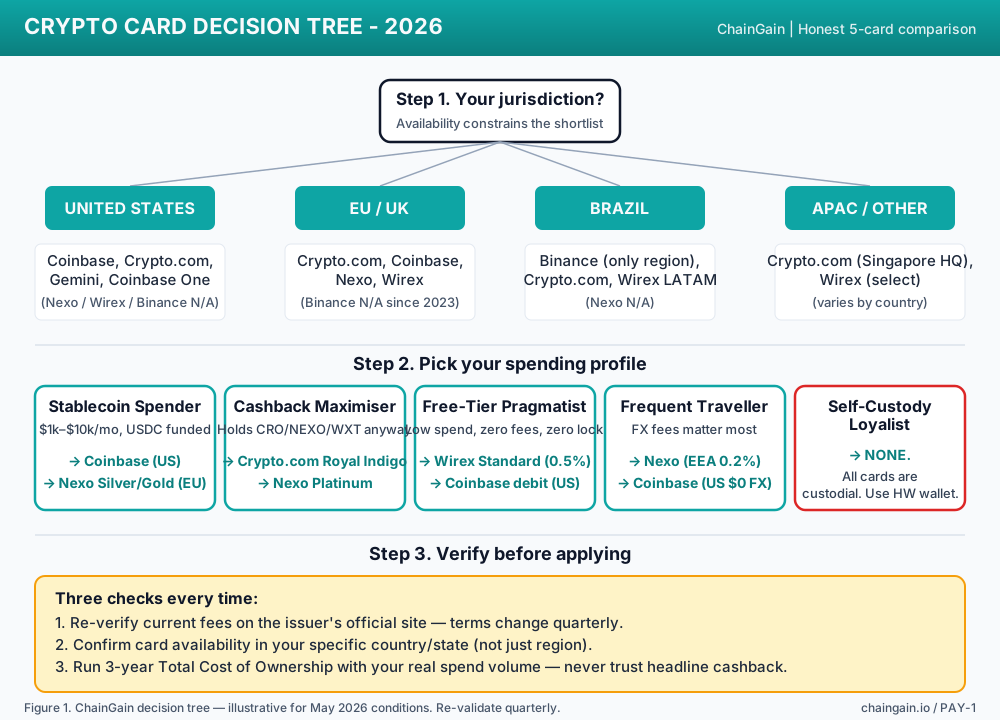
The right card depends on three inputs: your jurisdiction, your monthly spend volume, and whether you intend to fund the card with stablecoins or with appreciated crypto. Use the decision tree above as a starting point, then verify availability on the issuer’s site.
- US resident, light spender, no lockup: Coinbase Card with USDC funding. Track the rotating cashback category in-app.
- US resident, frequent traveller: Gemini Credit Card (not covered in detail here; check each issuer’s current US product lineup before committing). Avoid debit-card disposal events.
- EU resident, no lockup preference: Nexo Card at Gold or Silver tier (modest portfolio requirement, no monthly fee, generous ATM allowance).
- EU resident, willing to accept token exposure: Nexo Platinum (2% NEXO) — but only if you would hold NEXO independently.
- UK/EU traveller, low spend, free option: Wirex Standard (no fee, 0.5% — modest but truly free).
- High-volume Crypto.com user already holding CRO: Royal Indigo (3%) is the sweet spot — Obsidian rarely justifies the lockup unless you already hold a six-figure CRO position.
- Brazil resident: Binance Card is the only Binance-branded option globally; cashback cap of 250 BRL/month is modest but the product is otherwise functional.
Five-Year Custodial Risk Surface
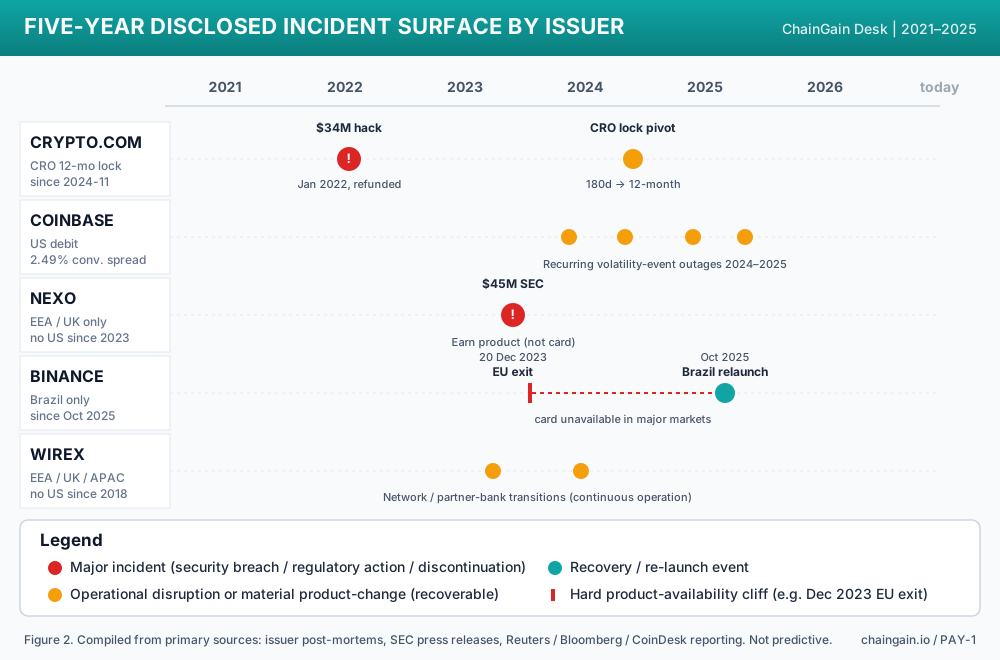
The chart above plots disclosed incidents — security breaches, regulatory settlements, partner-network disruptions — for each issuer across the 2021–2025 window. A few patterns are visible. Binance has the most disruption in card availability, driven primarily by network-partner withdrawals rather than security incidents per se. Crypto.com has one major security incident (2022 hack) but a strong recovery response. Nexo has one significant regulatory event (2023 SEC settlement) but no card-specific security failure. Coinbase shows recurring operational issues during volatility events but no large-scale security failure. Wirex shows network transitions but no disclosed major incident.
None of this is a recommendation to avoid any issuer. It is the disclosure pattern you should weigh against headline cashback rates when sizing the card balance you are willing to carry. The smaller your everyday spending balance on the card, the less the custodial-risk surface matters; the larger your stored value, the more it does.
The Verdict — Cards by Spending Persona
There is no “best” crypto card in 2026. There is a best card for your jurisdiction, spend volume, token-holding posture, and risk tolerance. Below is the consolidated verdict by persona. None of this is a vendor recommendation in the affiliate sense — we receive no commission from any issuer named in this article.
- The Stablecoin Spender (US): Coinbase Card with USDC funding. No conversion fee, no monthly fee, no lockup. Track in-app rotating rewards. Accept that headline 4% is rare.
- The Stablecoin Spender (EU/UK): Nexo Card at Silver or Gold tier. The 0.7%–1% in NEXO (or even smaller BTC option) plus zero monthly fee and €1,000/mo free ATM is the best low-friction EU option.
- The Cashback Maximiser, willing to hold the token: Crypto.com Royal Indigo at ~SG$6,500 CRO lockup for 3% capped — a smaller bet on CRO than Obsidian, with most of the practical benefit.
- The Free-Tier Pragmatist: Wirex Standard. 0.5% in WXT, no fees, no lockup, $200/mo free ATM. The token reward is symbolic but the card is genuinely free.
- The Brazil Resident: Binance Card (Mastercard prepaid). Limited cap but the only Binance-branded card globally; treat the 2% as the local norm.
- The Self-Custody Loyalist: None of the above. Every card in this comparison is custodial. If self-custody matters more than cashback, keep your funds in a hardware wallet (see our Ledger vs Trezor 2026 comparison) and convert to fiat only when needed via a regulated exchange.
Frequently Asked Questions
Is the headline cashback rate the real return I will earn?
Almost never. The headline rate (5%, 8%, 4%) is the top tier under specific conditions — usually a six-figure token lockup, a monthly subscription, or a US-only rotating category. Realistic returns for a typical user without large lockups are 0.5% to 2% after accounting for monthly fees, conversion fees, and FX. Run a three-year Total Cost of Ownership for your specific spend volume before committing to a tier.
Will spending crypto on a debit card create a tax event?
Yes, in most jurisdictions (US, UK, Germany, Australia, Japan). Each debit-card swipe of appreciated crypto is a disposal that triggers a capital gain or loss. To avoid this, fund the card with stablecoins (USDC, USDT, EURC where supported) or use a credit card where rewards are paid in crypto (the fiat purchase itself is not a disposal). Always consult a qualified tax professional in your jurisdiction. For a deeper analysis, see our USDT vs USDC head-to-head comparison.
What happens to my card balance if the issuer goes bankrupt?
Your fiat balance is typically held by a regulated banking partner (FDIC-insured in the US, or covered by EU deposit-guarantee schemes up to local limits). Your crypto balance is held by the issuer’s custody arrangement, which may not be segregated, may not be insured, and is rarely covered by the same depositor protections as fiat. Treat the card as a spending tool, not a savings account. Keep only what you plan to spend in the near term on the card.
Are crypto credit cards safer than crypto debit cards?
They are different rather than safer. Credit cards (Gemini, Coinbase One, Nexo Credit Mode) extend a fiat credit line and pay rewards in crypto — your principal is not at the issuer’s custody risk in the same way. Debit cards spend from your existing crypto or stablecoin balance — the balance carries full custodial risk while it sits on the card. The trade-off is that credit cards require a credit check and a hard credit pull, and Nexo Credit Mode uses your crypto as collateral with margin-call risk.
Why is Binance Card not in my country anymore?
Binance discontinued its Visa and Mastercard card products in the EU, EEA, and UK on 20 December 2023 after both networks ended their partnerships with Binance. The card was never available in the United States or Canada. As of May 2026, Binance Card has been relaunched only in Brazil, as a Mastercard prepaid product. There is no announced timeline for expansion. If you are outside Brazil, Binance Card is not currently an option; Binance Pay (a QR/in-app payment rail) is the substitute the platform points users to.
Conclusion: A Card, Not a Religion
The honest answer to “what’s the best crypto card in 2026?” is that the question is mis-framed. The right card is whichever one minimises your cost of spending crypto in your jurisdiction, given the spending balance you are willing to keep custody-exposed at any one time. For most readers that means a no-lockup, low-fee debit card funded with stablecoins, used for routine purchases, with a hardware wallet handling everything you do not plan to spend in the next few weeks. The cards offering 5%–8% headline rates are not free money; they are leveraged positions in volatile tokens, with the cashback as the entry incentive.
Re-verify the numbers in this article on the issuers’ official pages — crypto.com/cards, coinbase.com/card, nexo.com/cards, binance.com/en/cards, and wirexapp.com — before you commit. Cashback rates, lockup amounts, ATM limits, and regional availability have all shifted within the last twelve months and will continue to. The honest comparison is the one you do with the current numbers, not last quarter’s.
Continue Learning
- Ledger vs Trezor 2026: Long-Term Owner’s Honest Comparison — self-custody alternative to custodial cards
- Hardware Wallets 2026: Trezor vs Ledger vs SafePal vs Tangem — broader hardware overview
- Crypto Wallet Decision Framework 2026 — 6-step methodology for self-custody choices
- Crypto Wallet by Persona 2026 — choose by use case rather than brand
- Crypto Capital Gains Tax 2026 — full 5-country tax framework for card spending
- Best Stablecoin Savings Rates 2026 — what your locked-up cashback capital could be earning instead
- Best EVM Browser Wallets 2026 — for the DeFi side of crypto card workflows

Editorial pen name · ChainGain
Alex Mercer is the editorial pen name used for ChainGain’s cryptocurrency education content. Articles are based on cited sources and reproducible comparisons. Editorial profile
Disclaimer. This article is for educational purposes. It is not financial, legal, or tax advice. Cashback rates, fees, lockup requirements, and regional availability change frequently — re-verify on each issuer’s official site before applying for any card. All cards compared here are custodial; the issuer holds your funds. Past incidents are described for risk context, not as predictions. Consult a qualified tax professional in your jurisdiction before making decisions whose tax consequences you do not fully understand.