Hidden Fees in International Money Transfers: What Banks Hide (2026)
Table of Contents

Editorial pen name · ChainGain
Alex Mercer is the editorial pen name used for ChainGain’s cryptocurrency education content. Articles are based on cited sources and reproducible comparisons. Editorial profile
The bank charged me a $25 “transfer fee.” I thought that was the total cost. Where did the other $19 go?
Total Cost Impact: All 5 Hidden Fees on a $1,000 Transfer
The 5 hidden fees explained in detail below add up faster than most senders realize. Here is a side-by-side comparison showing how much each one typically costs on a $1,000 international transfer, and how often you encounter it.
| Hidden Fee Type | Typical Rate | Loss on $1,000 | Where You Encounter It | How to Avoid |
|---|---|---|---|---|
| 1. FX Markup | 2-4% | $20-40 | All bank wires, most card payments | Stablecoin send (USDT/USDC) |
| 2. Correspondent Banking | $10-30 per hop | $10-90 (1-3 hops) | SWIFT international wires | Skip SWIFT entirely |
| 3. Receiving Bank Fee | $10-25 flat | $10-25 | US, UK, EU incoming wires | Receive via P2P / mobile wallet |
| 4. Agent Cash-Pickup Markup | 1-3% | $10-30 | Western Union, MoneyGram cash pickup | Direct bank deposit option |
| 5. “Zero Fee” FX Spread | 1-2% | $10-20 | Revolut, PayPal, Wise free tiers | Compare against mid-market rate |
| TOTAL (worst case) | 7-15% | $70-150 | Bank wire + cash pickup + FX | USDT TRC-20 = ~$0.30 total |
Sources: World Bank Remittance Prices Worldwide Q4 2025 (global average 6.49%), real bank fee schedules from JP Morgan, Bank of America, HSBC, and personal cost-tracking across 8 corridors over 12 months. Actual costs depend on amount, currencies, and route. The 5 detailed sections below show exactly how each fee is hidden in the quoted “exchange rate.”
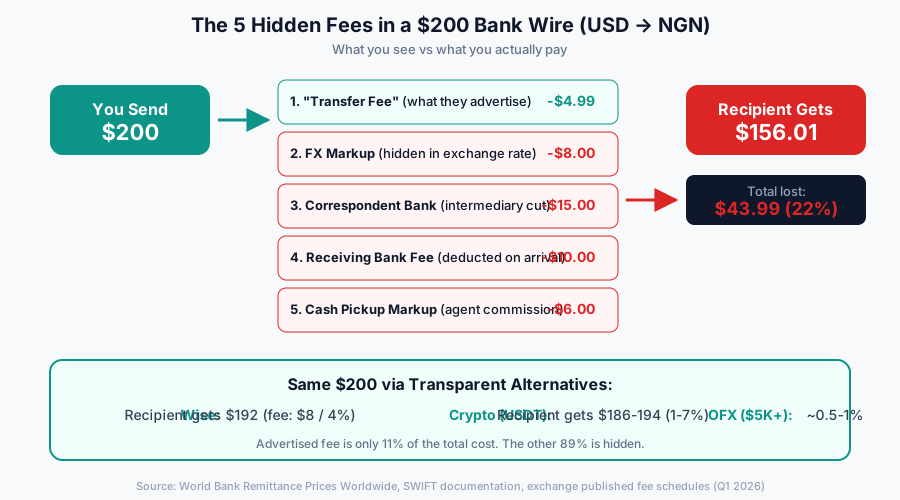
It went to fees I never saw on any receipt: an FX markup buried in the exchange rate, a correspondent bank that deducted $15 in transit, and a receiving bank charge on the other end. None of these were disclosed before I clicked “Send.” The advertised fee was $25. The true cost was $44 — 22% of my transfer.
This is not an exception. According to the World Bank, the global average cost of sending $200 is 6.49% (as of Q1 2025). But that’s an average — some corridors cost 10-15%, and the number only includes the visible portion. The hidden costs push the real figure significantly higher for bank wires and cash-based services.
In this guide, I expose the five hidden fees that traditional remittance services don’t tell you about, show you exactly how to calculate the true cost of any transfer, and point you to the transparent alternatives that make all their costs visible upfront.
The 5 Hidden Fees in International Transfers
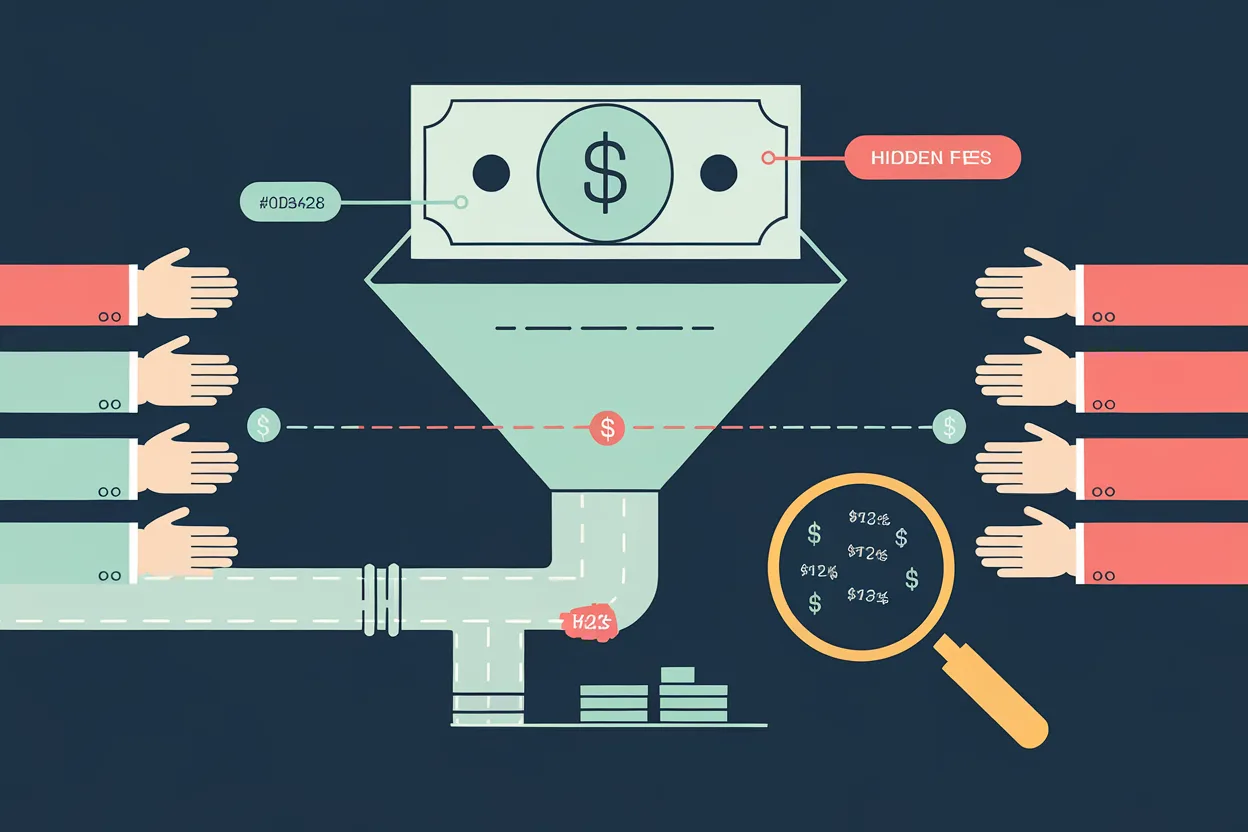
When you send money abroad, the “transfer fee” you see on the screen is often just the tip of the iceberg. Here are the five costs that most services bury, minimize, or simply don’t mention.
1. FX Markup — The Biggest Hidden Cost
FX markup is the difference between the mid-market exchange rate (the real rate you see on Google) and the rate your transfer service actually gives you. It is, by far, the largest hidden cost in international transfers.
- Western Union: FX markup ranges from 0.4% to 7%, depending on the corridor. For USD→INR (India), the markup can reach 7%. For popular corridors like USD→MXN (Mexico), it’s typically 2–3%.
- MoneyGram: Typical markup of 1–3%, but credit card payments push it to 3%+.
- Remitly: 0.5–3.7% depending on tier. The “Economy” (slower) tier has a lower markup than “Express.”
- Banks (SWIFT): Often the worst offenders — 2–5% markup plus the transfer fee on top.
How to spot it: Before confirming a transfer, Google “USD to [currency] exchange rate” and compare the mid-market rate to what your service offers. If the mid-market rate is 1,600 NGN per dollar but your service offers 1,540, you’re paying a 3.75% markup — that’s $7.50 on a $200 transfer, invisible on any receipt.
For a full comparison of FX transparency across services, see our Wise vs Crypto comparison.
2. Correspondent Banking Fees (SWIFT Transfers)
Correspondent banking fees are deductions made by intermediary banks that route your transfer between the sending and receiving bank. They are the most invisible of all hidden costs because they are not disclosed before sending.
- Approximately 75% of SWIFT transfers pass through at least one intermediary bank.
- Each intermediary deducts $15–$50 from your transfer amount in transit.
- A transfer from the US to a small African country might pass through 2–3 intermediary banks, costing $30–$90 total.
- Your bank does not tell you which correspondent banks will handle the transfer or how much they will charge. You find out when your recipient reports receiving less than expected.
SWIFT offers three fee-sharing options — SHA (shared), OUR (sender pays all), and BEN (beneficiary pays all) — but even the “OUR” option cannot guarantee that an intermediary bank won’t deduct its own fee. For a detailed explanation, see Wise’s guide to correspondent fees.
3. Receiving Bank Fees
When the transfer arrives at the recipient’s bank, the bank may deduct another $10–$25 as an incoming wire fee. This fee exists because the receiving bank has to process the SWIFT message, verify compliance, and credit the account.
- Most major banks charge for incoming international wires (Bank of America: $15, many others: $10–$25).
- A few don’t charge (Marcus by Goldman Sachs, Fidelity) — but these are rare.
- This fee is never disclosed to the sender. You only discover it when the recipient checks their account balance.
4. Cash Pickup Agent Markup
If your recipient picks up cash from a Western Union or MoneyGram agent, there’s an additional layer of cost that’s invisible to you as the sender: the agent’s commission.
- Agents earn 10–30% commission on each transaction (paid by Western Union/MoneyGram, not by you directly).
- This commission is funded by inflating the FX markup on cash pickup transactions. That’s why cash pickup is almost always more expensive than digital delivery to a bank account or mobile wallet.
- The customer never sees “agent commission” as a line item — it’s absorbed into the exchange rate.
This is why sending to a mobile wallet (GCash, M-Pesa) or bank account is consistently cheaper than cash pickup. For country-specific comparisons, see our guides for Nigeria, Philippines, and India.
5. “No Fee” Promotions That Aren’t Free
Services like Remitly and MoneyGram frequently advertise “$0 transfer fee” promotions. These are not lies — the visible transfer fee is genuinely waived. But the FX markup is not.
- Remitly “first transfer free”: The visible fee is $0, but the FX markup of 0.5–2.5% still applies. On a $500 transfer, that’s $2.50–$12.50 in hidden cost.
- MoneyGram “zero fee” transfers: The fee line reads $0.02 (or similar), but the FX markup of 1–5% is always present.
- Industry practice: Advertise “no fee” to win customers, then recover the cost through a wider FX spread. The customer thinks they’re getting a deal, but the total cost is often the same as — or higher than — a competitor who charges a transparent fee.
Rule of thumb: if a service advertises “no fee,” always check the exchange rate against the mid-market rate. The fee is there — it’s just hiding in the rate.
How Much Are You Really Losing?
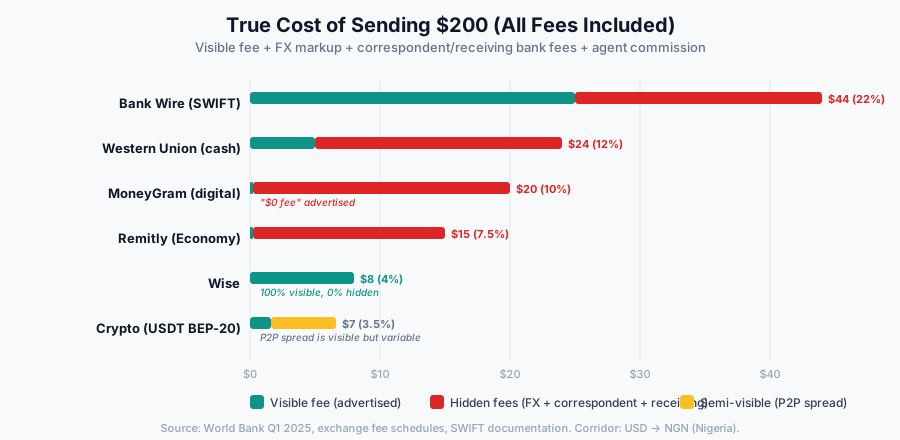
Here’s the true cost breakdown for a $200 transfer from the US to Nigeria (USD→NGN), including every fee layer — visible and hidden. This is the comparison that no remittance service wants you to see.
| Method | Visible Fee | Hidden Costs | Total Cost | % of Transfer |
|---|---|---|---|---|
| Bank Wire (SWIFT) | $25 | $19 (FX + correspondent + receiving) | $44 | 22% |
| Western Union (cash) | $5 | $19 (FX 7% + agent) | $24 | 12% |
| MoneyGram (digital) | $0.02 | $20 (FX 3% + receiving bank) | $20 | 10% |
| Remitly (Economy) | $0 | $15 (FX 2.5% + receiving bank) | $15 | 7.5% |
| Wise | $8 | $0 | $8 | 4% |
| Crypto (USDT BEP-20) | $0.70 | $6 (P2P spread ~3%) | $7 | 3.5% |
The pattern: Services with “low visible fees” (MoneyGram $0.02, Remitly $0) have the highest hidden costs. Services with transparent, higher visible fees (Wise $8) have zero hidden costs. The total cost of the “no fee” options is often 2–3 times higher than the transparent alternatives.
For a full 20-corridor cost analysis, see our Crypto Remittance Costs: Stablecoins vs Banks Compared (2026).
How to Calculate the True Cost of Any Transfer
You don’t need a finance degree.
- Find the mid-market rate. Google “USD to [currency]” or check XE.com. This is the “real” exchange rate with zero markup. Write it down.
- Calculate what your recipient should receive. Multiply your send amount by the mid-market rate. Example: $200 × 1,600 NGN/USD = 320,000 NGN.
- Compare to what they actually receive. After the service confirms the amount delivered, subtract: 320,000 − 277,000 = 43,000 NGN lost = $26.88 in total fees (at mid-market rate). That’s 13.4%, not the 2.5% “fee” you were shown.
Pro tip: The best services show you the mid-market rate AND their fee separately, so you can verify the math before sending. Wise is the gold standard here — they show the real rate and their fee side by side, and the total matches every time. Crypto also makes all three cost layers visible (exchange fee + network fee + P2P spread), though you need to calculate the total yourself.
For step-by-step instructions on how to send USDT internationally, see our How to Send USDT Abroad guide.
The Transparent Alternatives
Now that you know where the hidden fees are, here are the services that make all their costs visible upfront:
Wise (formerly TransferWise): Uses the real mid-market exchange rate with zero markup. Charges a transparent flat fee (~0.57–1.5% depending on corridor and amount). No correspondent bank fees, no receiving bank fees, no hidden costs. What you see is what you pay. Full Wise vs Crypto comparison →
Crypto (USDT/USDC on BEP-20 or TRC-20): Three visible cost layers: exchange trading fee (0.1%), network fee ($0.05–$2), and P2P conversion spread (0.5–5% depending on country). No FX markup, no correspondent banks, no receiving bank fees. Total cost: 1–7% depending on corridor. Cheapest in low-spread markets (Philippines, India, Brazil). Best Blockchain for Sending Money →
OFX (for large transfers $5,000+): Zero transfer fee with an FX spread of ~0.4–1.5%. Best for large business or personal transfers where the spread is small relative to the amount. Not ideal for small $200 transfers, but excellent for $5,000+.
Frequently Asked Questions
Why don’t banks disclose all the fees upfront?
Banks are required to disclose their own transfer fee, but not the fees charged by correspondent or receiving banks, because those are separate institutions with their own pricing. The FX markup is technically not a “fee” — it’s a difference in the exchange rate offered, which banks are not required to explain or justify. This regulatory gap allows the total cost to far exceed the advertised fee.
What’s the single biggest hidden cost?
FX markup. For most traditional services, the exchange rate markup accounts for 50–80% of the total cost. Western Union’s USD→INR markup can reach 7% — on a $1,000 transfer, that’s $70 hidden in the exchange rate alone, on top of whatever transfer fee they charge.
Are “no fee” transfer services really free?
No. When a service advertises “$0 transfer fee,” the cost is almost always hidden in the exchange rate. Remitly’s “free” Economy transfers include a 0.5–2.5% FX markup. MoneyGram’s “$0.02 fee” transfers include a 1–5% FX markup. Always compare the exchange rate offered to the mid-market rate on Google or XE.com to see the true cost.
How can I avoid correspondent banking fees?
Use a service that doesn’t use the SWIFT network. Wise, Remitly, MoneyGram, and crypto transfers all bypass SWIFT entirely — they use their own settlement networks, which means no intermediary banks and no surprise deductions. Bank-to-bank wires (SWIFT) are the only method where correspondent fees apply.
Is crypto really more transparent than traditional services?
Partially. The three cost layers of a crypto transfer (exchange fee, network fee, P2P spread) are all visible, but the P2P spread is variable and unpredictable until you match with a buyer. Wise is the most consistently transparent option because the total cost is fixed and shown before you confirm. Crypto is transparent but variable; traditional services are neither. For the full comparison, see our Crypto vs Western Union analysis.
Continue Learning
Remittance Cluster:
- Crypto vs. Bank Transfers: Remittance Cost Guide (2026) — full 20-corridor comparison
- Wise vs Crypto: Complete Comparison (2026)
- Best Blockchain for Sending Money: Fee Comparison (2026)
- How to Send USDT Abroad: Step-by-Step Guide (2026)
- Crypto vs. Western Union: Which Is Cheaper? (2026 Data)
- Stablecoin Remittances Explained
- Crypto Cash Out & Off-Ramp Guide (2026)
Country Guides:
- Philippines · Nigeria · India · Brazil
Related: