Wise vs Crypto: Complete Comparison for International Transfers (2026)

Editorial pen name · ChainGain
Alex Mercer is the editorial pen name used for ChainGain’s cryptocurrency education content. Articles are based on cited sources and reproducible comparisons. Editorial profile
A common question is simple: which route is actually cheaper?
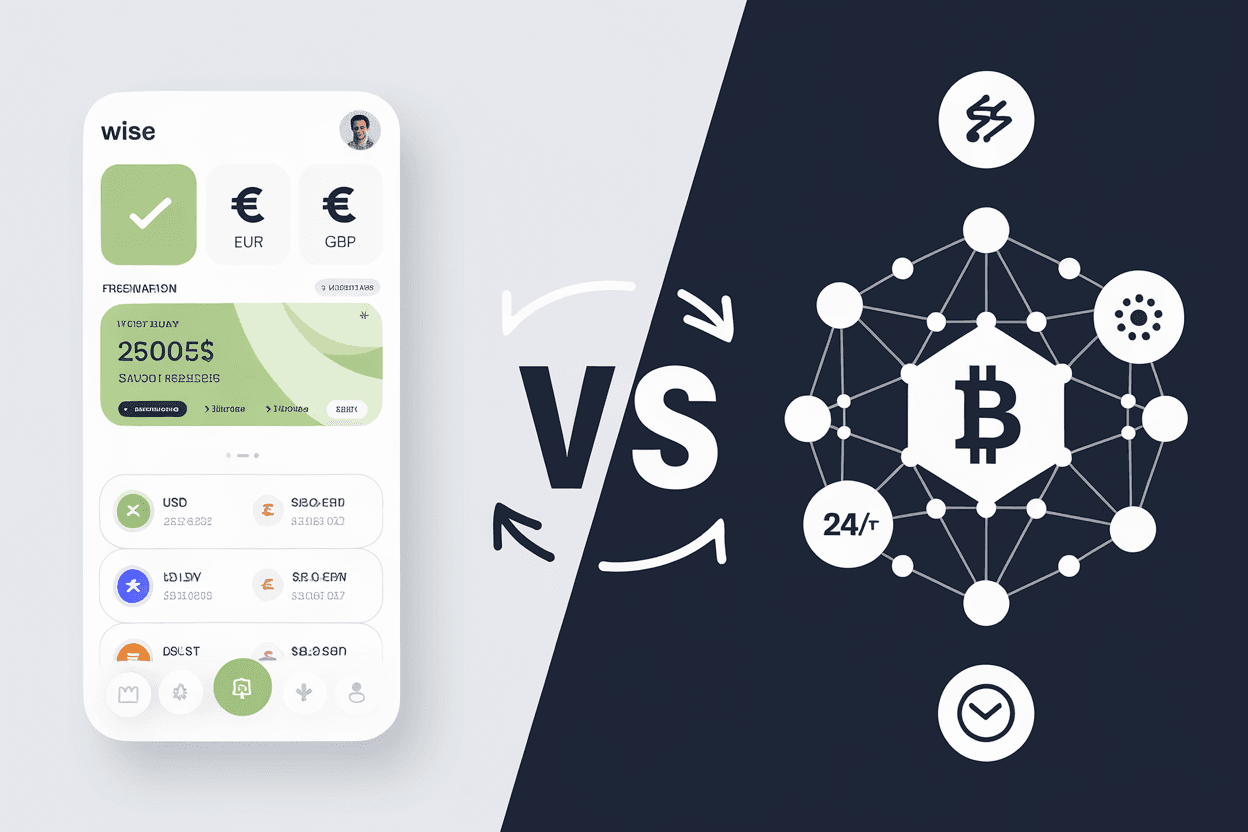
Wise is a regulated fintech platform that quotes a route-specific transfer using the mid-market exchange rate. A stablecoin route is self-directed and adds entry, blockchain, issuer, platform and cash-out dependencies. Neither structure proves a lower delivered cost without a same-time quote.
This source-based guide compares the two routes by delivered amount, access, timing and recovery. Provider access changes by country, so verify the live route and local eligibility before sending.
Key Takeaways
- Wise quote: route-specific fee and exchange-rate information is shown before confirmation.
- Stablecoin route: a self-directed chain of funding, conversion, network and cash-out steps.
- No flat winner: compare the same delivered amount, timing and payout method.
- Starting rates are not quotes: Wise advertised US sending and conversion from 0.23% in August 2026, while actual cost varies.
- Operational difference: provider support and recovery differ from irreversible on-chain settlement.
Wise and a Stablecoin Route Are Different Products
Wise is a regulated transfer provider that quotes delivery into supported payout rails. A stablecoin route is a sequence of separate services and blockchain transfers that the sender must assemble.
| Question | Wise | Stablecoin route |
|---|---|---|
| What is quoted? | Fee, exchange rate and recipient payout | Usually several separate prices |
| Who controls delivery? | Provider and payout partners | Sender, wallet, network, exchange and off-ramp |
| Recipient needs | Supported bank, wallet or other payout rail | Compatible wallet/provider and lawful cash-out |
| Error recovery | Provider process may be available | On-chain transfers may be irreversible |
Build a Like-for-Like Cost Comparison
| Cost layer | Wise evidence | Stablecoin evidence |
|---|---|---|
| Funding | Payment method in live quote | Deposit or card fee |
| FX / conversion | Mid-market rate and displayed fee | Buy and sell spreads plus trading fees |
| Transfer | Included in quoted route | Withdrawal and network fee |
| Payout | Recipient amount shown | Off-ramp and local withdrawal |
| Time / recovery | Provider estimate and support | Network plus exchange and banking dependencies |
Wise US pricing displayed rates from 0.23% when checked in August 2026. Wise’s fee documentation says the actual amount depends on currencies, amount and payment method. A lower-bound percentage is not a corridor quote.
Decision Procedure
- Open both available routes at the same time with the same amount and funding method.
- Record the final spendable recipient amount and delivery estimate.
- Reject any stablecoin route without exact token, network and lawful off-ramp support.
- Compare support, reversibility, provider limits and recipient ability.
- Requote before sending; do not carry a winner from an earlier corridor or amount.
The BIS cautions that stablecoin entry and exit costs can remove the apparent ledger-fee advantage. Use the all-in cost guide and calculator methodology.
How to Read a Wise Quote
Wise says its transfer cost depends on the amount, payment method and currencies. The quote normally combines a fee with an exchange rate and shows the expected recipient amount. The official fee explanation is the source for that structure; a pricing-page “from” rate is not a promise for every route.
Three inputs deserve separate attention. First, funding by bank account and card can produce different costs. Second, the sending and payout currencies determine conversion. Third, recipient delivery can depend on local banking hours and account details. Save the complete quote, not only the percentage highlighted on a pricing page.
Wise product availability is also customer- and country-specific. A card, balance feature, interest product or outbound route available in one market does not prove that it is available in another. Check the current help page and the exact customer flow rather than relying on a country list copied into an article.
How to Build the Stablecoin Quote
A stablecoin route needs at least two executable quotes: one for acquiring the token and one for the recipient’s cash-out. It may need more when the sender and recipient providers do not share a native network. Record the buy price, trading fee, withdrawal fee, network, recipient sell price and local withdrawal amount.
Do not replace an executable withdrawal fee with a blockchain’s base fee. Exchanges can set withdrawal charges independently of network conditions. Likewise, a quoted sell price can differ from a reference dollar price because local demand, order-book depth and payment method affect the spread.
A bridge or token swap adds another dependency. It can introduce smart-contract, liquidity, price-impact and wrong-token risk. If the recipient provider accepts a different native network, re-quoting a directly supported route is usually easier to evaluate than assuming a bridge will be cheap or instant.
Access, Support and Recovery
Wise is a single provider relationship for the quoted transfer. A stablecoin route can involve a bank, exchange, wallet, blockchain, token issuer, recipient exchange and payout bank. Each party can apply its own limits, service hours, screening and support process.
This difference is especially important after an error. A bank-funded provider transfer may have a cancellation or investigation path under the applicable terms. A blockchain transfer sent to the wrong address or unsupported network may be unrecoverable. A provider can sometimes assist with a compatible but unsupported deposit, but recovery is discretionary and may involve a fee.
Self-custody changes who controls the private keys; it does not remove issuer controls from USDT or USDC, legal obligations, exchange screening or recipient cash-out requirements. Custody is one risk dimension, not a universal advantage.
Three Route Scenarios
Recipient needs a bank deposit
Start with a live Wise quote and other licensed bank-payout providers. Compare a stablecoin route only if the recipient already has a lawful off-ramp and the complete payout, timing and recovery trade-off are competitive.
Recipient already uses a regulated crypto provider
Verify the exact native token and network, deposit status, sell quote and local withdrawal. Existing access reduces setup effort but does not prove a lower final cost.
Transfer is urgent
Compare end-to-end delivery estimates. Continuous blockchain operation does not guarantee continuous exchange review or bank payout, while a provider’s “instant” label may still be conditional on funding and verification.
Evidence to Save
- Timestamped sender charge and recipient payout for each route.
- Funding method, exchange rate and fee breakdown.
- For crypto, exact token contract, native network, withdrawal fee and off-ramp quote.
- Provider legal entity, route availability, limits and recovery terms.
- A note that worked calculations are examples rather than personal transactions.
Use the off-ramp guide to map the recipient side and the all-in framework to keep both routes comparable.
August 2026 Verification: Why There Is No Flat Winner
TLDR: Wise and crypto expose costs differently. Wise presents a route-specific quote; a stablecoin route must reconstruct several separate charges before the two are comparable.
| Cost component | Wise check | Stablecoin check |
|---|---|---|
| Funding | Payment-method fee in the quote | Deposit or card fee |
| Conversion | Mid-market rate plus displayed fee | Buy and sell spread plus trading fee |
| Transfer | Included in the route quote | Withdrawal plus network fee |
| Recipient access | Bank or supported payout method | Off-ramp spread, fee and withdrawal |
| Recovery | Provider support and transfer tracking | Often limited after an irreversible on-chain transfer |
Wise’s US pricing page advertised sending and conversion from 0.23% when checked in August 2026. That is a starting rate, not a universal corridor price: Wise’s fee documentation says the cost depends on the amount, payment method and currencies.
Worked example, not a quote: 0.23% of $500 is $1.15. The actual Wise amount can be higher, while comparing $1.15 with only a crypto network fee would omit the stablecoin route’s entry and exit costs. The BIS similarly cautions that stablecoin on- and off-ramps may erase the apparent ledger-fee advantage.
- Open both routes at the same time and use the same funding method and payout currency.
- Write down the final amount the recipient can spend or withdraw.
- Reject any crypto path whose exact network or lawful off-ramp is uncertain.
- Choose on delivered amount, delivery window and recovery options—not the smallest advertised fee.
Frequently Asked Questions
Is crypto always cheaper than Wise?
No. Compare the live Wise payout with every stablecoin entry, network and cash-out cost for the same route and amount.
Does Wise availability stay the same in every country?
No. Products, funding and payout functions depend on country, legal entity and customer eligibility. Check the current route before sending.
Which route has better recovery options?
Wise may provide a support and complaint process under its terms. An on-chain transfer can be irreversible, and exchange or off-ramp support is separate.
Can yield make a stablecoin route cheaper?
Yield is a separate risk product, not a remittance discount. It can introduce smart-contract, counterparty, liquidity and loss risk.
What should I do for a one-time transfer?
Get same-time quotes, compare final payout and delivery, and use the route the recipient can lawfully and safely access.
Continue Learning
Remittance Cluster:
- Crypto vs. Bank Transfers: Remittance Cost Guide (2026) — the full 20-corridor comparison
- Best Blockchain for Sending Money: Fee Comparison (2026)
- How to Send USDT Abroad: Step-by-Step Guide (2026)
- Crypto vs. Western Union: Which Is Cheaper? (2026 Data)
- Stablecoin Remittances Explained
- Crypto Cash Out & Off-Ramp Guide (2026)
Country Guides:
- Philippines · Nigeria · India · Brazil
Related: