Best Crypto Wallets 2026: Hot vs Cold vs Multi-sig (Complete Guide by User Persona)
Intermediate 17 min read Updated: April 25, 2026
Educational content only. Not financial advice. ChainGain may earn affiliate commissions on hardware wallet purchases at no cost to you.
The wrong wallet for your situation is dangerous in two opposite directions: a complicated multi-sig for a $200 newcomer creates friction that pushes them off-chain, while a hot browser wallet for a $500K HODLer is an open invitation to the next supply-chain attack like the December 2025 Trust Wallet Chrome extension hack that drained $8.5 million from 2,520 addresses in days.
Blockchain analytics is the systematic mapping of on-chain addresses to real-world entities — but a crypto wallet is the inverse: the system that proves you control specific addresses. This guide covers the three wallet categories that matter (hot, cold, multi-signature), profiles the 2026 leaders in each, and gives you a decision matrix tied to holding amount and user persona — the two axes that no general “best wallet” guide actually maps.
What’s in This Guide
- 3 dimensions of “best” in 2026
- Hot wallets — when convenience wins
- Cold wallets — when security matters most
- Multi-sig — when trust must be distributed
- 3-axis decision matrix
- Pick your wallet by holding amount
- Pick your wallet by user persona
- 2025 incidents you should know
- Recovery options decoded
- FAQ
Key Takeaways
- There is no single best wallet: The right choice depends on three axes: how much you hold, who controls the keys, and your threat model.
- Daily DeFi ($1K-10K, single signer): Hot wallet — Rabby (anti-phishing scanner) paired with a small Ledger Nano for cold storage of the bulk.
- Long-term hold ($5K-100K): Cold wallet — Trezor Safe 7 with Shamir Backup (open-source, seed split across multiple shares).
- High value ($100K-1M, single owner): Multi-cold + multisig — a Safe 2-of-3 using three hardware wallets from different vendors (no single point of failure).
- DAO or team treasury (any size): Multi-sig — a Safe 3-of-5 with multiple signers so no single human can move funds and it survives a lost key.
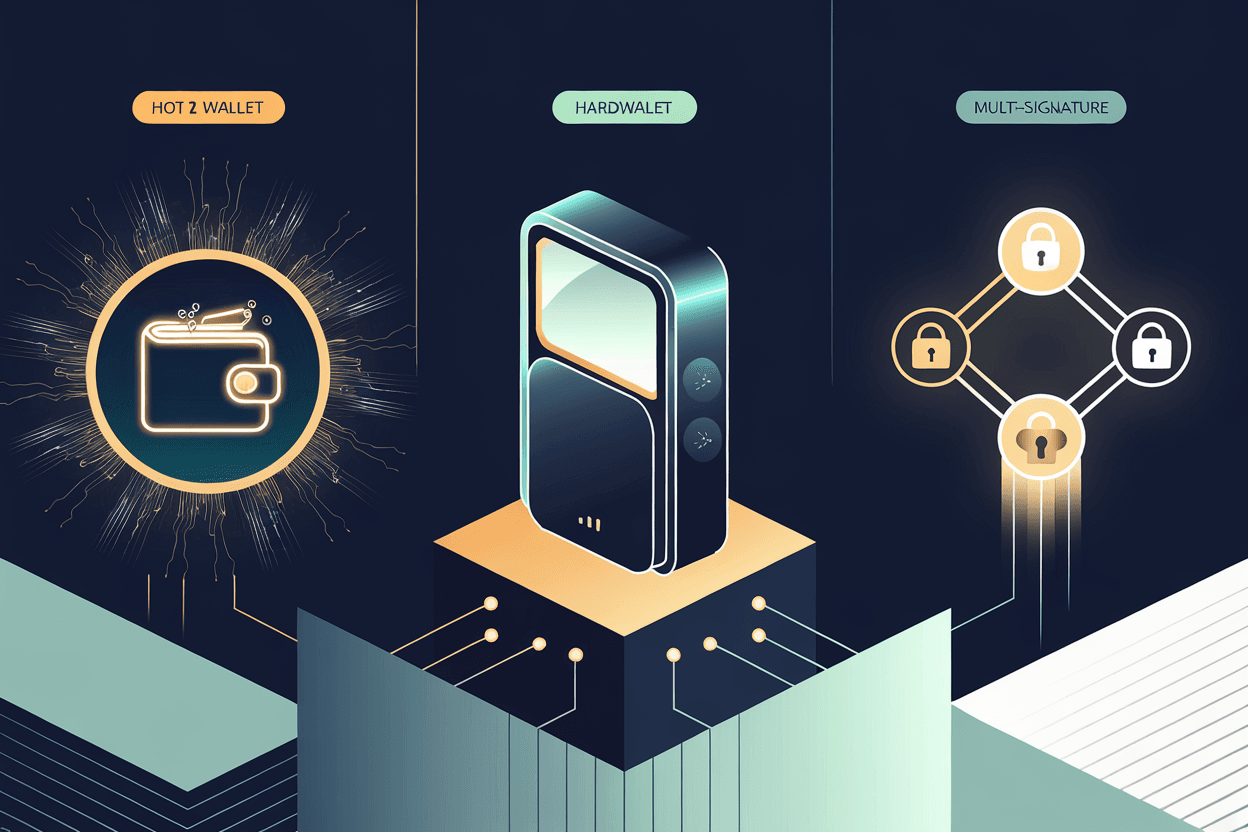
- Match the wallet to the threat, not the brand: Hot = convenience, Cold = security, Multi-sig = distributed trust — pick by what you are defending against.
- Know your recovery options before you need them: Seed phrase, Shamir shares, and multisig signer sets each fail differently — set up and test recovery while funds are small.
What “Best” Means: 3 Dimensions of Crypto Wallets
Every wallet trade-off lives on three sliders. Get this framework right and the rest of the guide will read as predictions you could have made yourself.
- Custody axis: who holds the keys? Hot and cold wallets are self-custody — your seed phrase, your responsibility. Custodial wallets (exchange wallets like Binance or Coinbase’s main app, not Coinbase Smart Wallet) hand the keys to a third party. Multi-signature wallets fragment custody across multiple parties or devices.
- Threat-model axis: what are you defending against? Cold wallets defeat remote attackers but lose to physical loss. Hot wallets defeat physical loss (you can recover anywhere) but fall to phishing and supply-chain compromises. Multi-sig defeats single-key compromise but introduces coordination risk.
- Frequency axis: how often do you sign? Multi-sig is brutal for daily DeFi. Cold wallets create friction every transaction. Hot wallets are designed for volume. Choose for your actual usage, not your aspirational usage.
The mistake almost every “best wallet” guide makes is collapsing all three axes into a single ranking. There is no universal best. There is only a best for your specific position on these three sliders. The rest of this guide is the map.
Hot Wallets — When Convenience Wins
Hot wallets keep your private keys on an internet-connected device — your browser extension, your phone, your laptop. They are the right tool when speed and frequency matter more than maximum security. In 2026, Chainalysis reports that 62% of the year’s $4.04 billion in stolen crypto came out of hot wallets — yet they remain the dominant choice for active users because the alternative is friction that drives people off-chain. Used correctly, with small amounts, hot wallets are fine. Used as primary storage for $50K+, they are a bet you eventually lose.
MetaMask — The DeFi Standard
What it is. The browser extension and mobile app that effectively defined Ethereum-side onchain UX. Approximately 30 million monthly active users as of 2026, with cumulative installs above 100 million. Native support for every EVM chain, plus emerging non-EVM bridges via Snaps.
Where it wins. If you live on Ethereum mainnet, Arbitrum, Optimism, Base, or Polygon, MetaMask is the default for a reason — every dApp tests against it first. The Snaps system extends to Solana, Bitcoin, Cosmos, and Starknet without leaving the same interface.
Where it loses. Phishing site approvals are the single largest crypto loss vector and MetaMask’s native warnings are weaker than Rabby’s. Pair MetaMask with a hardware wallet for any holding above $5K, and never approve a transaction whose contents you cannot read.
Phantom — Multi-chain Going Wide
Originally Solana-only, Phantom now supports eight networks: Solana, Ethereum, Bitcoin, Polygon, Base, Sui, Monad, and HyperEVM. Real-time scam detection on transaction signing is genuinely useful for catching drainer contracts before signature. The mobile app is among the smoothest in crypto.
Rainbow — Mobile-first Ethereum
Rainbow nails the design language for newcomers buying their first ETH-side asset. Multi-chain across Ethereum, Polygon, Optimism, Arbitrum, BSC, Base, and Zora. The desktop browser extension launched after the mobile app and is now solid. Rainbow’s NFT and ENS handling is best-in-class for non-technical users.
Rabby — Power-user Anti-phishing
Rabby’s pre-signing simulation shows you exactly what tokens leave your wallet on every transaction — including approvals to malicious contracts that look identical to legitimate ones. If you are an active DeFi user and you are not running Rabby alongside or instead of MetaMask, you are leaving security on the table for free. Open source, maintained by DeBank.
Trust Wallet — 100+ Chains for Mobile
Acquired by Binance in 2018, Trust Wallet covers more chains (100+) and assets (10M+) than any competitor. Adoption sits at roughly 200 million users, mostly mobile-first emerging-market users. The December 2025 Chrome extension supply-chain hack — covered in detail below — is a sobering reminder that even reputable wallet teams can ship a malicious build when an attacker compromises their distribution channel.
Coinbase Smart Wallet — The AA Bet
Coinbase’s Smart Wallet uses passkeys instead of seed phrases and supports gasless transactions through paymasters on Base, Ethereum, Optimism, Arbitrum, Polygon, Avalanche, BNB Chain, and Zora. This is the consumer face of ERC-4337 account abstraction (the Ethereum standard that replaces fixed-key accounts with programmable smart-contract wallets capable of social recovery, batch transactions, and gasless flows), which has now seen 40 million+ smart accounts deployed and processed 100 million+ UserOperations. The trade-off: you trust Coinbase’s passkey infrastructure rather than holding a seed phrase yourself.
Cold Wallets — When Security Matters Most
Cold wallets keep your private keys on a device with no internet connectivity (or strictly intermittent connectivity). Direct cold-wallet compromises in 2025 were statistically negligible compared to hot wallet losses — the math says cold wallets work. We’ve covered the four leading hardware wallets in dedicated depth in our Hardware Wallet 2026 Comparison; this section is the executive summary.
Trezor Safe 7 — Open-source with TROPIC01
$249. Launched October 21, 2025. The TROPIC01 chip is the first transparent, open-source secure element in any major hardware wallet — meaning the security claims are auditable, not just trust-us. Supports Shamir Backup (SLIP-39, a method that splits your recovery phrase into multiple shares where only a subset reconstructs the wallet) for 2-of-3 or 3-of-5 seed sharding. Trezor Safe 5 sits below at $169 if you don’t need TROPIC01.
Ledger Nano Gen5 — The Mainstream Default
$179. Launched October 23, 2025. EAL6+ certified secure element, Bluetooth 5.2, NFC, and the new Recovery Key NFC card included. Clear Signing technology displays full transaction details on the device’s E Ink touchscreen. Ledger Flex sits at $249 (larger touchscreen, mid-range), Ledger Stax at $399 (premium with wireless charging).
SafePal S1 Pro and X1 — DeFi Cold Hybrid
SafePal S1 Pro at $89.99 is the budget air-gapped option with QR-code signing only. SafePal X1 at $69.99-$79.99 is the newer model with Bluetooth 5.0 plus air-gapped key storage — Bluetooth handles only signing communication; private keys never leave the offline chip.
Tangem — Cards Instead of Seeds
$54.90 (2-card pack), $69.90 (3-card pack). NFC cards with EAL6+ certified microchips. The card is the wallet — there is no seed phrase to write down. Backup is the second or third card, kept somewhere physically separate. Six million cards shipped to date, zero successful key extractions reported.
Multi-sig — When Trust Must Be Distributed
Multi-signature wallets require multiple keys (held by different people or different devices) to authorize a transaction. The classic configurations are 2-of-3 (two of three keys must agree) and 3-of-5 (three of five). Multi-sig solves the single-point-of-failure problem of seed phrases: a thief who steals one key still cannot move funds. The trade-off is coordination overhead — every transaction requires multiple signers, every signer must protect their key, every signer becomes a potential attack target. Multi-sig is overkill for a $5K stack and essential for a $500K stack.
Safe (formerly Gnosis Safe) — The DAO Standard
Safe is the dominant Ethereum/EVM multi-sig with 57 million+ wallets deployed, $60 billion+ in total value secured, and $1 trillion+ in volume processed across its lifetime. Free to deploy and use; you pay only the underlying L1 or L2 gas. Used by Aave, the Ethereum Foundation, Morpho Labs, and most major DAOs. The threshold and signer set are programmable — start with 2-of-3, upgrade to 3-of-5 as treasury grows.
Sparrow + Multiple Hardware Wallets — Bitcoin Power Users
For Bitcoin-native multisig, Sparrow Wallet (current version 4.6.2) plus two or three hardware wallets from different vendors (e.g., Trezor + Ledger + Coldcard) is the standard. The benefit of mixing vendors is that a vulnerability in one product line cannot drain your entire stack. The cost is setup complexity that takes a careful weekend to learn.
Squads — Solana’s Multi-sig
Free, native Solana multi-sig used by major Solana protocols and DAOs for treasury management. Part of the broader Squads Labs financial infrastructure stack (Altitude, Fuse, Grid). If your treasury is on Solana, Squads is the answer.
BitGo — Institutional Multi-sig
For organizations managing $1M+ in custody, BitGo offers institutional multisig combined with custody services and is now a federally chartered bank in the US (OCC approval). Pricing is enterprise contract — if you have to ask, this is not your tier. Holds $104 billion in assets on platform.

3-Axis Decision Matrix
Match your situation to the row that fits, then read across:
| Your situation | Wallet type | Specific recommendation | Why |
|---|---|---|---|
| Daily DeFi, $1K-$10K, single signer | Hot | Rabby + small Ledger Nano Gen5 | Rabby’s anti-phishing scanner + cold storage for excess |
| Long-term hold, $5K-$100K, single signer | Cold | Trezor Safe 7 with Shamir Backup | Open-source TROPIC01, 2-of-3 seed sharding |
| Personal high-value, $100K-$1M, single owner | Multi-cold + multisig | Safe 2-of-3 with three hardware wallets from different vendors | Single-vendor compromise insufficient; you can lose one device safely |
| DAO/team treasury, any size | Multi-sig | Safe 3-of-5 with multiple signers | No single human can move funds; survives team turnover |
| Daily user, <$500 | Hot | Phantom or Trust Wallet | Friction kills small-stack users; risk is bounded |
| Bitcoin-only HODLer, $50K+ | BTC multi-sig | Sparrow + Trezor + Ledger + Coldcard, 2-of-3 | Vendor diversification protects against firmware attacks |
| Active trader, $10K-$50K | Hot+Cold split | Phantom or MetaMask hot for active stack, Trezor or Ledger cold for reserve | Hot for speed, cold for the larger reserve |
| Privacy-focused, no-KYC | BTC multi-sig (offline) | Sparrow + Coldcard + air-gapped backup | No third-party servers, no recovery cloud, full self-custody |

Pick Your Wallet by Holding Amount
The single best heuristic for non-experts is your portfolio size. Each tier below assumes a single individual without specific business or trust requirements:
| Holdings | Recommended setup | Estimated cost | Annual time investment |
|---|---|---|---|
| Under $500 | One hot wallet (Phantom, Trust, or Rainbow) | $0 | ~0 hours |
| $500 – $5K | Hot wallet + Tangem 2-card pack for backup of larger positions | $54.90 | ~1 hour setup |
| $5K – $50K | Ledger Nano Gen5 or Trezor Safe 5 + MetaMask/Rabby hot wallet | $169-$179 | ~3 hours |
| $50K – $500K | Trezor Safe 7 with Shamir Backup + secondary hardware wallet (different vendor) + hot wallet for active stack | $300-$500 | ~8 hours |
| $500K – $5M | Safe 2-of-3 multisig with 3 hardware wallets from different vendors stored in different physical locations | $700-$1,200 | ~20 hours |
| $5M+ | Safe 3-of-5 multisig with vendor diversification + qualified custody (BitGo, Anchorage) for portion + insurance | $1,500+ (plus custody fees) | ~40 hours setup, ongoing legal/tax review |
The pattern is simple: each tier doubles the security architecture and roughly doubles the setup time. The cost is trivial relative to the value protected — a $179 Ledger that prevents the loss of a $50K stack is the highest ROI security investment you will ever make. The tier that catches most people off-guard is the $50K-$500K range, where one hardware wallet stops being sufficient: a single-vendor firmware vulnerability can drain everything.
Pick Your Wallet by User Persona
Holding amount alone misses the texture of how you actually use crypto. Here are the seven personas we see most frequently and the specific stacks that fit each:
| Persona | Profile | Recommended stack | Critical avoidance |
|---|---|---|---|
| Beginner | $100-$1K, learning, mostly read-only | Phantom or Trust Wallet (mobile) | Don’t buy hardware before you understand seed phrases |
| Active DeFi trader | $1K-$50K, daily transactions | Rabby (anti-phishing) + Ledger Nano Gen5 for reserve | Never approve unlimited token allowances |
| Long-term HODLer | $5K-$100K, hold 1+ years | Trezor Safe 7 with Shamir Backup; add a second-vendor device (Ledger or Coldcard) once you cross $50K | Don’t reuse seed phrase across multiple devices |
| DeFi power user | $10K-$100K, multi-protocol farming | Rabby for hot + SafePal S1 Pro for cold | Run revoke.cash quarterly to clean approvals |
| DAO treasurer / Builder | $50K+ team-controlled funds | Safe 3-of-5 multi-sig with role-separated signers | Don’t keep single-signer “ops wallet” with significant balance |
| International remittance sender | Multi-currency, multi-country | Tangem 2-card (travel-resilient) or Trust Wallet (mobile-first) | Don’t store recovery card in same bag as your wallet card |
| Privacy-focused / no-KYC | Bitcoin maximalist or sanctions-cautious | Sparrow + Coldcard + Tor; consider running own node | Don’t reuse addresses; use Bitcoin coin control |
Two non-obvious calls in the persona table: First, beginners benefit from not immediately buying hardware. The cognitive load of learning what a seed phrase is and how DeFi works is enough; adding a hardware wallet to that stack increases the chance the user writes their seed phrase down wrong, panics, and exits crypto entirely. Hot wallet first, hardware wallet at the $5K crossover. Second, the DeFi power user gets Rabby specifically — not MetaMask — because the daily transaction volume of multi-protocol farming makes pre-signing simulation worth more than dApp default support.
2025 Wallet Incidents You Should Know About
In a year when $4.04 billion was stolen from crypto users (Chainalysis 2026), three incident types accounted for the majority of loss. Knowing the pattern helps you avoid being the next data point.
Trust Wallet Chrome Extension Hack — December 2025
On December 24, 2025, attackers compromised a leaked Chrome Web Store API key belonging to Trust Wallet’s distribution pipeline and pushed a malicious update — version 2.68 — to the official extension. Users who auto-updated lost approximately $8.5 million across 2,520 wallet addresses before the breach was discovered and the build pulled. Trust Wallet is voluntarily reimbursing affected users, but the lesson stands: auto-updates on browser extensions that hold private keys are an attack surface. If you must use a browser extension wallet for high-value holdings, freeze the extension’s auto-update, monitor the official changelog manually, and prefer hardware-wallet pairing for anything above $5K.
Approval-Drainer Phishing — Persistent Pattern
Drainer-as-a-service kits like Inferno, Pink, Atomic, and Chick Drainer industrialized in 2024 and continued through 2025. The mechanic is unchanged: a fake dApp asks you to “claim airdrop” or “verify wallet”; the transaction it presents is actually an unlimited token approval to an attacker contract. Your wallet then gets emptied later, often hours after the signing, when the user has forgotten the interaction. Run revoke.cash quarterly to audit and clear stale approvals. The single most useful security habit a hot-wallet user can adopt.
Address Poisoning — Cheap and Effective
Attackers send dust transactions from addresses that look identical to wallets you frequently transact with (same first 4 + last 4 characters). When you copy a recipient address from your transaction history, you risk grabbing the attacker’s address. Always verify the full middle of the address against the original source, never copy from your wallet history. For repeat counterparties, save them as named contacts in your wallet rather than pulling from history.
For the broader compliance and freeze context — when funds are stolen and recovered, when stablecoin issuers blacklist addresses — see our companion guides on USDT freeze recovery and AML score drift.
Recovery Options Decoded
Lose your seed phrase, lose your funds. Every cold-wallet vendor in 2026 offers a different answer to the recovery problem; understanding the trade-offs is the difference between a $50K stack you can recover from a fire and a $50K stack that disappears when you misplace one piece of paper.
- Trezor Shamir Backup (SLIP-39). Splits the seed into N shares; M of them reconstruct the wallet. Common configurations are 2-of-3 (one share at home, one at bank, one with trusted family) or 3-of-5 (more redundancy, more complexity). No single share reveals anything about the seed. Battle-tested protocol, supported by multiple vendors beyond Trezor.
- Ledger Recovery Key (NFC card, 2025). A physical NFC card included free with Stax and Flex (sold separately at $39 for Nano Gen5 owners). The card holds an encrypted recovery secret — tap it to a Ledger device to restore. Offline, no third-party server. Distinct from the older Ledger Recover (cloud, $9.99/month, 3-way share split with Coincover and EscrowTech) which was — and remains — controversial in the crypto community.
- SafePal X1 air-gapped recovery. Despite Bluetooth 5.0 for signing, X1’s recovery process never exposes the private key to the internet — restoration uses the same Bluetooth-paired device flow as initial setup, with the chip holding the secret offline.
- Tangem multi-card backup. The 2-card pack ($54.90) and 3-card pack ($69.90) replace the seed phrase concept entirely. The cards are the wallet — you back up by storing the second/third card in a different physical location. No words to write down, no shares to compute.
For deeper hardware wallet detail including specific firmware update procedures and seed-phrase-on-paper alternatives, see our Hardware Wallet 2026 deep-dive comparison.
Frequently Asked Questions
Should beginners start with a hot wallet or a cold wallet?
Hot wallet, with a small balance, until you have crossed roughly $5,000 in holdings. Hardware wallet first is well-intentioned advice that misses the failure mode: a beginner who is overwhelmed by the seed-phrase ritual writes it down wrong, panics when they cannot restore, and either exits crypto or — worse — leaves a misrecorded seed phrase as their only backup. Use a hot wallet to learn the model. Add hardware when the stack is large enough that the friction is worth it.
When do I need multi-sig vs just a hardware wallet?
Three triggers each independently justify multi-sig: (1) holdings above roughly $500K where a single-vendor firmware vulnerability becomes existential risk, (2) team-controlled funds where no single person should be able to move money alone, (3) inheritance planning where you want a defined process if you become incapacitated. Below those thresholds, a single hardware wallet (or two from different vendors with the same seed never reused) is enough.
Is a software wallet ever safer than a hardware wallet?
In two specific cases, yes. First, if you cannot reliably store a seed phrase securely (no safe physical location, high theft risk environment), an MPC wallet (Multi-Party Computation — see Q5 below for the full definition) like ZenGo with social recovery may be safer than a hardware wallet whose seed phrase ends up in a desk drawer. Second, for very small balances where a hot wallet’s loss does not change your life, the convenience genuinely outweighs the marginal security improvement. For the typical $5K+ holder with a safe, hardware wins.
How do I migrate between wallets safely?
Never type or paste a seed phrase from one wallet directly into another’s interface — always create a new wallet with a fresh seed in the destination, then transfer assets via on-chain transactions. Sign the transactions on the device you trust most. Pay the gas; treat it as the cost of separation. The exception is restoring the same wallet on a new device of the same vendor (e.g., upgrading from Ledger Nano X to Gen5 with the same seed) — that is the design, and the seed never crosses the internet.
What is MPC and how is it different from multi-sig?
Multi-Party Computation (MPC) splits a single private key into shares held by different parties; reconstruction happens cryptographically without any party seeing the full key. The transaction signature looks like an ordinary single-signer transaction on-chain. Multi-sig, in contrast, is on-chain native — multiple keys each sign separately and the contract or script enforces the threshold. MPC has lower on-chain costs and is invisible to the receiver; multi-sig has stronger guarantees because the threshold is enforced by the chain itself, not the off-chain MPC software. ZenGo, Coinbase Smart Wallet (effectively MPC via passkey), and Fireblocks are leading MPC providers; Safe is the leading on-chain multi-sig.
Conclusion: Match the Wallet to the Threat Model
Three takeaways from a year of wallet ecosystem evolution:
- Holding amount is the strongest single signal for which architecture you need — but persona modifies it. Passive holders: hot wallet below $5K, single hardware wallet $5K-$50K, dual hardware wallet across vendors at $50K-$500K, multi-sig above $500K. Active DeFi users should compress these tiers — adding hardware as low as $1K because their daily approval surface is much wider.
- Vendor diversification matters at the $50K crossover. A single firmware vulnerability in a single hardware wallet line drains everything. Trezor + Ledger or Trezor + Coldcard makes that scenario impossible.
- The biggest risk for hot-wallet users in 2025 was supply-chain compromise (Trust Wallet Chrome) and approval-drainer phishing — not exotic cryptography attacks. Pin extensions to known-good versions, run revoke.cash quarterly, and never auto-approve unlimited token allowances.
The right wallet is the one whose friction matches your usage and whose threat model matches your stack. There is no other test that matters.

Editorial pen name · ChainGain
Alex Mercer is the editorial pen name used for ChainGain’s cryptocurrency education content. Articles are based on cited sources and reproducible comparisons. Editorial profile
Disclaimer: This article is for informational and educational purposes only. Not financial, legal, or tax advice. Wallet pricing, supported assets, and security claims change continuously; verify current specifications directly with each vendor before purchasing. Hardware wallet links may be affiliate links — ChainGain may earn commissions at no extra cost to you. Sources: Safe wallet metrics, Ledger Nano Gen5 official page, Trezor Safe 7 product page, Chainalysis 2026 crypto crime report, Trust Wallet Chrome extension hack coverage, ERC-4337 adoption stats, Ledger Recovery Key FAQ.