Centralized Stablecoins 2026: USDT vs USDC vs DAI vs USDS Risk Comparison
Table of Contents
Difficulty: Intermediate · Educational content — not financial advice. ChainGain does not receive affiliate compensation for the stablecoins mentioned in this article.
In 2026, the stablecoin market crossed $310 billion (including fiat-backed, crypto-collateralized, and synthetic dollar tokens across all chains) — and something fundamental changed. MakerDAO, once the flagship of decentralized finance, rebranded to Sky and shipped USDS with a governance-controlled upgrade path that includes a potential freeze function. Tether froze another $182 million in January alone. According to Chainalysis 2025 Crypto Crime Report, freeze enforcement at the issuer level has accelerated across all major fiat-backed stablecoins, while industry analysts — including Vitalik Buterin’s broader writings on stablecoin trust-minimization — have argued that even “decentralized” designs carry structural centralization risks. The line between “centralized” and “decentralized” stablecoins has effectively collapsed.
This guide compares the four stablecoins that matter most in 2026 — USDT, USDC, DAI, and USDS — through the lens most guides skip: who can freeze your funds, under what conditions, and what actually happened the last time a stablecoin broke. If you’re choosing where to park $500 or $50,000, this matters more than market cap rankings.
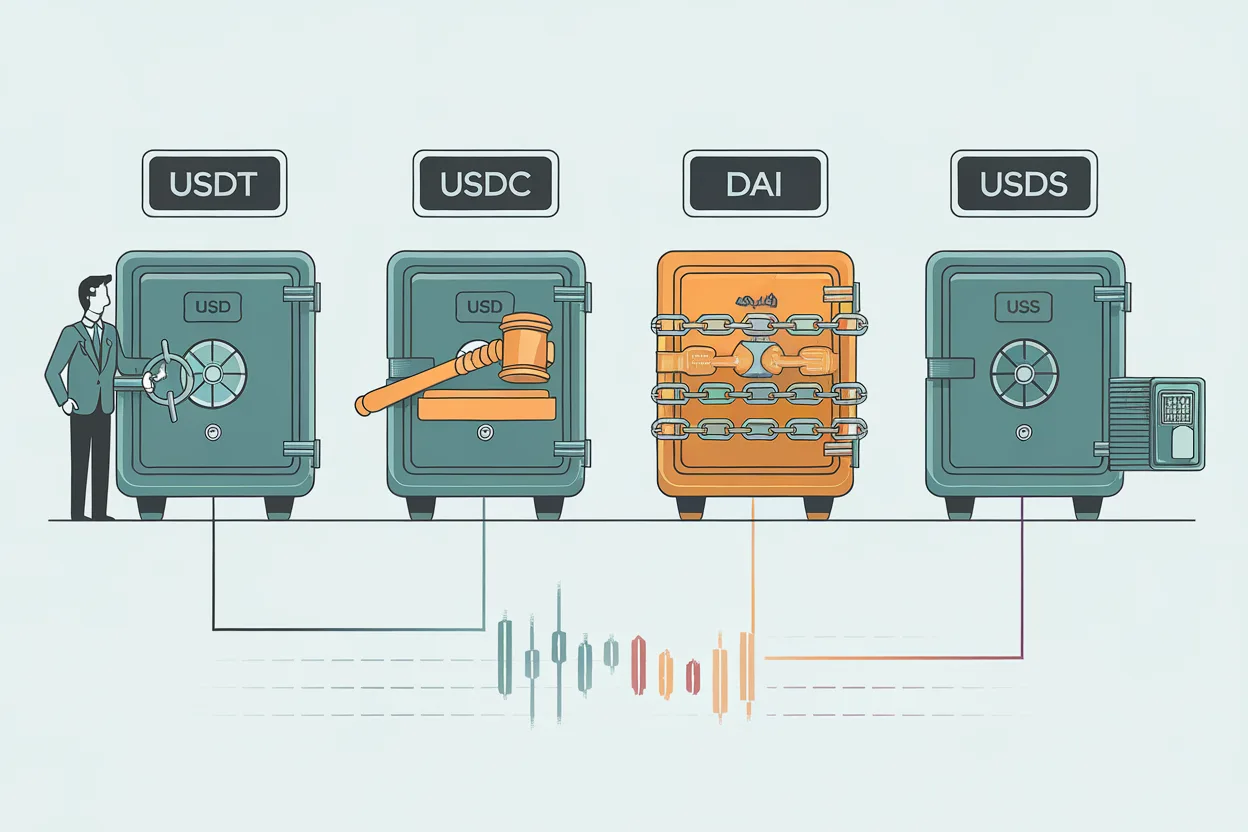
Why “Decentralized” Stablecoins No Longer Exist (2026 Reality Check)
By early 2024, over 40% of DAI’s backing was USDC — meaning if Circle froze the USDC held in MakerDAO’s Peg Stability Module (PSM, a contract that lets users swap USDC directly for DAI at 1:1 to keep the peg tight), DAI would lose its peg. That’s not decentralized. That’s “USDC with extra steps.”
MakerDAO’s September 2024 rebrand to Sky made this explicit. The new USDS token launched as an upgrade path from DAI (conversion is optional and 1:1), and the governance framework now allows token holders to add a freeze function if the Sky community votes for it. CEO Rune Christensen clarified in September 2024 that USDS does not ship with freeze capability at launch, but the architectural door is open. Meanwhile, the yield-bearing sUSDS (formerly sDAI — savings DAI) pays a Sky Savings Rate (SSR) of around 4% APY as of April 2026.
Industry analysts and crypto researchers have repeatedly identified three structural problems in so-called “decentralized” stablecoins: dollar dependence (the underlying value is denominated in USD, anchoring the system to the US banking and regulatory framework), oracle fragility (price feeds and collateral valuations come from a small number of providers), and yield competition pushing issuers toward riskier collateral. The broader market signal: stablecoins are consolidating around issuers who can be pressured by regulators, courts, or attackers — regardless of whether they brand themselves as “decentralized.”
Bottom line: every major dollar stablecoin in 2026 has at least one party who can, under specific conditions, block your access to funds. The question is no longer “which one is decentralized?” but “which one matches my risk tolerance and use case?”
USDT (Tether): $187B Liquidity King with Highest Freeze Risk
Tether’s USDT remains the undisputed liquidity leader with a market cap of approximately $187 billion as of April 2026 (CoinGecko), accounting for over 60% of stablecoin trading volume across exchanges like Binance, OKX, and Bybit. It dominates trading pairs in BTC, ETH, and altcoin markets, and it’s the default for cross-border settlement in emerging markets from Brazil to Nigeria to Vietnam.
Network distribution (2026)
- TRON (TRC-20): ~53%+ of USDT supply, lowest fees (~$1 per transfer), dominant in Asia and LATAM remittances
- Ethereum (ERC-20): Institutional trading and DeFi integration, higher gas fees
- Solana (SPL): Growing share for high-speed DEX trading
- Others: Avalanche, TON, Aptos, Near, and 10+ native chains
Freeze history: The highest in the industry
Tether has the most aggressive blacklist policy of any major stablecoin issuer. Between 2023 and 2025, Tether froze approximately $3.3 billion across 7,268 blacklisted addresses. In January 2026 alone, Tether froze an additional $182 million across five TRON wallets in cooperation with law enforcement. Over 2,800 of the blacklisted addresses are linked to U.S. regulatory action.
The architecture: Tether’s smart contracts on every chain include an addBlackList() function that the issuer controls. Once an address is blacklisted, USDT held in that wallet becomes non-transferable — the tokens still exist but cannot move. Recovery requires a successful legal petition to Tether’s compliance team, with a reported success rate of around 6.4% based on AMLBot’s 2025 analysis of publicly documented unfreeze requests.
Reserve composition, per Tether’s April 2026 transparency report: U.S. Treasury Bills (~78%), cash and cash equivalents, corporate bonds, and a Bitcoin treasury of over $5 billion (per Tether’s own disclosures, not independently audited). Tether has published quarterly attestations from BDO Italia but has never produced a full audit in its history — a critical distinction that regulators in the EU and UK have repeatedly flagged.
Best for: Trading liquidity, emerging market remittances on TRON, arbitrage across exchanges. Avoid if: You’re operating in a high-risk jurisdiction, dealing with P2P counterparties of unknown origin, or want the tightest regulatory compliance.
USDC (Circle): Transparency Champion, 30x Lower Freeze Rate
Circle’s USDC sits at approximately $78 billion market cap as of April 2026 — less than half of USDT, but growing faster year-over-year. USDC is positioned as the compliance-first stablecoin, with monthly attestations by Deloitte, full MiCA (Markets in Crypto-Assets) authorization in the European Union, and direct partnerships with BlackRock for reserve management.
The 2023 Silicon Valley Bank depeg — lessons learned
On March 11, 2023, Circle disclosed that $3.3 billion of USDC cash reserves were stuck at the failed Silicon Valley Bank. USDC depegged to a low of $0.8726 before the FDIC announced it would cover all deposits regardless of the $250,000 insurance cap. USDC began recovering within 72 hours (back to $0.99+ by March 13) and fully repegged within a week. Circle has since diversified banking partners and now holds reserves across multiple regulated institutions, with the majority in BlackRock’s Circle Reserve Fund — a government money market fund holding short-dated Treasuries.
This event is important because it shows both the risk and the recovery profile: a centralized stablecoin can lose its peg if a banking partner fails, but regulatory backstops (in this case, the FDIC) can restore confidence quickly. It also validates USDC’s transparency — traders knew exactly where the reserves were and could price the risk.
Freeze history: ~$109M across 372 addresses
Between 2023 and 2025, Circle froze approximately $109 million across 372 addresses — roughly 30x less than Tether in dollar terms, and roughly 20x fewer addresses. Circle’s policy, stated publicly by CEO Jeremy Allaire in April 2026, is that USDC freezes only occur following a valid court order or regulatory directive. Circle does not freeze in response to private reports, exchange security incidents, or DeFi protocol hacks unless ordered by a court.
This legal-authority requirement has consequences during DeFi exploits. Circle’s published policy (verifiable in their USDC Terms) requires a court order or formal enforcement request before USDC freezes can occur. In practice, this means that when DeFi protocols are hacked, Circle generally cannot fast-freeze the attacker’s USDC holdings the way Tether can with USDT — leading to public debate among chain analysts (including ZachXBT and other on-chain investigators) about whether strict legal compliance helps or harms user protection. For advocates of censorship resistance, this is USDC working as intended. For DeFi victims expecting faster recovery action, it’s a limitation worth understanding before you choose where to custody funds.
Best for: Institutional treasuries, European users requiring MiCA-compliant assets, DeFi positions where regulatory clarity matters, long-term holdings. Avoid if: You’re in a jurisdiction where Circle has no banking relationships, or you need maximum deep liquidity on obscure trading pairs (USDT still wins there).
DAI → USDS: MakerDAO’s Controversial Rebrand
MakerDAO’s Sky rebrand on September 18, 2024 was the most contentious stablecoin move of the decade. DAI, once the flagship of censorship-resistant decentralized stablecoins, was positioned as the “old” asset. USDS was launched as the upgrade path, with 1:1 optional conversion and an architecture that permits Sky governance to add a freeze function if voted in.
How DAI actually works in 2026
DAI is collateralized by a mix of assets locked in MakerDAO vaults:
- USDC (via Peg Stability Module): Still the largest single backing source
- ETH and stETH: Overcollateralized crypto vaults
- Real-world assets (RWA): Tokenized Treasuries and private credit via BlockTower and Monetalis
- Other stablecoins: USDP, GUSD in smaller amounts
The combined market cap of DAI and USDS sits around $11-13 billion as of April 2026 — a fraction of USDT or USDC. The critical fact for risk analysis: if Circle freezes the USDC held in MakerDAO’s PSM, DAI’s peg breaks. This isn’t theoretical — during the 2023 SVB depeg, DAI temporarily traded near $0.89-0.91 on DEX pools because its USDC backing was impaired.
Why USDS is controversial
Three reasons the DeFi community pushed back on the USDS migration:
- Upgradeable freeze function: Even if not activated at launch, the architectural capability exists. Censorship-resistance purists argue this fundamentally changes the asset.
- Centralized governance path: Sky’s tokenomics concentrate governance power in ways that differ from the original MakerDAO model.
- sUSDS integration with CeFi partners: To source yield for sUSDS, Sky partners with more centralized counterparties than the original Dai Savings Rate (DSR) used.
Best for: DeFi-native users who want dollar exposure without direct custody by Circle or Tether, participants in the Sky ecosystem earning sUSDS yield (~4% APY), users who accept USDC backing risk. Avoid if: You need deep cross-chain liquidity, you want the strongest regulatory compliance, or you specifically oppose the USDS freeze-function architecture.
Freeze Risk Comparison Matrix: Who Can Block Your Funds?
This is the comparison table most guides omit. Every centralized-ish stablecoin in 2026 has at least one freeze authority — the question is who, how fast, and under what conditions.
| Factor | USDT (Tether) | USDC (Circle) | DAI | USDS (Sky) |
|---|---|---|---|---|
| Market cap (Apr 2026) | $187B | $78B | ~$5B | ~$6-7B |
| Freeze authority | Tether Ltd., proactive | Circle, court-ordered only | MakerDAO (via USDC PSM) | Sky governance (vote required) |
| Historical freezes (2023-25) | $3.3B / 7,268 addr | $109M / 372 addr | Indirect (USDC backing) | Newly launched |
| Trigger conditions | Law enforcement, regulatory, internal risk | Court order, legal subpoena | USDC freeze cascades | Community governance vote |
| Unfreeze success rate | ~6.4% (AMLBot 2025) | Court-determined | Indirect | Not yet tested |
| Reserve transparency | Quarterly attestations (BDO Italia), no full audit | Monthly attestations (Deloitte), reserve breakdown public | On-chain vault data | On-chain vault data |
| Yield option | None (exchange rates on CEX only) | None direct (Coinbase Rewards ~4% for US only, not available internationally) | Dai Savings Rate (DSR) paused | Sky Savings Rate ~4% (sUSDS) |
| MiCA compliant | No (delisted from EU in 2025) | Yes (fully authorized) | No | Under review |

Key takeaways from this matrix:
- USDT has the broadest freeze authority and the most active enforcement. If you’re in a high-risk jurisdiction or receiving P2P transfers of unknown provenance, this is a real risk factor — not a theoretical one.
- USDC’s strict court-order requirement cuts both ways: it protects legitimate users from arbitrary freezes but offers no fast-response protection against DeFi hacks (Circle has historically declined to freeze attacker addresses absent court orders or sanctions designations).
- DAI inherits USDC freeze risk through the Peg Stability Module. Treating DAI as “censorship resistant” in 2026 is outdated.
- USDS’s governance-based freeze path is untested. It may or may not trigger freezes — the architecture permits it, but no precedent exists.
For deeper detail on how freezes actually happen, our guide on USDT recovery after a Tether freeze walks through the legal petition process and documents the ~6.4% success rate in detail. For understanding why addresses get flagged in the first place — the AML score drift risk that can hit ordinary P2P users — see our breakdown on why crypto gets frozen.
Historical Crisis Performance: Depegs, Crashes, and Lessons
Theory is cheap. Here’s how these stablecoins actually behaved when the market tested them.
May 2022: Terra UST crash ($45B evaporated)
Terra’s UST was an algorithmic stablecoin — no fiat reserves, maintained by an arbitrage mechanism with the LUNA governance token. On May 9, 2022, large Anchor Protocol withdrawals triggered a cascade. Over the following week, UST lost its peg entirely, LUNA fell from $116 (April 2022 high) to effectively zero (exchange data shows lows under $0.0001, with the chain eventually halted), and approximately $45 billion of combined market cap evaporated.
Lesson: Algorithmic stablecoins without meaningful collateral are fundamentally unstable. None of the four stablecoins discussed here are pure algorithmic designs — USDT/USDC are fiat-backed, DAI is overcollateralized crypto + RWAs, USDS follows the Sky framework. But the UST collapse is why regulators (GENIUS Act in the US, MiCA in EU) now require explicit reserve backing.
March 2023: USDC SVB depeg (recovery in 72 hours, full repeg within a week)
Covered earlier in detail. The recovery trajectory established a template: fiat-backed stablecoins with transparent reserves can absorb banking shocks if regulatory backstops exist. USDC survived because the FDIC intervened and Circle had public reserves. USDT actually traded briefly above $1 during the same week — a “flight to Tether” reaction as traders moved away from the transparent-but-vulnerable USDC. This is counterintuitive: transparency exposed USDC to panic selling, while USDT’s opacity was briefly seen as a benefit.
The DAI contagion effect
During the March 2023 USDC depeg, DAI briefly traded near $0.89-0.91 on DEX pools. This was the first real-world demonstration that DAI’s USDC backing created direct contagion risk. MakerDAO’s emergency response was to temporarily cap USDC exposure and raise USDC PSM fees. The long-term response was the USDS rebrand.
USDT resilience under sustained FUD
USDT has survived multiple coordinated FUD cycles (2018 NYAG investigation, 2022 UST contagion fears, 2023 SVB crisis). In each case, USDT’s peg stayed at or slightly above $1 — never meaningfully broke. The resilience is real, but it’s driven by market depth and the practical difficulty of redeeming USDT directly from Tether, not by transparent reserve verification.
Historical Depeg Events Timeline
To put the freeze and depeg risks above into historical context, here are the major stablecoin depeg events of the past four years and what each one revealed about underlying centralization or backing fragility:
| Date | Stablecoin | Depeg Low | Recovery Time | Root Cause |
|---|---|---|---|---|
| May 2022 | UST (Terra) | $0.00 (collapsed) | Never recovered | Algorithmic design failure: reflexive death-spiral when LUNA mint pressure overwhelmed redemption mechanism. ~$45 billion vanished. |
| March 2023 | USDC (Circle) | $0.8726 | ~3 days (FDIC-insured) | Banking exposure: $3.3 billion of USDC reserves held at Silicon Valley Bank; FDIC backstop intervention restored confidence. |
| March 2023 | DAI (Maker) | $0.89 | ~3 days | Contagion: at the time DAI was over 50% backed by USDC, so the SVB shock transmitted directly. Triggered Maker’s shift to T-bill collateral. |
| 2024–2025 | FDUSD, TUSD | $0.92–$0.97 (intermittent) | Hours to days | Reserve transparency questions and exchange concentration risk; both stablecoins remained operational but lost majority market share. |
The pattern across these events: algorithmic stablecoins fail catastrophically (UST, no recovery), while fiat-backed stablecoins with transparent reserves recover within days — but only because regulatory or banking-system actors (FDIC, MakerDAO governance) intervened. The “decentralized” stablecoin space has no such backstop, which is why the surviving “decentralized” designs (DAI, USDS) are now meaningfully reliant on centralized collateral.
The Yield-Centralization Trade-off (New 2026 Trend)
Here’s a 2026 trend that’s easy to miss: every meaningful stablecoin yield option comes with increased centralization. This is the hidden cost of “passive income” on stablecoins.
- Ethena USDe: Synthetic dollar that pays 3-8% via delta-neutral short perps (a hedging strategy using perpetual futures to offset ETH price movement) plus staking. Depends on positive funding rates and centralized exchange custody of the collateral. Q1 2026 reports show the Reserve Fund at ~1.18% of TVL — thin for tail risk events.
- Sky sUSDS: ~4% APY sourced partly from RWAs (tokenized Treasuries) and partly from CeFi lending partners. Yield requires Sky’s centralized collateral managers to remain solvent.
- Coinbase USDC Rewards: ~4% for US users only (not available in most countries). Yield comes from Coinbase’s discretion — they can cut or eliminate at any time.
- CEX savings products (Bybit, Binance, Nexo): 3-13% on stablecoins. Yield comes from the exchange’s lending book, which introduces counterparty risk (see: Celsius 2022, Nexo regulatory actions 2023).
Compare this to holding uncollateralized USDC or USDT: no yield, but no additional counterparty exposure beyond the issuer itself. For risk-averse holders, this trade-off matters. Our deeper guide on stablecoin savings rates across CeFi and DeFi breaks down the yields and the specific counterparty exposures for each option.
Which Stablecoin for Your Use Case?
| Use case | Primary choice | Secondary | Reasoning |
|---|---|---|---|
| Active trading | USDT | USDC | Deepest liquidity, most trading pairs |
| European institutional | USDC | EURC | MiCA compliant, transparent reserves |
| Emerging market remittance | USDT (TRON) | USDC (Solana) | Lowest fees, widest P2P acceptance |
| DeFi positions | USDC | DAI | Broadest protocol support, full audit trail (note: no fast-freeze protection against protocol hacks) |
| Long-term holding (risk-off) | USDC | Split USDT/USDC | Regulatory clarity, transparency |
| Yield-seeking (accept risk) | sUSDS | USDe | ~4% passive yield with known trade-offs |
| Censorship resistance priority | DAI (pre-USDS) | USDC (court-order only) | True DeFi alternatives are narrow in 2026 |

Special note for emerging market users
If you’re using stablecoins for remittances or savings in Brazil, Nigeria, Indonesia, Turkey, or similar high-inflation or capital-controlled economies, USDT on TRON remains the practical default because P2P liquidity is deepest. But the freeze risk is also highest — receiving USDT from a counterparty whose funds are later flagged can cascade to your wallet. Practical mitigation: split holdings across USDT and USDC in roughly a 60/40 or 70/30 ratio, use a dedicated receiving wallet for P2P transactions over $500, and verify counterparty history with AMLBot or Breadcrumbs before any transaction over $1,000. Our stablecoin remittances guide and USDT vs USDC for remittances cover the corridor-specific details, and What Are Stablecoins is a good primer if you’re new to the category.
Frequently Asked Questions
Which stablecoin is the most decentralized in 2026?
None of the major dollar stablecoins are fully decentralized in 2026. DAI is the closest, but over 40% of its backing is USDC, meaning Circle has indirect control. USDS has an upgradeable freeze function permitted by governance. If true censorship resistance is non-negotiable, non-USD alternatives like RAI (purely ETH-collateralized) exist but have extremely limited liquidity and adoption.
Can my USDT be frozen if I did nothing wrong?
Yes — indirectly. If you receive USDT from a counterparty whose wallet is later flagged for illicit activity (AML score drift), Tether can freeze downstream addresses. The unfreeze success rate is around 6.4%. Best protection: verify counterparty history using tools like AMLBot or Breadcrumbs before P2P receives over $500, and split USDT across multiple wallets to isolate exposure.
Should I migrate from DAI to USDS?
The 1:1 conversion is optional. Reasons to migrate: access to sUSDS yield (~4% APY), alignment with the active Sky ecosystem. Reasons not to migrate: the USDS architecture permits a future freeze function, and the governance changes concentrate power differently than MakerDAO’s original model. For DeFi-native users prioritizing the original ethos, holding DAI is defensible — but DAI is being deprioritized by MakerDAO’s development efforts over time.
What happens if Tether collapses?
Tether has survived every FUD cycle since 2018. In a hypothetical collapse: USDT holders would need to redeem directly from Tether (subject to $100,000 minimum and verification, which most retail users cannot meet) or sell at a discount on secondary markets. The cascading effect on DeFi would be severe because USDT is embedded in lending protocols and trading pairs. For portfolio risk management: don’t hold more USDT than you can afford to lose, and maintain a USDC or diversified stablecoin position as a backstop.
Best stablecoin for long-term holding?
USDC is the practical choice for long-term holdings where regulatory clarity matters. Monthly attestations, MiCA compliance, clear banking partnerships, and a tested recovery record (2023 SVB) make it the most transparent option. That said, concentration risk in any single issuer is meaningful — holding 100% in one stablecoin, even USDC, is a risk. For amounts over $10,000, consider splitting across at least two stablecoins and two custody methods (self-custody + regulated exchange). Monitor depeg events via CoinGecko’s peg tracker and follow @paoloardoino on X for official Tether announcements.
Conclusion
The stablecoin landscape in 2026 doesn’t reward ideology. “Decentralized” has become a spectrum rather than a binary, and every major dollar stablecoin has specific, knowable trade-offs around freeze authority, reserve composition, and yield architecture. The right choice depends on your jurisdiction, use case, and risk tolerance — not on marketing claims.
For most users in 2026, a practical allocation looks like: USDC for long-term holdings and DeFi, USDT (TRON) for active trading and emerging market remittances, and a small position in DAI or sUSDS for exposure to the Sky ecosystem if you accept the USDC backing risk. Avoid putting everything in one issuer, verify counterparty history on P2P receives over $500, and monitor the freeze and depeg news for the stablecoins you hold.
That’s a preventable risk with basic hygiene. The systemic risks (issuer insolvency, regulatory shock) are less controllable, which is why diversification across stablecoins — not just within one — matters more than ever.
Continue Learning
- What Are Stablecoins? — Foundational guide to fiat-backed, crypto-collateralized, and algorithmic stablecoins
- USDT vs USDC for Remittances — Two-way deep comparison for cross-border transfer use cases
- USDT Frozen by Tether: Recovery Guide — Step-by-step legal petition process with success rate data
- Why Crypto Got Frozen: AML Score Drift Explained — Understanding the risk that cascades freezes to ordinary users
- Stablecoin Savings Rates 2026 — Yield comparison across CeFi and DeFi platforms
- Stablecoin Remittances Explained — How USDT/USDC replace wire transfers
- Stablecoin Savings Guide — Comprehensive yield and risk framework

Editorial pen name · ChainGain
Alex Mercer is the editorial pen name used for ChainGain’s cryptocurrency education content. Articles are based on cited sources and reproducible comparisons. Editorial profile
Disclaimer
This article is for educational purposes and does not constitute financial, legal, or tax advice. Stablecoins carry counterparty, regulatory, and technical risks — including the risk of permanent freeze, depeg, or issuer insolvency. Cryptocurrency values and yield rates change rapidly; verify current figures before making decisions. ChainGain does not receive affiliate compensation for any of the stablecoins (USDT, USDC, DAI, USDS) mentioned in this article. Links to our guides on Margex, Bybit, and other exchanges may include affiliate relationships disclosed on those respective pages. Always conduct your own research and consider consulting a qualified professional before moving significant amounts.