Hardware Wallet 2026: Trezor vs Ledger vs SafePal vs Tangem Compared
Disclosure: This article may contain affiliate links. We earn a commission at no extra cost to you. Our editorial policy ensures all recommendations are based on genuine analysis.
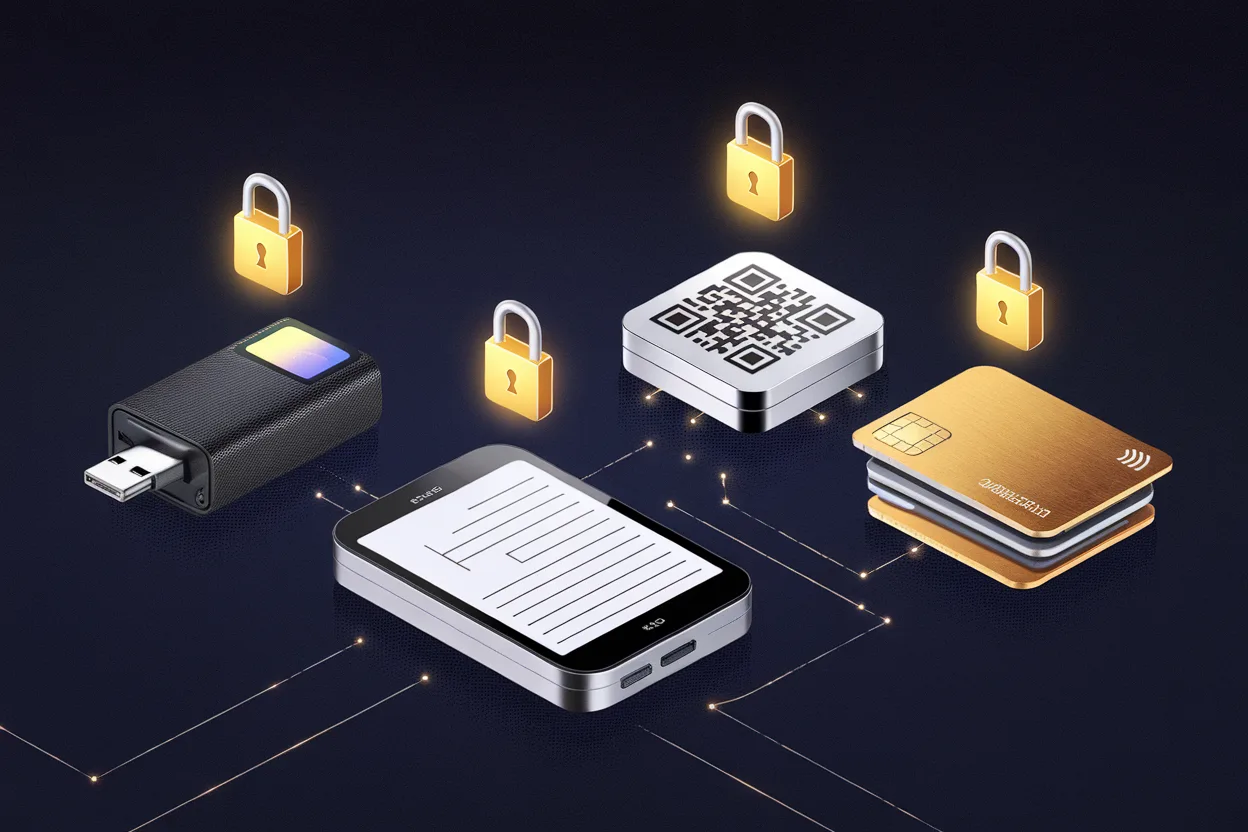
In December 2025, attackers pushed a malicious Trust Wallet Chrome extension update (v2.68) to the official Chrome Web Store and drained $8.5 million from 2,520 wallet addresses in about 48 hours. The takeaway isn’t that Trust Wallet is broken — it’s that any wallet running on an internet-connected device inherits the attack surface of the browser and the OS around it. A hardware wallet moves your keys off that surface entirely.
This guide compares the four hardware wallet brands most people actually consider in 2026 — Trezor Safe 7, Ledger Nano Gen5 / Stax / Flex, SafePal S1 Pro / X1, and Tangem 2-card / 3-card sets — on the criteria that matter for long-term holders: open source status, secure element pedigree, backup model, and attack surface.
What you will learn:
- Which four evaluation criteria actually matter when picking a hardware wallet in 2026
- Side-by-side specs, prices, and chip details for the current flagship models
- Why the “Ledger Recover” controversy is different from the new “Ledger Recovery Key”
- What Trezor’s TROPIC01 auditable secure element actually changes in the threat model
- When Shamir Backup (SLIP-39) is worth the added complexity — and which wallets support it
- The honest trade-offs between air-gapped (QR) and connected (Bluetooth/USB) designs
- Red flags that tell you a hardware wallet is not worth buying
Intermediate
The Four Criteria That Actually Matter
Most hardware wallet reviews fixate on the supported-coin count or the screen size. Those matter for usability, but they do not move the needle on whether your funds stay safe if something goes wrong. These four criteria do:
| Criterion | What it tells you | Why it matters |
|---|---|---|
| Open-source or auditable | Can independent researchers inspect the firmware and secure-element code? | Closed code means you’re trusting the vendor’s claims. Audited closed code is acceptable; unauditable is not. |
| Secure element certification | EAL5+, EAL6+, or consumer-grade microcontroller? | EAL-certified chips are tested against physical extraction and side-channel attacks. A generic MCU is not. |
| Backup/recovery model | 12/24-word seed, SLIP-39 Shamir, seedless cards, or cloud backup? | Your seed handling is usually the weakest link. Better backup models reduce theft and loss risk. |
| Attack surface | USB-only, Bluetooth, NFC, QR air-gap, card-based? | Every connection method adds a possible compromise path. Pick the minimum you can live with. |
If a wallet loses on all four, brand recognition and price don’t save it. If it wins on all four, it’s a candidate worth paying a premium for.

2026 Flagship Comparison — Current Prices & Specs
All prices are direct-from-manufacturer USD as of April 2026. Note: affiliate/reseller pricing may differ. Specs verified against official product pages.
| Model | Price | Connectivity | Secure Element | Open Source |
|---|---|---|---|---|
| Trezor Safe 7 Oct 2025 release |
$249 | USB-C | TROPIC01 (auditable, EAL6+) | Full (firmware + SE) |
| Trezor Safe 5 | $169 | USB-C | Secure Element + OPTIGA | Firmware open |
| Ledger Nano Gen5 Oct 2025 release |
$179 | USB-C + Bluetooth + NFC | ST33 (EAL6+, closed) | App layer only |
| Ledger Nano X | $149 | USB-C + Bluetooth 5.2 | ST33J2M0 (EAL5+) | App layer only |
| Ledger Nano S Plus | $79 | USB-C only | ST33K1M5 (EAL6+) | App layer only |
| Ledger Stax | $399 | USB-C + Bluetooth + NFC | ST33 (EAL6+) | App layer only |
| Ledger Flex | $249 | USB-C + Bluetooth + NFC | ST33 (EAL6+) | App layer only |
| SafePal S1 Pro | $89.99 | Air-gap (QR only) | EAL6+ CC | Yes (GitHub) |
| SafePal S1 | $49.99 | Air-gap (QR only) | EAL5+ CC | Yes (GitHub) |
| SafePal X1 | $69.99 | Bluetooth 5.0 (not air-gap) | EAL6+ CC | Yes (GitHub) |
| Tangem 3-card set | $69.90 | NFC only | Samsung EAL6+ | Firmware audited |
| Tangem 2-card set | $54.90 | NFC only | Samsung EAL6+ | Firmware audited |
A note on “air-gapped”: SafePal S1 and S1 Pro are genuinely air-gapped — they communicate only via QR codes, with no USB/Bluetooth/WiFi at all. SafePal X1 is a different product entirely: it uses Bluetooth 5.0 for convenience and is NOT air-gapped. If air-gap is why you chose SafePal, you want the S1 or S1 Pro, not the X1.
The Ledger Recover vs Ledger Recovery Key Distinction
Ledger’s backup offerings create genuine user confusion because two different products launched two years apart have similar names.
| Product | Launch | How it works | Criticism |
|---|---|---|---|
| Ledger Recover | May 2023 | Shards your seed, encrypts it, and stores shards with three custodians. Requires $9.99/month subscription and KYC. | Breaks the “seed never leaves the device” promise. Widely rejected by the security community. Optional — off by default. |
| Ledger Recovery Key | 2025 (Stax/Flex) | A physical NFC card you tap on your wallet to write an encrypted backup. No cloud, no subscription, no KYC. | Generally accepted. The key never leaves your physical possession. |
If you hear someone say “Ledger Recover is fine now,” ask which one they mean. The 2023 cloud-shard service is unchanged. The 2025 physical card is a separate product with very different properties. For a wider discussion of what happens when your funds are frozen — including by issuer-level blacklists — see our USDT freeze recovery guide.
TROPIC01 — What “Auditable Secure Element” Actually Changes
The Trezor Safe 7 shipped in October 2025 with the TROPIC01 chip from Tropic Square (a Trezor sister company). It’s the first production-shipped secure element that’s designed to be open for third-party inspection. For context on why this matters:
- Traditional secure elements (Ledger’s ST33, NXP chips, Infineon) are closed. STMicroelectronics legally prohibits Ledger from disclosing ST33 internals, so independent review is limited to what can be observed from outside.
- TROPIC01 publishes its architecture, protocols, and key routines. Researchers can verify that the chip does what it claims without needing to trust a non-disclosure agreement.
- The trade-off: TROPIC01 is newer, so it has less field history. ST33 has been battle-tested for a decade and no public extraction attacks have succeeded. Auditable <> automatically more secure — it’s more verifiable.
TROPIC01 is EAL6+ certified, runs quantum-resistant firmware verification (important for future protocol upgrades), and is the only secure element publicly auditable as of early 2026. Both approaches — audited closed-source (Ledger) and auditable open-source (Trezor) — are legitimate answers to the same question. The question is which kind of trust you prefer to grant.
Shamir Backup (SLIP-39) — Who Actually Supports It
SLIP-39 is a standard that lets you split your seed into N parts where only K of them reconstruct it (e.g., 3-of-5, 2-of-3). Losing any K-1 shards still keeps you safe; a single thief finding one shard learns nothing.
| Wallet | SLIP-39 Support | Notes |
|---|---|---|
| Trezor Model T / Safe 5 / Safe 7 | Yes — native | First hardware wallet to implement SLIP-39. 2-of-3, 3-of-5, up to 16 shards. |
| Keystone 3 Pro | Yes (2024+) | Air-gapped QR wallet; also added SLIP-39. |
| Coldcard | Yes | Bitcoin-only, security-focused. SLIP-39 available. |
| Ledger (all models) | No | Uses BIP-39 seed only. Recovery Key is a different backup model. |
| SafePal (all models) | No | Standard BIP-39 only. |
| Tangem | No | Seedless card model; the cards themselves act as redundancy. |
SLIP-39 is most useful if you’re splitting custody across family members, jurisdictions, or physical locations. For a single holder with a modest amount, a well-protected 24-word seed and a separate secondary backup location is usually simpler.

Air-gap vs Connected — The Honest Trade-off
A truly air-gapped wallet never touches USB, Bluetooth, WiFi, or NFC. It communicates only through the screen (showing QR codes) and the camera (reading QR codes). The only two mainstream air-gap designs in 2026 are the SafePal S1 / S1 Pro and Keystone 3 Pro. Tangem cards are also air-gap-adjacent in that NFC is a very short-range passive channel with no continuous link.
The case for air-gap: eliminates USB exploits, Bluetooth pairing attacks, and malicious-charger scenarios. If the host device is compromised, the air-gapped wallet still only ever sees what QR codes you manually scan to it.
The case against: QR scanning is slower and error-prone on first setup. No firmware updates over the air; you physically bring the device in when updates are needed. Some dApp interactions are cumbersome because every signature round-trip is a QR exchange.
For most holders who transact a few times per month, air-gap is worth the minor inconvenience. For DeFi-heavy users who sign dozens of transactions per day, a USB or Bluetooth wallet with strong clear-signing (like the Ledger Nano Gen5 or Stax) is more practical. For protecting your funds once they arrive, our cryptocurrency security fundamentals guide covers the operational-security habits that matter more than the hardware choice itself.
Who Should Pick Which Wallet
| Your profile | Recommended starting point | Why |
|---|---|---|
| First hardware wallet, under $2,000 held | Tangem 2-card / Ledger Nano S Plus | Low-friction, inexpensive, good enough security for the amount. |
| Active trader or DeFi user | Ledger Nano Gen5 / Stax | Clear-signing, broad dApp support, Bluetooth for mobile. |
| Long-term holder, $10,000+ | Trezor Safe 7 + SLIP-39 Shamir | Fully auditable, Shamir Backup for redundancy, quantum-resistant firmware verification. |
| Operational security paranoid | SafePal S1 Pro (air-gap) | Genuinely air-gapped. Slow but reduces attack surface to near-zero. |
| Non-technical household members | Tangem 3-card set | Tap-to-sign via phone. No seed phrase to lose. Three-card redundancy. |
| Estate planning / multi-signature | Trezor Safe 7 + Keystone (mixed stack) | Mixing vendors reduces single-vendor supply-chain risk for multisig quorums. |
Red Flags — What to Skip
- Unbranded “hardware wallets” from Amazon/AliExpress. Supply-chain tampering is a documented risk. Buy direct from the manufacturer or an authorized reseller — Trezor, Ledger, SafePal, Tangem all operate direct-order stores.
- Second-hand hardware wallets. The previous owner may have pre-generated the seed. Even if the device looks factory-sealed, the shrink wrap can be replaced. Never trust a used wallet.
- Wallets that request the seed during setup. A legitimate wallet generates the seed on-device; it never asks you to type one in unless you’re explicitly restoring. Phishing fakes reverse this.
- Wallets without a Secure Element. Several budget vendors (not on our comparison) use a generic microcontroller. These can be extracted by a determined attacker with physical access in hours.
- Cloud-based “hardware wallet” services. If the seed is custodied in a third-party service, it’s a custodial wallet with a hardware-looking UI. Not the same threat model.
For a broader overview of scam patterns — including those that target hardware-wallet users specifically — our scam identification guide walks through the most common attack vectors seen in 2025-2026.
Setup Best Practices Applied to Any Brand
- Buy direct. Trezor Shop, Ledger.com, SafePal official store, Tangem.com. Accept no shortcuts.
- Verify the packaging. Each brand has anti-tamper features documented on their site. Compare before opening.
- Generate the seed on-device. Don’t ever type in a pre-made seed for a “new” wallet.
- Write the seed by hand on paper or steel. No photos, no typing, no cloud notes. A stainless steel seed plate (Cryptosteel, Billfodl) survives fire and water.
- Split the backup. Either two copies in two separate locations (simpler) or SLIP-39 Shamir shards if your wallet supports it.
- Test the recovery before you fund the wallet. Restore the seed on the same device (or a second one) with an empty wallet. Confirm you can access it before you deposit.
- Keep the recovery location hidden. Not in the same room as the device. Not in a labeled safe. Not in anything searchable online.
- Verify receiving addresses on-device every time. Malware can display a fake address in your browser. The hardware wallet screen is the source of truth.
If you’re also planning to eventually move funds to a bank account, our USDT-to-bank guide covers the off-ramp side of the equation.
Key Takeaways
- The Trust Wallet December 2025 incident ($8.5M lost in 48 hours via a malicious Chrome extension update) is a reminder that internet-connected wallets depend on every piece of software around them. Hardware wallets take most of that surface away.
- The four criteria that matter: open source / auditable status, secure element certification (EAL5+ or 6+), backup model, attack surface. Brand and coin count are secondary.
- Trezor Safe 7 ($249) leads on transparency — the TROPIC01 chip is the first auditable secure element in production. Best for long-term holders who want independent verifiability.
- Ledger Nano Gen5 ($179) is the current best-balanced Ledger for active users — Bluetooth + NFC + Clear Signing at a reasonable price. Ledger Recover (2023 cloud backup) and Ledger Recovery Key (2025 physical card) are distinct products; don’t conflate them.
- SafePal S1 Pro ($89.99) is the most affordable genuinely air-gapped wallet. SafePal X1 is a Bluetooth product and is NOT air-gapped — if air-gap matters, pick S1 or S1 Pro specifically.
- Tangem 2-card / 3-card sets ($54.90–$69.90) are the easiest model for non-technical users. Seedless by default, NFC tap-to-sign, 25-year warranty. Over 6 million cards shipped with zero successful extraction attacks on record.
- Shamir Backup (SLIP-39) is no longer exclusive to Trezor — Keystone 3 Pro and Coldcard also support it.
- Never buy second-hand, never trust an unbranded knockoff, and always verify receiving addresses on the device screen, not the browser.
Continue Learning
Related guides in the Security & Basics clusters:

Editorial pen name · ChainGain
Alex Mercer is the editorial pen name used for ChainGain’s cryptocurrency education content. Articles are based on cited sources and reproducible comparisons. Editorial profile
Disclaimer: This article is for informational and educational purposes only. It is not financial, legal, or security advice. Hardware wallet models, prices, and security features evolve continuously; always verify current specifications directly with the manufacturer before purchasing. Pricing is direct-from-manufacturer USD as of April 2026 and may differ from resellers. Sources: Trezor Safe 7 official, Ledger hardware comparison, SafePal official, Tangem official, Trust Wallet December 2025 incident coverage, Ledger Recovery Key launch.