Best Stablecoin Savings Rates 2026 (USDT & USDC)
This article is for educational purposes.
Rates have stabilized after the chaos of the 2022 CeFi collapses, and new DeFi protocols are offering competitive yields with better transparency. In this guide, I’ll break down the best stablecoin savings rates 2026 has to offer — from centralized platforms like Nexo and Bybit to decentralized protocols like Aave V3 — so you can make an informed decision about where to park your USDT and USDC.
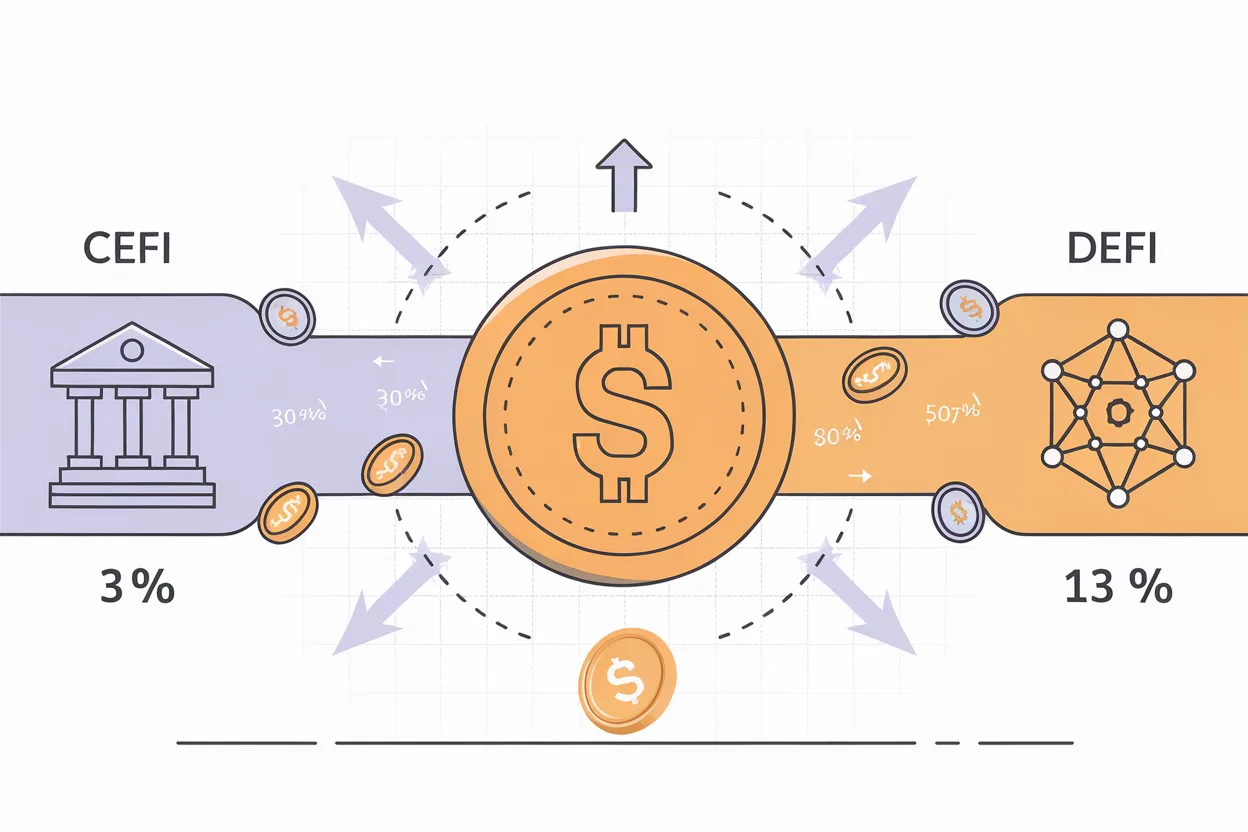
The stablecoin market has exploded to $317.9 billion in total market cap (CoinGecko data) as of April 2026. USDT leads at $186.6B (36% YoY growth), while USDC has surged to $75.12B (73% YoY growth) — now handling 64% of all stablecoin transaction volume for the first time in a decade. The passage of the GENIUS Act has boosted demand for regulated stablecoins, making this the best time to explore stablecoin yield strategies.
Key Takeaways
- CeFi versus DeFi yield trade-off: CeFi pays 3-15% APY but holds your funds (counterparty risk); DeFi pays 2.5-7% but you keep custody (smart-contract risk).
- Higher APY means higher risk: Promotional CeFi rates (10-15%) carry the same failure risk that took down Celsius and BlockFi — sustainable rates sit lower.
- Custody is the core difference: CeFi platforms hold your keys; DeFi protocols let you keep them — this single choice drives most of the risk profile.
- KYC expectations: CeFi usually requires KYC; most DeFi protocols do not — relevant for both privacy and access.
- Diversify across both: Spread funds across multiple CeFi platforms and DeFi protocols rather than chasing one top rate — concentration is the real danger.
- Do not ignore tax: Stablecoin yield is typically taxable income in most jurisdictions — track accrual dates and amounts.
- Realistic expectations 2026: Treat anything above about 7-8% as elevated risk you must underwrite; the safest stable yield clusters around 3-6%.
What Are Stablecoin Savings?
Stablecoin savings is the practice of depositing dollar-pegged cryptocurrencies (like USDT or USDC) into platforms that pay you interest — similar to a traditional savings account, but typically offering much higher yields. Unlike volatile crypto assets, stablecoins maintain a 1:1 peg to the US dollar, so your principal stays relatively stable while you earn returns.
There are two main approaches:
- CeFi (Centralized Finance) — Platforms like Nexo, Binance, and Bybit accept your deposits and lend them out to borrowers or institutional traders. You earn a fixed or variable rate. The platform manages everything, but you’re trusting them with your funds.
- DeFi (Decentralized Finance) — Protocols like Aave and Compound let you supply stablecoins directly to a smart contract-based lending pool. Rates are algorithmic (based on supply and demand), and you maintain custody of your funds through your own wallet.
CeFi vs DeFi Yield: Which Is Better?
| Factor | CeFi Platforms | DeFi Protocols |
|---|---|---|
| Typical APY (USDT/USDC) | 3-15% (varies by tier/promo) | 2.5-7% (variable) |
| Custody | Platform holds your funds | You control via wallet |
| KYC Required | Usually yes | No |
| Counterparty Risk | High (Celsius, BlockFi precedent) | Smart contract risk |
| Ease of Use | Simple — deposit and earn | Requires wallet + DeFi knowledge |
| Insurance/Protection | Varies (some offer insurance) | No insurance (audit-dependent) |
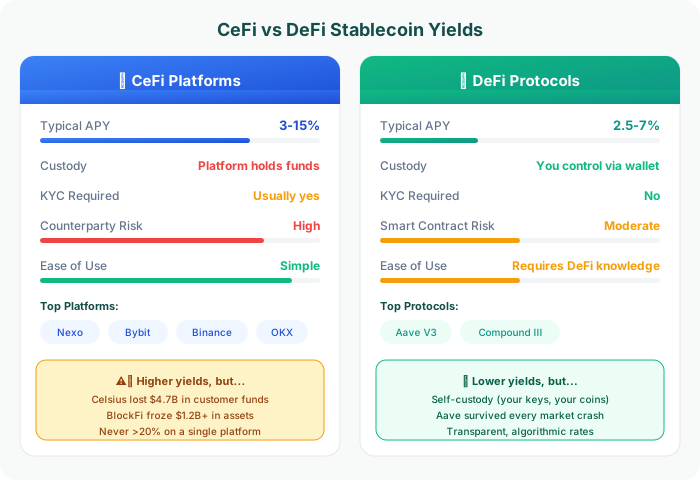
My take: CeFi offers higher advertised rates, but those “up to X%” numbers often require holding platform tokens or locking funds for extended periods. DeFi rates are lower but more transparent — what you see is what you get, and you never give up custody.
Best CeFi Platforms for Stablecoin Savings (2026)
Here’s what you need to know:
1. Nexo — Best for Large Deposits
| Detail | USDT | USDC |
|---|---|---|
| Flexible Rate | 8-10% APY | 8% APY |
| Fixed Rate | 12-13% APY | 12-13% APY |
| Minimum | $5,000+ | $5,000+ |
To unlock the 12-13% APY, you need to hold NEXO tokens (their native token) and choose to receive interest in NEXO rather than in-kind. This introduces token price risk — if NEXO drops 20%, your effective yield drops significantly. The base rate without NEXO holdings is closer to 5-6%.
Best for: Users with $5,000+ who are comfortable holding NEXO tokens as part of their portfolio strategy.
2. Bybit — Best Tiered Structure
| Detail | USDT | USDC |
|---|---|---|
| Flexible (first $200) | 8.2% APR | 8.2% APR |
| Flexible (above $200) | 3.2% APR | 3.2% APR |
| Fixed (7-day) | 7.7% APR | 7.7% APR |
The 8.2% rate only applies to your first $200 — anything above that drops to 3.2%. For a $10,000 deposit, your blended rate is about 3.3%. The 7-day fixed product at 7.7% is more attractive for larger amounts.
Best for: Small depositors who want a straightforward earn product without token-holding requirements.
3. Binance — Highest Promotional Rates (But Volatile)
USDT: Variable promotional rates ranging from 5-20% APR. USDC: 5.6-15% APR. No minimum deposit.
Don’t plan your strategy around Binance’s “up to” rates — they’re marketing tools designed to attract deposits during specific periods.
Best for: Active users who monitor rates daily and can move funds quickly to capture promotional offers.
4. OKX — Variable Range
USDT: 1.68-10% APR. USDC: 2.53-10% APR. No minimum deposit.
The lower end (1.68%) reflects the flexible savings rate, while the higher end requires longer commitments. Similar to Binance, the “up to 10%” figure is optimistic — realistic sustained returns are in the 3-5% range for most users.
Best for: Users already on OKX for trading who want to put idle stablecoins to work.
5. YouHodler — Highest Advertised Yields
USDT/USDC: 8-15% APY flexible, up to 18% APY with activity requirements. Rates are tier-dependent.
Higher yields typically mean higher risk — the platform must be generating returns somewhere to pay you 15-18%. Their business model involves crypto-backed lending and leveraged products. If you use YouHodler, consider limiting your exposure and not depositing more than you’re willing to lose.
Best for: Risk-tolerant users seeking maximum yield from a smaller portion of their portfolio.
Best DeFi Protocols for Stablecoin Yield (2026)
1. Aave V3 — The Gold Standard
Supply APY: ~2.5-6% (variable, fluctuates with borrow demand). Available on Ethereum mainnet and multiple L2s.
The rates are lower than CeFi alternatives, but you maintain full custody through your own wallet. The protocol has survived multiple market crashes without user fund losses.
Best for: DeFi-savvy users who prioritize security and self-custody over maximum yield.
2. Compound III — Algorithmic Simplicity
Supply APY: 4-7% APY (variable, algorithmic). Primarily USDC.
Supply rates for USDC have been slightly higher than Aave’s in recent months, averaging around 5%. The protocol is straightforward — supply USDC and earn. One limitation: Compound III focuses primarily on USDC, so USDT users should look at Aave instead.
Best for: USDC holders who want a simple, well-audited DeFi yield source.
The Risks You Must Know
Before depositing a single dollar, understand the risks.
CeFi Counterparty Risk: The 2022 Lesson
The 2022 CeFi meltdown wiped out billions in customer deposits:
- Celsius: $4.7 billion in customer funds frozen, filed for bankruptcy
- BlockFi: $1.2 billion+ in assets frozen after SEC settlement
- Voyager: $5.4 billion affected, eventually sold to Binance.US
- Genesis Global Capital: Bankruptcy following exposure to 3AC and Terra-Luna
The common thread? Rehypothecation — platforms took customer deposits and lent them to overleveraged hedge funds (like Three Arrows Capital) or invested in risky assets. When the market crashed, they couldn’t return customer funds.
Never deposit more than 20% of your stablecoin holdings on any single CeFi platform. Diversification isn’t just for tokens — it’s for platforms too.
DeFi Smart Contract Risk
DeFi isn’t risk-free either. Recent incidents include:
- USDe oracle failure (October 2025): $60 million in liquidations due to price feed issues
- Synthetix sUSD depegging (January 2026): sUSD lost its dollar peg temporarily
- Saga Dollars exploit (January 2026): Depegged to $0.75 due to a smart contract vulnerability
Stick to protocols with proven track records (Aave, Compound) and avoid newer, untested yield opportunities that promise unusually high returns.
Stablecoin Depegging Risk
Even stablecoins themselves carry risk. While USDT and USDC have maintained their pegs consistently, algorithmic stablecoins have a poor track record (UST/Luna collapse in 2022 is the most notable example). For savings purposes, stick to USDT and USDC — they’re backed by real reserves and have the deepest liquidity.
Tax Considerations
Stablecoin interest is taxable income in most jurisdictions. Here are some key considerations:
- UAE/Dubai: 0% personal income tax on crypto gains (as of 2026). However, businesses face a 9% corporate tax on profits exceeding AED 375,000. Note: The CARF (Crypto-Asset Reporting Framework) implementation begins in the UAE in 2027, with first exchange reporting in 2028.
- Most countries: Stablecoin interest is treated as ordinary income and taxed at your marginal rate.
- Record keeping: Track every interest payment with date, amount, and platform. Most CeFi platforms provide transaction histories that simplify tax reporting.
This is not tax advice. Consult a qualified tax professional in your jurisdiction.
How to Build a Diversified Stablecoin Yield Portfolio
Step-by-Step Portfolio Construction
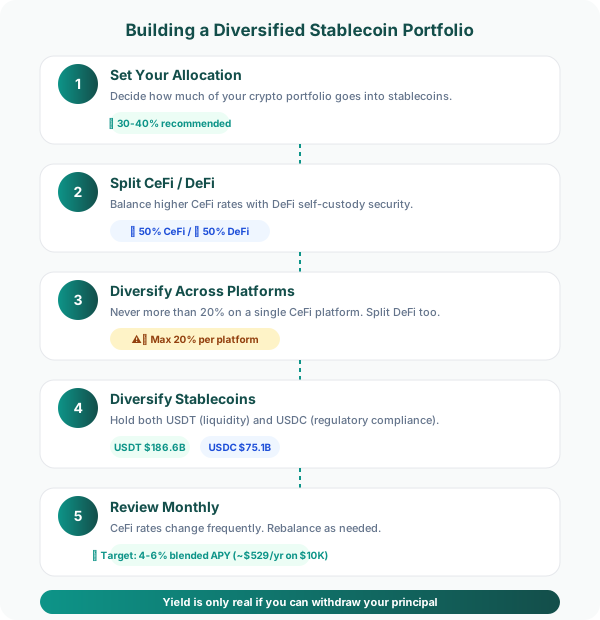
- Split between CeFi and DeFi — A 50/50 split gives you the higher CeFi rates while maintaining self-custody on half your funds. More conservative? Go 30/70 favoring DeFi.
- Diversify across platforms — Never more than 20% on a single CeFi platform. For DeFi, splitting between Aave and Compound reduces smart contract risk.
- Diversify stablecoins — Hold both USDT and USDC. USDT has the deepest liquidity; USDC has the strongest regulatory compliance (boosted by the GENIUS Act).
- Set a review schedule — Check rates monthly. CeFi rates change frequently, and you may need to rebalance. DeFi rates fluctuate with market conditions but require less active management.
Example Portfolio ($10,000)
| Allocation | Platform | Asset | Expected APY | Annual Yield |
|---|---|---|---|---|
| 20% | Bybit Fixed (7-day) | USDT | ~7.7% | ~$154 |
| 15% | OKX Earn | USDC | ~4% | ~$60 |
| 15% | Nexo (base tier) | USDT | ~6% | ~$90 |
| 25% | Aave V3 | USDC | ~4% | ~$100 |
| 25% | Compound III | USDC | ~5% | ~$125 |
| Total | Diversified | Mixed | ~5.3% blended | ~$529 |
This approach won’t give you the highest possible yield, but it dramatically reduces the chance of a total loss from any single platform failure.
Frequently Asked Questions
Is stablecoin savings safe?
No yield product is 100% safe. CeFi platforms carry counterparty risk (as proven by Celsius and BlockFi in 2022), while DeFi protocols carry smart contract risk. The safest approach is to diversify across multiple platforms and protocols, limit exposure to any single service, and stick to well-established providers with proven track records.
What’s the difference between APY and APR?
APR (Annual Percentage Rate) is the simple interest rate. APY (Annual Percentage Yield) includes compound interest. A 10% APR with daily compounding equals roughly 10.5% APY. When comparing platforms, make sure you’re comparing the same metric — some platforms advertise APR while others use APY, which makes their rates look higher.
Should I choose USDT or USDC for savings?
Both are viable, but they serve different purposes. USDT has the largest market cap ($186.6B) and deepest liquidity across exchanges. USDC ($75.12B) has stronger regulatory compliance, especially after the GENIUS Act, and now handles 64% of stablecoin transaction volume.
How much can I realistically earn on $10,000?
With a diversified approach across CeFi and DeFi platforms, expect $400-600 per year (4-6% blended APY) on a $10,000 deposit. Chasing the highest advertised rates (15-18%) typically requires holding platform tokens, locking funds for extended periods, or accepting higher risk — and the effective rate is often lower than advertised.
Do I need to pay tax on stablecoin interest?
In most jurisdictions, yes. Stablecoin interest is generally treated as ordinary income, taxable at your marginal rate. Notable exceptions include the UAE (0% personal income tax on crypto). Keep detailed records of all interest payments, as tax authorities worldwide are increasing crypto reporting requirements (CARF implementation begins in 2027-2028 in many countries).
Conclusion
Stablecoin savings in 2026 offers a genuine opportunity to earn passive income without the volatility of traditional crypto assets. The key is to approach it with the right expectations: realistic yields of 4-6% with a diversified strategy, not the 15-20% headlines that come with hidden conditions.
Start small, diversify across platforms, and never deposit more than you can afford to lose on any single service. The lessons of 2022’s CeFi collapses should be your guiding principle — yield is only real if you can withdraw your principal.
For more on cryptocurrency fundamentals, check out our guides on What Are Stablecoins and Cryptocurrency Security Best Practices.
Continue Learning

Editorial pen name · ChainGain
Alex Mercer is the editorial pen name used for ChainGain’s cryptocurrency education content. Articles are based on cited sources and reproducible comparisons. Editorial profile
Disclaimer: This article is for informational purposes only and does not constitute financial or tax advice. Cryptocurrency investments carry risk, including the potential loss of principal. Past performance does not guarantee future results. Always do your own research and consult qualified professionals before making financial decisions.
Last updated: April 2026. Rates and conditions may change — always verify on the platform’s official website before depositing.