Stablecoin Remittances Explained: How USDT/USDC Replace Wire Transfers (2026)

Editorial pen name · ChainGain
Alex Mercer is the editorial pen name used for ChainGain’s cryptocurrency education content. Articles are based on cited sources and reproducible comparisons. Editorial profile
I switched from wire transfers to stablecoin remittance in 2022, and I’ve saved over $2,000 in fees since then. What used to cost $45 per transfer now costs under $2 — and arrives in minutes instead of days. This guide explains exactly how stablecoins are replacing traditional wire transfers for millions of people worldwide.
Stablecoins aren’t a niche crypto experiment anymore. In 2025, stablecoin transaction volume hit $33 trillion — more than Visa and Mastercard combined. And a growing share of that volume is ordinary people sending money home to their families. Whether you’re a migrant worker sending $300 to the Philippines or a freelancer paying a contractor in Nigeria, stablecoins offer a faster, cheaper alternative to the legacy banking system.
In this guide, I’ll walk you through how stablecoin remittances work, compare USDT and USDC for international transfers, break down the real costs across popular corridors, and show you which companies are building the future of cross-border payments.

Key Takeaways
- Stablecoins cut remittance cost dramatically: A transfer that cost $45 by wire can cost under $2 with stablecoins and arrive in minutes instead of days.
- USDT vs USDC split: USDT ($187B, 20+ chains) dominates emerging-market P2P; USDC ($75.7B, 10+ chains) leads institutional and EU-compliant flows.
- EU regulation diverges in 2026: USDC is MiCA-compliant (Circle EMI license); USDT is not and faces potential EU delisting from July 2026.
- How it works in three steps: Buy stablecoin (on-ramp), send on a low-fee chain to the recipient wallet, then off-ramp to local currency via P2P or mobile money.
- Where stablecoins win: High-fee corridors and unbanked recipients — the $905B remittance market pays over 6% on average through traditional rails.
- Risks to plan for: Wrong-network loss, off-ramp and liquidity gaps, depeg events, and local tax rules — verify before sending large amounts.
- Traditional giants are joining: MoneyGram (via Stellar) and others now bridge crypto savings with familiar pickup — the line between crypto and traditional is blurring.
Why Stablecoins Are Disrupting the $905 Billion Remittance Market
The global remittance market is enormous — and enormously expensive. According to the World Bank, worldwide remittances reached $905 billion in 2024, with the average cost of sending $200 internationally sitting at 6.49%. For families in developing countries, that percentage translates to billions of dollars lost to intermediaries every year.
Stablecoins are eating into this market from multiple angles:
- $33 trillion in stablecoin transaction volume was processed in 2025 (source: Chainalysis), up from $11 trillion in 2024
- 26% of US migrant workers have used stablecoins to send money abroad, according to a 2025 Federal Reserve survey
- An estimated 3–5% of global remittances now use crypto or stablecoins as a settlement layer — and that number is growing by roughly 50% year over year
- Sub-Saharan Africa, the world’s most expensive remittance corridor at 8.78% average cost, has seen the fastest adoption of stablecoin-based transfers
- The UN’s Sustainable Development Goal 10.c targets remittance costs below 3% — stablecoins are one of the few technologies that can actually get there
The fundamental advantage is simple: sending USDT on the TRON network costs roughly $1–$4 regardless of the amount. Sending $500 or $5,000 costs the same network fee. Compare that to SWIFT wire transfers, where you pay a flat fee plus intermediary bank charges plus foreign exchange markups that scale with the amount.
For a detailed breakdown of how these costs compare across corridors, see our Complete Guide to Crypto Remittance Costs in 2026.
What Are Stablecoins? (Quick Refresher)
If you’re already familiar with stablecoins, feel free to skip ahead. For everyone else, here’s what you need to know.
A stablecoin is a cryptocurrency designed to maintain a stable value, typically pegged 1:1 to a fiat currency like the US dollar. Unlike Bitcoin or Ethereum, which can swing 10–20% in a single day, stablecoins are engineered to stay at (or very close to) $1.00. (For a side-by-side breakdown of stablecoins vs Bitcoin for sending money abroad across 5 axes, see our deep comparison.)
The three most widely used stablecoins are:
- USDT (Tether) — Market cap: $187 billion. The oldest and most liquid stablecoin, available on 20+ blockchain networks. Dominant in emerging markets and P2P trading.
- USDC (Circle) — Market cap: $75.7 billion. Backed by US Treasuries and cash reserves, with monthly third-party attestations. The regulatory-compliant choice, especially in Europe after MiCA.
- DAI (MakerDAO) — Market cap: ~$5 billion. Decentralized and crypto-collateralized. Less common for remittances but important in DeFi ecosystems.
For remittances, USDT and USDC are the only two that matter in practice — they have the deepest liquidity and the widest exchange support. For a deeper dive into how stablecoins work, their backing mechanisms, and their risks, see our article: What Are Stablecoins? A Beginner’s Guide.
Before diving into corridor-specific costs, it’s worth understanding a critical risk that most remittance guides skip: centralized stablecoins like USDT, USDC, and DAI can be frozen by their issuers. While freeze events are rare for ordinary remittance users, they are real — Tether alone has frozen over $1.26 billion in 2025. If you are sending large amounts (over $10,000) or transacting in high-AML-risk corridors, this matters. Read our full centralized stablecoins risk comparison to understand which stablecoin offers the strongest counterparty protections for your situation.
USDT vs USDC — Which Is Better for Remittances?
This is one of the most common questions I get. The answer depends on where you’re sending money and what matters most to you.
| Feature | USDT (Tether) | USDC (Circle) |
|---|---|---|
| Market cap | $187B | $75.7B |
| Best for | Emerging markets, P2P | Institutional, EU compliance |
| Supported chains | 20+ (TRON, Ethereum, BSC, Solana, etc.) | 10+ (Ethereum, Solana, Base, Stellar, etc.) |
| EU MiCA compliance | NOT compliant (faces EU delisting July 2026) | Compliant (EMI license from ACPR) |
| US GENIUS Act | Unclear status | Compliant |
| P2P liquidity | Highest globally | Growing but lower |
| Transparency | Reserve reports (no full audit) | Monthly attestations by Deloitte |
My recommendation: For sending money to Africa, Southeast Asia, or Latin America, USDT has significantly better P2P liquidity — which means your recipient can convert to local currency faster and with tighter spreads. For EU transfers or institutional use, USDC is the safer and often only compliant choice, especially after the MiCA regulation takes full effect in July 2026.
Having both in your toolkit gives you the flexibility to optimize for each corridor.
How Stablecoin Remittances Work (Step by Step)
The process is simpler than most people expect. Here’s how a typical stablecoin remittance works from start to finish:
- Buy USDT or USDC on a centralized exchange or through P2P (cost: 0.1–1.5% depending on method and region)
- Send to your recipient’s wallet address on a low-cost network like TRON, Solana, or Stellar (cost: $0.01–$4 depending on the blockchain)
- Recipient sells for local currency via P2P marketplace, local exchange, or cash-out agent (spread: 1–3% above mid-market rate)
- Total time: 10–30 minutes from initiation to local currency in hand (vs 3–5 business days for SWIFT wire transfers)
The critical cost that most crypto articles overlook is step 3 — the off-ramp spread. While the blockchain network fee might be $0.01 on Solana, the real cost of converting stablecoins to local currency via P2P adds 1–3% on top. I covered this in detail in our Remittance Cost Guide.
Total Cost Comparison: $500 Transfer
Here’s what a $500 international transfer actually costs through different methods in 2026:
| Method | Fee ($500 transfer) | Speed | Hidden Costs |
|---|---|---|---|
| Bank wire (SWIFT) | $25–50 + FX markup | 3–5 business days | Intermediary bank fees ($15–30) |
| Western Union | $5–19 + FX markup | 1–3 business days | Exchange rate markup 2–5% |
| Wise (TransferWise) | $2–5 + 0.4% FX | 1–2 business days | Minimal markup |
| Stablecoin (TRON) | $1–4 total | 3–5 seconds | P2P off-ramp spread 1–3% |
| Stablecoin (Solana) | $0.01 total | <1 second | P2P off-ramp spread 1–3% |
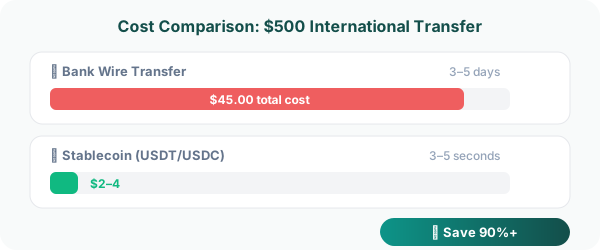
Note: Stablecoin costs include network fee only. The P2P off-ramp spread (1–3%) applies when converting to local currency and varies by corridor. For detailed corridor-by-corridor analysis, see our Crypto Remittance Costs guide.
The takeaway: for a $500 transfer, stablecoins can save you $20–$50 compared to bank wires and $5–$20 compared to Western Union, while arriving in minutes instead of days. The savings are most dramatic for higher amounts — sending $2,000 via SWIFT might cost $60–$80 in total fees, while stablecoins remain under $10 in network costs.
Who’s Building the Stablecoin Remittance Future?
What surprised me most researching this article was how many traditional financial companies are now building stablecoin infrastructure. This isn’t just a crypto-native movement anymore — the incumbents are joining in.
| Company | What They Do | Status |
|---|---|---|
| MoneyGram + Stellar | USDC settlement via 480K+ agents worldwide | Active (Fireblocks partnership Dec 2025) |
| Western Union | Launching USDPT stablecoin on Solana | H1 2026 launch |
| Circle | USDC issuer, MiCA compliant, African partnerships | Active |
| Flutterwave + Polygon | Stablecoin payments in 34 African nations | 2026 consumer rollout |
| Coins.ph + Remitly | Stablecoin remittances to Philippines | 2026 partnership |
| Yellow Card + Visa | Africa stablecoin payments network | 2026 launch |
| Chipper Cash | USDC behind-the-scenes for Africa corridor | Active |
The biggest story of 2026? Western Union — the company that built its empire on $10–$15 transfer fees — is launching its own stablecoin, USDPT, built on the Solana blockchain. When the disruptor becomes the incumbent’s tool, you know the technology has crossed a threshold.
MoneyGram’s integration with Stellar is already live and represents one of the first cases where you can walk into a physical MoneyGram agent, hand over cash, and have USDC delivered to a wallet on the other side of the world — all settled in seconds on the Stellar network. Their December 2025 partnership with Fireblocks added institutional-grade custody, making this viable for much larger transfer amounts.
Key Corridors Where Stablecoins Win
Not all remittance corridors are created equal. Stablecoins offer the biggest advantage in regions where traditional banking is expensive, slow, or both.
US → Philippines (GCash + USDC)
The Philippines is the third-largest remittance recipient in the world, receiving over $40 billion annually. Traditional remittance costs on this corridor average 5–7%.
- GCash integration with USDC via Stellar allows Filipinos to receive stablecoins directly into their mobile wallets
- The Coins.ph + Remitly partnership (announced early 2026) enables stablecoin-powered transfers with local peso cash-out at 45,000+ outlets
- Users report 80% fee reduction compared to traditional bank-to-bank transfers
US → Nigeria ($600M/Month CBN Inflows)
Nigeria’s Central Bank reports over $600 million in monthly diaspora inflows, and a growing share now settles via stablecoins. Sub-Saharan Africa has the highest traditional remittance costs globally at 8.78%.
- P2P is dominant: Chipper Cash, Yellow Card, and Flutterwave are the primary platforms
- Stablecoin transfers reduce costs to 1–3% (including P2P spread) vs the 8.78% Sub-Saharan average
- Yellow Card’s partnership with Visa (2026) is building an on/off-ramp network across 20 African countries
- Flutterwave’s integration with Polygon enables stablecoin settlement in 34 African nations with consumer rollout planned for 2026
Turkey → MENA (Inflation Hedge + Remittance)
Turkey represents a unique case where stablecoins serve a dual purpose: inflation hedge and remittance tool. With the Turkish Lira losing over 40% of its value against the dollar in 2025 alone, many Turks hold savings in USDT as a store of value.
- Stablecoin adoption in Turkey is among the highest per capita in the world
- The Turkey → UAE corridor is particularly active, with the UAE processing over $30 billion in digital assets annually
- P2P platforms like Binance P2P and Bybit P2P have deep TRY/USDT liquidity
- For Turkish workers in the Gulf states, sending USDT home and converting via P2P saves 3–5% compared to traditional remittance channels
Russia → CIS (Telegram/TON)
International sanctions have made traditional remittances to and from Russia extremely difficult. SWIFT disconnections for major Russian banks mean that stablecoins have become the primary cross-border payment method for many in the CIS region.
- Telegram/TON has emerged as the only practical option for many users under sanctions — its integrated wallet supports USDT transfers within the chat interface
- Promsvyazbank has launched a rouble-pegged stablecoin for CIS trade settlement
- P2P volume on Russian exchanges for USDT/RUB pairs has grown over 300% since 2023
- The corridor is uniquely sanctions-driven rather than cost-driven — users have no viable alternative, not just a cheaper one
For a deeper look at which blockchain is best for each corridor, see our guide: Best Blockchain for Sending Money Abroad.
Risks You Should Know
I’d be doing you a disservice if I only talked about the benefits. Stablecoin remittances carry real risks that you need to understand before relying on them.
1. De-pegging risk. Stablecoins can temporarily lose their $1 peg. The most notable example: USDC dropped to $0.88 in March 2023 when Silicon Valley Bank (which held $3.3 billion of Circle’s reserves) collapsed. The peg recovered within days, but if you had sent a $1,000 remittance during those 48 hours, your recipient would have received roughly $880 in value. USDT has also briefly traded at $0.97–$0.98 during market stress events.
2. USDT MiCA non-compliance. Tether’s USDT is not compliant with the EU’s MiCA regulation. European exchanges face mandatory delisting after July 2026. If you rely on EU-based platforms for on/off-ramping USDT, you need a migration plan to USDC or another MiCA-compliant stablecoin. See the ESMA website for the latest timeline.
3. Off-ramp challenges. Converting stablecoins to local currency isn’t instant everywhere. In some countries, P2P liquidity is thin, and your recipient might wait hours or even days to find a buyer at a reasonable rate. In-person cash trades carry safety risks. And bank deposit from P2P can trigger compliance flags at local banks.
4. Tether reserve transparency. Despite publishing quarterly reserve reports, Tether has never undergone a full independent audit. Their reserves include commercial paper, secured loans, and other assets whose quality is debated. While USDT has maintained its peg through multiple market crises, the lack of full audit transparency remains a concern — especially for large transfers.
5. Regulatory changes. The regulatory landscape for stablecoins is evolving rapidly. The US GENIUS Act may impose new requirements on stablecoin issuers. Countries like India and Indonesia are developing their own frameworks. A sudden regulatory change could disrupt the on-ramp or off-ramp infrastructure you depend on.
None of these risks are dealbreakers, but they’re real.
For a step-by-step guide on actually sending stablecoins internationally, including wallet setup and off-ramp options, see our tutorial: How to Send USDT Abroad: Complete Guide. For a deep dive on how MoneyGram’s Stellar integration works in practice, see MoneyGram + Stellar: How Crypto-Powered Remittances Actually Work.
The Future: Traditional Giants Go Crypto
The most fascinating development in stablecoin remittances isn’t happening in crypto-native startups — it’s happening inside the traditional finance companies that crypto was supposed to disrupt.
Western Union’s USDPT on Solana
Western Union’s planned launch of USDPT — its own stablecoin built on Solana — is arguably the clearest signal that stablecoins have won the remittance argument. When a 170-year-old company with 550,000 agent locations pivots to blockchain settlement, it’s not a trend — it’s an infrastructure shift. Expected in H1 2026.
MoneyGram + Fireblocks Integration
MoneyGram has gone further than any legacy provider in embracing stablecoins. Their partnership with Fireblocks (December 2025) added institutional-grade custody and compliance tooling, making their USDC settlement via 480,000+ agents viable for larger transaction sizes. The end user doesn’t even need to know they’re using crypto — they just see faster, cheaper transfers.
Stablecoin Startups Raising Significant Capital
The venture capital flowing into stablecoin infrastructure tells you where the smart money sees the future:
- Better Money: Raised $10 million from a16z to build a stablecoin clearinghouse for cross-border settlement
- KAST: Closed an $80 million Series A for a consumer stablecoin wallet focused on emerging markets
- Bridge (acquired by Stripe): Stripe’s $1.1 billion acquisition of stablecoin API company Bridge signals massive institutional interest
My prediction: within 5 years, the distinction between “crypto remittance” and “normal remittance” will disappear. Stablecoins will be the settlement layer, but users will interact with familiar brands and familiar interfaces. The blockchain will fade into the background — just like TCP/IP powers the internet without anyone thinking about it.
For a comparison of how crypto stacks up against specific legacy providers right now, see: Crypto vs Western Union: Which Is Cheaper?
Frequently Asked Questions
Are stablecoin remittances legal?
In most countries, yes. Stablecoins are legal to buy, hold, and transfer in the majority of jurisdictions. However, regulations vary significantly by country. Some nations (like China) restrict cryptocurrency trading, while others (like the UAE, Singapore, and most of Europe) have clear regulatory frameworks. Always check your destination country’s current regulations. The EU’s MiCA framework, effective 2025–2026, provides the clearest legal structure for stablecoin use in Europe.
What’s the cheapest stablecoin to send money with?
The cheapest option depends on the network, not the stablecoin itself. USDT on Solana costs approximately $0.01 per transaction, and USDT on TRON costs $1–$4. USDC on Stellar is similarly cheap at under $0.01. However, the network fee is only part of the total cost — you also need to factor in the on-ramp fee (0.1–1.5%) and off-ramp P2P spread (1–3%). For a full cost analysis, see our Remittance Cost Guide.
How do I convert stablecoins to local currency?
The three main methods are: (1) P2P marketplaces on exchanges like Binance or Bybit, where you sell USDT/USDC to a local buyer who pays via bank transfer or mobile money; (2) Local crypto exchanges with fiat withdrawal support (e.g., Coins.ph in the Philippines, Yellow Card in Africa); and (3) Cash-out agents like MoneyGram’s network of 480,000+ locations. P2P is the most common method in emerging markets.
Is USDT safe for international transfers?
USDT has maintained its dollar peg through multiple market crises and processes more daily volume than any other stablecoin. The main concerns are: (1) Tether has not completed a full independent audit of its reserves; (2) USDT is not MiCA compliant and faces EU delisting in July 2026; and (3) during extreme market events, USDT has briefly traded at $0.97–$0.98. For most practical purposes, USDT is safe for transfers — but consider diversifying with USDC for larger amounts.
Will stablecoins replace Western Union?
Not replace — absorb. Western Union is launching its own stablecoin (USDPT) on Solana, and MoneyGram already settles via USDC on Stellar. The most likely outcome is that traditional remittance companies adopt stablecoin settlement behind the scenes, offering faster and cheaper transfers while maintaining their brand, agent networks, and regulatory licenses. The winner isn’t “crypto vs Western Union” — it’s stablecoins as the shared infrastructure that everyone uses.
Continue Learning
Remittance Cluster:
- Complete Guide to Crypto Remittance Costs (2026) — Pillar article with corridor-by-corridor fee analysis
- Best Blockchain for Sending Money Abroad — TRON vs Solana vs Stellar compared
- How to Send USDT Abroad: Step-by-Step Guide — Practical walkthrough with wallet setup
- Crypto vs Western Union: Which Is Cheaper? — Head-to-head cost comparison
Foundations:
- What Are Stablecoins? A Beginner’s Guide — How USDT, USDC, and DAI work