How to Buy Cryptocurrency: Step-by-Step for 20+ Countries (2026)
Table of Contents

Editorial pen name · ChainGain
Alex Mercer is the editorial pen name used for ChainGain’s cryptocurrency education content. Articles are based on cited sources and reproducible comparisons. Editorial profile
Beginner
Disclosure: This article contains affiliate links to cryptocurrency exchanges. We may earn a commission if you sign up through our links, at no extra cost to you. See our full disclosure.
Buying cryptocurrency for the first time can feel overwhelming. Hundreds of exchanges, dozens of payment methods, and constant warnings about scams — it’s enough to make anyone hesitate.
But here’s the truth: buying your first crypto is simpler than opening a bank account in most countries. In 2026, you can go from zero to holding Bitcoin or stablecoins in under 15 minutes, often without submitting any ID documents.
This guide walks you through every step — from choosing where to buy, to funding your account with your local payment method, to securing your holdings. I’ve included country-specific payment instructions for over 20 countries, because what works in London doesn’t work in Lagos.
What You Need Before You Start
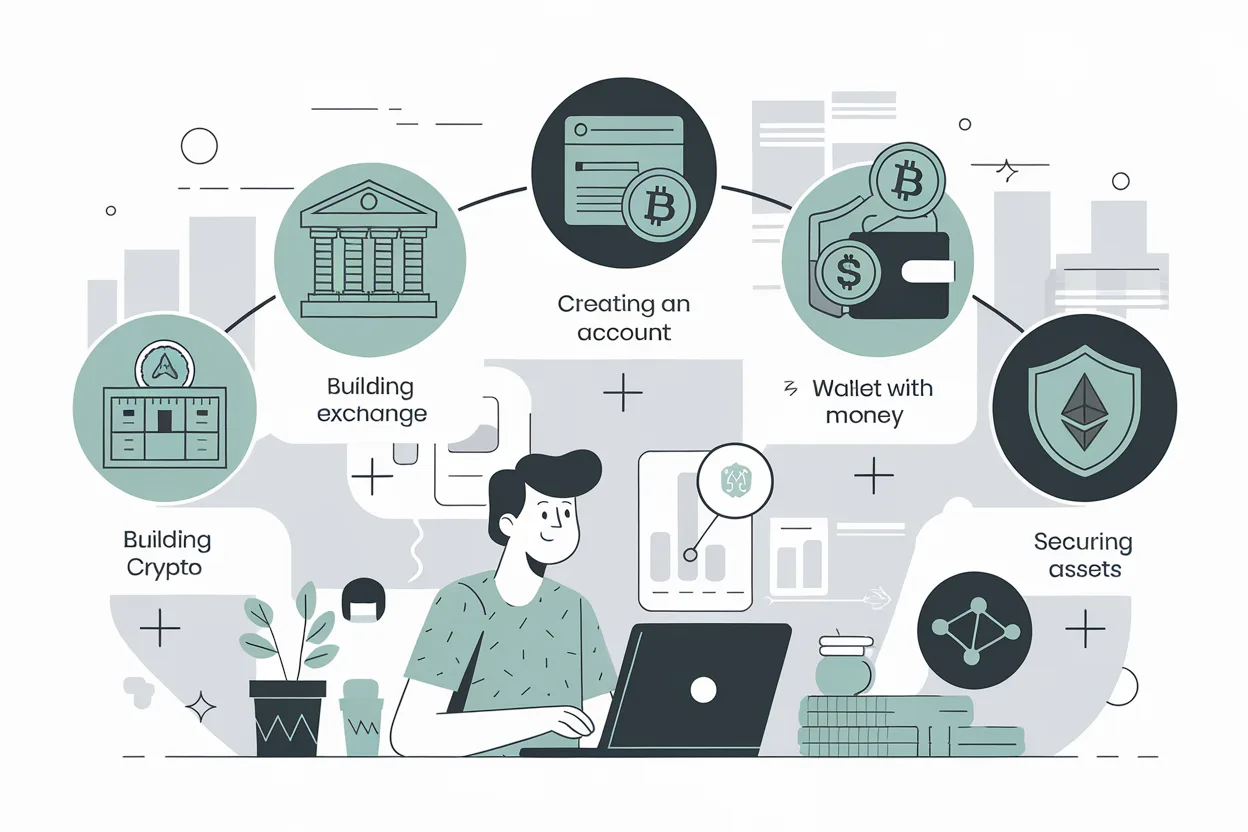
Before buying crypto, make sure you have:
- A smartphone or computer with internet access
- An email address (preferably one you use only for crypto)
- A payment method — bank account, mobile wallet, or cash (see your country’s options below)
- A basic understanding of what you’re buying — if you’re new, read our What Is Cryptocurrency? guide first
You do not need:
- A passport or government ID (for crypto-deposit exchanges)
- A bank account (P2P and mobile money work)
- A large amount of money ($10 is enough to start)
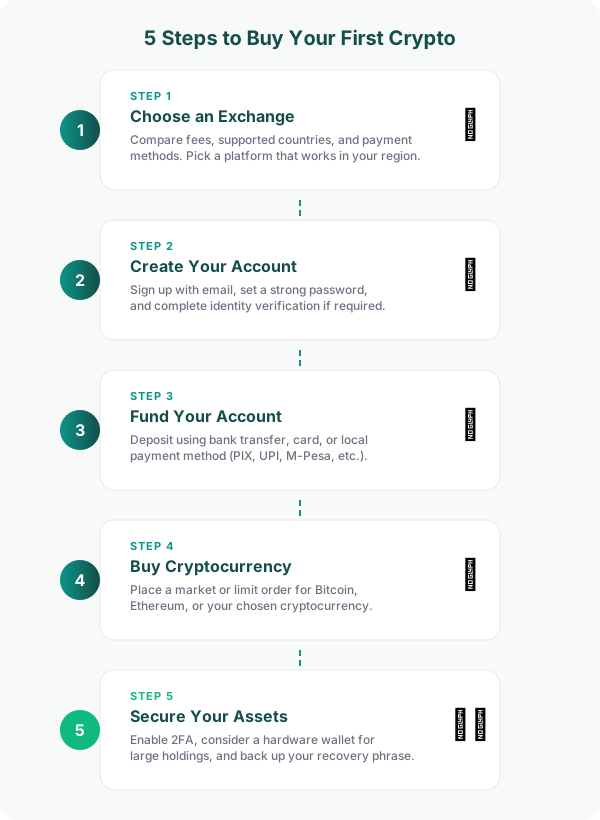
Step 1: Choose Where to Buy
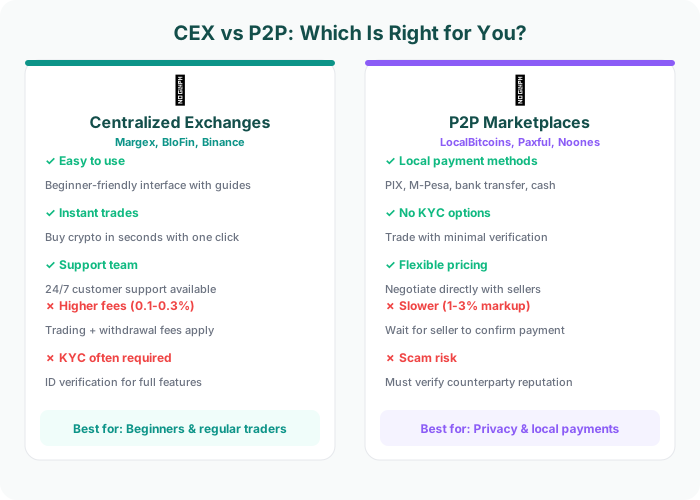
There are three main ways to buy cryptocurrency. Each has trade-offs between convenience, fees, and privacy.
| Method | Best For | Fees | KYC Required? | Speed |
|---|---|---|---|---|
| Centralized Exchange (CEX) | Beginners, frequent trading | 0.1-0.6% | Varies — some require none for crypto deposits | Minutes |
| P2P Marketplace | Restricted countries, local payment methods | 0% explicit (0.8-4% spread) | Usually minimal | 5-30 min |
| Decentralized Exchange (DEX) | Privacy, advanced users | 0.3-1% + gas fees | None | Seconds (need existing crypto) |
Centralized Exchanges (Recommended for Beginners)
A centralized exchange is the easiest way to buy crypto. You create an account, deposit funds, and buy — similar to any online broker.
Two exchanges that stand out for beginners in 2026:
- Margex — No KYC required for crypto deposits. Minimum $10 deposit. 46+ trading pairs with maker fees of just 0.019%. Simple interface designed for newcomers. Create a free account →
- BloFin — No KYC for basic trading with up to 20,000 USDT/day withdrawal limit. 400+ spot pairs and 530+ futures pairs. Competitive fees at 0.02% maker / 0.06% taker. Create a free account →
Important: Both Margex and BloFin accept crypto deposits without identity verification. If you want to deposit fiat currency (USD, EUR, etc.) directly via card, full KYC verification is required at all major exchanges.
P2P Marketplaces (Best for Local Payment Methods)
Peer-to-peer (P2P) platforms connect buyers and sellers directly. You pay the seller using your local payment method — mobile money, bank transfer, or even cash — and receive crypto in return.
P2P is especially useful if:
- Your country has restrictions on exchange access (Nigeria, Vietnam)
- You want to pay with mobile money (M-Pesa, GCash, JazzCash)
- You prefer not to submit identity documents
Popular P2P platforms in 2026: Binance P2P (110+ fiat currencies, 100+ payment methods), Remitano (strong in Southeast Asia and Africa), and Hodl Hodl (non-custodial, Bitcoin-focused).
Read our P2P Crypto Trading Safety Guide before making your first P2P trade.
Step 2: Create Your Account
Creating an account on most exchanges takes under 3 minutes:
- Visit the exchange website or download the mobile app
- Enter your email address and create a strong password
- Verify your email (check your inbox for a confirmation code)
- Enable two-factor authentication (2FA) — this is critical for security. Use an authenticator app like Google Authenticator, not SMS
For exchanges like Margex and BloFin, that’s it — you can start depositing crypto immediately. No passport photos, no selfies, no waiting days for approval.
Step 3: Fund Your Account
This is where the process varies most by country. You have two main paths:
If you’re receiving crypto from someone in another country, read How to Send USDT Abroad: Step-by-Step Guide (2026) for the sender’s walkthrough including network selection (TRC-20 vs BEP-20) and fee comparison.
Path A: Deposit Crypto Directly (No KYC)
If you already have crypto or can get it from someone, you can deposit directly to your exchange wallet:
- Go to “Deposit” on your exchange
- Select the cryptocurrency (e.g., USDT, BTC)
- Choose the network (TRC-20 for USDT is cheapest — ~$1 fee)
- Copy the deposit address
- Send crypto from your source wallet to this address
Network matters: Sending USDT on the wrong network means lost funds. Always double-check that sender and receiver use the same network (TRC-20, ERC-20, etc.).
Path B: Buy Crypto with Local Payment (P2P)
If you’re starting from zero with only local currency, P2P is your best option in most countries:
- Open a P2P platform (e.g., Binance P2P)
- Select “Buy” → choose USDT (most stable for beginners)
- Filter by your payment method (bank transfer, mobile money, etc.)
- Choose a seller with high completion rate (98%+) and many trades (500+)
- Enter the amount you want to buy
- Follow the payment instructions — transfer money to the seller’s account
- Mark as “Paid” — the seller releases crypto from escrow to your wallet
Safety tip: Never release payment outside the P2P platform. The escrow system protects both buyer and seller. If anything goes wrong, the platform can arbitrate.
Step 4: Make Your First Purchase
With funds in your exchange account, buying crypto takes seconds:
If you plan to use your crypto for cross-border transfers, read our Best Blockchain for Sending Money: Fee Comparison (2026) to choose the right network before buying — TRC-20, BEP-20, and Polygon have drastically different fees.
- Go to the trading page (or “Buy Crypto” for simplified view)
- Select the pair — e.g., BTC/USDT (buy Bitcoin with USDT)
- Choose Market Order for instant execution at current price
- Enter the amount
- Confirm and buy
What Should You Buy First?
| Cryptocurrency | Why Consider It | Risk Level | Good For |
|---|---|---|---|
| Bitcoin (BTC) | Largest, most established, 15+ year track record | Medium | Long-term holding |
| Ethereum (ETH) | Largest smart contract platform, wide utility | Medium | DeFi, NFTs, holding |
| USDT / USDC | Pegged to USD — holds value during volatility | Low | Savings, remittances, trading base |
There’s no wrong answer — start with what you’re comfortable with.
Step 5: Secure Your Crypto
Leaving large amounts on an exchange is risky. Exchanges can be hacked, freeze accounts, or shut down. Once you hold more than you can afford to lose, move your crypto to a personal wallet.
- Under $100: Exchange wallet is fine for now
- $100-$1,000: Use a mobile wallet like Trust Wallet or MetaMask
- Over $1,000: Consider a hardware wallet (Ledger, Trezor)
For a detailed comparison, read our How to Choose a Crypto Wallet guide.
Country-Specific Payment Guide
The best way to buy crypto depends entirely on where you live. Below is a verified guide for the most popular payment methods in each country, updated for 2026.
→ Sending or receiving money abroad? After you buy your first crypto, see our country-specific remittance guides: Philippines, Nigeria, India, and Brazil.
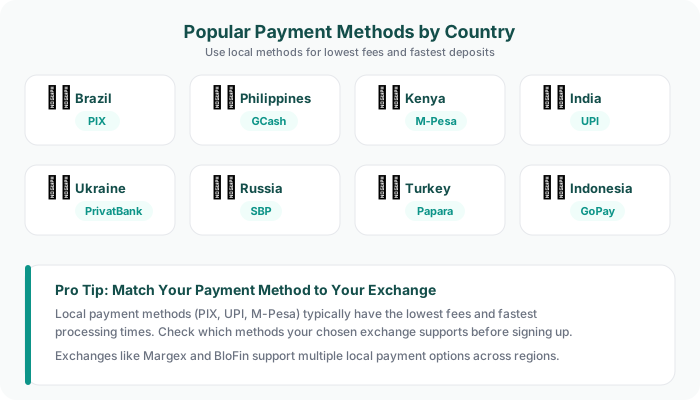
| Country | Best Payment Methods | Recommended Path | Typical Fees | Speed |
|---|---|---|---|---|
| 🇳🇬 Nigeria | Bank transfer, P2P | Binance P2P → USDT → Exchange | 1-3% spread | 5-15 min |
| 🇰🇪 Kenya | M-Pesa | P2P (M-Pesa) → USDT → Exchange | 1-2% spread | 5-10 min |
| 🇬🇭 Ghana | Mobile Money (MTN, Vodafone) | P2P (Mobile Money) → USDT | 2-3% spread | 5-15 min |
| 🇹🇿 Tanzania | M-Pesa, Tigo Pesa | P2P (M-Pesa) → USDT | 2-4% spread | 10-20 min |
| 🇿🇦 South Africa | Bank transfer (EFT), Instant EFT | Local exchange (Luno) or P2P | 0.5-1.5% | Instant-1hr |
| 🇬🇧 United Kingdom | Faster Payments, Debit card | Direct exchange deposit → Buy | 0-1.5% | Instant |
| 🇮🇳 India | UPI, IMPS, NEFT | P2P (UPI) → USDT → Exchange | 0.5-2% | Instant-5 min |
| 🇵🇰 Pakistan | JazzCash, Easypaisa, Bank | P2P (JazzCash) → USDT | 1-3% spread | 5-15 min |
| 🇵🇭 Philippines | GCash, Maya, Bank transfer | P2P (GCash) → USDT → Exchange | 1-2% | 5-10 min |
| 🇪🇹 Ethiopia | Telebirr, Bank transfer | P2P (Telebirr) → USDT | 3-5% spread | 10-30 min |
| 🇧🇩 Bangladesh | bKash, Nagad, Bank | P2P (bKash) → USDT | 2-4% spread | 10-20 min |
Note for Nigeria: Since Binance suspended naira services in 2024, P2P through verified platforms remains the primary path for Nigerian users. Always use escrow-protected P2P services and verify the seller’s trade history before transacting. For detailed NGN corridor costs and the top P2P platforms (Binance, Remitano, Noones), see our Cheapest Way to Send Money to Nigeria (2026) guide.
Note for India: Indian exchanges require KYC under RBI regulations. For UPI-based fiat send/receive and the cheapest INR corridor options, see our Cheapest Way to Send Money to India (2026) guide. For no-KYC access, use P2P to buy USDT, then deposit to a crypto-deposit exchange like Margex or BloFin.
Fee Comparison: How Much Does It Really Cost?
Fees vary dramatically depending on how you buy. Here’s what to expect in 2026:
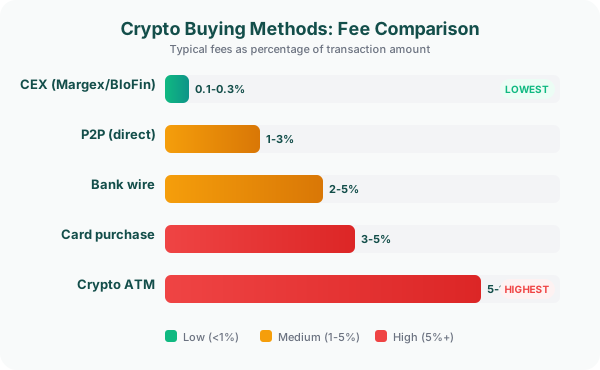
| Payment Method | Typical Fee | Speed | Best For |
|---|---|---|---|
| Bank transfer (domestic) | 0-0.5% | 1-3 days | Large amounts, low cost |
| Mobile money (M-Pesa, GCash, PIX) | 0-0.5% | Instant | Small-medium amounts |
| P2P marketplace | 0% fee + 0.8-4% spread | 5-30 min | Restricted countries |
| Credit/debit card | 2-3% | Instant | Convenience over cost |
| International wire (SWIFT) | $25-50 flat | 3-5 days | Avoid if possible |
Pro tip: The cheapest path in most developing countries is: local payment → P2P buy USDT → deposit USDT to exchange. This avoids card fees entirely and typically costs only 1-2% in P2P spread.
Common Mistakes to Avoid
- Sending crypto on the wrong network — Always match networks between sender and receiver. USDT exists on 10+ networks; sending TRC-20 USDT to an ERC-20 address means permanent loss.
- Skipping 2FA setup — Without two-factor authentication, a leaked password means stolen funds. Set up 2FA immediately after creating your account.
- Buying during a price spike — FOMO (fear of missing out) leads to buying at peaks. If Bitcoin just rose 20% in a week, waiting for a pullback is usually wiser.
- Investing more than you can afford to lose — Crypto can drop 30-50% in days. Only invest money you won’t need for at least a year.
- Trusting “guaranteed returns” — No legitimate platform guarantees profits. If someone promises 10% weekly returns, it’s a scam. Read our scam prevention guide (coming soon).
- Not saving your wallet seed phrase — Your seed phrase (12 or 24 words) is the only backup for your wallet. Write it on paper, never store it digitally, and never share it with anyone.
FAQ
How much money do I need to start buying crypto?
You can start with as little as $10 on most exchanges. Margex’s minimum deposit is $10 worth of crypto. There’s no rule that says you need to buy a whole Bitcoin — you can buy a fraction (called “satoshis” for Bitcoin).
Can I buy crypto without a bank account?
Yes. In many countries, you can buy crypto using mobile money (M-Pesa, GCash, JazzCash, bKash), prepaid cards, or even cash through P2P trades. A bank account is not required.
Is it safe to buy crypto in 2026?
Buying from reputable exchanges is as safe as using any online financial service. The main risks are price volatility (crypto values fluctuate), phishing attacks (fake websites), and user error (sending to wrong addresses). Using 2FA, bookmarking exchange URLs, and double-checking addresses eliminates most risks.
What’s the difference between Bitcoin and USDT?
Bitcoin’s price changes constantly — it can gain or lose 5-10% in a single day. USDT (Tether) is a stablecoin pegged to the US dollar, so 1 USDT ≈ $1.00 always. Beginners who want to learn the process without price risk often start with USDT. Read more in our What Are Stablecoins? guide.
Do I need to pay taxes on crypto?
Tax rules vary by country. In some countries (e.g., UAE, Singapore), there’s no crypto tax. In others (e.g., India at 30%, Japan up to 45%), crypto profits are heavily taxed. Check your local regulations before trading significant amounts.
What if I send crypto to the wrong address?
Crypto transactions are irreversible. If you send funds to the wrong address, they are likely lost permanently. Always send a small test amount first (e.g., $5) before transferring larger sums, and triple-check the address matches.
Final Thoughts
Buying cryptocurrency in 2026 is accessible to anyone with a smartphone and $10. The key steps are simple: pick an exchange, fund your account using whatever payment method is available in your country, make your purchase, and move your crypto to a secure wallet.
Don’t overcomplicate it. Start small, learn the process, and increase your position only when you’re comfortable. The crypto market isn’t going anywhere — there’s no rush.
Continue Learning
Disclaimer: This article is for educational purposes only and does not constitute financial advice. Cryptocurrency investments carry significant risk. Always do your own research and consult a qualified financial advisor before making investment decisions. Prices, fees, and availability mentioned are accurate as of March 2026 and may change.