
Beginner
Disclosure: This article contains affiliate links. If you sign up through our links, we may earn a commission at no extra cost to you. See our full disclosure.
Crypto scams stole over $14 billion in 2025 alone, according to Chainalysis — and that number is likely underreported. From AI-generated deepfake videos of celebrities to romance scams that drain victims’ life savings, criminals are becoming more sophisticated every year.
I first encountered a crypto scam in 2020 when a “friend” on Telegram sent me a link to a “guaranteed 200% return” staking platform. The website looked professional, had fake testimonials, and even showed real-time profit dashboards. Fortunately, I did 10 minutes of research before depositing anything and discovered the domain was 3 days old. Not everyone is that lucky — the FBI received over 149,000 crypto fraud complaints in 2024 with losses exceeding $9.3 billion.
This guide covers the most dangerous crypto scams active right now, exactly how each one works, and the concrete steps you can take to protect yourself.
The State of Crypto Scams in 2026: Key Numbers
Before diving into specific scam types, here is what the data tells us about the current threat landscape:
| Metric | Value | Source |
|---|---|---|
| Total crypto scam losses (2025) | $14–17 billion | Chainalysis 2026 Crypto Crime Report |
| FBI crypto complaints (2024) | 149,686 complaints, $9.3B losses | FBI IC3 Annual Report 2024 |
| YoY increase in scam losses | +66% | FBI IC3 2024 |
| AI-enabled scam profitability | 4.5× more profitable than non-AI scams | Chainalysis 2026 |
| Scams involving AI tools | 60% of scam deposits | Chainalysis 2026 |
| Average loss per pig butchering victim | $150,000+ | FBI IC3 / MIT Technology Review |
| Ponzi scheme share of all scams | 22% (Q1 2025) | CoinLaw |
| Impersonation scam growth | +1,400% YoY | Chainalysis 2026 |
The 7 Most Dangerous Crypto Scams in 2026
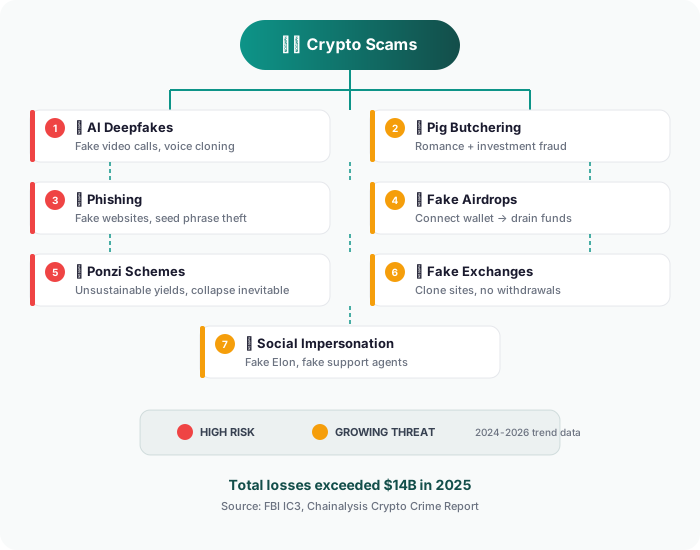
1. AI Deepfake Scams
What it is: Scammers use artificial intelligence to create realistic video or voice clones of celebrities, executives, or even your friends. These deepfakes promote fake investment platforms, giveaways, or token presales.
How it works:
- Scammers create AI-generated videos of well-known figures (Elon Musk, CZ, Vitalik Buterin) endorsing a crypto project
- Videos are distributed via YouTube ads, social media, or direct messages
- Victims click links to “exclusive” investment platforms
- Deposits go directly to the scammer’s wallet
Scale: In Q1 2025, authorities dismantled 87+ scam rings using AI deepfakes. Nearly 40% of high-value crypto fraud cases now involve deepfake technology, and AI-enabled scams generate $3.2 million per operation compared to $719K without AI.
Red flags:
- Celebrity “endorsements” of specific crypto projects
- Urgency language (“limited time,” “only 100 spots”)
- Unusual lip-sync or robotic speech patterns in video
- No verifiable information on the project’s official channels
2. Pig Butchering (Romance Scams)
What it is: Long-term social engineering where scammers build fake romantic or friendship relationships over weeks or months, then convince victims to “invest” in fraudulent crypto platforms. The name comes from the concept of “fattening the pig before slaughter” — building trust before stealing.
How it works:
- Contact initiated on dating apps, WhatsApp, Telegram, or even LinkedIn
- Weeks of normal conversation to build trust and emotional connection
- Scammer casually mentions crypto profits they’ve been making
- Victim is guided to a fake trading platform showing fabricated profits
- Small withdrawals may be allowed initially to build confidence
- After large deposits, the platform blocks withdrawals or demands “tax” payments
Scale: Pig butchering generated $12.4 billion in losses in 2024 alone, making it the most profitable scam category. Over 64,000 U.S. victims reported losses in 2025. Many operations are run from scam compounds in Southeast Asia (Cambodia, Myanmar, Laos) where trafficked workers are forced to carry out the scams.
Red flags:
- Unsolicited contact from an attractive stranger
- Conversations that quickly move to crypto investing
- “Friend” showing screenshots of impressive trading profits
- Being directed to download a specific trading app or visit a platform you’ve never heard of
- Platform requires crypto deposits only (no bank transfers)
3. Phishing Attacks
What it is: Fake websites, emails, or messages that mimic legitimate exchanges, wallets, or services to steal your login credentials or private keys.
How it works:
- You receive an email/SMS that looks identical to your exchange (Coinbase, Binance, etc.)
- Message claims urgent action needed: “suspicious login detected” or “verify your account”
- Link leads to a pixel-perfect copy of the real website
- You enter your credentials → scammers immediately access your real account
Scale: Phishing remains the most common attack vector. In 2025, fake Coinbase support emails and SMS messages became so convincing that even experienced users fell victim. Recovery rates for phishing victims are below 50%.
Red flags:
- Emails from slightly misspelled domains (c0inbase.com instead of coinbase.com)
- Urgency and threats (“account will be locked in 24 hours”)
- Links that don’t match the official domain when you hover over them
- Requests for your seed phrase or private key (legitimate services never ask for these)
4. Fake Airdrop and Giveaway Scams
What it is: Scammers create fake token airdrops or celebrity giveaways that require you to “connect your wallet” or “send a small amount to receive more.”
How it works:
- Social media post or website promises free tokens from a known project
- To “claim,” you must connect your wallet to a malicious smart contract
- The contract includes approval to drain your wallet of all tokens
- Alternatively, “send 0.1 ETH to receive 1 ETH back” (you never receive anything)
Scale: ScamSniffer identified 737,000+ wallets targeted with fake airdrops in 2025, using names like ApeCoin, Pepe, and Sandbox. A fake Polygon airdrop alone caused $1.2 million in losses.
Red flags:
- Any “giveaway” that requires you to send crypto first
- Wallet connection requests from unfamiliar websites
- Airdrop claims from unverified social media accounts
- Token approvals requesting unlimited spending permission
5. Ponzi and Yield Farming Scams
What it is: Platforms promising unrealistic returns (10-50%+ monthly) that pay early investors with new investors’ money until the scheme collapses.
How it works:
- Platform advertises “guaranteed” high APY through “AI trading” or “arbitrage”
- Early investors receive payouts, creating social proof
- Word-of-mouth marketing drives massive deposits
- When new deposits slow, the platform freezes withdrawals or disappears
Scale: Ponzi schemes accounted for 22% of all crypto scams in Q1 2025, with $6.1 billion in funds (a 49% YoY increase). 72% of crypto Ponzis disguise themselves as staking or yield farming platforms.
Red flags:
- “Guaranteed” returns above 1% daily or 30% monthly
- No verifiable trading strategy or audit
- Referral bonuses that incentivize recruiting new investors
- Anonymous team or vague “AI trading” claims with no proof
- Withdrawal delays or requirements to deposit more to withdraw
6. Fake Exchanges and Wallets
What it is: Counterfeit trading platforms or wallet apps designed to steal your deposits or credentials.
How it works:
- A website or app clone mimics a legitimate exchange interface
- You create an account and deposit crypto
- The platform may show fake balances and allow small “trades”
- When you try to withdraw, funds are already stolen
Scale: In 2025, the SEC charged three fake trading platforms (Morocoin, Berge Blockchain, Cirkor) responsible for over $14 million in losses. The average scam payment increased 253% — from $782 in 2024 to $2,764 in 2025.
Red flags:
- Exchange not listed on CoinGecko or CoinMarketCap
- Domain registered recently (check with whois lookup)
- No regulatory registration or license information
- Unusually high bonuses for first deposits
- App not available on official app stores (APK download only)
7. Social Media Impersonation
What it is: Fake accounts impersonating exchanges, projects, or influencers on Telegram, Discord, X (Twitter), and other platforms.
How it works:
- Scammer creates an account nearly identical to a real project or person
- Sends direct messages offering “exclusive” deals, airdrops, or support
- Victims share seed phrases, private keys, or send crypto for “verification”
Scale: Impersonation scams grew 1,400% YoY in 2025. Chinese-language scam marketplaces on Telegram process hundreds of millions in monthly transactions. A common pipeline funnels victims from Telegram → Discord → fake trading platforms.
Red flags:
- “Support” contacting you first (legitimate support never DMs you first)
- Slight username variations (@BinanceSupp0rt vs @BinanceSupport)
- Requests for private keys or seed phrases
- Urgency to act immediately
Who Gets Targeted? Regional Risk Map
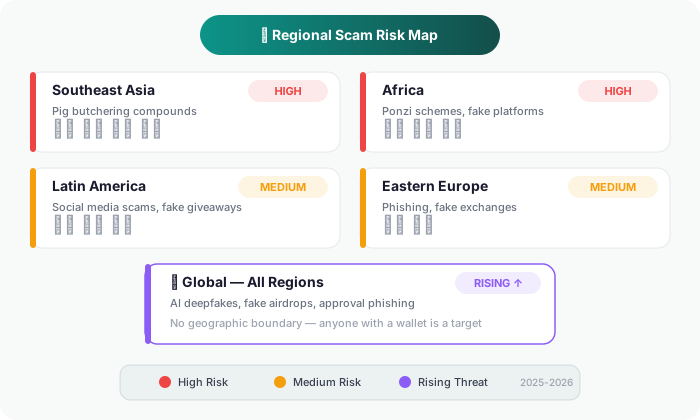
Crypto scams are a global problem, but some regions face higher risks due to rapid adoption without proportional consumer education:
| Region | Key Risk Factors | 2025 Data |
|---|---|---|
| 🇮🇳 India | 200% YoY fraud increase, influencer-driven scam rings | 27,000 suspicious accounts flagged (Q1 2025) |
| 🇮🇩 Indonesia | Rapid crypto adoption, 1,303% spike in suspicious activity | Q1 2025 vs. Q4 2024 |
| 🇳🇬 Nigeria | 35% adult crypto adoption (highest globally), Ponzi history | Highest adoption, growing scam awareness |
| 🇻🇳 Vietnam | 38% YoY crypto usage increase, romance scam target | $4.3B in stablecoin remittances (2024) |
| 🇵🇭 Philippines | Major romance scam hub, offshore compound operations | Significant forced-labor scam operations |
| 🇧🇷 Brazil | Growing crypto market, P2P-heavy ecosystem | Latin America recovery rate <50% |
| 🇺🇦 Ukraine | War-related economic vulnerability, crypto reliance | Eastern Europe: 380% YoY fraud growth |
| 🇹🇷 Turkey | High inflation drives crypto adoption, exchange collapses | Middle East/N. Africa: 300% fraud growth |
| 🇺🇸 United States | 40% of global losses, elderly targets (60+: $2.8B losses) | 149,686 complaints (FBI IC3 2024) |
10 Rules to Protect Yourself
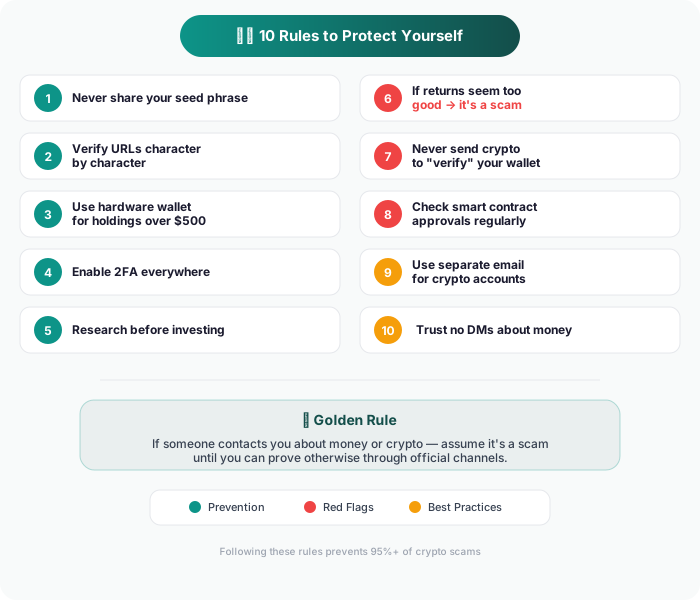
- Never share your seed phrase or private keys. No legitimate service, exchange, or support agent will ever ask for them. Write them on paper and store offline.
- Verify URLs character by character. Bookmark the official URLs of exchanges you use. Never click links from emails or messages — type the URL directly.
- If it sounds too good to be true, it is. “Guaranteed” returns above 1% per day, celebrity-endorsed platforms, and “risk-free” investments are always scams.
- Research before you deposit. Check the platform on CoinGecko, search for reviews on Reddit, and verify the domain age with a WHOIS lookup. Legitimate projects have verifiable histories.
- Use hardware wallets for significant holdings. Keep only trading amounts on exchanges. A $50-80 hardware wallet can protect thousands in crypto. See our crypto wallet guide for recommendations.
- Enable 2FA with an authenticator app. SMS-based 2FA can be intercepted via SIM swaps. Use Google Authenticator, Authy, or a hardware key for all exchange accounts.
- Be suspicious of unsolicited contact. Whether it’s a stranger on a dating app talking about crypto profits, or “customer support” DMing you on Telegram — assume it’s a scam until proven otherwise.
- Check smart contract approvals regularly. Use Revoke.cash to review and revoke token approvals you no longer need. One unlimited approval on a malicious contract can drain your entire wallet.
- Start small with any new platform. Before depositing significant amounts, test with a small withdrawal first. Scam platforms often allow small withdrawals initially to build trust.
- Report scams immediately. Report to your local authorities, the platform where you encountered the scam, and resources like the FBI IC3 (US), Action Fraud (UK), or your country’s financial regulator. Quick reporting increases recovery chances — the FBI’s recovery team had a 66% success rate freezing fraudulent funds in 2024.
I run this check monthly on my own wallets — it takes under 2 minutes and has saved me from two suspicious approvals.
What to Do If You’ve Been Scammed
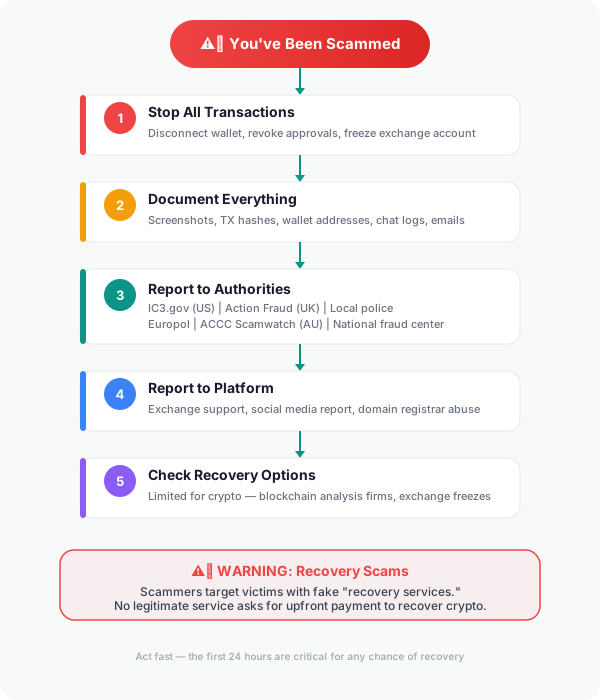
If you suspect you’ve fallen victim to a crypto scam, act immediately:
- Stop all communication with the suspected scammer. Do not send additional funds, even if they claim you need to pay “taxes” or “fees” to unlock your money.
- Secure your accounts. Change passwords and 2FA on all crypto exchanges and email accounts. If you shared your seed phrase, move all remaining funds to a new wallet immediately.
- Document everything. Save screenshots of conversations, transaction hashes, wallet addresses, website URLs, and any other evidence.
- Report to authorities. File reports with local police, your country’s cybercrime unit, and the platform where you were contacted.
- Contact your exchange. If you sent funds from a regulated exchange, they may be able to flag the receiving address or freeze funds.
- Be wary of “recovery services.” Many companies claiming to recover stolen crypto are themselves scams (double-dipping on victims). Legitimate law enforcement is your best resource.
Recovery reality: Overall crypto scam recovery rates average around 70% for North America/Europe when funds are frozen quickly, but drop below 50% in Latin America and Southeast Asia. For DeFi exploits, recovery is 60-70%. For exit scams and Ponzi collapses, recovery is effectively 0%.
FAQ
Can you get your money back from a crypto scam?
It depends on how quickly you act and the type of scam. If funds were sent through a regulated exchange, contact them immediately — the FBI’s Recovery Asset Team successfully froze $561 million in 2024. However, funds sent directly to a scammer’s personal wallet are extremely difficult to recover.
How do I know if a crypto exchange is legitimate?
Check if it’s listed on CoinGecko’s exchange list, verify the domain registration date (legitimate exchanges have years of history), look for regulatory licenses on their website, and search for user reviews on Reddit and Trustpilot. Our buying guide covers trusted options.
Are all crypto airdrops scams?
No — legitimate airdrops exist (Uniswap’s UNI airdrop in 2020 distributed $6.4 billion to users). However, legitimate airdrops never ask you to send crypto first, never require your seed phrase, and are announced on the project’s official channels. If you need to “connect your wallet” to an unfamiliar site, check the smart contract approvals carefully.
What is the biggest crypto scam in history?
The OneCoin Ponzi scheme (2014-2017) defrauded investors of an estimated $4 billion. More recently, the FTX collapse in 2022 resulted in $8 billion in customer losses. Pig butchering scams collectively generated $12.4 billion in 2024 alone.
How do AI deepfake scams work in crypto?
Scammers use AI tools to generate realistic videos of celebrities or crypto figures endorsing fake projects. In 2025, 60% of scam deposits involved AI tools, and AI-enabled scams were 4.5× more profitable. Always verify endorsements through the person’s official accounts and website.
Is it safe to invest in crypto at all?
Yes, when done through reputable exchanges with proper security measures. The scam problem is not with cryptocurrency itself but with criminals exploiting people who don’t follow basic security practices. Using proper security, a reliable wallet, and common sense makes crypto as safe as any other financial activity. Start with small amounts and learn as you go.
Continue Learning
- Cryptocurrency Security: How to Protect Your Digital Assets
- How to Choose a Crypto Wallet (2026)
- How to Buy Your First Crypto: Step-by-Step Guide
- P2P Crypto Trading Safety Guide
- What Is Cryptocurrency? Complete Beginner’s Guide
- How Blockchain Works
- What Are Stablecoins?
- Stablecoin Savings Guide: Protect Your Money from Inflation
- Crypto vs Bank Transfers: Remittance Cost Guide
- Freelancer Crypto Payment Guide
Alex has been analyzing cryptocurrencies and blockchain technology since 2019. He focuses on making complex crypto concepts accessible to beginners across emerging markets, with a particular emphasis on security and practical usage.
Disclaimer: This article is for educational purposes only and does not constitute financial advice. Cryptocurrency involves significant risk. Always do your own research and consult a qualified financial advisor before making investment decisions. Data and statistics cited in this article were accurate as of March 2026.