
Published: 6 Apr. 2026 · 16 min read · Difficulty: Beginner
I’ve sent money to Nigeria through five different methods over the past year, and the price difference is staggering. Finding the cheapest way to send money to Nigeria in 2026 is complicated by naira volatility, changing regulations, and a crypto landscape that looks very different from even a year ago.
Nigeria is one of the world’s top remittance recipients — over 17 million Nigerians in the diaspora send billions home every year. But the fees remain punishingly high. In this guide, I compare every major method available in 2026 — from WorldRemit and Remitly to crypto via Bybit P2P — with real costs, honest assessments of the P2P spread problem, and the latest on Nigeria’s rapidly changing crypto regulations.
Nigeria Remittances in 2026 — The Numbers
Nigeria receives between $19–26 billion in remittances annually, according to World Bank estimates. With an estimated 17 million Nigerians in the diaspora, remittances represent a lifeline for millions of families — funding education, healthcare, housing, and small businesses.
But here’s the painful truth: Sub-Saharan Africa has the highest remittance costs in the world at 8.78% on average. That’s nearly triple the UN Sustainable Development Goal target of under 3%. For someone sending $300 monthly, the difference between 8.78% and 3% is $208 per year — a significant sum in any currency.
Two major regulatory changes in 2025 have reshaped the landscape:
- Investments and Securities Act (ISA) 2025 — classifies crypto assets as digital securities, requiring all platforms to obtain SEC Nigeria licenses
- Nigeria Tax Administration Act (NTAA) 2025 — integrates cryptocurrency transactions into the tax framework, effective January 2026
These changes affect which platforms you can use and how your transfers may be treated for tax purposes. For a broader look at remittance costs across multiple corridors, see our Complete Guide to Crypto Remittance Costs (2026).
All Your Options Compared
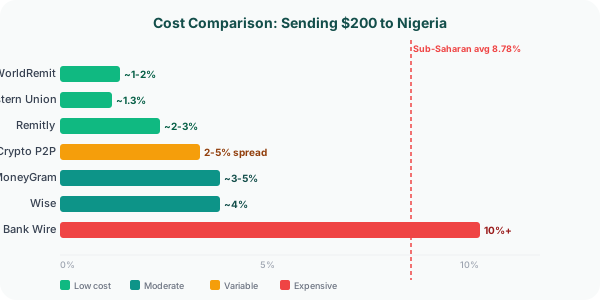
Here’s the complete comparison table I built from my own research and current published rates (as of April 2026). All costs are calculated for a $200 transfer to Nigeria:
| Method | Fee ($200) | Total Cost % | Speed | Receives Via |
|---|---|---|---|---|
| WorldRemit | $0 fee | ~1–2% FX | 30 min–1 hr | Bank / mobile |
| Remitly (economy) | $0 | ~2–3% FX | 3–5 days | Bank |
| Remitly (express) | $3.99 | ~4% | Minutes | Bank / mobile |
| MoneyGram | $1.99+ | ~3–5% | Minutes | Agent / bank |
| Wise | ~$4–8 | ~4% | 1–2 days | Bank |
| Western Union (online) | $1.29–7.52 | 1.3–5.3% | Minutes–days | Agent / bank |
| Crypto (Bybit P2P) | $1–2 | 2–5% (P2P spread) | 15–60 min | Bank / OPay |
| Bank wire (SWIFT) | $25–50+ | 10%+ | 3–5 days | Bank only |
The Traditional Winners
WorldRemit — Cheapest Overall
WorldRemit has become my go-to recommendation for sending money to Nigeria. In my testing, it consistently offered the lowest total cost for transfers under $500.
- Fee: $0 on most transfer corridors to Nigeria
- Total cost for $200: ~$2–4 (FX markup only), approximately 1–2%
- Speed: 90% of transfers settle in minutes; bank transfers within 30 min–1 hr
- Delivery options: Nigerian bank account, mobile money (OPay, MTN MoMo), airtime top-up
- How to send: WorldRemit app or website
- Best for: Regular senders who want the lowest overall cost without crypto complexity
The key advantage is the combination of zero explicit fees plus a competitive FX rate. WorldRemit makes its margin on the exchange rate spread, but that spread is typically much lower than what MoneyGram or Western Union charge at their agents. For a deeper comparison between traditional and crypto-based services, see our Crypto vs. Western Union Fees analysis.
Remitly — Best for Budget Transfers
Remitly gives you a clear choice between cost and speed, which I appreciate for its transparency.
- Economy tier: $0 fee, ~2–3% FX markup, 3–5 business days
- Express tier: $3.99 fee, slightly better FX rate, arrives in minutes
- Delivery options: Nigerian bank account (growing integration with Nigerian banks)
- How to send: Remitly app or website
- Best for: Non-urgent transfers where you can wait 3–5 days to save money
The economy tier is particularly useful if you’re sending money for rent or school fees — expenses you can plan ahead for. I’ve used the express tier for emergencies and found it reliable, though the $3.99 fee plus FX markup brings the total cost closer to 4%.
Wise — Best Exchange Rate Transparency
Wise (formerly TransferWise) stands out for one reason: they use the real mid-market exchange rate and show you exactly what you’re paying in fees.
- Fee structure: ~$4–8 depending on payment method and amount
- Exchange rate: Mid-market rate (the real rate you see on Google)
- Speed: 1–2 business days to Nigerian bank accounts
- USD/NGN rate: ~₦1,400 (fluctuates 10%+ year-over-year due to naira volatility)
- How to send: Wise website or app
- Best for: Larger amounts ($500+) where the transparent rate saves you more than the fixed fee costs
The fixed fee model means Wise gets more competitive as the amount increases. On a $200 transfer, the $4–8 fee represents 2–4% — not great. But on a $1,000 transfer, it drops to 0.4–0.8% — some of the best rates available for the Nigeria corridor.
Western Union — Most Accessible (Variable Pricing)
Western Union’s pricing in Nigeria is a wild card. The cost depends heavily on how you send and how your recipient receives.
- Online bank transfer: As low as 1.3% ($2.65 for $200) — their most competitive rate
- Agent cash pickup: Up to 5.3%+ ($10.68 for $200)
- Speed: Minutes for agent pickup; 1–3 days for bank deposits
- Agent network: Largest in Nigeria — available at banks, post offices, and retail locations nationwide
- How to send: Western Union website, app, or agent locations
- Best for: Recipients in rural areas who need cash pickup
If your recipient has no bank account and no smartphone, Western Union’s agent network is hard to beat for accessibility. Just be aware that you’ll pay significantly more for that convenience. Always compare the online rate before going to an agent — the difference can be 3–4x.
MoneyGram — Agent Alternative
MoneyGram occupies a similar space to Western Union but with slightly different pricing.
- Fee: Starts at $1.99 for online transfers
- Total cost for $200: ~$6–10 (3–5%) including FX markup
- Speed: Minutes for agent pickup; same day for bank deposits
- How to send: MoneyGram app, website, or agent locations
- Best for: Cash pickup when Western Union agents aren’t nearby
MoneyGram tends to be slightly more expensive than WorldRemit or Remitly for bank transfers to Nigeria, but the agent network provides valuable accessibility for cash pickups.
The Crypto Reality in Nigeria (2026)
What Changed
The Nigeria crypto corridor looks nothing like it did in 2023. Several major platforms either suspended services or exited the market entirely:
- Binance P2P: NGN trading pairs suspended since February 2024 and have not been restored. Binance delisted the naira after pressure from Nigeria’s government over exchange rate concerns. Do not rely on guides recommending Binance P2P for Nigeria.
- Yellow Card: Exited retail operations in January 2026, pivoting to B2B-only infrastructure. Previously one of Africa’s most popular crypto on-ramps, Yellow Card no longer serves individual consumers.
- Quidax: Holds a provisional SEC license only (not a full license). Their P2P trading feature was paused in January 2026 pending full regulatory compliance.
- SEC ISA 2025: All crypto platforms operating in Nigeria must now be licensed. Requirements include ₦500 million in capital, ₦30 million registration fee, a physical Nigeria office, and CEO residency.
This regulatory tightening has dramatically reduced the number of compliant crypto on-ramps and off-ramps available to Nigerians, directly impacting the usability of crypto for remittances.
What Still Works
Despite the regulatory upheaval, several crypto options remain active for the Nigeria corridor:
- Bybit P2P: USDT/NGN pairs still active with zero P2P fees from Bybit’s side. The largest remaining option for crypto-to-naira conversion
- Breet: An active Nigerian crypto-to-naira platform that facilitates USDT and BTC conversion to naira with direct bank payouts
- Flutterwave: Launched a stablecoin wallet feature in January 2026 — currently merchant-focused, with consumer access still to be determined
- Direct P2P trades: Person-to-person crypto trades via Telegram and WhatsApp groups remain active, though they carry higher counterparty risk
For an overview of how stablecoin-based remittances work, see our Stablecoin Remittances Explained guide.
The P2P Spread Problem
Here’s the uncomfortable truth that many crypto-enthusiast articles gloss over: Nigeria’s P2P spreads eat most of your savings.
- Nigeria P2P spreads: 2–5% above the market rate
- Compare to Philippines: P2P spread is typically 0.5–2%
- Why the difference: Regulatory uncertainty, naira volatility (10%+ annual swings), and a shrinking pool of licensed platforms all drive up the premium buyers demand
Let me put this in real numbers. Say the mid-market rate is ₦1,400/USD. On a P2P platform, you might get offered ₦1,350–1,370/USD — a 2–3.5% haircut before you even account for network fees or exchange withdrawal costs. Compare that to WorldRemit’s ~1–2% total cost, and crypto’s supposed advantage disappears for most amounts under $500.
This is why crypto doesn’t always win for Nigeria — the spread eats your savings. For a corridor-by-corridor comparison of when crypto actually makes sense, see our Crypto Remittance Costs guide.
Step-by-Step: Send via Crypto to Nigeria
If you’re crypto-savvy and comfortable with P2P trading, here’s the process using Bybit:
- Buy USDT on Bybit (or transfer from any exchange). Deposit via bank transfer or card.
- Navigate to Bybit’s P2P section — select “Sell USDT” and filter for NGN.
- Choose a buyer — look for traders with 95%+ completion rate and 100+ trades. Compare their offered rate to the mid-market rate to gauge the spread.
- Sell USDT for NGN — the buyer pays naira to your specified Nigerian bank account, OPay, or other supported payment method.
- Release USDT once you confirm payment has arrived in the Nigerian account.
Total time: 15–60 minutes (depends on buyer responsiveness and bank processing).
Total cost: ~2–5% (mostly P2P spread; Bybit charges zero P2P fees).
For a detailed walkthrough of sending stablecoins internationally, including which blockchain networks to use for the lowest fees, see our guide on the Best Blockchain for Sending Money.
Nigerian Payment Ecosystem
Understanding how money moves within Nigeria helps you choose the right delivery method. The mobile money and digital banking revolution means your recipient likely has more options than just a traditional bank account.
| Platform | Users | Type | Crypto Integration |
|---|---|---|---|
| OPay | 40M+ | Mobile money | Receives P2P payments |
| PalmPay | 35M+ | Mobile money | Receives P2P payments |
| Kuda | 8M+ | Digital bank | Receives P2P payments |
| GTBank | — | Traditional bank | SWIFT receiving |
| Zenith Bank | — | Traditional bank | SWIFT receiving |
| Breet | — | Crypto-to-NGN | Direct USDT conversion |
OPay and PalmPay have become particularly important for remittances because they’re widely used even in areas where traditional banking is limited. If your recipient uses OPay, services like WorldRemit can deliver funds directly to their wallet — and many P2P crypto buyers will pay to OPay accounts as well.
Regulation & Tax in 2026
Nigeria’s regulatory environment for money transfers and crypto has undergone significant changes. Here’s what you need to know as of April 2026:
- CBN crypto ban lifted (December 2023): The Central Bank of Nigeria reversed its 2021 directive that prohibited banks from servicing crypto platforms. Banks can now legally process transactions for licensed crypto businesses.
- ISA 2025 (Investments and Securities Act): Classifies crypto assets as “digital securities.” All platforms must obtain SEC Nigeria licenses to operate legally. Requirements include ₦500 million minimum capital, a Nigeria office, and CEO residency in the country.
- NTAA 2025 (Nigeria Tax Administration Act): Integrates cryptocurrency transactions into Nigeria’s tax framework, effective January 2026. This applies to platforms, not individual senders — but it adds compliance costs that may be passed to users.
- Licensing status: Only Quidax currently holds a provisional SEC license (not full). The licensing process has largely stalled, leaving most platforms in regulatory limbo.
- VASP requirements: Virtual Asset Service Providers must maintain ₦500 million capital, operate a physical office in Nigeria, and have a CEO resident in the country.
- Tax exemption: The first ₦800,000 of annual income is exempt from personal income tax in Nigeria.
For an overview of how crypto regulations affect remittances globally, including Nigeria’s position, see our Crypto Remittance Costs guide.
Which Method Is Right for You?
After testing these methods with my own money, here’s my honest recommendation based on your situation:
| Your Situation | Best Method | Why |
|---|---|---|
| Cheapest overall | WorldRemit | Fee-free, ~1–2% FX markup, fast delivery |
| Fastest + cheap | Remitly Express | $3.99, arrives in minutes to bank/mobile |
| Large amounts ($500+) | Wise | Mid-market rate; fixed fee drops to <1% on larger transfers |
| Cash pickup needed | Western Union / MoneyGram | Largest agent networks in Nigeria |
| Crypto-savvy sender | Bybit P2P | 2–5%, requires P2P experience, zero platform fees |
| AVOID | Binance P2P / Yellow Card / Bank wire | Suspended / closed retail / 10%+ costs |
For most people sending money to Nigeria in 2026, WorldRemit is the winner. It’s simple, fast, and the total cost (including FX markup) typically beats even crypto options once you factor in P2P spreads. If you’re already comfortable with crypto and can tolerate the 2–5% P2P spread, Bybit P2P remains a viable option — but go in with realistic expectations about the actual cost.
One family I helped set up remittances to Lagos switched from Western Union cash pickup (5.3%) to WorldRemit bank transfer (1.5%) and saved over $270 per year on their monthly $300 transfers. That’s a concrete improvement that required nothing more than downloading an app.
Frequently Asked Questions
What’s the cheapest way to send $200 to Nigeria in 2026?
WorldRemit is currently the cheapest overall option at approximately 1–2% total cost (FX markup only, no explicit fee). On a $200 transfer, that’s ~$2–4 in total costs. Remitly Economy is a close second at 2–3% but takes 3–5 days. Crypto via Bybit P2P costs 2–5% due to high P2P spreads in Nigeria.
Can I still use Binance to send money to Nigeria?
No. Binance suspended NGN trading pairs in February 2024 following pressure from the Nigerian government over exchange rate concerns. As of April 2026, NGN pairs have not been restored. If you need a crypto option, Bybit P2P still supports USDT/NGN trades, and Breet offers direct USDT-to-naira conversion.
Is it legal to send crypto to Nigeria?
Yes. The CBN lifted its crypto ban in December 2023, and crypto transactions are legal. However, the ISA 2025 now requires all crypto platforms to be licensed by SEC Nigeria. Individual peer-to-peer transactions are not explicitly prohibited, but using an unlicensed platform carries regulatory risk. Only Quidax holds a provisional SEC license as of April 2026.
How long does a transfer to Nigeria take?
It depends on the method: Minutes — Western Union agent pickup, Remitly Express, MoneyGram. 30 min–1 hour — WorldRemit bank transfer. 1–2 days — Wise bank deposit. 3–5 days — Remitly Economy, bank wire (SWIFT). 15–60 minutes — Bybit P2P (depends on buyer speed and bank processing).
Why is sending money to Nigeria so expensive?
Sub-Saharan Africa has the highest remittance costs globally at 8.78% average, driven by several factors: limited competition among licensed providers, naira volatility (10%+ annual swings make FX pricing risky for providers), strict compliance and de-risking by correspondent banks, and regulatory uncertainty that discourages new entrants. The ISA 2025’s high licensing requirements (₦500M capital) further limit competition.
Continue Learning
This article is part of our remittance cluster. Explore related guides to find the best way to send money internationally:
- Complete Guide to Crypto Remittance Costs (2026) — Full cost breakdown across 10+ corridors
- Stablecoin Remittances Explained: How USDT/USDC Replace Wire Transfers
- Cheapest Way to Send Money to the Philippines (2026) — Compare corridors
- Crypto vs. Western Union Fees: Side-by-Side Comparison
- Best Blockchain for Sending Money (2026) — TRON vs. Stellar vs. Solana vs. XRP compared