
Published: 7 Apr. 2026 · 16 min read · Difficulty: Beginner
I send money to India regularly — and after testing every option from Wise to crypto P2P, I can tell you the cheapest way to send money to India in 2026 isn’t what most crypto articles claim. India’s 30% crypto tax changes the math completely.
India is the world’s largest remittance recipient, taking in a record $135.4 billion in FY25. With 35.4 million NRIs (Non-Resident Indians) sending money home from every corner of the globe, competition among remittance services is fierce — and that’s actually great news for senders. South Asia already has the lowest average remittance costs in the world at 4.80%, and services like Wise, Instarem, and Remitly are pushing those costs even lower.
But here’s where crypto advocates get it wrong for India: the moment you convert crypto to INR, you trigger a 31.2% effective tax (30% + 4% cess) on any gain, plus a 1% TDS deduction at source. That wipes out any fee advantage blockchain transfers might offer. In this guide, I’ll walk through every method I’ve tested, with honest costs, real timelines, and clear recommendations based on your specific situation.
India — The World’s Largest Remittance Market
India’s position as the global remittance leader isn’t even close. At $135.4 billion received in FY25, India accounts for roughly 3.4% of its GDP from remittances alone. To put that in perspective, that’s more than the combined remittance inflows of Mexico, the Philippines, and Egypt.
The diaspora driving these flows is massive: an estimated 35.4 million NRIs and PIOs (Persons of Indian Origin) live and work abroad. Here’s where the money comes from:
| Source Country | Share of Remittances | Estimated Annual Flow |
|---|---|---|
| United States | 27.7% | ~$37.5B |
| UAE | 19.2% | ~$26.0B |
| United Kingdom | 10.8% | ~$14.6B |
| Saudi Arabia | ~7% | ~$9.5B |
| Singapore | 6.6% | ~$8.9B |
What makes India unique in the remittance world is that South Asia has the lowest average remittance cost of any region at 4.80%, according to the World Bank Remittance Prices Worldwide database. This is significantly lower than the Sub-Saharan Africa average (8.78%) or the global average (~6.2%). The reason? Competition and infrastructure — India’s UPI payment system has made last-mile delivery nearly free.
A recent development worth noting: in September 2025, India Post partnered with UPI and the Universal Postal Union (UPU) to create a new remittance corridor targeting costs below 6% for 190+ postal operators worldwide. This could further reduce costs for senders in smaller corridors where traditional services charge premium rates.
For a broader perspective on how India compares to other remittance corridors, see our Complete Guide to Crypto Remittance Costs (2026).
All Your Options Compared
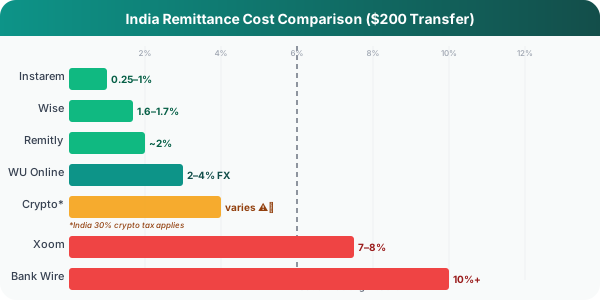
I’ve compiled every major method for sending money to India, with real costs calculated for a $200 transfer (as of April 2026, USD/INR ~₹92.86–92.99):
| Method | Fee ($200) | Total Cost % | Speed | Receives Via |
|---|---|---|---|---|
| Wise | ~$3.20–3.40 | 1.6–1.7% | 1–2 days | Bank (UPI) |
| Instarem | $0–2.50 | 0.25–1% | 1–2 days | Bank |
| Remitly (economy) | $0 | ~1–2% FX | 3–5 days | Bank / UPI |
| Remitly (express) | $3.99 | ~3% | Minutes | Bank / UPI |
| Western Union (online) | $0 (bank) | ~2–4% FX markup | 1–3 days | Bank / agent |
| MoneyGram | $1.99+ | ~3–5% | Minutes | Agent / bank |
| Xoom | $7–9 | ~7–8% | 1–3 days | UPI / bank |
| Crypto (CoinDCX P2P) | $1–2 | 1–3% + 30% tax on gains | 15–30 min | UPI / bank |
| Bank wire (SWIFT) | $25–50 | 10%+ | 3–5 days | Bank |
The Traditional Winners
Wise — Best Overall for India
After testing multiple services for the India corridor, Wise consistently delivers the lowest total cost for most transfer amounts. The reason is simple: Wise uses the real mid-market exchange rate and charges a transparent, low fee on top.
- Fee for $200: ~$3.20–3.40 (varies by payment method)
- Total cost: 1.6–1.7% — among the lowest for any India corridor
- Exchange rate: Mid-market rate (the actual rate you see on Google/Reuters)
- Speed: 1–2 business days to Indian bank accounts
- Delivery: Direct bank transfer (UPI-compatible accounts supported)
- Additional costs: ₹200 ($2.50) FIRA fee + 18% GST on the conversion margin applies on the Indian side
- How to send: Wise website or app
- Best for: Regular senders who want transparent pricing and low overall costs
The FIRA (Foreign Inward Remittance Advice) fee is worth mentioning — it’s a small charge from Indian banks for processing incoming foreign transfers. At ₹200 plus GST, it’s minimal on larger transfers but adds up on very small amounts. For a deeper look at how traditional and crypto services compare across corridors, check our remittance cost breakdown.
Instarem — Best for Fee-Conscious Senders
Instarem is a Singapore-based service that’s become increasingly popular for the India corridor, especially among senders in Southeast Asia and Australia.
- Fee: 0.25–1% of transfer amount (no fee on transfers under $500 in select corridors)
- Total cost for $200: As low as $0.50–2.00
- Exchange rate: Competitive — typically within 0.3–0.5% of mid-market
- Speed: 1–2 business days
- Delivery: Indian bank account (NEFT/IMPS)
- How to send: Instarem app or website
- Best for: Singapore→India corridor, fee-conscious senders of medium amounts ($200–$2,000)
I particularly recommend Instarem if you’re sending from Singapore, Australia, or the UK to India. Their rates for these corridors are often better than Wise. The zero-fee promotion on smaller transfers (when available) can make Instarem the absolute cheapest option for amounts under $500.
Remitly — Best for UPI Delivery
Remitly’s strength for India is its deep integration with UPI, India’s dominant payment system. Your recipient doesn’t need to share bank account details — a UPI ID is enough.
- Economy tier: $0 fee, ~1–2% FX markup, 3–5 business days
- Express tier: $3.99 fee, arrives in minutes to UPI or bank account
- First transfer: Fee waived on your first Remitly transfer
- Delivery: UPI ID, bank account, or mobile wallet
- How to send: Remitly app or website
- Best for: Quick transfers directly to a UPI ID, first-time senders (fee waiver)
The express tier is ideal for emergencies — I’ve tested it and the money reached a UPI-linked account within 10 minutes. For non-urgent transfers like monthly support, the economy tier saves you the $3.99 fee at the cost of a few days’ wait.
Western Union — Free Bank Transfers (But Watch the FX Markup)
Western Union can look deceptively cheap for India. Their online bank transfer option shows $0 in fees — but the exchange rate markup tells a different story.
- Online bank transfer fee: $0
- FX markup: 2–4% below mid-market rate (sometimes up to 7% for agent cash pickup)
- Speed: 1–3 days for bank deposits, minutes for agent pickup
- Agent network: Extensive across India — available at post offices, banks, and retail locations
- How to send: Western Union website, app, or agent locations
- Best for: Recipients in rural areas who need cash pickup at a local agent
Always compare Western Union’s effective rate (fee + FX markup combined) against Wise or Instarem before sending. On a $200 transfer, that 2–4% FX markup means you’re paying $4–8 in hidden costs despite the “$0 fee” headline. The agent cash pickup option is significantly more expensive and should only be used when the recipient has no bank account or UPI access.
Why Crypto Is NOT Cheaper for India
This is the section that sets India apart from almost every other remittance corridor. In the Philippines and Nigeria, crypto can genuinely save money on remittances. In India, the tax regime makes that nearly impossible.
The 30% Tax Problem
India’s crypto taxation is among the harshest in the world. Here’s what hits you when you convert crypto to INR:
- 30% flat tax on any gain from crypto transactions (Section 115BBH of the Income Tax Act)
- 4% health and education cess on top of the 30% — effective rate: 31.2%
- 1% TDS (Tax Deducted at Source) on every crypto sale above ₹10,000/year — deducted automatically by the exchange
- No loss offset — losses from one crypto asset cannot be used to reduce gains from another
- No deductions — except cost of acquisition, no expenses can be deducted
- Buy $200 of USDT on an exchange abroad
- Send USDT to recipient’s Indian exchange wallet (~$0.50–1.00 network fee)
- Recipient sells USDT for INR on CoinDCX P2P
- If USDT appreciated even 1% during transit: $0.62 in tax (31.2% of $2 gain)
- If USDT appreciated 5%: $3.12 in tax on top of any P2P spread
- 1% TDS is automatically deducted: $2.00 (refundable at tax filing, but locks up capital)
Total cost with even a small gain: $3–6+ for a $200 transfer. That’s 1.5–3%+ before you even count the P2P spread — worse than Wise or Instarem.
The 1% TDS is particularly painful for regular remittances. While it’s technically refundable when you file taxes, it means 1% of every transaction is locked up with the government until the next tax filing cycle. For someone receiving monthly remittances via crypto, that’s a significant cash flow drag.
When Crypto Might Still Make Sense for India
Despite the tax burden, there are narrow scenarios where crypto could work:
- If you already hold USDT/USDC — no purchase step means potentially no gain to tax (though the Indian tax authority may view it differently)
- Large amounts ($5,000+) — where Wise’s percentage fee may exceed a stablecoin P2P spread, even after tax considerations
- If the recipient wants to keep crypto — no conversion to INR means no tax event (until they eventually sell)
- Stablecoin-to-stablecoin — if the recipient plans to hold USDT/USDC without converting to INR, no taxable gain occurs
But for the vast majority of remittance use cases — where the recipient needs INR to pay rent, school fees, or medical bills — crypto is simply more expensive than traditional services in India. For a full explanation of how stablecoins work in remittances, see our Stablecoin Remittances Explained guide.
Crypto Options (If You Still Want To)
If you’ve considered the tax implications and still want to use crypto for India remittances, here are the available platforms:
CoinDCX P2P
- India’s largest crypto exchange by market share
- P2P trading fee: 0.17%
- Supports USDT/INR with UPI off-ramp
- Full KYC required (PAN + Aadhaar verification)
- Compliant with Indian regulations
Binance India
- Global platform with India operations
- Mandatory full KYC: PAN card + Aadhaar verification required for all users
- P2P available for INR pairs
- Higher liquidity than domestic exchanges
India’s Payment Ecosystem — UPI Dominance
To understand why traditional remittance services work so well for India, you need to understand UPI (Unified Payments Interface). It’s the reason India’s remittance costs are among the world’s lowest — and it’s a significant competitive moat against crypto.
| Platform | Users / Volume | Type |
|---|---|---|
| UPI (total) | 839M users, 22.64B txn/month | Payment rail |
| PhonePe | 48.3% market share | UPI app |
| Google Pay | 35% market share | UPI app |
| Paytm | 6.1% market share | UPI app |
| IMPS | Real-time (₹25K+ now charged) | Interbank |
| NEFT | ₹1 minimum, batch settlement | Interbank |
| RTGS | ₹2 lakh minimum, real-time | Large transfers |
UPI is why India’s remittance costs are among the world’s lowest — money arrives directly in the recipient’s UPI-linked bank account in seconds. When you send via Wise or Remitly, your recipient sees the money appear in their PhonePe, Google Pay, or Paytm app almost immediately after it clears. This kind of last-mile delivery infrastructure is something most countries lack, and it makes traditional rails extremely efficient for India.
The scale is remarkable: 22.64 billion transactions per month means UPI processes more digital payments than Visa and Mastercard combined in India. For remittance senders, the practical implication is that you almost never need to worry about cash pickup or agent networks — direct-to-bank or direct-to-UPI is almost always the best option.
Tax & Regulation
India’s approach to crypto regulation remains cautious, with the tax framework being the primary tool for discouraging speculative crypto activity. Here’s the current landscape as of April 2026:
- 30% flat tax on all crypto gains (no slab benefit, regardless of income level)
- 4% health and education cess — effective rate: 31.2%
- 1% TDS on every crypto transaction above ₹10,000/year
- No loss offset between different crypto assets or against other income
- Penalty for non-compliance (effective April 2026): ₹200/day + ₹50,000 for incorrect information
Beyond taxation, the broader regulatory picture:
- RBI stance: The Reserve Bank of India maintains a cautious-to-hostile position on crypto. While it can’t outright ban crypto (the Supreme Court overturned a banking ban in 2020), RBI officials have repeatedly expressed concerns about financial stability
- No comprehensive crypto law: India still has not passed a dedicated crypto regulatory framework, despite multiple announcements. The Cryptocurrency and Regulation of Official Digital Currency Bill remains delayed
- OECD CARF adoption: India has committed to implementing the Crypto-Asset Reporting Framework (CARF) from April 2027, which will enable automatic exchange of crypto transaction data with 50+ countries — making offshore wallet tracking possible
- Digital Rupee (e₹): The RBI’s CBDC pilot continues to expand but has not gained meaningful consumer adoption
For a comprehensive breakdown of crypto taxation rules and strategies across multiple jurisdictions, see our Crypto Tax Basics guide.
Which Method Is Right for You?
Based on my testing and the data above, here are my specific recommendations for different scenarios:
✓ Cheapest overall: Wise (1.6–1.7%) or Instarem (0.25–1%) — both use transparent rates and low fees. Instarem edges out Wise for transfers under $500 when the zero-fee promotion is active.
✓ Fastest delivery: Remitly express to UPI — arrives in minutes. Best for emergencies when your recipient needs money immediately.
✓ Free transfer (watch the FX): Western Union online bank transfer — $0 fee but 2–4% exchange rate markup. Do the math: 3% FX markup on $200 = $6, which is more expensive than Wise’s $3.40 explicit fee.
✓ Large amounts ($1,000+): Instarem or Wise — both become more cost-effective as amounts increase. Compare rates at the time of transfer, as the better deal shifts between them.
✓ Already holding crypto: CoinDCX P2P — if you already have USDT/USDC and the recipient is okay with KYC and the tax implications. Factor in the 30% tax on any gain + 1% TDS.
✗ AVOID: Xoom (7–8% total cost), bank wire/SWIFT (10%+), WazirX (security concerns after $230M hack).
Frequently Asked Questions
What’s the cheapest way to send $500 to India?
For $500, Instarem is typically the cheapest at 0.25–1% total cost ($1.25–$5.00), especially if their zero-fee promotion is active for your corridor. Wise comes in a close second at approximately 1.6–1.7% ($8–$8.50). Both are significantly cheaper than crypto after India’s 30% tax is factored in.
Is it cheaper to send crypto or use Wise for India?
Wise is almost always cheaper for India. At 1.6–1.7% total cost, Wise beats crypto’s combination of network fees (0.5–1%), P2P spread (1–3%), 30% tax on any gain, and 1% TDS. The only exception is if you already hold stablecoins and the recipient wants to keep them as crypto (no INR conversion = no tax event).
Do I have to pay tax on crypto received in India?
Yes. When you sell or convert crypto to INR in India, any gain is taxed at 31.2% effective rate (30% + 4% cess). A 1% TDS is also deducted at source by the exchange on every sale. Even if you receive crypto as a gift above ₹50,000, it’s taxable as income. The tax applies regardless of whether the crypto was purchased abroad or in India.
Can I send money directly to UPI from abroad?
Not directly — UPI is a domestic Indian payment rail. However, services like Remitly, Wise, and Google Pay (in select corridors) can deliver funds to UPI-linked bank accounts. The money goes to the bank account behind the UPI ID, and the recipient sees it appear in their PhonePe, Google Pay, or Paytm app instantly.
How long does an international transfer to India take?
It depends on the service: Remitly express delivers in minutes to UPI/bank. Wise and Instarem take 1–2 business days. Western Union online takes 1–3 days for bank deposits but offers minutes for agent cash pickup. Bank wire (SWIFT) is the slowest at 3–5 business days and also the most expensive.
Continue Learning
- Complete Guide to Crypto Remittance Costs (2026) — how all remittance corridors compare
- Stablecoin Remittances Explained: How USDT/USDC Replace Wire Transfers
- Cheapest Way to Send Money to the Philippines (2026) — where crypto actually saves money
- Cheapest Way to Send Money to Nigeria (2026) — navigating the P2P spread problem
- Crypto Tax Basics: What Every Holder Should Know (2026)