Crypto Order Types Explained 2026: Market vs Limit vs Stop-Loss
Table of Contents
Beginner
If you’ve placed any crypto trade before, you have enough background. We start from the bid-ask basics.
This article is educational. ChainGain has affiliate relationships with a small number of exchanges (disclosed in our affiliate disclosure). We screenshot exchange UIs to teach mechanics, not to push trades. The order-type mechanics described here are exchange-agnostic.
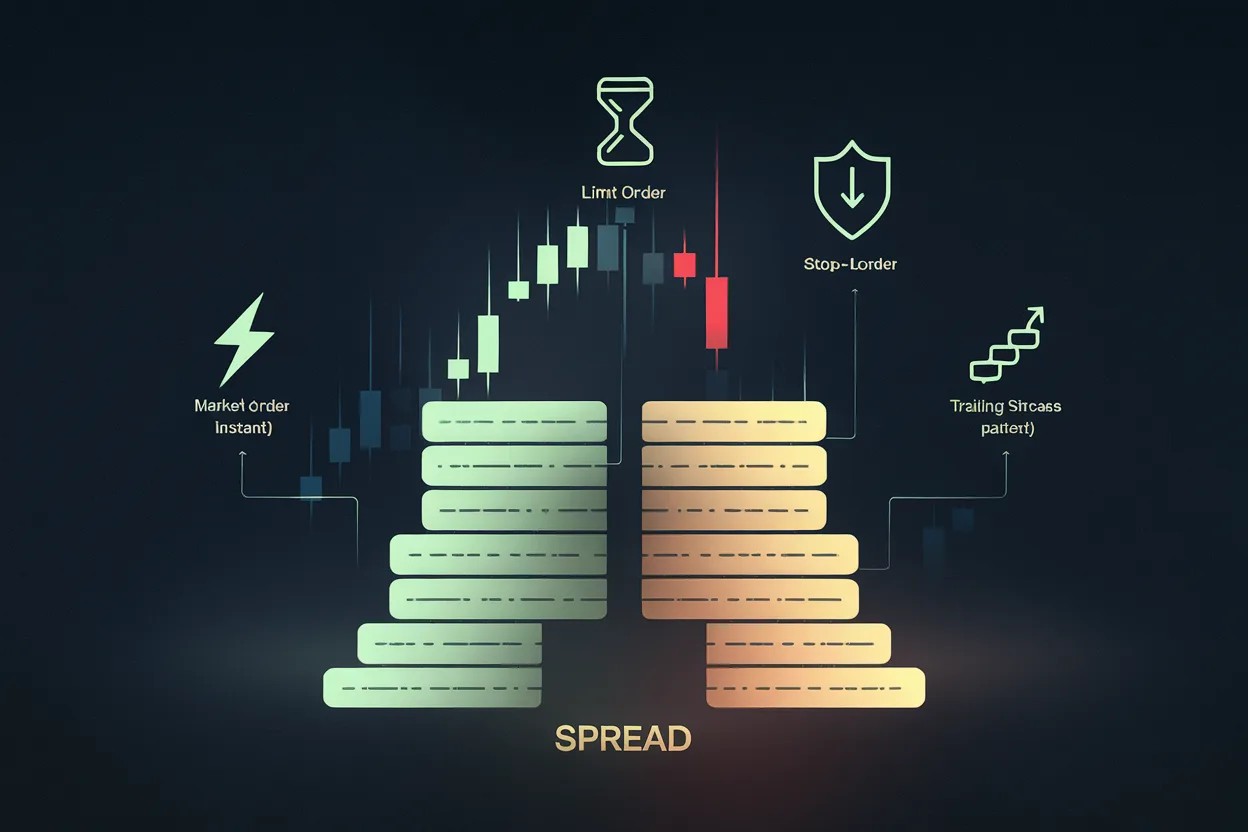
If you only ever use the green “Buy” button, you’re paying the highest fee tier on every trade and giving up almost every protective tool a real exchange UI offers.
Most “crypto order types” guides stop at four definitions and a comparison table. This one goes further: how each order type actually fills (or doesn’t), the four real-world events where stop-losses failed for everyone, the right order type for your portfolio size, and what the IRS does to your cost basis when a single market order fills in five partial pieces. By the end you’ll know exactly which buttons to press — and which to leave alone — for a position the size you actually trade.
This guide explains market, limit, stop, stop-limit, trailing-stop, and OCO order mechanics with worked examples and links to current exchange documentation.
Quick Verdict (TL;DR)
If you only read one paragraph: default to limit orders, pair every entry with a stop-loss + take-profit (OCO bracket), and never use market orders on pairs with under $10M of 24-hour volume. Stop-losses are a useful tool 95% of the time and a complete illusion the other 5% — knowing which 5% means knowing how gap-down candles, illiquid order books, and exchange downtime interact with your trigger price. Trailing stops let winners run, but only on trending markets; in a range, they get chopped to pieces. The eight order types every retail trader should recognize by 2026: market, limit, stop-market (stop-loss), stop-limit, trailing stop, OCO, take-profit, and bracket. The advanced two — TWAP and iceberg — start mattering above ~$10,000 per trade.
💡 Before you pick an exchange, compare the real all-in cost (trading, spread, funding and withdrawal) with our free Crypto Exchange Fee Calculator — no-KYC and major venues, no signup.
What Is a Crypto Order? (60-Second Primer)
An order is two things glued together: an instruction (“buy 0.1 BTC”) and a set of parameters (“…at $42,000 or better, expire end of day, taker side, post-only off”). The exchange’s matching engine takes your order and tries to pair it with someone willing to take the other side at a compatible price. That someone is reading the same order book you are.
The order book has two columns: bids (people willing to buy) on one side, asks (people willing to sell) on the other. The gap between the highest bid and the lowest ask is the spread. Every order type in this guide is just a different rule for how — and when — your instruction interacts with the bids and asks waiting for you. Once you internalize that mental model, the rest is bookkeeping.
One more piece of vocabulary: every fill is either maker (you added liquidity to the book and someone hit it) or taker (you crossed the spread and removed liquidity). Maker fees are lower or even negative; taker fees are higher. Your choice of order type is, in practice, a choice between maker and taker.
The 8 Order Types You Actually Need to Know in 2026
Before we go deep on each, here’s the cheat sheet you can save:
| Order Type | Speed | Price Control | Fill Guarantee | Best For | Hidden Risk |
|---|---|---|---|---|---|
| Market | Instant | None | Yes (at any price) | Cutting losses fast on liquid pairs | Slippage on thin books |
| Limit | Patient | Full | No (may never fill) | Default entry tool, fee optimization | Missed runs if price gaps through |
| Stop-Market (Stop-Loss) | Triggered | None after trigger | Yes (at any price) | Risk control on trending positions | Fills well below trigger on gaps |
| Stop-Limit | Triggered | Full after trigger | No (may not fill) | Avoiding flash-crash bad fills | Total miss in fast markets |
| Trailing Stop | Triggered | None at trigger | Yes | Letting winners run in trends | Premature trigger in a range |
| OCO (One-Cancels-Other) | Triggered | Mixed | Yes | Bracketing exits without monitoring | Exchange-side outage breaks the pair |
| Take-Profit (TP) | Triggered | Full or none | No | Locking gains at a target | Same flash-up missed-fill issue as stop-limit |
| Bracket (Entry + TP + SL) | Multi-stage | Mixed | Yes (one of the legs) | One-and-done trade plans | Complex; one bad parameter ruins the trade |
We’ll cover advanced types — TWAP and iceberg — in their own section because they only matter above ~$10,000 per trade.
Market Orders — Speed at Any Cost
A market order says: “I don’t care about the price — get me filled, now.” The matching engine walks down the order book and fills you against the best available asks (if you’re buying) until your size is exhausted. On a deep pair like BTC/USDT, a $1,000 market buy hits the top of the book and you’re done in under 50 milliseconds. On a thin altcoin pair, the same $1,000 might walk through five different price levels and arrive at an average fill price 2-3% worse than the best ask you saw on the screen.
The single most useful rule for beginners: only use market orders on pairs with at least $10 million of 24-hour spot volume on the exchange you’re using. Below that, the spread widens and you become the slippage. (Volume on CoinGecko or the exchange’s own ticker is the easiest sanity check.)
Where market orders win:
- Cutting a losing position fast on a liquid pair. If you decide to exit, the cost of an extra few basis points of slippage is much smaller than the cost of fumbling with a limit order during a real selloff.
- Capturing a breakout where you’d rather pay a small premium than miss the move entirely.
- Initial position sizing on majors when you’re below ~$2,000 and the spread doesn’t matter.
Where market orders lose: thin altcoins, weekend dumps, and any pair where the spread is wider than the maker rebate. On Margex, the taker fee for spot is around 0.06%; on Bybit it’s 0.10%; on Coinbase Advanced Trade the entry tier sits at 0.40%. That’s a 6.7× difference — a single misplaced market order on Coinbase costs as much as six on Margex.
Limit Orders — Your Default Order Type
A limit order says: “I’ll buy at $42,000 or better — and not a cent worse.” The order sits on the book until either (a) the market reaches your price and someone takes it, or (b) you cancel it, or (c) it expires according to its time-in-force flag. If the market never touches your price, you simply don’t get filled.
Two things every beginner under-uses about limit orders:
1. The Post-Only flag. If your limit order would cross the spread and immediately fill as a taker, Post-Only cancels the order instead. This guarantees you stay on the maker side, which means you pay the lower fee (or earn a rebate on some venues). On Bybit, Coinbase Advanced, and Margex, Post-Only is a one-checkbox setting — and over a few months of trading, it routinely saves more than the cost of a hardware wallet.
2. Laddering. Instead of one $5,000 buy at $42,000, post five $1,000 buys at $42,200, $42,000, $41,800, $41,600, and $41,400. If price wicks down 1%, you fill the bottom three and skip the two worst prices; if it never dips, you only buy a fifth of your intended size. The cost of laddering is mental overhead; the benefit is a better average entry on volatile coins. I now ladder every entry above ~$2,000.
Limit orders also pair beautifully with yield-bearing parking spots: when an entry doesn’t fill, the cash sits in a stablecoin or money-market position earning yield instead of rotting in your spot wallet.
Stop-Loss Orders — The Tool Everyone Misuses
“Stop-loss” is the umbrella term, but most exchanges actually offer two flavors: stop-market (officially “stop-loss” on most UIs) and stop-limit. Both have a trigger price that wakes the order up. After the trigger, stop-market fires a market order; stop-limit fires a limit order at a price you also pre-specify.
The most common misconception, by far, is treating the trigger price as the fill price. It’s not. The trigger price is when the order goes live; the fill price depends on the order book at that exact moment. In normal conditions, the two are within a few basis points. In a flash crash, they can differ by 30% or more. This is the single most important sentence in this guide.

When Stop-Losses Fail (Four Real Events)
I’m spending real screen space on this because no other “order types explained” guide does. Stop-losses fail in four specific market conditions, and each one has a public crisis you can study:
- Gap-down candles. Crypto trades 24/7, but liquidity isn’t 24/7 — it concentrates around US/Asia overlap and thins out on weekends. When real news drops during low-liquidity hours, the order book empties and price gaps through your trigger. Black Thursday, March 12, 2020: BTC fell roughly 50% in 24 hours, from about $8,000 to about $3,800. Many stops on Bitfinex, BitMEX, and other major venues filled 20-40% below their trigger price because there were no bids in the book at the trigger level.
- Illiquid pairs. Even on a “normal” day, a thin altcoin can have a 1-2% spread between top bid and top ask. If your stop trigger sits anywhere in that spread, you’re getting the bottom of the book. Terra/UST collapse, May 9-13, 2022: LUNA fell from roughly $60 to a final low of ~$0.0003 — a 99.9995% wipeout. Holders with stops at $50 and $40 watched fills come in at $30, $15, then nothing as exchanges suspended trading.
- Exchange downtime or insolvency. A stop-loss is a server-side instruction. If the exchange’s matching engine, withdrawals, or the entire exchange goes offline, your stop is meaningless. FTX, November 8-11, 2022: Binance announced a tentative letter of intent to acquire FTX on November 8; FTX began halting withdrawals on November 10; the exchange filed for Chapter 11 bankruptcy on November 11. Customer funds — and their open stop-loss orders — were trapped on the platform.
- Trading throttling during incidents. Even when an exchange stays solvent, security incidents can throttle order processing. Bybit, February 21, 2026: the exchange disclosed a $1.46-1.5 billion theft of staked ETH and related assets. Withdrawals were paused for roughly 1.5 hours during the immediate response, and many conditional orders queued during that window did not behave as expected.
The takeaway isn’t “stop-losses are useless” — they protect you 95% of the time. The takeaway is: treat your stop-loss as insurance against ordinary moves, not exchange-level catastrophes. The defenses against the latter are size limits per exchange, hardware-wallet self-custody for non-trading capital, and (where appropriate) using non-custodial DeFi venues for assets you don’t actively trade.
Stop-Limit Orders — When “No Fill” Beats “Bad Fill”
Stop-limit orders solve the gap-down fill problem at the cost of solving it too well. You set two prices: a trigger and a limit. When the market touches the trigger, the order goes live as a limit order at the limit price. If the market is already below your limit price (because price gapped through), nothing fills.
This is the right answer when you want to protect against fat-finger flash crashes. It is the wrong answer when you actually need an emergency exit. In the LUNA collapse, traders with stop-limits set at $50/$48 watched the price drop straight through both legs without any fill, because there were no $48 bids in the book.
Rule of thumb: use stop-market for emergency exits, stop-limit for fee-sensitive risk control on calm pairs. Coinbase Advanced Trade calls these “Take Profit / Stop Loss” orders and lets you place both at the same time as your main order — a small UI feature, but it saves a real step.
Trailing Stops — Letting Winners Run
A trailing stop ratchets your stop price upward as the position moves in your favor, then triggers when the price reverses by a set amount. You can specify the trail in dollars (or quote currency) or as a percentage. Margex and Bybit both support percentage-based trails on perpetual futures (contracts that never expire, unlike monthly or quarterly options); Margex offers it on spot for most listed pairs as well.
Trailing stops are powerful in trending markets and miserable in chop. If BTC ranges between $42,000 and $44,000 for two weeks, a 3% trailing stop will get triggered on every retracement and you’ll re-enter higher every time. The fix is to size your trail against volatility, not against your dollar P&L. A common heuristic is to use roughly 1.5× the asset’s 14-day Average True Range (ATR) as your trail width, which keeps you in the trade through normal noise but exits on a meaningful break.
Trailing stops also interact poorly with leverage on perpetual futures: if your trail width is smaller than the typical liquidation buffer, a single bad wick can blow out the position before the trail even has a chance to ratchet. Set your stop wider than the typical wick on the asset’s 1-hour chart.
OCO, Brackets, and TP Orders — The Pro Toolkit
An OCO (One-Cancels-the-Other) order is a pair: a take-profit limit order above the market, and a stop-loss order below. Whichever fills first, the other is automatically cancelled. This is the standard way to walk away from a screen with both sides of your trade pre-defined.
A bracket order takes this one step further by combining the entry, the take-profit, and the stop-loss into a single ticket. You define all three prices at submission time. When the entry fills, the TP and SL are placed automatically; when one of those fills, the other cancels. Coinbase Advanced Trade implements this as the “Bracket” preset; Bybit calls it “TP/SL with main order”; Margex bundles it under “Conditional Orders.”
The pro pattern that compounds well over time: place every entry as a bracket with a 2-3:1 reward-to-risk ratio. A losing trade caps at 1R; a winner pays 2-3R; you can be wrong more often than right and still grow the account. The order ticket enforces the discipline you’d otherwise abandon mid-trade.
The break-even math here matters: at a 2:1 reward-to-risk ratio you need to win only 34% of trades to break even; at 3:1 you need just 25%. The position-sizing rule that makes this real: if you’re willing to risk $100 on a trade and your stop-loss is 5% below entry, your maximum position size is $2,000 (because $2,000 × 5% = $100 risk). Size always flows from the stop, never the other way around.
Time-in-Force Flags Every Trader Confuses
Every order has a hidden parameter that controls its lifetime. Most retail traders ignore this and accept the exchange default. The default is usually fine — until it isn’t.
| Flag | What it does | Best use case | Watch out for |
|---|---|---|---|
| GTC (Good Till Canceled) | Stays on the book until filled or you cancel | Limit orders you want to leave running | Forgetting they exist after market regime changes |
| IOC (Immediate or Cancel) | Fills what it can immediately, cancels the rest | Aggressive entries on partially filled books | Partial fills you didn’t want |
| FOK (Fill or Kill) | Fills the entire order immediately or cancels everything | Block-size entries where partial isn’t useful | Frequent rejects on illiquid pairs |
| Day | Expires at session end | Carry-over from traditional finance | “Day” in 24/7 crypto = 24h or exchange daily reset; venue-specific |
| Post-Only | Cancels if order would take liquidity | Maker-fee optimization on every limit | Misses fast moves entirely |
| Reduce-Only | Can only reduce an existing position, not flip it | Margin/futures risk control | Spot-only traders won’t see this flag |
The most common beginner mistake is leaving GTC limits running across regime changes. A buy limit at $35,000 from a calm market becomes a free option you’ve handed to whoever’s selling during the next crash. Sweep your open orders weekly.
Advanced: TWAP and Iceberg Orders for $10k+ Holdings
Above ~$10,000 per trade, the order book starts pushing back. Drop a $50,000 market buy on a mid-cap altcoin and you’ll move the price 1-2% just by entering. The two professional tools for this are TWAP and iceberg orders.
TWAP (Time-Weighted Average Price) slices your total size into equal pieces and feeds them into the market at fixed intervals over a duration you specify (often 30 minutes to several hours). Coinbase Advanced Trade exposes TWAP as a top-level order type; Bybit offers it on its institutional-grade pro UI. The benefit is a fill price close to the time-weighted average over your window, with much less market impact than a single block trade.
Iceberg orders hide most of your size from the public order book. You specify a total quantity and a visible “tip” (e.g., total 100 ETH, visible 5 ETH). The book shows only 5 ETH; when that fills, another 5 ETH is automatically posted. Bybit and OKX offer iceberg orders on their pro tier; Binance exposes them via API. Margex does not currently advertise iceberg as a standard feature, so don’t plan around it on that venue.
For most retail readers, iceberg and TWAP are the equivalent of a feature you rarely use but want to know exists. The threshold to start mattering is when your single trade size exceeds ~5% of the typical 1-hour candle volume on the pair you’re trading.
Which Order Type Should You Use? (Holding-Size Decision Flow)
The right order type depends almost entirely on how big your trade is relative to the order book.
| Tier | Trade Size | Default Entry | Default Exit | Optional Tools |
|---|---|---|---|---|
| Tier 1 | $100-1,000 | Market on majors only | Manual or single stop-loss | Skip everything else; learn the basics first |
| Tier 2 | $1,000-10,000 | Limit (Post-Only) | OCO bracket: TP + stop-market | Trailing stop on trending winners |
| Tier 3 | $10,000-100,000 | Laddered limits (3-5 levels) | Stop-limit (avoids bad fills; accepts no-fill risk in extreme crashes) | TWAP for entries, Reduce-Only on margin |
| Tier 4 | $100,000+ | TWAP + iceberg | Manual exit ladder | Multi-exchange split, OTC for very large size |

The pattern across tiers: as size grows, you trade execution speed for price control, and you accept smaller slippage in exchange for more order management overhead. A $300 trader who copies the Tier 4 playbook will spend more time managing TWAPs than they earn in P&L.
Order Types and Your Tax Bill (Per-Fill Cost Basis)
The mechanics below use US Internal Revenue Service (IRS) rules as the worked example because they are the most documented; the multi-fill cost-basis principle applies in most countries with capital-gains taxation. For country-specific rules across 20+ jurisdictions, see our crypto tax basics guide.
This is the section nobody talks about. Each partial fill of an order is a separate lot for tax purposes. A single market order for 1 BTC that fills in five pieces at five slightly different prices generates five separate cost-basis lots. When you later sell, the IRS expects you to identify which lot you’re selling from — FIFO (first in, first out), LIFO, HIFO (highest in, first out), or specific identification.
For active traders, this matters in two ways:
- Form 8949 short-term gains. If you hold each lot under one year, every fill is short-term and taxed at ordinary income rates in the US. The selection method (FIFO vs HIFO) can swing your bill meaningfully across many trades.
- Wash sale status. Crypto is currently exempt from the §1091 wash sale rule because the IRS classifies digital assets as property, not securities. This means you can sell at a loss and rebuy immediately to harvest the loss — a strategy not available to stock traders. Caveat: legislative proposals (the Build Back Better Act in 2021, the Lummis-Gillibrand framework in 2024) have repeatedly attempted to extend §1091 to crypto. The exemption may not last forever; track tax bills annually.
For the practical mechanics of using AI tools to keep up with multi-fill cost basis, see our companion guide on AI crypto tax tools and where they fail. For the tax basics across major jurisdictions, our crypto tax basics guide covers 20+ countries.
Order Types When Bots Are Doing the Trading
If you’re running automation — your own scripts or a third-party platform — order types map directly to bot strategies. The pairing matters because the wrong order type for a strategy guarantees suboptimal fills:
- Grid bots (e.g., 3Commas, Pionex, Bybit’s native grid) place laddered limit orders at fixed price intervals. Limits only — using market orders inside a grid would obliterate the grid’s edge by paying taker fees on every flip.
- DCA (dollar-cost-averaging) bots use scheduled market orders at fixed time intervals. The bot trades execution simplicity for slippage; this is acceptable because DCA is by design indifferent to short-term price.
- ML/predictive bots typically use Post-Only limits with IOC fall-backs. The bot wants the maker rebate but not at the cost of missing the trade if the prediction was time-sensitive.
For the broader honest take on retail crypto trading bots — what works, what doesn’t, and the 5 risks nobody mentions — see our AI crypto trading bots guide. The order-type knowledge in this article is the substrate every bot strategy is built on.
Reading the Chart Before You Place the Order
The order type is the last decision. Before you choose between a market or a limit, you should know where price is in its trend, where the recent support and resistance sit, and whether volume is confirming the move. Our technical analysis guide covers the chart-reading basics that turn an order ticket from a button into a plan.
Frequently Asked Questions
1. Why did my stop-loss fill 8% below my trigger price?
Almost certainly a gap-down candle on a thin order book. Your trigger price woke the order up; the order then became a market order; the matching engine walked down the book through whatever bids existed and gave you the average fill price. If the spread between bids was wide — common in low-liquidity hours, on small altcoins, or during news shocks — the fill came in well below the trigger. The fix isn’t a tighter stop; it’s either a stop-limit (with the trade-off of potentially not filling at all) or sizing positions so the worst-case fill is still survivable.
2. Should I use market orders if I’m new to crypto?
Only on the most liquid pairs (BTC and ETH against USD/USDT) and only for cuts you’ve already decided you need to make immediately. For entries, default to limit orders with the Post-Only flag turned on. The fee savings alone — typically 0.02-0.40% per trade depending on venue — pay for any premium feature subscription you might consider. Beginners who default to market orders on altcoins typically donate 1-3% per round-trip to slippage and taker fees combined.
3. What happens to my open orders if the exchange goes down?
Open limit and stop orders sit on the exchange’s matching engine, not your computer. If the exchange’s order-processing systems are offline, your orders neither execute nor expire — they freeze. When the exchange comes back, behavior varies: some venues cancel all open conditional orders on restart, others honor the original instructions. Worst case is the FTX scenario, where the exchange’s bankruptcy made all open orders effectively worthless. The structural defense is to keep only your active trading capital on any single exchange and to self-custody the rest in a hardware or multi-sig wallet.
4. Can I trail-stop with a percentage instead of a dollar amount?
Yes, on most major venues. Margex supports percentage-based trailing stops on spot and futures; Bybit and BloFin support them on derivatives. The percentage version is generally better for crypto because dollar amounts don’t scale with volatility — a $200 trail that’s perfect for $40,000 BTC becomes way too tight at $80,000 and way too loose at $20,000. Volatility-adjusted trails (1.5-2× the 14-day ATR) outperform fixed dollar trails across most market regimes.
5. Are crypto stop-loss losses tax-deductible if they fail?
Yes — a realized loss from a stop-loss order that filled is just a regular capital loss for tax purposes, no different from any other sale. The fill price (not the trigger price) is what determines the loss. Where it gets interesting: because crypto is currently exempt from the §1091 wash sale rule, you can immediately rebuy the same asset after the stop fills and still claim the loss against other gains — a strategy not available to stock traders. Track wash-sale legislation (Lummis-Gillibrand 2024 and similar) annually; this exemption may not last.
The Bottom Line — Your 3-Step Starting Checklist
If you remember three things from this article:
- Default to limit orders. Use Post-Only, ladder anything above $2,000, and only fall back to market orders for fast emergency exits on liquid pairs.
- Pair every entry with an OCO bracket. A take-profit limit on one side, a stop-market on the other. Whichever fills first cancels the other. This single discipline saves more accounts than every charting indicator combined.
- Size your stop-loss against volatility, not dollars. Use 1.5-2× the asset’s 14-day ATR as your stop distance, scale your position size to keep the dollar risk constant, and accept that 5% of the time gap-downs will make your stop irrelevant — that’s what position sizing per exchange and self-custody for the rest of your stack are for.
That’s it. Eight order types, four real failure modes, and a tax angle most “guides” skip. Stop pressing the green Buy button blind — you’re better than that, and your fees and slippage will tell the story over the next year.

Editorial pen name · ChainGain
Alex Mercer is the editorial pen name used for ChainGain’s cryptocurrency education content. Articles are based on cited sources and reproducible comparisons. Editorial profile