How to Send Money to Brazil Using Crypto (PIX + USDT) 2026

Editorial pen name · ChainGain
Alex Mercer is the editorial pen name used for ChainGain’s cryptocurrency education content. Articles are based on cited sources and reproducible comparisons. Editorial profile
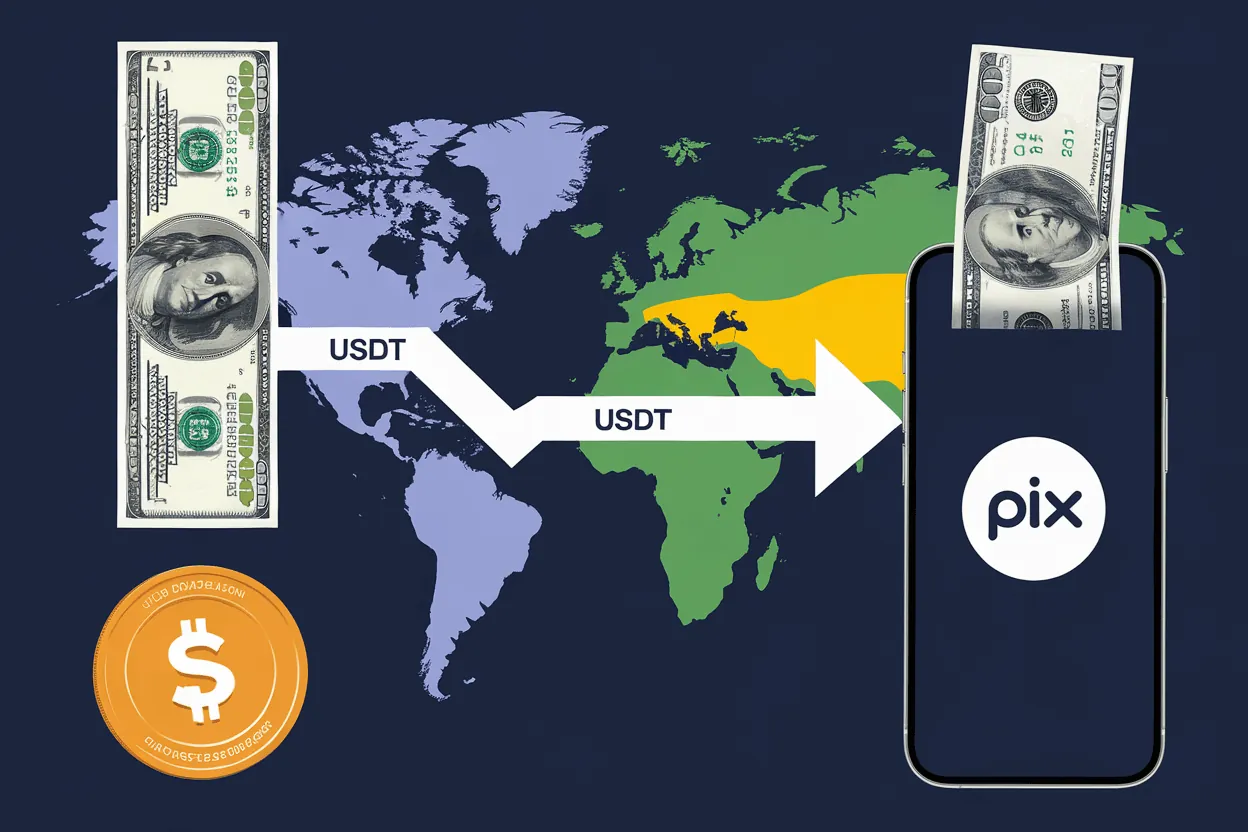
The cheapest way to send money to Brazil with crypto in 2026 isn’t theoretical anymore: with PIX handling 174 million users and 82% of Brazilian adults, combined with a stablecoin ecosystem that now accounts for roughly 90% of all Brazilian crypto volume, the infrastructure is finally mature.
Brazil is the world’s 5th largest crypto market by adoption (Chainalysis 2025 Global Adoption Index), receiving $318.8 billion in on-chain value in 2024-2025. It is also one of the most expensive corridors in the G20 for traditional remittances, with the World Bank measuring the average cost of receiving money in Brazil at 4.67% in Q1 2025 — the second-most expensive among G20 destinations. In this guide, I compare eight methods for sending money to Brazil, from Wise and Remitly to Mercado Bitcoin and Binance P2P, with real fees, real timings, and a step-by-step walkthrough for the crypto + PIX route. I’ll also cover the major 2026 tax overhaul (the old R$35,000 monthly exemption is gone) that every Brazilian crypto user now needs to understand.
Key Takeaways
- Cheapest method 2026: USDT (BEP-20) to Mercado Bitcoin to PIX — about 0.9% all-in, 10-20 min, delivered to any PIX key.
- Why PIX changes everything: PIX reaches 174M users (82% of Brazilian adults) and settles in about 3 seconds — the off-ramp bottleneck seen in other corridors is gone.
- Cost ranking for $1,000: Crypto+PIX about 0.9% beats Wise 0.9-1.5% and Foxbit 1.0-1.3%, all far cheaper than Remitly 2.5-3.5% and MoneyGram 3.5-5%.
- Crypto wins decisively for: $200+ transfers to any recipient with a PIX key (nearly everyone) — saves 2-4% versus Remitly and MoneyGram.
- Wise still competitive for: Senders who want a regulated single-app flow without touching crypto — cost is close (about 0.9-1.5%) for bank delivery.
- Three hidden costs to check: P2P spread (1.0-1.5% on Binance), exchange withdrawal fees, and wrong-network risk (BEP-20 vs TRC-20 mistake means permanent loss).
- Decision by priority: Cheapest = USDT BEP-20 to Mercado Bitcoin to PIX (about 0.9%); simplest non-crypto = Wise; avoid Remitly and MoneyGram for $200+ (2.5-5%).
For an all-in cost comparison across eight remittance corridors (crypto vs banks, at $200 and $1,000), see ChainGain’s Remittance Cost Report 2026.
Brazilian Remittances in 2026 — The Numbers
Before comparing services, let’s ground ourselves in the actual size of the Brazilian payments market and why fees matter so much here.
- PIX transactions: 6.3–6.5 billion per month (Q1 2025, Banco Central do Brasil), BRL 35.3 trillion in value (2025, +34% YoY)
- PIX users: 174 million — roughly 82% of Brazilian adults
- PIX settlement speed: 3 seconds, guaranteed, 24/7 (not 10 as sometimes quoted)
- PIX cost for individuals: Free — no fee, no exceptions
- Inbound remittances to Brazil: ~US$4.5 billion annually (2024-2025 projection, Banco Central balance of payments)
- Brazil in global crypto adoption: Rank #5 in Chainalysis 2025 Global Adoption Index, with $318.8B received on-chain (+109.9% YoY)
- Stablecoin share of Brazilian crypto volume: ~90% (Gabriel Galipolo, BCB President, 2025) — the highest concentration in any major economy
- World Bank average cost of receiving in Brazil: 4.67% (World Bank Remittance Prices Q1 2025) — 2nd most expensive G20 corridor
For someone sending US$500 per month to family in Brazil, the difference between a 4.67% average cost and a 1% crypto route is US$220 per year — enough to cover several weeks of groceries in Recife or a month of utilities in Curitiba. For a deeper breakdown of cross-border costs across 20 corridors, see our Complete Guide to Crypto Remittance Costs (2026).
All Your Options Compared
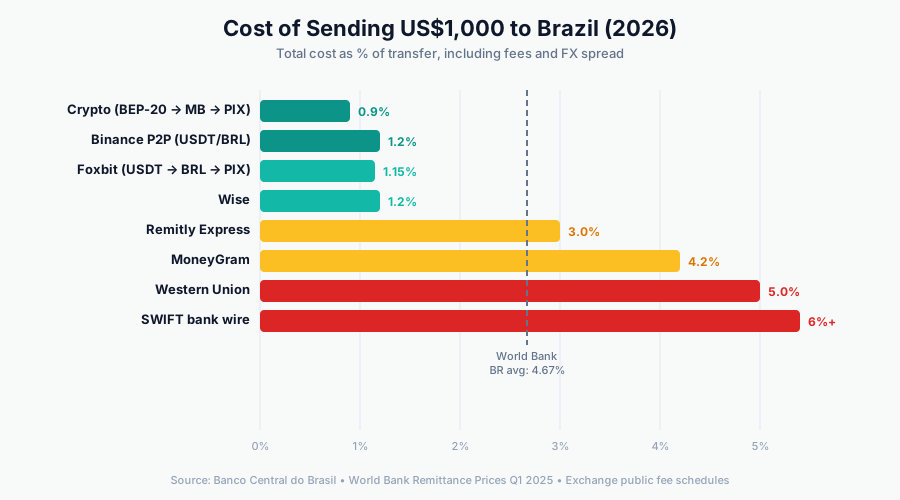
Here’s a like-for-like comparison of sending US$1,000 from the United States to a recipient in Brazil with a bank account and a PIX key. Costs include transfer fee plus the effective FX spread versus the mid-market USD/BRL rate. All figures are typical as of Q1 2026 and will vary slightly by day.
| Method | Total Cost | Speed | Delivery |
|---|---|---|---|
| Crypto (USDT BEP-20 → Mercado Bitcoin → PIX) | ~0.9% | 10–20 min | PIX key / bank |
| Binance P2P (USDT/BRL) | ~1.0–1.5% | 15–30 min | PIX key / bank |
| Wise | ~0.9–1.5% | Same day – 1 day | Bank / PIX |
| Foxbit (USDT → BRL → PIX) | ~1.0–1.3% | 10–20 min | PIX key |
| Remitly (Express) | ~2.5–3.5% | Minutes | Bank |
| MoneyGram | ~3.5–5% | Minutes | Bank / agent |
| Western Union | ~4–6% | Minutes – hours | Bank / cash pickup |
| SWIFT bank wire | 6%+ | 2–5 days | Bank |
What this table tells you: crypto via a regulated Brazilian exchange (Mercado Bitcoin, Foxbit, NovaDAX) is now comparable to Wise on a $1,000 transfer — and frequently beats it as the amount grows, because crypto network fees are roughly fixed while Wise’s 0.57% fee scales linearly. The traditional options (Remitly, MoneyGram, Western Union, SWIFT) are all multiples more expensive, largely because they monetise the FX spread rather than charging a transparent fee.
The Traditional Winners
Not everyone wants to touch crypto, and that’s fine. Among fiat-only services, here’s what actually works for Brazil in 2026.
Wise — The Benchmark for Transparency
Wise (formerly TransferWise) is my benchmark when comparing any remittance method, because they publish the mid-market exchange rate and charge a clearly broken-out fee on top. For Brazil specifically, Wise delivers directly to Brazilian bank accounts and can settle via PIX for eligible institutions.
- Fee structure: Transparent fee (~0.57% for USD→BRL on larger amounts) plus mid-market rate
- Total cost on US$1,000: ~US$9–15 (~0.9–1.5%)
- Speed: Same day for most US→BR transfers, up to 1 business day for first-time users
- Delivery: Brazilian bank account — Itaú, Bradesco, Santander, Nubank, Banco do Brasil, Caixa and most others supported
- Best for: Users who don’t want to touch crypto but still care about transparent pricing
One thing to watch since July 17, 2025: Brazil’s IOF tax on certain USD-denominated inbound operations was raised, pushing the effective cost of some non-remittance categories to 3.5%. Personal remittances are typically classified differently and still benefit from lower IOF rates, but it’s worth reading your Wise receipt carefully to confirm the exact IOF line.
Remitly — Easy, With a Promo Caveat
Remitly is the most popular app-based option for US-to-Brazil transfers among first-time senders. Their interface is clean, delivery is fast, and first-transfer promotions often let you send your debut payment with essentially no fee.
- Economy tier: Low/zero transfer fee, 1–2 business day delivery, FX markup ~1.5–2.5%
- Express tier: ~US$3.99 fee, delivery in minutes to a Brazilian bank account, total cost ~2.5–3.5%
- First transfer promo: New users often see a near-zero fee and a tighter FX spread — use it, but do not assume this is the long-term rate
- Delivery: Bank deposit to all major Brazilian banks; some digital banks settle via PIX on the receiving end
Remitly’s honest role in a Brazil corridor is the first-transfer bonus. On your second or third transfer, Wise almost always beats it on total cost. If you are sending money once or twice to open a new relationship, use Remitly’s promo; if you send monthly, graduate to Wise or crypto.
MoneyGram — Shrinking Advantage
MoneyGram is the survivor of the traditional money-transfer generation, and they’ve integrated with USDC on the Stellar network globally — making them technically a crypto-backed option even for users who never touch a wallet. For Brazil, however, the delivered cost is still in the 3.5–5% range for typical consumer amounts.
- Total cost on US$1,000: ~US$35–50 (3.5–5%)
- Speed: Minutes for debit-card funded transfers to Brazilian bank accounts
- Delivery: Bank deposit and agent cash pickup across Brazil
- Unique feature: USDC/Stellar rails under the hood (via partners) — the user experience is fiat-only
I only recommend MoneyGram if your recipient specifically needs cash pickup or does not have a Brazilian bank account. For anyone with Nubank, Itaú, or any PIX-enabled account, Wise or crypto is cheaper.
Western Union — Most Expensive, Most Accessible
Western Union remains the default for users with zero digital comfort, and its agent network across Brazil is unmatched. But the price is harsh: 4–6% total cost on typical consumer amounts, hidden mostly in the FX markup rather than a visible fee.
- Speed: Minutes for cash pickup, same day to hours for bank deposit
- Cost: 4–6% on typical amounts, higher on smaller ones
- Delivery: Cash pickup at thousands of WU agents, bank deposit to major Brazilian banks
- Best for: Emergencies, recipients without bank accounts, rural areas without reliable internet
For a deeper comparison of Western Union against crypto on multiple corridors, see our Crypto vs. Western Union Fees breakdown.
The Crypto Option — Why PIX + USDT Wins
This is where Brazil is genuinely ahead of most of the world. Because PIX is free, instant, and used by 82% of adults, and because Brazilian exchanges are now fully regulated by the Banco Central do Brasil (BCB) under Lei 14.478/2022, the path from USDT on your exchange to BRL on your recipient’s PIX key is shorter and smoother than in almost any other major market. Roughly 90% of all Brazilian crypto volume is stablecoin, which is both a cause and a consequence of this maturity.
Mercado Bitcoin — The Default for BRL Liquidity
Mercado Bitcoin is Brazil’s oldest and largest crypto exchange, founded in 2013, with 5.7% of the Brazilian USDT market share as of April 2025 and deep BRL/USDT order books.
- Trading fees: 0.30% maker / 0.70% taker (base) — VIP tiers lower this further with volume
- BRL/USDT pair: Yes, with consistent spread under 0.3% in normal conditions
- PIX deposit: Free, instant — the recipient can fund the exchange with PIX in seconds
- PIX withdrawal: Free for Brazilian residents, settlement in seconds 24/7
- Regulation: Registered as a VASP with the BCB under Lei 14.478/2022
- Supports: BRL/USDT, BRL/USDC, BRL/BTC, BRL/ETH and 200+ other pairs
Mercado Bitcoin is my default for anyone sending to Brazil for the first time, because it’s the most recognised name and PIX withdrawals go through without drama. For larger, repeat users, Foxbit sometimes edges it on fees.
For the fundamentals of stablecoins in remittances, check out our Stablecoin Remittances Explained guide.
Foxbit — Lower Taker, Free Withdrawals
Foxbit is one of the older Brazilian exchanges and has aggressively courted retail remittance users with lower fees and a clean mobile app.
- Trading fees: 0.25% (limit / maker) / 0.50% (market / taker)
- BRL/USDT pair: Yes
- PIX deposit & withdrawal: Free — no hidden withdrawal fee on BRL
- Regulation: Registered VASP under BCB framework
- Best for: Repeat senders who want the lowest all-in cost and whose recipients are comfortable with a less famous brand
The trade-off: Foxbit has a smaller active order book than Mercado Bitcoin for USDT/BRL, so on larger amounts you may see slightly wider effective spreads. For amounts under US$5,000 this is usually negligible.
Binance P2P — Best for Large Amounts
Binance P2P is the heavyweight option for larger transfers. Instead of selling USDT to an exchange, your recipient trades directly with a verified Brazilian counterparty who pays them via PIX in BRL.
- Zero-fee P2P trading on Binance’s platform (you only pay the effective spread)
- USDT/BRL pair with hundreds of active merchants at any given time
- Payment methods: PIX (dominant), bank transfer, digital wallets
- Total cost: ~1.0–1.5% depending on how aggressively you choose the best merchant
- Speed: 15–30 minutes including escrow and PIX confirmation
- Regulation: Binance Brasil was authorised as a securities broker in December 2024
Binance P2P is ideal for larger transfers (US$2,000+) where a fractional improvement in the spread pays for the extra complexity. For smaller one-off transfers, it’s usually more effort than it’s worth compared to Mercado Bitcoin.
Step-by-Step: Send via Crypto to a PIX Key
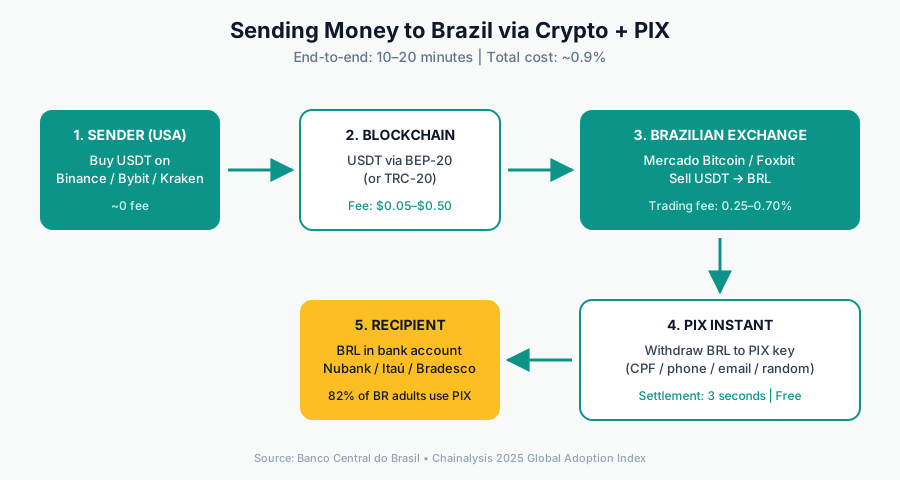
Total time: 10–20 minutes the first time; 5 minutes once you’re set up.
- Buy USDT on any global exchange — Binance, Bybit, Kraken, or your existing crypto account. If you already hold USDT or USDC, skip this step.
- Choose the right network for the withdrawal. For Brazil, BEP-20 (BNB Chain) is the cheapest at typically US$0.05–0.50 in network fees. TRC-20 (TRON) is the second choice at ~US$0.50–4. Avoid ERC-20 unless you want to pay US$3–15 in gas for no benefit.
- Send USDT to your recipient’s Brazilian exchange account. Mercado Bitcoin, Foxbit, NovaDAX and Binance Brasil all accept USDT on BEP-20 and TRC-20. Double-check the deposit address character by character and always send a small test transaction first if it’s your first time on that network.
- Recipient sells USDT for BRL. On Mercado Bitcoin, open USDT/BRL, place a limit order at or just above the current bid, and wait for the fill. Trading fee: 0.30% maker / 0.70% taker.
- Recipient withdraws BRL via PIX. From Mercado Bitcoin, tap Saque (Withdraw) → PIX → enter PIX key (CPF, phone, email, or random key) → confirm. Settlement is free and takes 3 seconds, 24/7, including weekends and holidays.
- Recipient spends. PIX is accepted at 82% of Brazilian adult-owned bank accounts and is the default payment rail for everything from groceries to utility bills to small-business invoices.
Pro tip: If your recipient is not comfortable with crypto, walk them through the Mercado Bitcoin signup and first sell on a video call. After that, the loop is just “Incoming USDT → Sell → Withdraw to PIX” — three taps.
For detailed instructions on choosing the right blockchain network, see our Best Blockchain for Sending Money guide. And for a step-by-step tutorial on sending USDT internationally, check our How to Send USDT Abroad walkthrough.
Brazilian Payment Ecosystem
To understand why PIX + crypto is so powerful in Brazil specifically, you need to know the local payment landscape. Here’s a snapshot of the rails that matter.
| Rail | Users / Reach | Type | Crypto Bridge |
|---|---|---|---|
| PIX | 174M (82% of adults) | Instant payment | All major BR exchanges |
| Nubank | 95M+ customers | Digital bank | Native crypto feature |
| Itaú / Bradesco / Santander | — | Traditional bank | PIX withdrawal from exchanges |
| Caixa / Banco do Brasil | — | State bank | PIX withdrawal from exchanges |
| Boleto Bancário | Nationwide | Voucher payment | Some exchanges (declining) |
| TED | All banks | Same-day wire | Mostly replaced by PIX |
| PIX Internacional | Argentina, US, Portugal | Cross-border PIX | USDC integration 2026 |
Key insight: PIX is not a niche payment option in Brazil — it is the payment option. With 174 million users and 82% adoption among adults, it is essentially universal. This is why crypto remittances to Brazil are uniquely efficient: as soon as USDT is converted to BRL on a Brazilian exchange, the last mile to the recipient is free, instant, and accepted everywhere.
Nubank deserves a special mention. With 95 million customers and native crypto features, it is often the receiving account for family members who don’t use dedicated exchanges. The workflow can be as simple as PIX from Mercado Bitcoin directly into a Nubank account, where the BRL is immediately spendable.
PIX Internacional is a newer development: as of 2024-2026, Brazil has launched pilot corridors with Argentina (fully active), the United States (Miami and Orlando), and Portugal (Lisbon), and the BCB has signalled support for a USDC-integrated cross-border PIX. This is worth watching, because it could eventually remove even the exchange leg for certain corridors.
Tax and Regulation — Major 2026 Changes
Brazilian crypto tax law was substantially rewritten in 2025, and the new regime takes full effect in January 2026. If you or your recipient read an article written before mid-2025, almost everything you learned about the “R$35,000 monthly exemption” is now out of date.
New 2026 Tax Rules (Critical)
- Flat 17.5% rate on crypto gains — Provisional Measure 1303 (published June 12, 2025) replaces the previous progressive system (15–22.5%) with a single rate of 17.5% on crypto gains, effective January 1, 2026.
- R$35,000 monthly exemption eliminated. The old rule that exempted small retail traders is gone. Every taxable disposal now counts, regardless of amount.
- Scope: Domestic exchanges, foreign exchanges, self-custody wallets, DeFi, NFTs and staking rewards — all captured by the new flat rate.
- Quarterly reporting replaces the old monthly structure. Losses can be carried forward for up to 5 quarters.
- Foreign-held crypto assets are separately subject to a 15% flat annual tax under Lei 14.754/2023.
- Receita Federal IN 1.888/2019: Individuals must still report monthly crypto activity above R$30,000 in foreign-exchange or off-exchange transactions, by the last business day of the following month.
- Regulatory supervision: The Banco Central do Brasil formally took authority over VASPs (exchanges, custodians, token transfer services) via Decree 11,563/2023 and the operational framework in Resolutions 519/520/521 (November 10, 2025). CVM supervises only crypto assets that qualify as securities (tokenised receivables, some utility tokens) — it does not regulate Bitcoin or USDT.
Note: This is a dramatic change for small Brazilian crypto users who used to operate below the R$35,000 monthly exemption. Consult a qualified Brazilian accountant before assuming anything about your personal situation. Receita Federal guidance is still being clarified through 2026.
For Senders
- Remittances received in Brazil are not taxed as income when they are personal transfers to family members. The new 17.5% flat rate applies only to gains on crypto disposal — if your recipient immediately sells USDT for BRL at the market rate they paid, there is typically no capital gain to tax.
- IOF (Imposto sobre Operações Financeiras) applies to some inbound foreign-exchange operations, including when Brazilian exchanges settle fiat. Rates were adjusted in July 2025; current relevant rates for personal transfers are typically 0.38–1.1% depending on classification.
- Sender-side taxes depend on your country. In the US, sending money abroad is not a taxable event. In the EU and UK, small personal remittances are also generally not taxed but may trigger reporting at higher amounts.
- Anti-money laundering: BCB-regulated exchanges apply full KYC and monitor transfers. For typical remittance amounts (US$100–5,000), there is no practical friction beyond the standard verification at signup.
Tax laws change. This article is informational only and is not tax or legal advice — consult a qualified professional for your specific situation.
Which Method Is Right for You?
Cheapest overall: Crypto via Mercado Bitcoin or Foxbit with USDT on BEP-20 (~0.9–1.3%). Binance P2P can match or beat this for amounts above US$2,000 but requires more active effort.
Easiest for beginners: Wise (~0.9–1.5%). You don’t need to touch crypto, the UI is clean, the fee is transparent, and the recipient sees BRL in their bank account the same day.
Fastest delivery: Crypto to PIX is the absolute winner here once USDT arrives at the Brazilian exchange. The last leg is PIX, which settles in 3 seconds 24/7. Total door-to-door time: 10–20 minutes.
Best for large amounts (US$2,000+): Binance P2P or Mercado Bitcoin. Crypto fees are effectively flat, so the per-unit cost shrinks as the transfer grows. On a US$10,000 transfer, crypto is typically half the cost of Wise.
Cash pickup needed: Western Union or MoneyGram. More expensive, but essential for recipients without a bank account or PIX key. This is increasingly rare in Brazil given 82% PIX adoption.
My personal setup: Mercado Bitcoin for monthly transfers (lowest all-in cost with zero friction), Wise as a backup when the recipient needs BRL in a bank account and I don’t have time to coordinate the crypto leg.
Frequently Asked Questions
What’s the cheapest way to send US$1,000 to Brazil in 2026?
For most users, crypto via Mercado Bitcoin or Foxbit costs ~0.9–1.3% all-in, landing as BRL on a PIX key within 10–20 minutes. Wise is comparable at 0.9–1.5% for fiat-only senders. Remitly, MoneyGram, and Western Union are all 3–6% on typical amounts — meaningfully more expensive.
Can I send money directly to a PIX key from abroad?
Not directly — PIX is a domestic Brazilian rail. Your international transfer will always end by converting to BRL somewhere (at Wise’s BR partner bank, at a regulated Brazilian exchange, or inside Remitly’s BR settlement layer), and only then can the final leg be PIX. The crypto path (USDT → BR exchange → PIX) is the cheapest version of this pattern. Brazil also operates PIX Internacional with Argentina, the US (Miami/Orlando), and Portugal (Lisbon), but coverage is still limited.
Is the R$35,000 monthly crypto tax exemption still valid in 2026?
No. The old exemption was eliminated by Provisional Measure 1303 (June 2025). Starting January 1, 2026, all crypto gains are taxed at a flat 17.5% regardless of amount, exchange location, or custody type. Foreign-held crypto assets are separately taxed at a flat 15% under Lei 14.754/2023. This is a major change — consult a Brazilian accountant if you are affected.
Which network should I use to send USDT to Brazil?
BEP-20 (BNB Chain) is the cheapest, typically US$0.05–0.50 per transaction. TRC-20 (TRON) is a reliable second choice at US$0.50–4. Avoid ERC-20 (Ethereum) unless you are moving institutional-scale amounts where the higher gas fee becomes negligible. Always double-check that your recipient’s Brazilian exchange supports the network you choose before sending.
How long does a crypto transfer to Brazil actually take?
End-to-end, 10–20 minutes is realistic: ~1 minute for the USDT on-chain confirmation on BEP-20 or TRC-20, a few minutes for the exchange to credit the deposit, 1–3 minutes to sell USDT/BRL, and 3 seconds for the PIX withdrawal itself. The PIX leg is the fastest part — it works 24/7 including weekends and holidays.
Continue Learning
Next steps in the Remittance Cluster:
- Crypto vs. Bank Transfers: Remittance Cost Guide (2026) — the full 20-corridor comparison (Pillar)
- Best Blockchain for Sending Money: Fee Comparison (2026)
- How to Send USDT Abroad: Step-by-Step Guide (2026)
- Crypto vs. Western Union: Which Is Cheaper? (2026 Data)
- Stablecoin Remittances Explained
- Crypto Cash Out & Off-Ramp Guide: Convert to Local Currency (2026)
Foundations: