What Is Cryptocurrency? Beginner’s Guide in 5 Minutes (2026)

Editorial pen name · ChainGain
Alex Mercer is the editorial pen name used for ChainGain’s cryptocurrency education content. Articles are based on cited sources and reproducible comparisons. Editorial profile
Beginner
Cryptocurrency is a digital form of money that uses cryptography and blockchain technology to operate without banks or governments. Since Bitcoin launched in 2009, the crypto market has grown to over $3 trillion in total value — yet most people still struggle to understand what cryptocurrency actually is and how it works.
Blockchain, private keys, mining — it all felt overwhelming.
This guide breaks down everything you need to know about cryptocurrency in plain language. No technical background required.
What Is Cryptocurrency? A Clear Definition
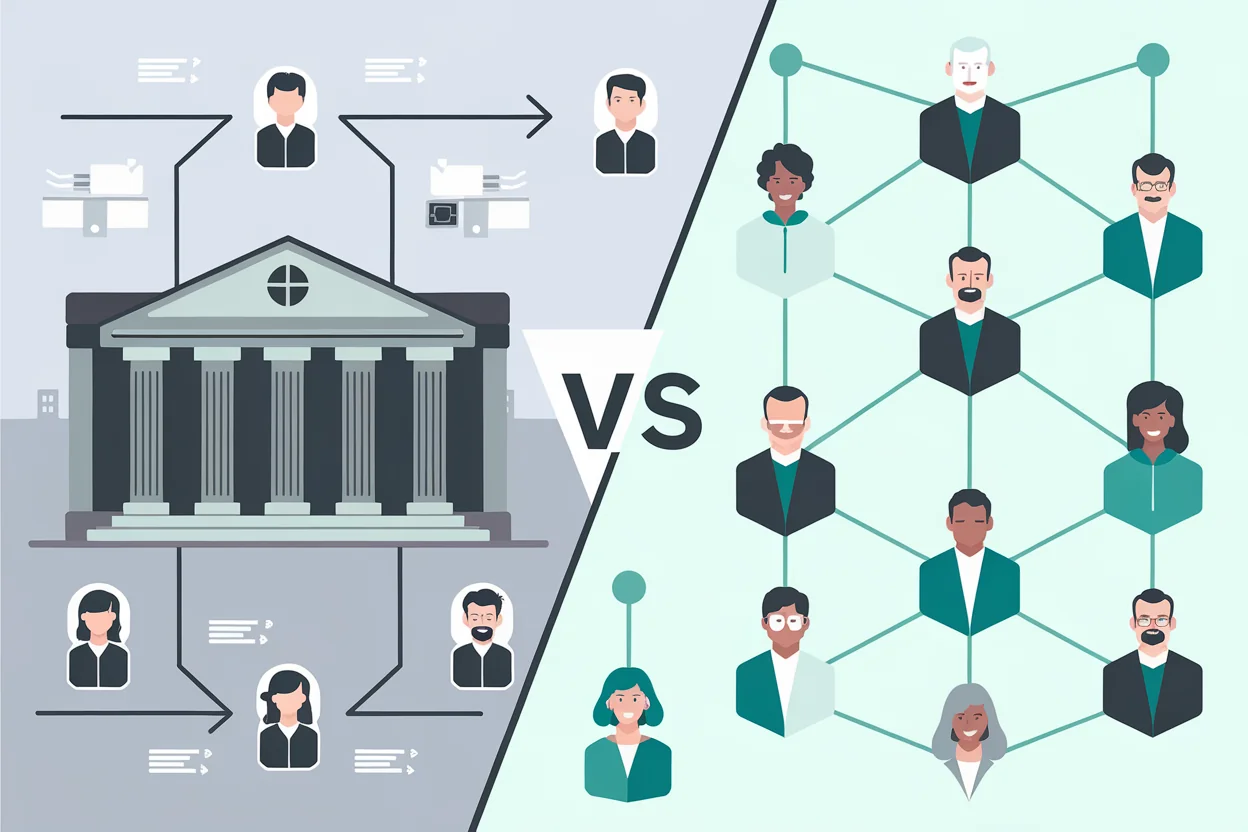
Cryptocurrency is a digital or virtual currency that uses cryptographic techniques to secure transactions and control the creation of new units. Unlike traditional currencies issued by central banks (known as fiat currencies like the US dollar or euro), cryptocurrencies operate on decentralized networks — meaning no single authority controls them.
Here’s what makes cryptocurrency different from the money in your bank account:
| Feature | Traditional Currency | Cryptocurrency |
|---|---|---|
| Issued by | Central banks (Fed, ECB) | Network protocols (code) |
| Controlled by | Governments, banks | Decentralized network |
| Transaction speed | 1-5 business days (international) | Minutes to seconds |
| Operating hours | Business hours / banking days | 24/7, 365 days |
| Transaction fees | 2-5% (international transfers) | $0.01 to $5 (varies by network) |
| Privacy | Full identity linked | Pseudonymous |
| Supply | Unlimited (can be printed) | Often fixed (Bitcoin: 21M cap) |
The first cryptocurrency, Bitcoin, was created in 2009 by an anonymous person or group using the pseudonym Satoshi Nakamoto. The original Bitcoin whitepaper described it as “a peer-to-peer electronic cash system” — a way to send money directly between people without needing a bank in the middle.
Why “Crypto” Currency?
The “crypto” in cryptocurrency comes from cryptography — the science of encoding information. Every cryptocurrency transaction is secured using advanced mathematical algorithms. This makes it virtually impossible to counterfeit or double-spend crypto, which was the key problem that prevented digital money from working before Bitcoin solved it.
How Does Cryptocurrency Work?
Understanding cryptocurrency requires knowing three core components: blockchain technology, consensus mechanisms, and wallets. Let me break each one down.
Blockchain: The Foundation
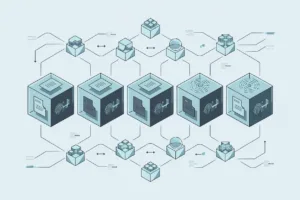
A blockchain is a digital ledger (record book) shared across thousands of computers worldwide. Every transaction ever made is recorded in “blocks” that are chained together chronologically — hence the name blockchain.
Think of it like a Google Spreadsheet that thousands of people have a copy of. When someone adds a new entry, everyone’s copy updates automatically. But unlike a spreadsheet, once data is recorded on a blockchain, it cannot be altered or deleted. This makes the system transparent and tamper-proof.
Here’s what happens when you send cryptocurrency to someone:
- You initiate a transaction — “Send 0.5 BTC to address XYZ”
- The transaction broadcasts to the network of computers (nodes)
- Validators verify the transaction is legitimate (you have enough funds, the signature is valid)
- The transaction is grouped into a block with other transactions
- The block is added to the blockchain permanently
- The recipient receives the funds in their wallet
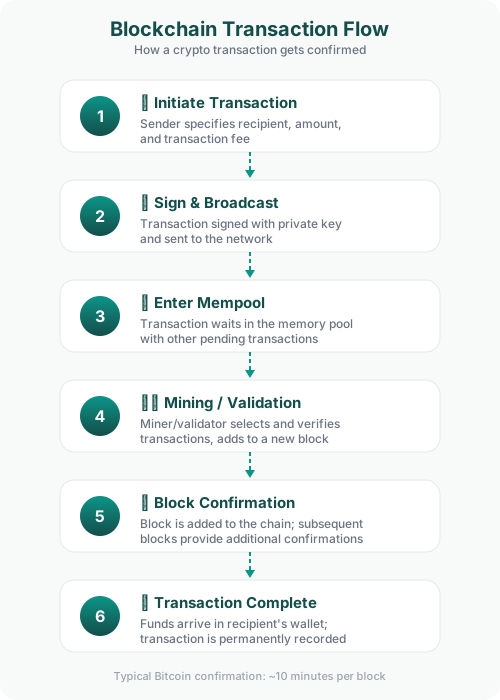
This entire process takes anywhere from a few seconds (on networks like Solana) to about 10 minutes (on Bitcoin), depending on the cryptocurrency.
Consensus Mechanisms: How Transactions Get Verified
Since there’s no central authority verifying transactions, cryptocurrencies use consensus mechanisms — rules that network participants follow to agree on which transactions are valid.
The two most common consensus mechanisms are:
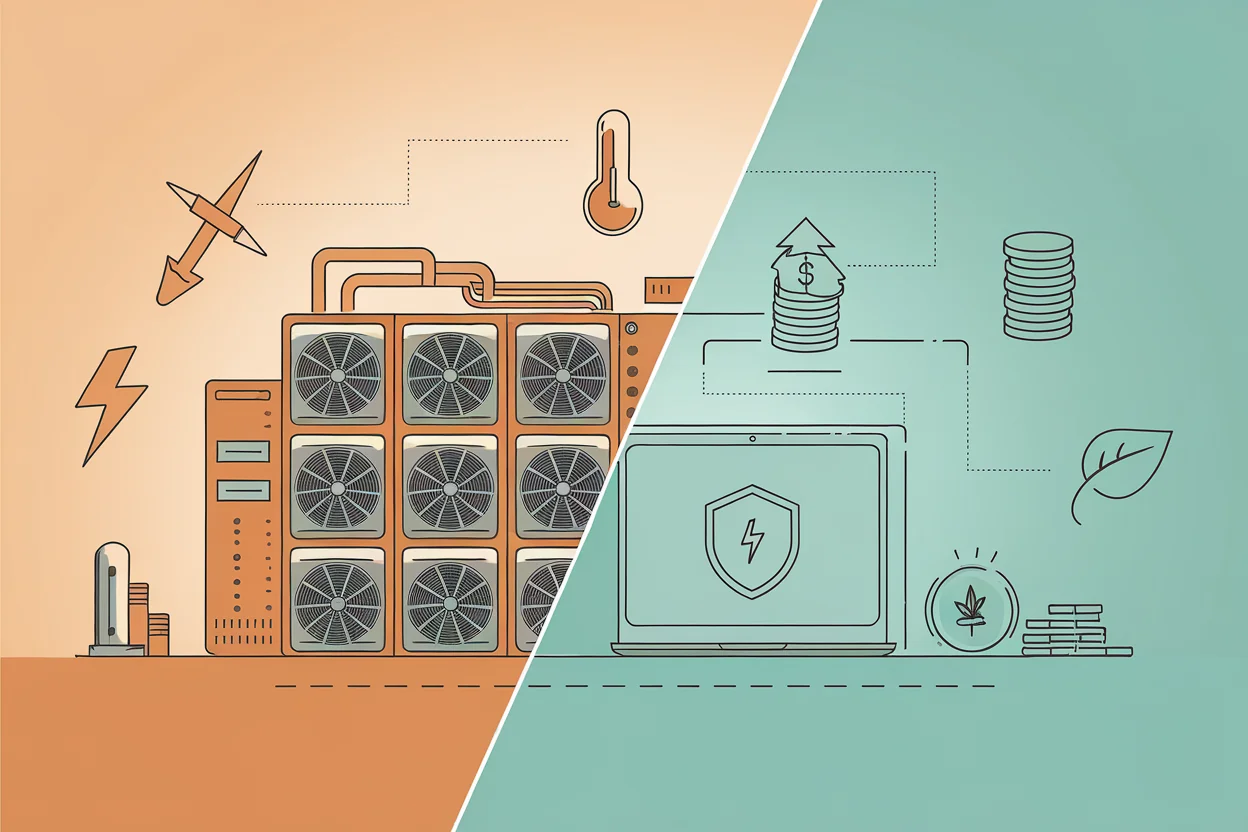
Proof of Work (PoW) — Used by Bitcoin. Computers compete to solve complex mathematical puzzles. The first to solve it gets to add the next block and earns a reward. This process is called “mining” and requires significant computing power and electricity.
Proof of Stake (PoS) — Used by Ethereum (since 2022), Solana, and many others. Instead of solving puzzles, validators lock up (stake) their cryptocurrency as collateral. Validators are selected to create new blocks based on how much they’ve staked. This uses far less energy than Proof of Work.
| Aspect | Proof of Work | Proof of Stake |
|---|---|---|
| Energy usage | High | Low (~99.9% less) |
| Hardware needed | Specialized mining rigs | Standard computer |
| Notable users | Bitcoin, Litecoin | Ethereum, Solana, Cardano |
| Transaction speed | Slower | Generally faster |
| Entry barrier | Expensive equipment | Minimum stake amount |
Wallets and Keys: Your Crypto Access
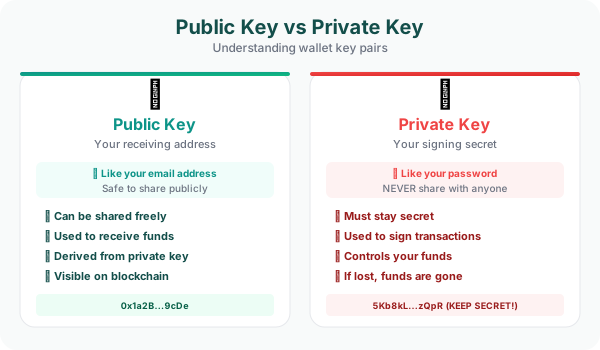
A cryptocurrency wallet doesn’t actually “hold” your crypto — your coins exist on the blockchain. Instead, a wallet stores your private key, which is essentially the password that proves you own your cryptocurrency and lets you send it.
Every wallet has two components:
- Public key (address) — Like your email address. You share this to receive crypto. Example:
1A1zP1eP5QGefi2DMPTfTL5SLmv7DivfNa - Private key — Like your email password. Never share this. Anyone with your private key can access your funds.
This is why you’ll hear the phrase “not your keys, not your coins” repeated throughout the crypto community.
Types of Cryptocurrency
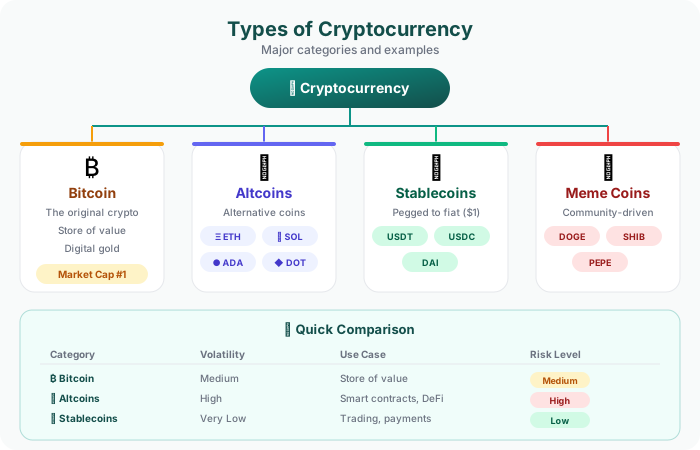
As of early 2026, there are over 15,000 different cryptocurrencies. They broadly fall into several categories.
Bitcoin (BTC)
Bitcoin is the first and largest cryptocurrency by market capitalization. Created in 2009, it’s often called “digital gold” because of its fixed supply of 21 million coins and its role as a store of value. As of March 2026, Bitcoin’s market cap exceeds $1.5 trillion, making it roughly the size of a major global company.
Key facts about Bitcoin:
- Maximum supply: 21,000,000 BTC (approximately 19.8 million already mined)
- New BTC created: ~3.125 BTC per block (after the April 2024 halving)
- Block time: ~10 minutes
- Creator: Satoshi Nakamoto (anonymous)
Altcoins
Any cryptocurrency other than Bitcoin is called an “altcoin” (alternative coin). Some major categories:
Smart Contract Platforms — These blockchains can run programmable applications (called smart contracts and dApps). Ethereum is the largest, but competitors like Solana, Avalanche, and Cardano offer different trade-offs in speed, cost, and decentralization.
Utility Tokens — Tokens that serve a specific purpose within a platform. For example, Chainlink (LINK) powers a decentralized data oracle network that feeds real-world data to smart contracts.
Meme Coins — Cryptocurrencies created as jokes or based on internet memes, like Dogecoin (DOGE) and Shiba Inu (SHIB). While some have gained significant market value, they carry higher risk due to their lack of fundamental utility.
Stablecoins
Stablecoins are cryptocurrencies designed to maintain a stable value, typically pegged 1:1 to a fiat currency like the US dollar. They’re widely used for trading, savings, and cross-border payments.
| Stablecoin | Symbol | Peg | Backing | Market Cap (2026) |
|---|---|---|---|---|
| Tether | USDT | $1 USD | Cash reserves, T-bills | ~$140B |
| USD Coin | USDC | $1 USD | Cash + short-term treasuries | ~$55B |
| DAI | DAI | $1 USD | Crypto collateral (over-collateralized) | ~$5B |
Stablecoins have become particularly important in countries experiencing high inflation. In countries like Argentina (87% peso depreciation over 3 years), Turkey (94% lira decline), and Ukraine (wartime currency instability), stablecoins aren’t speculation — they’re financial survival. Vietnam (#4 globally in crypto adoption) and Indonesia (#7) are leading the trend in Southeast Asia.
How to Buy Cryptocurrency: Step by Step
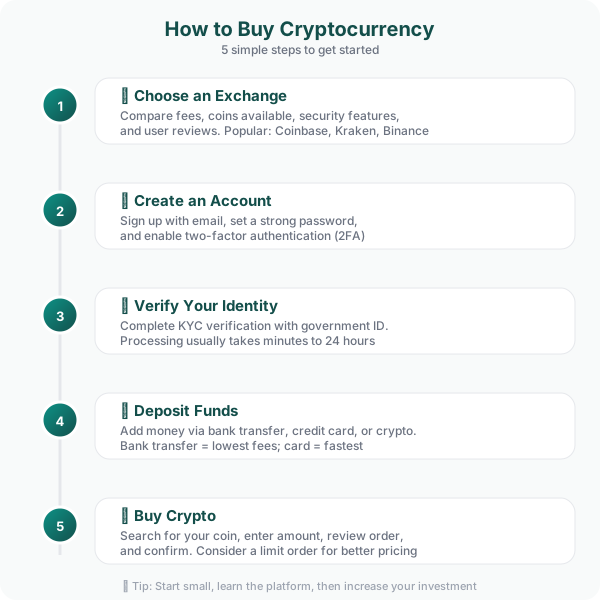
If you’re ready to buy your first cryptocurrency, here’s the process.
Step 1: Choose an Exchange
A cryptocurrency exchange is a platform where you can buy, sell, and trade crypto. There are two main types:
- Centralized exchanges (CEX) — Companies that operate the trading platform. Examples: Binance, Coinbase, Kraken. These are easier for beginners but require you to trust the company with your funds.
- Decentralized exchanges (DEX) — Smart contract-based platforms where you trade directly from your wallet. Examples: Uniswap, dYdX. These give you more control but have a steeper learning curve.
For beginners, a centralized exchange is usually the simplest starting point. Look for one that supports your local currency and payment method.
Step 2: Create and Verify Your Account
Most exchanges require identity verification (KYC — Know Your Customer) before you can buy crypto. You’ll typically need:
- Email address
- Phone number
- Government ID (passport, driver’s license)
- Selfie for identity matching
Verification usually takes 15 minutes to 24 hours, depending on the exchange.
Step 3: Deposit Funds
Once verified, deposit fiat currency using your available payment methods. Common options include bank transfer, credit/debit card, and in some regions, mobile money or P2P trading.
Step 4: Make Your First Purchase
Navigate to the exchange’s buy/trade section, select the cryptocurrency you want (Bitcoin is a common first choice), enter the amount, and confirm the purchase. Most exchanges offer a simple “Buy” interface alongside their more advanced trading view.
Step 5: Secure Your Investment
After buying, consider your storage options. Keeping crypto on an exchange is convenient but carries risk — if the exchange gets hacked or goes bankrupt (as happened with FTX in 2022), you could lose your funds. For larger amounts, transferring to a personal wallet gives you full control.
Understanding Crypto Markets
The cryptocurrency market operates differently from traditional stock markets. Here are the key concepts.
Market Capitalization
Market cap is the total value of all coins in circulation, calculated as: price per coin × total coins in circulation. It’s the most common metric for comparing cryptocurrency sizes.
As of early 2026, the total crypto market cap stands at approximately $3.2 trillion. For context:
- Bitcoin alone: ~$1.5 trillion (about 47% of the total market)
- Ethereum: ~$400 billion
- All other cryptocurrencies combined: ~$1.3 trillion
Volatility
Cryptocurrencies are significantly more volatile than traditional assets. It’s not uncommon for Bitcoin to move 5-10% in a single day, and smaller altcoins can swing 20-50% or more.
This volatility creates both opportunity and risk. The crypto market has produced extraordinary returns — Bitcoin went from under $1 in 2010 to over $90,000 in late 2024 — but has also experienced severe crashes, including a 77% decline in 2022.
24/7 Trading
Unlike stock markets that close on evenings and weekends, crypto markets never stop. This means prices can change at any time, including while you sleep.
Cryptocurrency Risks and How to Stay Safe
Crypto offers real opportunities, but it also comes with significant risks. Being aware of them is the first step to protecting yourself.
Price Risk
The value of any cryptocurrency can drop dramatically. Never invest money you can’t afford to lose.
Security Risks
- Phishing attacks — Fake websites or emails designed to steal your login credentials. Always double-check URLs before entering passwords.
- Scam projects — Fraudulent cryptocurrencies or platforms that promise unrealistic returns. If it sounds too good to be true, it probably is.
- Exchange hacks — Even reputable exchanges have been hacked. Use two-factor authentication (2FA) and consider hardware wallets for large holdings.
Regulatory Risk
Cryptocurrency regulations vary widely by country and are still evolving. Some countries embrace crypto (El Salvador, UAE, Thailand with 0% capital gains tax), while others restrict it (China). Key regulators worldwide include the EU’s MiCA framework (AMF in France, BaFin in Germany), Japan’s JFSA, South Korea’s FSC (VAUPA), Indonesia’s OJK, Thailand’s SEC, and UAE’s VARA. Changes in regulation can significantly impact prices and your ability to use crypto services in your region.
Essential Security Practices
- Enable 2FA on every crypto account (use an authenticator app, not SMS)
- Never share your private keys or seed phrase with anyone
- Use unique passwords for each crypto platform
- Verify URLs before entering credentials — bookmark your exchange’s real URL
- Start small and learn before committing significant funds
The Future of Cryptocurrency
Cryptocurrency technology continues to evolve rapidly. Several trends are shaping its future as of 2026:
Institutional adoption — Major financial institutions now offer crypto products. Bitcoin and Ethereum ETFs launched in the US in 2024, making crypto accessible through traditional brokerage accounts.
Central Bank Digital Currencies (CBDCs) — Over 130 countries are exploring or developing their own digital currencies. Thailand is piloting a digital baht, South Korea is testing a digital won, and the EU’s digital euro project is advancing. While not cryptocurrencies in the traditional sense (they’re centralized), CBDCs could normalize the concept of digital money for billions of people.
DeFi (Decentralized Finance) — Financial services like lending, borrowing, and trading built on blockchain technology, operating without traditional intermediaries. The DeFi ecosystem has grown to over $100 billion in total value locked.
Real-World Asset Tokenization — The process of representing real-world assets (real estate, bonds, art) as tokens on a blockchain. According to McKinsey research, tokenized assets could reach $2 trillion by 2030.
Continue Learning
- How Blockchain Works
- How to Choose a Crypto Wallet
- What Are Stablecoins?
- Cryptocurrency Security
- Crypto vs Bank Transfers: Remittance Cost Guide
- Stablecoin Savings Guide: Protect Your Money from Inflation
- Freelancer Crypto Payment Guide: Get Paid Globally, Spend Locally
- What Is DeFi? Decentralized Finance Explained
- Crypto Glossary: 200+ Terms Explained
- How to Spot and Avoid Crypto Scams
- How to Buy Your First Cryptocurrency
- P2P Crypto Trading Safety Guide: Buy and Sell Safely
Frequently Asked Questions
Is cryptocurrency legal?
Cryptocurrency is legal in most countries, including the United States, European Union (under MiCA regulation), United Kingdom, Brazil, Japan, South Korea, Indonesia, Thailand, UAE, Turkey, Vietnam, India, and many others. However, regulations vary significantly. Some countries like China have banned crypto trading, while others like El Salvador have adopted Bitcoin as legal tender. Always check your local regulations before buying or trading cryptocurrency.
How much money do I need to start with cryptocurrency?
You can start with as little as $1 on most exchanges. Bitcoin and other cryptocurrencies are divisible — you don’t need to buy a whole coin. For learning purposes, $10 to $50 is enough to understand how buying, selling, and transferring crypto works without significant financial risk.
Can I lose all my money in cryptocurrency?
Yes, it is possible to lose your entire investment. Cryptocurrency prices are highly volatile and can drop significantly. Individual cryptocurrencies can (and do) go to zero. Additionally, losing access to your wallet’s private keys means losing your funds permanently. Only invest what you can afford to lose, and never risk essential savings on crypto.
What is the difference between Bitcoin and other cryptocurrencies?
Bitcoin was the first cryptocurrency and remains the largest by market cap. It focuses primarily on being a decentralized store of value and payment system. Other cryptocurrencies (altcoins) often serve different purposes: Ethereum enables programmable smart contracts, stablecoins maintain price stability, and utility tokens power specific platforms. While Bitcoin has the strongest brand recognition and institutional adoption, altcoins offer diverse functionality beyond simple value transfer.
Do I need to pay taxes on cryptocurrency?
In most countries, yes. Cryptocurrency is typically treated as property or an asset for tax purposes. This means you may owe taxes when you sell crypto for a profit, trade one cryptocurrency for another, or receive crypto as payment. Tax rules vary by country — some nations like Portugal and the UAE have favorable crypto tax policies, while others tax crypto gains like regular income. Consult a tax professional in your jurisdiction for specific guidance.
Summary
Cryptocurrency is a digital currency secured by cryptography that operates on decentralized blockchain networks. While the technology can seem complex at first, the core idea is straightforward: it’s money that works without needing a bank or government to process transactions.
The key points to remember:
- Cryptocurrency uses blockchain technology to create a transparent, tamper-proof record of transactions
- Bitcoin is the first and largest cryptocurrency, but thousands of others serve different purposes
- You can start investing with any amount — even $10
- Security is your responsibility: protect your private keys and use strong authentication
- Only invest what you can afford to lose
If you’re new to crypto, start by learning before investing. Understanding the technology and risks will put you ahead of most participants in the market. Next, learn how blockchain technology works.
Disclaimer: This article is for educational purposes only and does not constitute financial advice. Cryptocurrency investments carry significant risk, including the potential loss of your entire investment. Always do your own research and consider consulting a qualified financial advisor before making investment decisions.