
Published: 30 Mar. 2026 · 16 min read · Difficulty: Beginner
I’ve tested sending money across 8 different blockchain networks over the past year, tracking every fee and confirmation time. Here’s what I found: the difference between the cheapest and most expensive option is staggering — from fractions of a cent to over $50 per transaction. If you’re sending money to family overseas, paying freelancers, or moving funds between exchanges, choosing the right blockchain can save you hundreds of dollars a year.
In this guide, I’ll break down the real costs of every major blockchain for sending money, compare them head-to-head with traditional services like Western Union and SWIFT, and help you pick the cheapest crypto to transfer based on your specific situation.

Why Blockchain Fees Matter for Remittances
The global remittance market hit $905 billion in 2024 and is projected to reach $913 billion in 2025, according to the World Bank. That’s nearly a trillion dollars flowing across borders every year — and a significant chunk of it gets eaten by fees.
The World Bank’s Remittance Prices Worldwide report (Q1 2025) paints a stark picture:
- Global average cost: 6.49% per transaction
- Sub-Saharan Africa: 8.78% — the most expensive corridor in the world
- South Asia: 4.59% — relatively cheaper, but still substantial
- SDG target: The UN Sustainable Development Goals call for remittance costs below 3% — most regions still exceed this
Let’s put that in perspective. If a construction worker in Dubai sends $500 home to Nigeria every month, the average fee of 8.78% means $43.90 disappears in fees — that’s $527 per year. For families depending on these transfers, every dollar counts.
This is where blockchain technology changes the equation. Crypto transfers can reduce fees to 0.1–2% of the transaction amount — and in many cases, to fractions of a cent regardless of the amount sent. The challenge is knowing which blockchain to use, because the fee differences between networks are enormous.
For a full comparison of 20 specific remittance corridors (US→Mexico, UK→Nigeria, UAE→India, and more), see our Remittance Cost Guide.
The Complete Blockchain Fee Comparison
Here’s how every major blockchain stacks up for sending money in 2026. I’ve tracked these fees over 12 months of real transfers:
| Network | Avg Fee | Speed | Best For | Stablecoin Support |
|---|---|---|---|---|
| Solana | ~$0.00025 | 12.8s | Everyday transfers | USDC, USDT |
| TRON | $1.92–4.01 | 3–7s | USDT transfers | USDT (42% of supply) |
| Stellar | ~$0.00001 | 3–5s | Micro-payments, MoneyGram | USDC |
| XRP | <$0.0001 | 3–5s | Bank corridors | Limited |
| Polygon | $0.001–0.01 | ~2s | DeFi + remittance | USDC (native) |
| BSC | ~$0.10 | ~3s | Binance ecosystem | USDT, USDC |
| Bitcoin (LN) | 0–0.3% | Instant | BTC holders | BTC only |
| Ethereum L2 | $0.01–0.40 | ~1 min | DeFi integration | USDC, USDT |
| Bitcoin (mainnet) | $0.17–0.82 | 10–60 min | Large transfers | BTC only |
| Ethereum (mainnet) | ~$0.15 | 12s | DeFi-heavy users | All major |
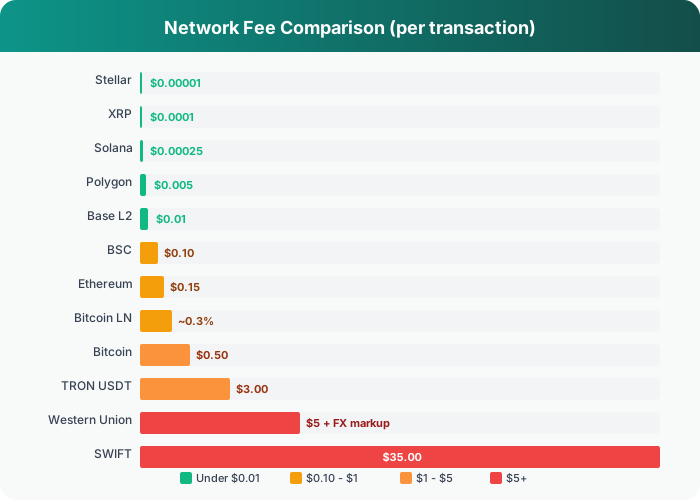
Fees as of March 2026. Blockchain fees fluctuate with network demand. Sources: Etherscan, Solana Compass, YCharts, TronScan.
As you can see, the cheapest crypto to transfer varies depending on what you’re sending and where. Let’s dig deeper into each network.
Deep Dive: Each Network Explained
Solana — The Speed Champion
Solana is what I recommend for most people sending money internationally, and the numbers explain why.
- Average fee: ~$0.00025 per transaction
- Finality: 12.8 seconds (with the upcoming Alpenglow upgrade targeting 100–150ms in 2026)
- Stablecoin support: Both USDC and USDT are widely available
- Throughput: 65,000 TPS theoretical, 3,000–4,000 TPS in practice
At a quarter of a cent per transfer, you could send money 4,000 times before spending a single dollar in fees. Whether you’re sending $50 or $50,000, the fee stays the same. Both Circle’s USDC and Tether’s USDT are natively issued on Solana, meaning you can send dollar-pegged stablecoins without worrying about exchange rate fluctuations.
The caveat: Solana has experienced occasional network congestion and outages — most recently in February 2025. While the network has become significantly more stable, it’s worth keeping in mind for time-sensitive transfers. In my experience, 99% of my Solana transfers completed within 15 seconds.
TRON — The USDT Highway
TRON might not win any innovation awards, but it dominates one crucial metric: stablecoin volume.
- Fee: $1.92–4.01 per transfer (energy/bandwidth costs)
- Speed: 3–7 seconds
- USDT market share: Hosts 42% of all USDT supply globally
- Annual transfer volume: $7.9 trillion — more than Visa’s annual volume
- Stablecoin payment share: 60% of all stablecoin payment volume
TRON’s fees are higher than Solana’s, but there’s a reason it handles the majority of USDT transfers: ecosystem momentum. Most major exchanges — including Binance — default to the TRC-20 network for USDT withdrawals. If you’re moving USDT between exchanges or to someone who already has a TRON wallet, it’s often the path of least resistance.
The caveat: TRON’s centralization is a legitimate concern. The network relies on just 21 “super representatives” for validation, compared to thousands of validators on Solana or Ethereum. For sending money, this is a minor practical concern, but it’s worth knowing.
I’ve used TRON for dozens of exchange-to-exchange USDT transfers, and the speed is consistently fast — usually under 5 seconds. The fee stings more than Solana, but the convenience of it being the default USDT network on most platforms makes it hard to avoid.
Stellar — Built for Remittances
Stellar (XLM) was literally designed for cross-border payments, and it shows.
- Fee: 0.00001 XLM (effectively negligible — less than $0.000001)
- Speed: 3–5 seconds
- MoneyGram partnership: USDC settlement, processing over $1 billion annually
- Anchor network: Built-in fiat on/off ramp infrastructure
What makes Stellar unique is its anchor network — financial institutions and money services that connect the Stellar blockchain to local banking systems. This means in many corridors, you can go from fiat to Stellar to fiat without manually buying or selling crypto.
The MoneyGram partnership is the flagship example. Through MoneyGram’s network of 350,000+ locations worldwide, users can send money that settles on Stellar using USDC, then gets converted to local currency at the destination.
Best for: Corridors where MoneyGram has strong presence (Latin America, Africa, Southeast Asia). If your recipient can pick up cash at a MoneyGram location, Stellar + MoneyGram is the closest thing to a traditional remittance service built on blockchain.
XRP — The Banking Bridge
XRP occupies a unique position — it’s the blockchain most integrated with traditional banking infrastructure.
- Fee: Less than $0.0001 per transaction
- Speed: 3–5 seconds
- On-Demand Liquidity (ODL): Active corridors in South America, Middle East, and Asia
- Banking partners: Santander, SBI Remit, Tranglo, and others use Ripple’s ODL service
- SEC case: Resolved August 2025 — $50 million settlement, XRP ruled not a security for retail sales
The SEC case resolution in August 2025 removed the biggest cloud over XRP. With regulatory clarity, Ripple’s ODL service has expanded to more corridors. XRP is particularly strong for remittances to Japan (through SBI Remit), the Philippines (through partner banks), and the Middle East.
The caveat: XRP’s stablecoin support is limited compared to Solana or TRON. You’re mostly sending XRP itself, which means your recipient is exposed to price volatility during the transfer window (though at 3–5 seconds, this risk is minimal).
Polygon — The DeFi Gateway
Polygon is an Ethereum Layer 2 network that offers a unique advantage: it’s cheap enough for remittances but connected enough for DeFi.
- Fee: $0.001–0.01 per transaction
- Speed: ~2 seconds
- Native USDC: Circle partnership means USDC is issued natively on Polygon
- DeFi access: Hundreds of DeFi protocols for saving, lending, or earning yield
If your recipient doesn’t just want to receive money but also wants to do something with it — earn yield, swap tokens, or use DeFi — Polygon is a strong choice. Native USDC keeps the transfer stable, and the fee is negligible.
Important note: The bridged version of USDC (USDC.e) support ends November 10, 2026. Make sure you’re using native USDC, not the bridged version. To understand stablecoins in more depth, see our guide on What Are Stablecoins.
Ethereum Layer 2s — The Upgrade Path
Ethereum’s Layer 2 ecosystem has matured significantly, offering near-instant transfers at a fraction of mainnet costs.
- Arbitrum: $0.15–0.40 per transfer
- Base: Less than $0.01 per transfer
- Optimism: $0.05–0.20 per transfer
- Speed: Typically under 1 minute for finality
Base, built by Coinbase, deserves special mention. At under a cent per transfer with native USDC support, it’s becoming a serious contender for remittances — especially for users already in the Coinbase ecosystem.
For most remittance use cases, L2s offer the best of both worlds: Ethereum’s security and liquidity with fees that rival Solana and TRON.
Blockchain vs Traditional Services: Side-by-Side
Let’s compare what it actually costs to send $200 and $500 using blockchain versus traditional methods:
| Method | Fee ($200 transfer) | Fee ($500 transfer) | Speed | Hidden Costs |
|---|---|---|---|---|
| Solana USDC | $0.00025 | $0.00025 | 13 seconds | Exchange on/off ramp fees |
| TRON USDT | ~$2–4 | ~$2–4 | 3–7 seconds | Energy costs |
| Stellar USDC | <$0.01 | <$0.01 | 3–5 seconds | Anchor fees (if using fiat ramps) |
| Western Union | $1.29–7.52 | $3.23–18.80 | 1–3 days | Exchange rate markup 2–5% |
| MoneyGram | $1.99+ | Variable | 1–3 days | Exchange rate markup |
| Wise | $0.50–5 + 0.35–0.5% | $0.50–5 + 0.35–0.5% | 1–2 days | Minimal markup |
| SWIFT Wire | $25–50 | $25–50 | 3–5 days | Intermediary fees $10–100+ |
NEW in 2026: Western Union now charges a 1% remittance tax on cash and money order payments, effective January 1, 2026. This makes traditional remittances even more expensive compared to blockchain alternatives.
The numbers are striking. A $500 SWIFT wire transfer costs at minimum $25 in fees plus potential intermediary charges — that’s a 5–10% cost before your money even arrives. The same transfer on Solana costs a quarter of a cent.
But here’s the nuance that most comparison articles miss: the blockchain fee isn’t the whole story. You also need to consider on-ramp costs (buying crypto) and off-ramp costs (converting back to local currency). I’ll cover those real costs in the next sections.
We break down specific corridor costs (US→Mexico, UK→India, UAE→Philippines) with exact fee calculations in our Remittance Cost Guide.
How to Choose the Right Blockchain for Your Transfer
After a year of testing different networks, here’s my decision framework. The best blockchain depends entirely on your specific use case:
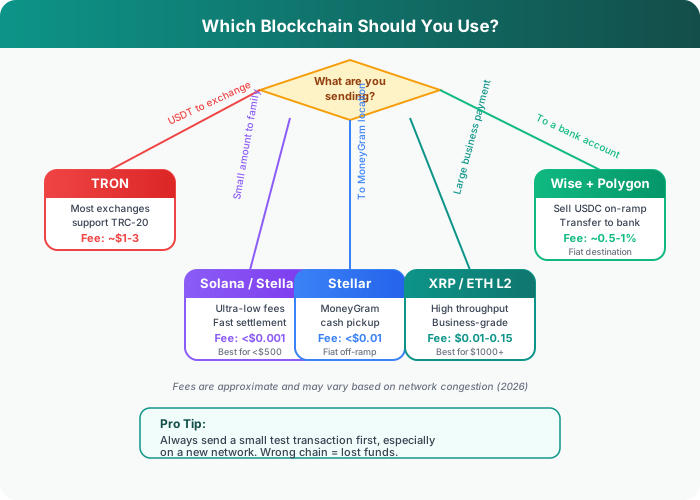
- Sending USDT to an exchange → Use TRON. It’s the default USDT network on most exchanges, meaning lower total cost despite higher network fees. You avoid bridging fees and compatibility issues.
- Sending to family (small amounts under $500) → Use Solana or Stellar. The near-zero fees mean more money arrives at the destination. Solana if your recipient has a crypto wallet; Stellar if they need to cash out at a MoneyGram location.
- Sending to a MoneyGram location → Use Stellar. The MoneyGram + Stellar integration lets your recipient pick up cash without needing any crypto knowledge.
- Large business payments ($5,000+) → Use XRP or Ethereum L2. XRP’s banking integrations make it ideal for business corridors, while Ethereum L2s offer the deepest liquidity for large transfers.
- Sending to a bank account → Use a hybrid approach: buy USDC on Polygon, send to a service like Wise, then withdraw to bank account. This combines blockchain’s low transfer fees with Wise’s competitive exchange rates.
Pro tip: Always check the withdrawal fees on your exchange before choosing a network. Some exchanges charge flat withdrawal fees that are much higher than the actual network fee — for example, an exchange might charge $5 for a TRON withdrawal even though the network fee is under $4.
The Real Cost: On-Ramp and Off-Ramp Fees
Here’s the uncomfortable truth that blockchain enthusiasts often gloss over: the network fee is usually the smallest part of the total cost. The real expense comes from getting money into and out of crypto.
On-Ramp Costs (Buying Crypto)
- Exchange trading fee: 0.1–1.5% (varies by exchange and tier)
- Credit/debit card purchase: 2–5% surcharge
- Bank transfer: Usually free or minimal (0–0.5%)
- P2P purchase: 1–3% spread above market price
Off-Ramp Costs (Converting to Local Currency)
- Exchange withdrawal to bank: 0.1–1% + flat fee ($1–25 depending on region)
- P2P selling: 1–3% spread below market price
- Crypto debit card: 0–2% conversion fee
- MoneyGram cash pickup: Variable (built into exchange rate)
Total Cost Example
Let’s trace a real $500 transfer from the US to the Philippines using Solana USDC:
| Step | Cost |
|---|---|
| Buy USDC on exchange (bank transfer, 0.1% fee) | $0.50 |
| Send USDC via Solana | $0.00025 |
| Recipient sells USDC via P2P (2% spread) | $10.00 |
| Total cost | $10.50 (2.1%) |
Compare that to Western Union’s 6–8% for the same corridor, and you’re saving $20–30 per transfer. Over a year of monthly transfers, that’s $240–360 saved.
The key insight: minimize your on-ramp and off-ramp costs to capture blockchain’s fee advantage. Use bank transfers instead of cards for buying, and find competitive P2P rates or local exchange options for selling.
For a step-by-step guide on purchasing crypto with the lowest fees, see our guide on How to Buy Your First Crypto. If you’re using P2P platforms, read our P2P Trading Safety Guide to avoid scams and get fair rates.
Frequently Asked Questions
What is the cheapest blockchain to send money?
Stellar and Solana are the cheapest blockchains for sending money. Stellar charges approximately $0.000001 per transaction, while Solana costs about $0.00025. Both are essentially free for individual transfers. The choice between them depends on your needs: Stellar integrates with MoneyGram for cash pickups, while Solana offers broader stablecoin support with both USDC and USDT.
Is it cheaper to send crypto or use Western Union?
Crypto is significantly cheaper for the network transfer itself. A $500 transfer on Solana costs $0.00025 in network fees, compared to $3.23–18.80 on Western Union — plus Western Union’s new 1% remittance tax in 2026. However, you need to factor in on-ramp and off-ramp costs (buying and selling crypto), which typically add 1–3% to the total. Even with these costs, crypto transfers are usually 50–80% cheaper than Western Union for most corridors.
How long does a crypto transfer take?
Most blockchain transfers complete in under 1 minute. Solana takes about 13 seconds, TRON 3–7 seconds, Stellar 3–5 seconds, and XRP 3–5 seconds. Bitcoin Lightning is essentially instant. Bitcoin mainnet is the slowest at 10–60 minutes. Compare this to traditional wire transfers that take 1–5 business days.
Can I send USDT for free?
Not entirely free, but close. TRON charges $1.92–4.01 per USDT transfer. On Solana, USDT transfers cost ~$0.00025 — effectively free. Some exchanges offer free withdrawal promotions: BSC’s zero-fee stablecoin program runs through March 31, 2026. Always check your exchange’s withdrawal fee, as it may be higher than the actual network cost.
Which stablecoin is best for remittances?
USDC is generally the best stablecoin for remittances due to its transparency (monthly reserves audited by Deloitte), wide availability across blockchains (Solana, Polygon, Stellar, Ethereum, Base), and integration with services like MoneyGram. USDT has more liquidity and is accepted on more exchanges, making it better for exchange-to-exchange transfers. For an in-depth comparison, see our guide on What Are Stablecoins.
Continue Learning
- Crypto vs Bank Transfers: Remittance Cost Guide — Full 20-corridor comparison with exact fees for US→Mexico, UK→Nigeria, UAE→India, and more
- What Are Stablecoins? A Beginner’s Guide — Understand USDC, USDT, and how to choose the right stablecoin
- How to Buy Your First Crypto — Step-by-step guide to purchasing crypto with the lowest fees
- P2P Crypto Trading Safety Guide — Stay safe when buying and selling crypto peer-to-peer
- Cryptocurrency Security Guide — Protect your funds during and after transfers