
Beginner
I’ve navigated crypto regulations across 15 countries — from trading legally in Japan to watching platforms get shut down in Bangladesh. The question is crypto legal depends entirely on where you live — and the answer has changed dramatically in 2026. The legal landscape changes fast, and what’s legal in one country may get you arrested in another. This guide covers every country ChainGain’s readers care about, with data current as of April 2026.
Cryptocurrency regulation is no longer a binary question of “legal or illegal.” In 2026, most countries fall somewhere on a spectrum: fully regulated with licensing frameworks, emerging regulation with partial rules, restricted use with gray areas, or outright banned. This guide breaks down the legal status of crypto in 30+ countries across six regions, so you know exactly where you stand.
The Global Crypto Regulation Landscape in 2026
The world has moved decisively from “ban or ignore” to “license and tax.” As of April 2026:
- 103+ countries now have some form of crypto regulatory framework, up from roughly 60 in 2023 (Atlantic Council tracker).
- The FATF Travel Rule — which requires exchanges to share sender and receiver information for transactions above a threshold — has been passed or is in progress in 85 of 117 monitored jurisdictions (FATF).
- El Salvador reversed its Bitcoin legal tender status in January 2025 under IMF pressure, though Bitcoin remains legal to hold and trade.
- The dominant trend is maturation: countries are moving from blanket bans or total silence toward licensing regimes and tax integration.
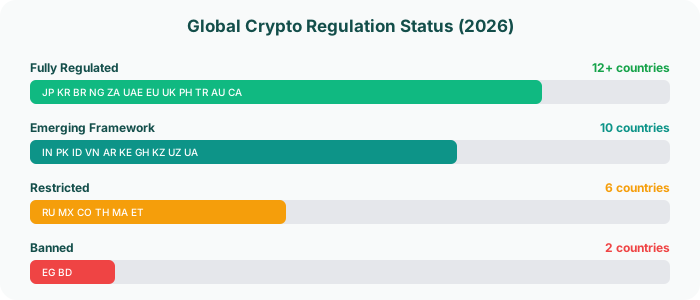
The following table summarizes the regulation status of every country covered in this guide:
| Status | Countries | Count |
|---|---|---|
| Fully Regulated | Japan, South Korea, Brazil, Nigeria, South Africa, UAE, EU (France, Germany), UK, Philippines, Turkey | 12+ |
| Regulated (Emerging) | India, Pakistan, Indonesia, Vietnam, Argentina, Kenya, Ghana, Kazakhstan, Uzbekistan, Ukraine | 10 |
| Restricted / Partial | Russia, Mexico, Colombia, Thailand, Morocco, Ethiopia | 6 |
| Banned / Prohibited | Egypt, Bangladesh | 2 |
Now let’s examine each region in detail.
Africa
Africa is one of the fastest-growing crypto adoption regions in the world, driven by remittance needs, currency instability, and young, tech-savvy populations. Regulation varies wildly — from Nigeria’s comprehensive framework to Egypt’s outright ban.
Nigeria — Fully Regulated
Nigeria is Africa’s largest crypto market and ranks among the top five globally for adoption (Chainalysis 2024 Global Crypto Adoption Index). After years of an ambiguous regulatory stance — including a 2021 banking ban that was later reversed — Nigeria passed the Investment and Securities Act (ISA) 2025, which formally brought digital assets under the Securities and Exchange Commission (SEC).
- Licensing: Exchanges must register with the SEC. The licensing fee is ₦30M (~$18,000 USD). As of early 2026, only Quidax and Busha hold full licenses, though more applications are pending.
- Tax: The Nigeria Tax Administration Act (NTAA) 2025 integrates crypto gains into the existing tax framework. Capital gains on disposal are taxable.
- Practical reality: Despite regulation, peer-to-peer (P2P) trading remains dominant. Most Nigerians buy crypto through P2P platforms and use it for cross-border payments.
Kenya — Regulated (Emerging)
Kenya passed the Virtual Asset Service Provider (VASP) Act in November 2025, establishing a joint oversight framework between the Central Bank of Kenya (CBK) and the Capital Markets Authority (CMA).
- Stablecoin rules: Issuers must hold KES 500M (~$3.8M USD) in capital reserves.
- Exchange licensing: Applications opened in Q1 2026. Exchanges must demonstrate cybersecurity audits and customer fund segregation.
- Adoption context: Kenya ranks 5th in Africa for crypto adoption, largely driven by M-Pesa integration and remittance corridors from the diaspora.
South Africa — Fully Regulated
South Africa has the most mature crypto regulatory environment on the continent. Under the Financial Advisory and Intermediary Services (FAIS) Act, crypto asset service providers (CASPs) must register with the Financial Sector Conduct Authority (FSCA).
- Scale: Over 300 CASPs have been approved as of March 2026.
- Travel Rule: South Africa was one of the first African countries to implement FATF Travel Rule requirements for exchanges.
- Tax: Crypto gains are treated as income or capital gains depending on the nature of the transaction. The South African Revenue Service (SARS) actively monitors exchange data.
Ghana — Regulated (Emerging)
Ghana passed the VASP Bill 2025, creating a licensing framework for crypto businesses. The country also runs a regulatory sandbox with 11 firms currently participating, allowing startups to test products under supervision before seeking full licenses.
Tanzania — Developing
Tanzania occupies an unusual position. In December 2024, the High Court ruled that cryptocurrency is not explicitly illegal under existing Tanzanian law, but there is no licensing framework. The government has signaled interest in developing regulation, but no timeline has been confirmed. In practice, Tanzanians trade crypto through international platforms without legal consequences — for now.
Egypt — Banned
Egypt maintains one of the strictest crypto bans in the world. The Central Bank of Egypt prohibits creating, trading, or promoting cryptocurrencies, and Egypt’s religious authority Dar al-Ifta has issued a ruling (fatwa) declaring crypto trading haram (forbidden under Islamic law). For context on the Islamic finance perspective, see our guide on whether crypto is halal.
- Penalties: Fines range from EGP 1M to EGP 10M (~$20,000–$200,000 USD).
- Reality: Despite the ban, Egypt ranks in the top 30 globally for crypto adoption according to Chainalysis, with users accessing international platforms via VPNs.
Ethiopia — Restricted
Ethiopia bans cryptocurrency for payments but has not made holding crypto explicitly illegal. The government is developing a Financial Information System (FIS) framework expected by mid-2026 that may clarify the legal status. Ethiopia’s large unbanked population (over 60%) makes crypto an attractive alternative, but infrastructure limitations and government caution have slowed adoption.
South & Southeast Asia
Asia dominates global crypto adoption. Five of the top ten countries in the Chainalysis Global Crypto Adoption Index are in this region. Regulation ranges from India’s punitive tax approach to Vietnam’s brand-new framework.
India — Regulated (Emerging)
Crypto is legal in India, classified as a Virtual Digital Asset (VDA). However, the tax regime is designed to discourage speculation:
- 30% flat tax on all crypto gains — no distinction between short-term and long-term.
- 1% TDS (Tax Deducted at Source) on every transaction above INR 10,000.
- No loss offset: You cannot offset crypto losses against crypto gains or any other income. If you make $1,000 on Bitcoin and lose $1,000 on Ethereum, you owe tax on the $1,000 gain.
In my experience researching Indian crypto regulations, this “no loss offset” rule is the most punitive feature — it effectively means active traders face taxation that can exceed their actual net profits.
Pakistan — Regulated (Emerging)
Pakistan made a major shift in early 2026 by passing the Virtual Assets Act 2026, establishing the Pakistan Virtual Asset Regulatory Authority (PVARA) as the primary oversight body.
- Exchange licensing: Binance and HTX have received No Objection Certificates (NOC), allowing them to operate while full licensing processes complete.
- Context: Pakistan’s move is driven by FATF compliance pressure (Pakistan was on the grey list until 2024) and the need to bring a massive informal crypto market into the tax system.
Indonesia — Regulated (Emerging)
Indonesia legalized crypto as a tradable commodity (asset) and transferred oversight from the Commodity Futures Trading Regulatory Agency (Bappebti) to the Financial Services Authority (OJK) in January 2025.
- Capital requirements: Exchanges must hold IDR 1T (~$62M USD) in capital — one of the highest thresholds in Southeast Asia.
- Restriction: Crypto cannot be used as a payment method. It is treated purely as an investment asset.
- Market size: Indonesia has over 18 million registered crypto investors, more than its stock market participants.
Philippines — Fully Regulated
The Philippines has a dual regulatory approach. The Bangko Sentral ng Pilipinas (BSP) oversees crypto-to-fiat exchanges (VASPs), while the Securities and Exchange Commission (SEC) regulates crypto assets that qualify as securities under Memorandum Circulars 4 and 5.
- License status: The BSP has imposed a moratorium on new VASP licenses, maintaining 9 active licensees. New applicants must wait for the moratorium to lift.
- Adoption: The Philippines ranks 2nd globally in the Chainalysis adoption index, driven by play-to-earn gaming and remittances.
Vietnam — Regulated (Emerging)
Vietnam made headlines with the Digital Technology Industry (DTI) Law, passed in June 2025 and effective January 2026. This was Vietnam’s first formal crypto legislation.
- Legal status: Crypto is legal to own and trade, but cannot be used for payments.
- Capital requirements: Exchanges must hold VND 10T (~$390M USD) — an extremely high bar that may limit the market to major international players.
- Adoption: Vietnam ranks 5th globally in the Chainalysis adoption index. DeFi usage is particularly high relative to the country’s GDP.
Thailand — Restricted / Partial
Thailand has a regulated crypto market under the SEC and the Ministry of Finance, but with notable restrictions. In a positive development, Thailand extended its exemption of the 7% VAT on crypto trading in 2024, which significantly reduces the cost of trading compared to countries that apply sales tax on each transaction.
- Payment ban: Since April 2022, crypto cannot be used to pay for goods and services.
- Tax: 15% withholding tax on crypto profits, though the VAT exemption makes Thailand more trader-friendly than it appears on paper.
Bangladesh — Banned
Bangladesh maintains a firm ban on cryptocurrency under Central Bank directives, reinforced in September 2025. Despite this, Bangladesh ranks 13th globally in the Chainalysis adoption index — a striking example of how bans often fail to prevent adoption. Users access crypto through international P2P platforms and remittance corridors.
East Asia
East Asia’s two major crypto markets — South Korea and Japan — represent opposite approaches to regulation: Korea moved fast with strict consumer protection rules, while Japan is methodically restructuring its framework.
South Korea — Fully Regulated
South Korea’s Virtual Asset User Protection Act (VAUPA), effective July 2024, is one of the most comprehensive crypto regulations in the world.
- Cold wallet requirement: Exchanges must hold at least 80% of customer deposits in cold storage.
- Record keeping: Exchanges must maintain transaction records for 15 years.
- Institutional access: As of early 2026, Korean regulators are gradually opening institutional participation. Corporate accounts on exchanges — previously restricted — are being permitted under new guidelines.
- Tax: A 20% capital gains tax on crypto profits above KRW 50M (~$37,000 USD) has been repeatedly postponed and is now expected to take effect in 2027.
Japan — Fully Regulated
Japan was the first major economy to regulate crypto exchanges (after the Mt. Gox collapse in 2014) and remains one of the most transparent regulatory environments.
- Current framework: Exchanges register with the Financial Services Agency (FSA) under the Payment Services Act.
- Framework shift: Japan is restructuring crypto regulation under the Financial Instruments and Exchange Act (FIEA), expected around 2027. This would treat crypto more like traditional securities.
- Tax reform proposal: The current crypto tax rate can reach up to 55% (as “miscellaneous income”). A proposed flat 20% capital gains tax would bring crypto taxation in line with stock trading — a widely anticipated change.
- BTC ETF: Multiple asset managers have filed spot Bitcoin ETF applications in early 2026, following the precedent set in the United States.
Europe
Europe is defined by MiCA (Markets in Crypto-Assets Regulation), the world’s first comprehensive multi-country crypto framework. If you’re in the EU, MiCA is the law you need to know.
EU (France, Germany) — Fully Regulated
MiCA was fully enforced across the EU starting December 2024. It creates a unified licensing framework for all 27 EU member states, covering crypto-asset service providers (CASPs), stablecoin issuers, and token offerings. Key points (ESMA MiCA overview):
- France: Existing PSAN (Prestataire de Services sur Actifs Numériques) registrations must be converted to full MiCA licenses by June 2026.
- Germany: BaFin (Federal Financial Supervisory Authority) required MiCA compliance by end of 2025. Germany already had one of the EU’s most crypto-friendly frameworks, so the transition was relatively smooth.
- Stablecoin rules: Stablecoin issuers must hold 1:1 reserves in regulated EU financial institutions. Tether (USDT) has faced compliance challenges and delisted from some EU exchanges.
- Consumer protection: CASPs must provide clear risk disclosures, implement complaint handling procedures, and segregate customer assets.
UK — Fully Regulated (Transitioning)
The UK, no longer bound by EU rules post-Brexit, is building its own framework. The Treasury published the Cryptoasset Regulations 2026 earlier this year.
- FCA regime: The Financial Conduct Authority’s full crypto regulation regime takes effect in October 2027.
- PASS (Pre-Authorization Supervision Scheme): Opens in July 2026, allowing firms to begin the application process ahead of the full regime.
- Current rules: Until the new regime launches, crypto firms must be registered with the FCA under existing anti-money laundering rules. Crypto promotions must comply with the FCA’s financial promotions regime (effective since October 2023).
Ukraine — Regulated (Emerging)
Ukraine is actively developing its crypto framework, with Draft Law 10225-d establishing the regulatory baseline.
- Tax: 18% income tax + 5% military levy = 23% total on crypto profits. The military levy was introduced during the ongoing conflict.
- Registration deadline: Crypto businesses must register with regulators by July 2026.
- Context: Ukraine is one of the highest crypto adoption countries in Europe, partly driven by wartime financial needs and a tech-savvy population.
CIS & Central Asia
The former Soviet states are diverging: Russia restricts domestic crypto payments while embracing mining, Kazakhstan is building national infrastructure, and Uzbekistan is experimenting with stablecoins.
Russia — Restricted / Partial
Russia’s crypto stance is a contradiction. In November 2024, Russia legalized crypto mining and introduced a tax framework for mining profits.
- Mining tax: 15% on mining profits, with miners required to report to the Federal Tax Service.
- Domestic payments: BANNED. Using crypto to pay for goods or services within Russia remains illegal.
- Trading: Holding and trading crypto is not illegal, but there is no domestic exchange licensing framework. Most Russian traders use international platforms.
- Practical note: Russia is one of the world’s largest crypto mining countries (estimated 2nd-3rd globally), and crypto is widely used for cross-border transactions despite the domestic payment ban.
Kazakhstan — Regulated (Emerging)
Kazakhstan signed a comprehensive Digital Assets Law in January 2026, positioning itself as a Central Asian crypto hub.
- National custodial service: A government-backed custodial solution launches in May 2026.
- Reserve fund: Kazakhstan has allocated $350M to a national digital asset reserve.
- Mining history: Kazakhstan was the 2nd-largest Bitcoin mining country in 2021 but cracked down on illegal miners after grid instability. Licensed mining continues under a regulated framework.
Uzbekistan — Regulated (Emerging)
Uzbekistan is taking an innovative approach with a stablecoin pilot program launched in January 2026, and a tokenized securities framework that allows traditional assets to be issued on blockchain. The National Agency for Perspective Projects (NAPP) oversees crypto regulation. Uzbekistan has positioned itself as more crypto-friendly than its neighbors to attract fintech investment.
Latin America
Latin America’s crypto adoption is driven by currency instability, inflation hedging, and remittance needs. Regulation is rapidly evolving across the continent.
Brazil — Fully Regulated
Brazil has one of the most sophisticated crypto frameworks in Latin America. Law 14,478 (passed in 2022) was supplemented by the Central Bank’s (BCB) detailed framework in November 2025.
- SPSAV entity: A new regulatory category — Sociedade Prestadora de Serviços de Ativos Virtuais (SPSAV) — for licensed virtual asset service providers.
- Stablecoins as forex: Brazil treats stablecoins as foreign exchange instruments, subjecting them to existing FX regulations. This is significant because stablecoins account for a large portion of crypto volume in Brazil.
- Tax: 15% capital gains tax on crypto profits above BRL 35,000/month (~$6,500 USD).
Argentina — Regulated (Emerging)
Argentina passed Law 27,739 to regulate virtual assets, and in a landmark move, banks were authorized to offer crypto services starting April 2026.
- Approved assets: Initially, only BTC, ETH, and USDC are approved for bank-offered crypto services.
- Adoption driver: Argentina has one of the highest crypto adoption rates in Latin America, driven by chronic inflation (often exceeding 100% annually) and peso devaluation. Argentines use stablecoins as a de facto savings tool.
Mexico — Restricted / Partial
Mexico’s Fintech Law (2018) was one of Latin America’s first to address crypto, but it has become outdated.
- Banking prohibition: Mexican banks are prohibited from offering crypto services. The central bank (Banxico) maintains a “healthy distance” policy between traditional finance and crypto.
- Exchanges: Bitso and other exchanges operate under the Fintech Law but face significant compliance requirements.
- Outlook: Mexico has not updated its crypto framework since 2018, creating regulatory uncertainty.
Colombia — Restricted / Partial (Tightening)
Colombia is moving toward stricter regulation. Tax reporting Resolution 000240 (December 2025) requires exchanges and users to report crypto transactions to the tax authority (DIAN).
- Bill 510: Currently pending in Congress, this would create a comprehensive licensing framework for crypto exchanges.
- Current status: Crypto is legal to hold and trade, but there is no dedicated licensing framework (yet). The Superintendencia Financiera has been gradually increasing oversight.
Venezuela — No Framework
Venezuela’s crypto experiment with El Petro (a government-issued cryptocurrency backed by oil reserves) ended in January 2024 when the token was officially discontinued. There is currently no regulatory framework for private cryptocurrencies, and the government has periodically cracked down on crypto mining operations, particularly in areas with subsidized electricity.
Middle East
The Middle East shows the widest regulatory divergence — from the UAE’s aggressive embrace to Morocco’s long-standing ban that’s finally lifting.
UAE — Fully Regulated
The UAE, particularly Dubai, has become the global crypto hub. The Virtual Assets Regulatory Authority (VARA) in Dubai has created one of the world’s most detailed licensing frameworks (VARA).
- Scale: Over 70 licensed VASPs operate in the UAE as of early 2026, including Binance, OKX, and Bybit.
- Travel Rule: Implemented in February 2026, requiring exchanges to share transaction data per FATF standards (Sumsub compliance tools).
- Tax advantage: The UAE has no personal income tax, making it attractive for high-volume crypto traders.
- Free zone strategy: DIFC, ADGM, and DWTC each have their own licensing tracks, creating a competitive environment within the UAE.
Morocco — Restricted / Partial (Changing)
Morocco banned crypto in 2017, but Bill 42.25 entered parliament in Q1 2026 and is expected to legalize and regulate crypto. If passed, Morocco would become the first North African country to create a comprehensive framework. The bill was driven by the realization that an estimated 3% of Moroccans already hold crypto despite the ban.
What This Means for You — Practical Guide
Understanding your country’s regulation status is the first step. Here’s how to act on it:
- Check your country’s status in the table above. Know whether you’re in a fully regulated, emerging, restricted, or banned jurisdiction.
- If your country is fully regulated: Use licensed exchanges, file taxes on your crypto gains, and keep detailed transaction records. Licensed platforms provide better consumer protection and are less likely to disappear with your funds.
- If your country has emerging regulation: You can trade legally, but stay informed about new requirements. Register with licensed exchanges when possible and begin keeping tax records even if enforcement is still developing.
- If your country is restricted: Crypto may be legal to hold but with significant limitations on usage. Understand exactly what is and isn’t allowed before trading.
- If your country has banned crypto: There are significant legal risks. Users in banned jurisdictions access crypto through international P2P platforms, but this carries legal exposure.
Regardless of your country’s stance, three principles apply everywhere:
- Keep records: Maintain a log of every transaction — date, amount, platform, and purpose. This protects you if regulations change or tax authorities request information. See our guide on buying your first crypto for practical steps.
- Use reputable platforms: Licensed exchanges in regulated jurisdictions provide better protection than offshore platforms with no oversight.
- Stay current: Crypto regulations change faster than almost any other area of financial law. What’s true in April 2026 may change by the end of the year.
For a deep dive into protecting your crypto holdings, see our cryptocurrency security guide.
Frequently Asked Questions
Is it illegal to own Bitcoin?
In the vast majority of countries, no. Only a handful of countries (notably Egypt and Bangladesh from this guide) explicitly ban owning cryptocurrency. In most countries — even those with restrictions — simply holding Bitcoin is legal. The restrictions typically apply to using crypto for payments, operating unlicensed exchanges, or failing to report crypto income for tax purposes. Check the table above for your country’s specific status.
Which country has the best crypto regulations?
It depends on what you value. The UAE offers zero personal income tax and a comprehensive licensing framework, making it attractive for traders and businesses. Japan provides maximum consumer protection with strict exchange requirements. Brazil integrates crypto naturally into existing financial law. South Korea prioritizes investor safety with its 80% cold storage requirement. There is no single “best” — it depends on whether you prioritize tax efficiency, consumer protection, or market access.
Do I need to pay tax on crypto?
Almost certainly yes, if you’re in a country where crypto is legal. The vast majority of regulated jurisdictions now tax crypto gains — either as income, capital gains, or both. Tax rates range from 0% (UAE) to over 50% (Japan under current rules). The trend globally is toward more comprehensive crypto tax enforcement, with countries like Colombia and Nigeria adding reporting requirements in 2025–2026. Keep records of every transaction — even in countries where enforcement is currently light.
Can I use crypto in a country where it’s banned?
Technically, people in banned countries do use crypto — Bangladesh ranks 13th globally for adoption despite its ban. However, this carries real legal risk, including fines and potentially criminal charges depending on the jurisdiction. Users typically access crypto through international P2P platforms and VPNs, but this does not eliminate legal liability. We do not recommend breaking local laws.
What happens if my country bans crypto after I buy it?
Historically, crypto bans have typically included a grace period for existing holders to liquidate their positions. For example, when countries restrict crypto, they usually target exchanges and payment usage rather than retroactively criminalizing ownership. That said, a ban would likely crash local demand and make it harder to convert crypto to local currency. The safest approach is to use non-custodial wallets (where you control your own keys) — see our introduction to cryptocurrency for the basics.