Disclosure: This article is for educational purposes only. It does not constitute financial or religious advice. If you sign up through our links, we may earn a commission at no extra cost to you. See our full Affiliate Disclosure and Editorial Policy for details.
With 1.9 billion Muslims worldwide and a $6 trillion Islamic finance market, the question “is crypto halal?” has become one of the most searched topics at the intersection of faith and technology. A 2025 survey found that 73% of Muslim investors actively seek Shariah-compliant crypto options — yet clear guidance remains fragmented across scholars, countries, and platforms.
Shariah-compliant investing follows Islamic law principles that prohibit riba (interest), gharar (excessive uncertainty), maysir (gambling), and investments in haram (forbidden) industries. Applying these centuries-old principles to digital assets is a challenge that scholars are still debating in 2026.
I’ve spent months researching scholarly opinions, regulatory frameworks, and Shariah-certified platforms to create this comprehensive guide. Whether you’re a practicing Muslim exploring crypto for the first time or an experienced investor seeking clarity, this article breaks down what the scholars say, which activities are halal or haram, and how to invest in crypto the Shariah-compliant way.
In this article, you’ll learn:
- The five core Islamic finance principles and how they apply to cryptocurrency
- What major Islamic scholars and institutions have ruled about crypto
- Which crypto activities are halal and which are haram
- Shariah-compliant platforms and projects available in 2026
- How to calculate zakat on your cryptocurrency holdings
- A practical 5-step guide to investing in crypto the halal way
Islamic Finance Principles and Cryptocurrency
To determine whether crypto is halal, we first need to understand the five foundational principles of Islamic finance and how each applies to digital assets.
Islamic finance is a financial system built on ethical guidelines derived from the Quran and Sunnah. It governs how Muslims earn, spend, and invest their money — and it represents one of the fastest-growing sectors in global finance, with assets projected to reach $7.5 trillion by 2028.
| Principle | Arabic Term | What It Means | How It Applies to Crypto |
|---|---|---|---|
| No Interest | Riba | Earning money from money (interest/usury) is forbidden | Margin trading with interest, DeFi lending at fixed rates = haram |
| No Excessive Uncertainty | Gharar | Contracts must be clear; excessive ambiguity is forbidden | Futures/derivatives without underlying assets are problematic |
| No Gambling | Maysir | Games of chance and speculative gambling are forbidden | Meme coins with no utility, casino platforms = haram |
| Asset-Backing | Mal | Investments should be tied to real economic activity or assets | Tokens with real utility or asset backing are favored |
| Ethical Screening | Halal/Haram | Investments in alcohol, gambling, pork, weapons are forbidden | Crypto projects must not facilitate haram industries |
The key takeaway: cryptocurrency itself is not inherently halal or haram. Like traditional money, it depends on how you earn it, spend it, and invest it. A Bitcoin used to buy groceries operates very differently — from a Shariah perspective — than one used for leveraged gambling.
What Islamic Scholars Say About Cryptocurrency
There is no single, universal fatwa on cryptocurrency. Opinions vary significantly across countries and institutions, reflecting the decentralized nature of Islamic jurisprudence itself. Here is what the major bodies have ruled:
Dar al-Ifta al-Misriyyah (Egypt) — HARAM
Egypt’s primary Islamic authority issued a fatwa declaring cryptocurrency haram, arguing that digital currencies lack intrinsic value, are not backed by physical assets, and their extreme volatility constitutes maysir (gambling). The fatwa specifically cited Bitcoin’s price swings as evidence of excessive speculation.
Majelis Ulama Indonesia (MUI) — CONDITIONAL
Indonesia’s top Islamic body ruled that crypto is permissible as a commodity (for trading and investment) but haram as a currency replacement. The key condition: transactions must follow Shariah principles — no interest, no excessive speculation, and the underlying asset must have clear utility.
Securities Commission Malaysia — HALAL (Regulated)
Malaysia became a pioneer by creating the first national Shariah-compliant crypto framework. The Securities Commission approved 15 digital assets for trading on regulated exchanges, each vetted by a Shariah Advisory Council. This includes Bitcoin, Ethereum, and select altcoins that meet compliance criteria.
Saudi Arabia — CAUTIOUS (No Explicit Fatwa)
The Kingdom has not issued a definitive fatwa on cryptocurrency. While crypto trading is not officially banned, authorities have warned citizens about risks. Meanwhile, Saudi Arabia’s participation in Project mBridge (a CBDC initiative) and growing blockchain adoption suggest increasing openness to Shariah-certified digital assets.
Global Shariah Advisory Bodies
Several international bodies have weighed in positively. The Accounting and Auditing Organization for Islamic Financial Institutions (AAOIFI) has published guidelines for Shariah-compliant crypto. Multiple independent Shariah scholars have certified specific projects like HAQQ Network and ZIGChain as compliant.
| Authority | Country | Ruling | Key Conditions |
|---|---|---|---|
| Dar al-Ifta | Egypt | Haram | Lacks intrinsic value; speculation = maysir |
| MUI | Indonesia | Conditional | Halal as commodity; haram as currency |
| Securities Commission | Malaysia | Halal | 15 approved assets; Shariah Advisory Council vetted |
| General Authority | Saudi Arabia | Cautious | No explicit fatwa; allows Shariah-certified projects |
| Diyanet | Turkey | Cautious | No formal ruling; crypto is legal and regulated |
What Makes Crypto Halal or Haram?
Rather than asking “is crypto halal?” as a blanket question, the more accurate approach is to evaluate specific activities within the crypto space. Scholars generally agree that the technology itself is neutral — the ruling depends on usage.
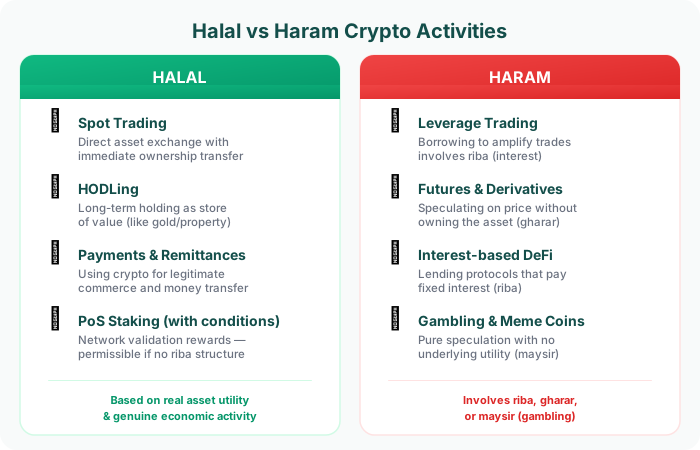
Halal Crypto Activities
Spot Trading (Immediate Ownership Transfer) — Buying and selling cryptocurrency on spot markets, where ownership transfers immediately, is widely considered halal. This mirrors traditional commodity trading (bay’ al-sarf), which is permissible under Shariah law as long as the exchange is immediate.
HODLing (Buy and Hold) — Purchasing crypto with the intention of long-term holding is generally accepted. You own the actual asset, there is no interest involved, and the investment is based on the belief that the asset will appreciate — similar to buying gold or real estate.
Using Crypto for Payments and Remittances — Sending money using cryptocurrency for legitimate purchases or cross-border remittances is halal, as it fulfills a real economic need without involving interest or gambling.
Proof-of-Stake (PoS) Staking — This is an area of evolving scholarly opinion. Increasingly, scholars accept PoS staking as halal because the validator is providing a real service (securing the network) in exchange for rewards — similar to mudarabah (profit-sharing partnerships). The Malaysia Securities Commission approved staking services, and projects like ZIGChain received Shariah certification for staking in 2025.
Haram Crypto Activities
Leverage/Margin Trading — Trading with borrowed funds that charge interest is clearly haram due to riba. Most exchanges offer 10x–100x leverage, and the interest (funding rates) charged on these positions violates the prohibition on usury.
Futures and Derivatives Without Underlying Assets — Perpetual contracts and speculative derivatives that don’t involve actual ownership of the underlying asset constitute gharar (excessive uncertainty) and are not permissible.
DeFi Lending with Fixed Interest Rates — Platforms that offer fixed interest rates on DeFi lending replicate the conventional banking model of riba and are haram.
Gambling and Casino Platforms — Any crypto used for online gambling, prediction markets based on chance, or casino platforms is maysir and strictly forbidden.
Meme Coins with No Utility — Tokens created purely for speculation with no real project, utility, or asset backing are considered maysir by most scholars due to their gambling-like nature.
| Activity | Ruling | Reason |
|---|---|---|
| Spot trading (buy/sell) | Halal | Immediate ownership transfer; like commodity trading |
| HODLing (long-term hold) | Halal | Real asset ownership; no interest |
| Payments / remittances | Halal | Fulfills real economic need |
| PoS staking | Halal* | Network service reward; increasingly accepted |
| Margin/leverage trading | Haram | Interest on borrowed funds = riba |
| Futures/derivatives | Haram | No real ownership; excessive gharar |
| DeFi lending (fixed interest) | Haram | Fixed interest = riba |
| Gambling / casino platforms | Haram | Maysir (gambling) |
| Meme coins (no utility) | Haram | Pure speculation = maysir |
*PoS staking is an area of ongoing scholarly debate. The majority trend in 2026 favors permissibility when the staking involves genuine network participation.
Shariah-Compliant Crypto Platforms and Projects
The demand for halal crypto has led to the emergence of dedicated platforms, screening services, and even entire blockchain networks built for Shariah compliance. Here are the most notable options in 2026:
HAQQ Network / Islamic Coin (ISLM)
HAQQ Network is an EVM-compatible Layer 1 blockchain built specifically for the Muslim community. Its native token, Islamic Coin (ISLM), was designed from the ground up to comply with Shariah law. Key features include:
- Shariah Oracle — on-chain compliance checking for all transactions
- Evergreen DAO — 10% of every ISLM issuance goes to a charitable fund for Muslim communities
- Fatwa-certified — approved by multiple independent Shariah scholars
- EVM-compatible — supports Ethereum-based dApps with Shariah compliance built in
Binance Shariah Earn
In 2025, Binance — the world’s largest crypto exchange — launched its Shariah Earn product, offering halal staking services vetted by an independent Shariah advisory board. This marked a major step in making Shariah-compliant crypto accessible to mainstream users.
Bybit Islamic Account
Bybit offers a dedicated Islamic Account that removes interest-based products (futures, margin) and provides only spot trading and Shariah-screened staking options. Users can request account conversion to Islamic mode.
Crypto Ummah
Crypto Ummah is a Shariah screening service that has evaluated 358 cryptocurrencies and verified 247 as halal. Their methodology examines each project’s revenue model, token utility, governance, and compliance with Islamic principles. Think of it as a halal certification body for crypto — similar to how food products receive halal certification.
Malaysia’s 15 Approved Digital Assets
The Malaysia Securities Commission maintains a list of 15 approved digital assets that can be traded on regulated Malaysian exchanges. Each asset was reviewed by the SC’s Shariah Advisory Council, making Malaysia the only country with a government-backed Shariah crypto framework.
| Platform / Project | Type | Shariah Features | Status (2026) |
|---|---|---|---|
| HAQQ Network / ISLM | L1 Blockchain | Shariah Oracle, Evergreen DAO, fatwa-certified | Active |
| Binance Shariah Earn | Exchange Feature | Halal staking, Shariah advisory board | Active |
| Bybit Islamic Account | Exchange Feature | Spot-only mode, no interest products | Active |
| Crypto Ummah | Screening Service | 247/358 coins verified halal | Active |
| Malaysia SC Framework | Government Regulation | 15 approved digital assets, SAC-vetted | Active |
Crypto Adoption in Muslim-Majority Countries
Understanding how Muslim-majority countries are adopting cryptocurrency provides important context for the “is crypto halal” debate. Adoption is surging despite — and sometimes because of — the ongoing scholarly discussion.
| Country | Muslim Pop. | Crypto Status | Islamic Finance | Key Stats |
|---|---|---|---|---|
| Nigeria | ~110M | Legal, regulated | Growing sector | 22M users, $59B volume, #2 global; 35% adults invested |
| Pakistan | ~230M | Legalizing (VAA 2026) | Shariah requirements in new law | 40M+ users; Virtual Assets Act 2026 with Shariah provisions |
| Indonesia | ~230M | Legal, commodity | MUI conditional ruling | World’s largest Muslim population; crypto as commodity OK |
| Turkey | ~84M | Legal, regulated | No Diyanet ruling | High adoption driven by lira inflation; growing exchange market |
| UAE | ~8M | Legal, regulated | 55+ Islamic fintech firms | Abu Dhabi/Dubai as Islamic fintech hubs |
| Bahrain | ~1.5M | Legal, regulated | 100+ Islamic fintech firms | Central Bank sandbox for Shariah crypto products |
| Malaysia | ~21M | Legal, regulated | Pioneer Shariah framework | 15 approved Shariah-compliant digital assets |
| Egypt | ~95M | Restricted | Dar al-Ifta fatwa (haram) | Despite fatwa, P2P trading volume growing |
| Saudi Arabia | ~35M | Cautious | No explicit fatwa | $24.9B market; Project mBridge CBDC participant |
The data reveals a clear trend: Muslim-majority countries are among the top crypto adopters globally, with Nigeria and Pakistan alone accounting for over 60 million users. The regulatory direction in most of these countries is toward accommodation and Shariah-compliant frameworks rather than outright bans.
How to Calculate Zakat on Cryptocurrency
Zakat is one of the Five Pillars of Islam — a mandatory charitable contribution of 2.5% of qualifying wealth. If you hold cryptocurrency, you are obligated to calculate and pay zakat on your holdings just as you would on gold, silver, or cash savings.
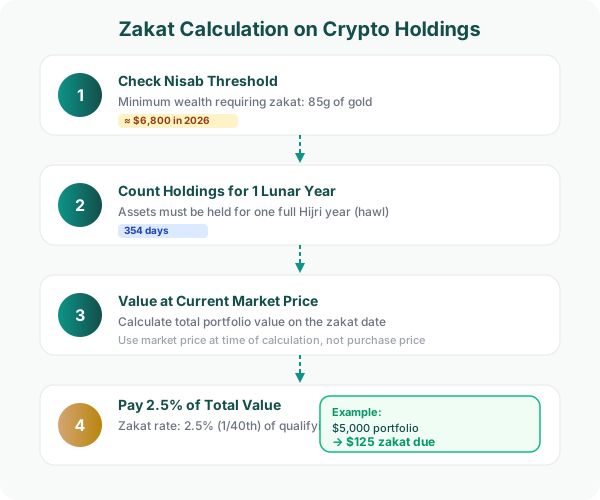
Zakat Rules for Crypto
| Parameter | Requirement |
|---|---|
| Rate | 2.5% of total qualifying holdings |
| Holding Period | One full lunar year (354 days) of continuous ownership |
| Nisab Threshold | Equivalent value of 85 grams of gold (~$7,200 at current prices) |
| Valuation Method | Current market price on zakat due date |
| Which Holdings Count | All crypto held for investment or savings (not daily-use wallet) |
Step-by-Step Zakat Calculation Example
Let’s walk through a practical example for a portfolio worth $5,000:
| Step | Action | Example |
|---|---|---|
| 1 | Calculate total crypto holdings at current market price | 0.05 BTC ($3,500) + 500 USDT + 2 ETH ($1,000) = $5,000 |
| 2 | Check if held for one lunar year (354 days) | Purchased March 2025 → Due March 2026 ✓ |
| 3 | Check if above Nisab (85g gold ≈ $7,200) | $5,000 < $7,200 → Below Nisab, no zakat due |
| 4 | If above Nisab: multiply total by 2.5% | If portfolio were $10,000 → $10,000 × 0.025 = $250 zakat |
| 5 | Pay zakat in cash or crypto to eligible recipients | Donate $250 to zakat-eligible causes |
Tip: Use the Zakat Foundation’s cryptocurrency calculator to automate this process. Emirates Islamic Bank also launched a dedicated crypto zakat calculator in 2025, processing over 50,000 zakat calculations in its first year.
Remember: if your total wealth (including cash, gold, and crypto combined) exceeds the Nisab, all qualifying holdings are subject to zakat — even if your crypto alone falls below the threshold.
How to Invest in Crypto the Halal Way
If you’ve decided to invest in cryptocurrency while maintaining Shariah compliance, follow these five steps:
- Choose a Shariah-compliant platform — Use exchanges that offer Islamic accounts or Shariah-vetted services. Binance Shariah Earn, Bybit Islamic Account, and Malaysia’s regulated exchanges are good starting points. Look for platforms that have been reviewed by an independent Shariah advisory board. Read our guide to buying your first crypto for step-by-step exchange setup instructions.
- Stick to spot trading only — Buy and sell cryptocurrency directly on spot markets where you receive immediate ownership. Avoid any product labeled “futures,” “perpetual,” “margin,” or “leverage.” These products involve borrowing and interest, which violate riba principles.
- Avoid interest-bearing products — Do not use DeFi lending platforms that offer fixed interest rates, margin trading with funding rates, or any “earn” product that generates returns through interest. If a platform offers “staking,” verify it involves real Proof-of-Stake network participation, not just relabeled interest.
- Screen coins for halal compliance — Before investing in any token, check its status on Crypto Ummah (247 verified halal coins) or consult the Malaysia SC’s approved list. Focus on coins with real utility, active development, and transparent governance. Avoid meme coins, casino tokens, and projects with no clear purpose. Review our crypto scams guide to identify fraudulent projects.
- Calculate and pay zakat annually — Set a reminder for your zakat due date (one lunar year from when your holdings first exceeded Nisab). Use a crypto portfolio tracker to monitor values and calculate 2.5% on the due date. Ensure your wallet is secure to protect the assets you’ll be paying zakat on.
I personally follow these five steps for my own crypto holdings. The key insight I’ve gained: keeping things simple — spot trading, holding quality assets, and avoiding leverage — not only satisfies Shariah requirements but also tends to produce better long-term results than speculative trading.
Frequently Asked Questions
Is Bitcoin halal?
Bitcoin’s permissibility depends on how you use it. Buying and holding Bitcoin as an investment or using it for legitimate payments is generally considered halal by the majority of scholars (including Malaysia’s Securities Commission). However, using Bitcoin for leverage trading, gambling, or other haram activities makes those specific activities haram — not Bitcoin itself. Think of it like cash: money is neutral, but how you use it matters.
Is crypto staking halal?
Proof-of-Stake (PoS) staking is increasingly accepted as halal by Islamic scholars, particularly when it involves genuine network participation (validating transactions). The Islamic Finance Guru and Malaysia’s Securities Commission have both indicated that PoS staking can be permissible. However, “staking” products that are actually repackaged interest-bearing deposits (common on centralized exchanges) may not qualify as halal.
Is crypto trading the same as gambling?
No — but certain types of crypto trading can cross into gambling (maysir) territory. Spot trading based on research and fundamental analysis is not gambling; it’s similar to commodity trading, which is permitted in Islam. However, high-leverage speculation, trading meme coins based purely on hype, and using prediction markets are forms of gambling and are haram. The distinction lies in whether the activity involves skill, research, and genuine economic participation versus pure chance.
Do I need to pay zakat on crypto?
Yes. If your total crypto holdings exceed the Nisab threshold (equivalent to 85 grams of gold, approximately $7,200 in 2026) and you’ve held them for one lunar year (354 days), you must pay 2.5% zakat. This applies to all crypto held for investment or savings. Use the Zakat Foundation’s calculator for an easy computation.
Which crypto exchanges are Shariah-compliant?
In 2026, the main options include: Binance (Shariah Earn product with advisory board), Bybit (Islamic Account mode), and regulated Malaysian exchanges (Luno, Tokenize) that operate under the Securities Commission’s Shariah framework. Additionally, the HAQQ Network offers a fully Shariah-native blockchain ecosystem. Always verify that the specific products you use have been reviewed by qualified Shariah scholars.
Continue Learning
Related Articles on ChainGain:
Disclaimer: This article is for educational purposes only and does not constitute financial advice, investment advice, or religious guidance. The information about Islamic finance principles and scholarly opinions is presented for informational purposes — readers should consult qualified Islamic scholars and financial advisors for personal rulings. Cryptocurrency investments carry significant risk, and past performance does not guarantee future results. Always do your own research before making any investment decisions.