
Published: 30 Mar. 2026 · 16 min read · Difficulty: Beginner
USDT (Tether) is the single most-used cryptocurrency for cross-border transfers. With a $184 billion market cap and roughly 58–60% of all stablecoin volume, it has become the de-facto digital dollar for millions of people who need to move money across borders quickly and cheaply.
I first sent USDT abroad in 2022 — a $200 test transfer to a freelancer in Vietnam. The transaction settled in 4 seconds on the TRON network and cost me $1.20 in fees. My bank had quoted me $35 for the same transfer, with a 3–5 business day wait. Since then, I’ve sent hundreds of USDT transactions across 12 countries, and I’ve made every mistake in this guide at least once — so you don’t have to.
This step-by-step guide covers everything you need to send USDT internationally: choosing the right network, avoiding costly mistakes, and understanding the safety considerations that most guides ignore.
Why USDT Is the World’s Most Popular Remittance Stablecoin
USDT dominates cross-border crypto transfers for three reasons: availability, speed, and ecosystem depth. Here’s where it stands in 2026:
| Metric | Value | Source |
|---|---|---|
| Market capitalization | $184 billion | Tether Transparency Page |
| Stablecoin market share | 58–60% | CoinGecko |
| TRON network annual volume | $7.9 trillion (2024) | Chainalysis |
| Number of USDT holders | 350+ million wallets | Tether |
| Supported blockchains | 16+ networks | Tether.to |
| Countries with active P2P USDT markets | 100+ | Exchange data |
| USDT Supply on TRON | ~42% | Tether Transparency Page |
USDT’s dominance is especially visible in emerging markets. In countries like Nigeria, Turkey, Argentina, and Vietnam, USDT functions as a parallel currency — people use it not just for remittances, but to protect savings from inflation and pay for goods and services.
The TRON network alone processed $7.9 trillion in USDT transfers in 2024 — more than Visa’s annual payment volume. That’s not speculation; it’s real people moving real money.
For background on how stablecoins work and why they maintain a $1 peg, see our What Are Stablecoins? guide.
USDT Network Comparison: Fees, Speed, and Trade-offs
USDT exists on multiple blockchains simultaneously, and the network you choose determines your fee and speed. This is the most important decision you’ll make when sending USDT abroad. Here’s my real-world data from 12 months of transfers:
| Network | Typical Fee | Speed | Pros | Cons |
|---|---|---|---|---|
| TRON (TRC-20) | $1.20–4.01 | 3–5 seconds | Largest USDT network, universally supported | Higher fees than newer chains |
| Solana (SPL) | ~$0.0001 | <1 second | Near-zero fees, fastest settlement | Occasional network congestion |
| Polygon (PoS) | ~$0.002 | 2–5 seconds | Very low fees, good exchange support | Less P2P liquidity in some regions |
| BSC (BEP-20) | $0.05–0.10 | 3–5 seconds | Wide exchange support, reliable | Higher fees than Solana/Polygon |
| Arbitrum One | <$1.00 | 1–3 seconds | Ethereum security, low fees | Newer, fewer P2P on/off-ramps |
| TON | $0.01–0.05 | 5–10 seconds | Telegram integration, growing fast | Limited exchange support vs TRON |
| Ethereum (ERC-20) | $0.50–$7+ | 15–60 seconds | Most secure, universal DeFi support | Fees spike during congestion |
My recommendation: For most international transfers, TRON (TRC-20) remains the safest default choice — not because it’s cheapest, but because the recipient almost certainly has a TRC-20 wallet and every major exchange supports it. If both sender and receiver use the same exchange (like Binance or Bybit), Solana is hard to beat at $0.0001.
I personally use Solana for transfers between exchanges and TRON for sending to individuals, because I’ve never met someone in Nigeria, Turkey, or Vietnam who didn’t have a TRC-20 address ready.
For a deeper dive into blockchain fee structures, see our Best Blockchain for Sending Money comparison.
How to Send USDT Abroad: 5 Steps
Whether you’re sending $50 to a friend or $5,000 to a business partner, the process follows the same five steps. I’ll walk through each one with the specific details that matter.
-
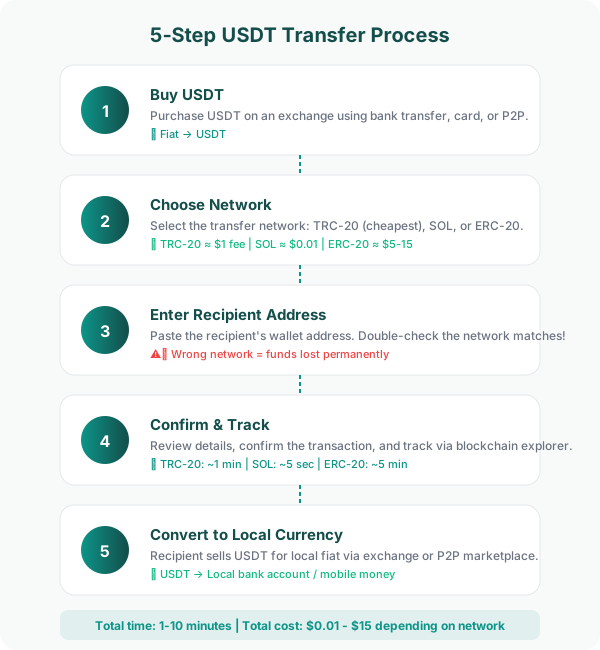
The complete 5-step process for sending USDT to another country. Step 1: Buy USDT on a Crypto Exchange
If you don’t already hold USDT, you’ll need to buy it first. The most common methods:
- Bank deposit or card purchase — Most major exchanges (Binance, Bybit, OKX, KuCoin) let you buy USDT directly with your local currency using a bank transfer, debit card, or credit card.
- P2P marketplace — On Binance P2P, Bybit P2P, or similar platforms, you buy directly from another person using local payment methods (bank transfer, mobile money, cash deposit). This is the most common method in countries like Nigeria, Kenya, India, and Turkey where direct card purchases may be restricted.
Tip: P2P rates vary by 1–3% between sellers. Always compare at least 3 offers before buying, and check the seller’s completion rate (aim for 95%+ with 500+ trades).
New to crypto? See our How to Buy Your First Crypto guide for a full walkthrough of the buying process.
-
Step 2: Choose the Right Network
This is where most people lose money. You and your recipient must use the same network. Sending USDT on TRON to an Ethereum address will result in permanent loss of funds.
How to choose:
- Ask your recipient which network they use — This is the single most important step. Never assume.
- If they don’t know — Default to TRON (TRC-20). It has the widest support and lowest confusion rate.
- If you’re both on the same exchange — Consider Solana for near-zero fees, or use the exchange’s internal transfer feature (free on most platforms).
- If they’re converting to local currency via P2P — Ask which network their exchange supports for deposits. Most P2P platforms in emerging markets default to TRC-20.
In my experience, TRON handles about 70% of my international USDT transfers because of its universal compatibility. The $1–4 fee is a small price for certainty.
-
Step 3: Get the Recipient’s Wallet Address
Ask your recipient to send you their deposit address for the specific network you agreed on. This is critical:
- Copy-paste only — Never type a wallet address manually. A single wrong character means lost funds.
- Verify the first and last 4 characters — After pasting, compare them with the original. Clipboard-hijacking malware is a real threat. I run a quick visual check on every transaction.
- Check for memo/tag requirements — Some exchanges require an additional memo or tag alongside the wallet address (especially for deposits on certain networks). Forgetting the memo means the exchange can’t credit the deposit, and recovery takes days to weeks.
Send a test transaction first. For any new address, send $1–5 first and wait for the recipient to confirm they received it. The $1–4 in extra fees is cheap insurance against losing your entire transfer. I still do this for every new recipient, even after hundreds of transactions.
For more on protecting your crypto during transfers, see our Cryptocurrency Security Guide.
-
Step 4: Confirm the Transaction and Track It
Once you’ve entered the address and amount, your exchange will show you a confirmation screen. Double-check:
- Network — Matches what you agreed with the recipient
- Amount — Correct (remember: withdrawal fees are deducted from the amount on most exchanges)
- Address — First and last 4 characters match
- Fee — Within expected range for the network
After confirming, you’ll receive a transaction hash (TXID). Share this with your recipient so they can track the transfer:
- TRON: Tronscan.org
- Ethereum / Arbitrum: Etherscan.io
- Solana: Solscan.io
- BSC: BscScan.com
- Polygon: PolygonScan.com
On TRON, you’ll typically see the transaction confirmed within 5 seconds. On Ethereum, expect 1–5 minutes depending on gas fees paid.
-
Step 5: Recipient Converts USDT to Local Currency
Once the USDT arrives, the recipient has several options to convert it to local currency:
- P2P marketplace — Sell USDT for local currency on Binance P2P, Bybit P2P, or local platforms. This is the most common method in Africa, Southeast Asia, and Latin America. Typical spreads: 0.5–2% above market rate.
- Direct exchange withdrawal — If the exchange supports fiat withdrawals in the recipient’s country, they can sell USDT for local currency and withdraw to a bank account.
- Crypto debit card — Some services allow spending USDT directly via Visa/Mastercard.
- Local crypto shops — In some countries (Nigeria, Vietnam, Turkey), physical shops buy USDT for cash.
For safe P2P trading practices, see our P2P Crypto Trading Safety Guide.
Exchange Withdrawal Fees: Side-by-Side Comparison
Withdrawal fees vary significantly between exchanges and networks. Here’s what major exchanges charge for USDT withdrawals as of early 2026:
| Exchange | TRON (TRC-20) | Solana (SPL) | Ethereum (ERC-20) | BSC (BEP-20) | Polygon | Arbitrum |
|---|---|---|---|---|---|---|
| Binance | 1.0 USDT | 1.0 USDT | 3.2 USDT | 0.29 USDT | 0.1 USDT | 0.1 USDT |
| Bybit | 1.0 USDT | 1.0 USDT | 3.0 USDT | 0.3 USDT | 0.1 USDT | 0.1 USDT |
| OKX | 0.8 USDT | 0.1 USDT | 3.0 USDT | 0.3 USDT | 0.1 USDT | 0.1 USDT |
| KuCoin | 1.0 USDT | 1.0 USDT | 3.5 USDT | 0.3 USDT | 0.1 USDT | 0.1 USDT |
Key observations from my testing:
- OKX consistently has the lowest TRON withdrawal fee (0.8 USDT vs 1.0 USDT elsewhere)
- Polygon and Arbitrum are universally cheap (0.1 USDT) across all exchanges
- Ethereum ERC-20 fees are 3–30x higher than alternatives — avoid this network unless the recipient specifically needs it
- These are fixed fees, so they matter most on small transfers. Sending $100 via Ethereum (3.0+ USDT fee) costs 3%+, while the same amount via Polygon costs 0.1%
Pro tip: If you regularly send USDT, compare the total cost (exchange withdrawal fee + network fee + P2P spread at the receiving end) rather than looking at withdrawal fees alone.
5 Common Mistakes That Lose Money
Mistake 1: Sending to the Wrong Network
This is the most expensive mistake you can make with USDT. Sending TRC-20 USDT to an ERC-20 address (or vice versa) can result in permanent, irrecoverable loss of funds. Some exchanges can recover cross-network deposits, but the process takes weeks and isn’t guaranteed.
Prevention: Always confirm the network with your recipient before sending. Read the network name on the withdrawal screen out loud. If you’re sending to a new person, ask them to screenshot their deposit page showing the network.
Mistake 2: Skipping the Test Transaction
I know — paying $1 in fees for a $2 test transfer feels wasteful. But I’ve seen people lose $3,000 because they sent to an old address, a wrong network, or a wallet that had been compromised. A $1–4 test transfer is the cheapest insurance in crypto.
Prevention: Always send a small amount first when using a new address. Wait for the recipient to confirm receipt before sending the full amount.
Mistake 3: Forgetting the Memo or Tag
Some exchanges generate a single deposit address shared across all users, using a memo (or tag or destination tag) to identify which account the deposit belongs to. If you forget the memo, the exchange receives your USDT but doesn’t know it’s yours.
Prevention: If the deposit page shows a memo field, it’s required. Copy it along with the address. Some wallets auto-populate the memo — verify it wasn’t left blank.
Mistake 4: Ignoring Exchange Withdrawal Fees
Choosing Ethereum (ERC-20) for a $50 transfer costs 6–10% in withdrawal fees alone. Plenty of beginners select ERC-20 by default because it appears first in the network dropdown. I made this mistake on my second-ever USDT withdrawal and paid $7 to send $80.
Prevention: Always check the fee before confirming. If the fee is more than 1% of your transfer amount, switch to a cheaper network (TRON, Polygon, or Solana).
Mistake 5: Not Accounting for Recipient’s Conversion Costs
You might pay $1 to send USDT on TRON, but if your recipient’s local P2P market has a 3% spread on the network you chose, the real cost is $1 + 3% — not just $1. Some networks have deep P2P liquidity (TRON), while others (Arbitrum, Polygon) may have thinner markets in certain countries.
Prevention: Ask your recipient to check the sell price for USDT on their preferred P2P platform before you send. In most emerging markets, TRC-20 USDT has the tightest P2P spreads.
Is USDT Safe? What You Need to Know
USDT is the largest stablecoin, but it’s not without controversy and risk. Here’s an honest assessment based on publicly available data:
Frozen Addresses and Blacklists
Tether has the ability to freeze USDT in any wallet. As of early 2026, Tether has frozen approximately 7,268 addresses holding ~$3.3 billion in USDT across TRON and Ethereum, according to on-chain analytics. Reasons include:
- Law enforcement requests (sanctions compliance, fraud investigations)
- Hack recovery (Tether has frozen stolen funds at the request of exchanges)
- OFAC sanctions (addresses linked to sanctioned entities)
For legitimate users, the risk of having your USDT frozen is extremely low. Tether primarily targets addresses flagged by law enforcement. However, it’s important to understand that USDT is not censorship-resistant — unlike Bitcoin or Ethereum, Tether can and does freeze funds.
Travel Rule Compliance
The FATF Travel Rule requires crypto exchanges to share sender and recipient information for transfers above certain thresholds (typically $1,000–3,000 depending on jurisdiction). This means:
- Large USDT transfers between exchanges may require identity verification
- Some exchanges delay or reject transfers that don’t include Travel Rule data
- P2P transfers to personal wallets are generally not affected
EU Warning: MiCA and USDT
The EU’s Markets in Crypto-Assets (MiCA) regulation has created uncertainty for USDT in Europe. As of early 2026, several EU exchanges have restricted or delisted USDT because Tether has not obtained the required e-money license. If you’re sending USDT to someone in the EU, verify that their exchange still supports it, or consider using USDC as an alternative.
For a deeper understanding of stablecoin mechanics, reserves, and risks, see our What Are Stablecoins? guide.
USDT vs USDC: Which Should You Use?
USDC (by Circle) is USDT’s main competitor. Here’s how they compare for international transfers:
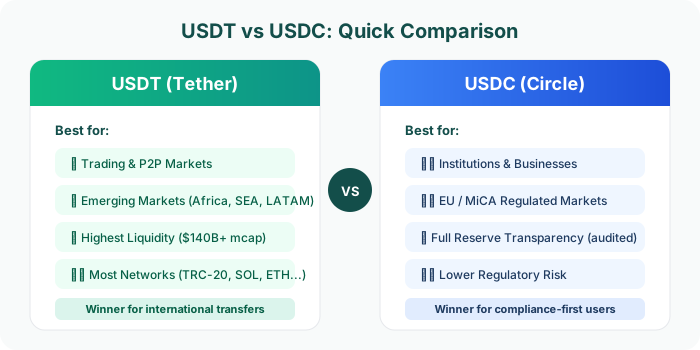
| Feature | USDT (Tether) | USDC (Circle) |
|---|---|---|
| Market cap | ~$184 billion | ~$60 billion |
| Stablecoin market share | 58–60% | ~20% |
| Reserve transparency | Quarterly attestations (BDO Italia) | Monthly attestations (Deloitte), real-time dashboard |
| EU MiCA compliance | Not compliant (restricted on EU exchanges) | Compliant (licensed in France) |
| P2P liquidity (emerging markets) | Dominant (highest volume) | Lower, but growing |
| Supported networks | TRON, Ethereum, Solana, BSC, Polygon, Arbitrum, TON, +10 more | Ethereum, Solana, Polygon, Arbitrum, Base, Avalanche, +6 more |
| TRON support | Yes (largest USDT network) | No |
| Can freeze funds | Yes (7,268+ addresses frozen) | Yes (fewer cases) |
| Best for | Emerging markets, TRON transfers, P2P | EU users, regulated exchanges, DeFi on Ethereum/Solana |
Bottom line: Use USDT for transfers to Africa, Southeast Asia, Latin America, Turkey, and the CIS region where TRC-20 dominates. Use USDC if you’re sending to the EU (where USDT availability is limited) or if the recipient specifically requests it.
Frequently Asked Questions
How long does it take to send USDT internationally?
On most networks, USDT transfers settle in seconds to minutes. TRON takes 3–5 seconds, Solana under 1 second, and Ethereum 15–60 seconds. The only delay is usually the exchange’s withdrawal processing time, which ranges from instant to 30 minutes depending on the platform and amount.
What is the cheapest way to send USDT abroad?
The cheapest option is Solana (SPL) at ~$0.0001 per transfer, followed by Polygon (~$0.002) and BSC ($0.05–0.10). However, the total cost includes your exchange’s withdrawal fee, so a “free” network with a $1 exchange fee still costs $1. For most people, TRON at $1–4 total offers the best balance of cost and universal compatibility.
Can I send USDT without KYC?
Wallet-to-wallet USDT transfers require no identity verification — you just need the recipient’s address. However, buying USDT on most exchanges requires at least basic KYC. Some P2P platforms and decentralized exchanges allow purchases with minimal verification, but availability varies by country.
What happens if I send USDT to the wrong network?
If you send USDT on the wrong network (e.g., TRC-20 USDT to an ERC-20 address), the funds may be permanently lost. Some exchanges can recover cross-chain deposits, but the process requires a support ticket, takes 1–4 weeks, and sometimes incurs a recovery fee. Personal wallets generally cannot recover wrong-network transfers.
Is it legal to send USDT internationally?
In most countries, sending USDT for personal remittances is legal. However, regulations vary: some countries require reporting transfers above certain thresholds, and a few (like China) restrict crypto trading entirely. Always check your local regulations and the recipient’s local regulations before sending. The FATF Travel Rule may also apply to exchange-to-exchange transfers above $1,000–3,000.
Continue Learning
- Crypto vs Bank Transfers: Remittance Cost Guide — Compare 20 corridors with real fee data
- Best Blockchain for Sending Money — Full fee comparison across all networks
- What Are Stablecoins? — How USDT, USDC, and DAI maintain their peg
- P2P Crypto Trading Safety Guide — Avoid scams when buying and selling crypto
- How to Buy Your First Crypto — Complete beginner buying guide
- What Is Cryptocurrency? — The fundamentals explained
- How Blockchain Technology Works — Understand the tech behind USDT
- Cryptocurrency Security Guide — Protect your assets
About the Author: Alex Mercer is a crypto analyst at ChainGain with 5+ years of experience covering digital assets, cross-border payments, and blockchain technology. He has personally tested sending USDT across 12+ countries and 8 blockchain networks. Full bio →