
Intermediate
Disclosure: This article is for educational purposes only. ChainGain may earn a commission if you sign up through our links, at no extra cost to you. See our Affiliate Disclosure and Editorial Policy for details.
In 2025, the global freelancing market reached an estimated $1.5 trillion, with over 1.57 billion people working independently worldwide. Yet the payment infrastructure for cross-border freelance work remains stuck in the past — wire transfers that take 3–5 days, PayPal fees that eat 4–6% of every invoice, and currency conversion spreads that silently drain your earnings.
I’ve been tracking freelancer payment methods across 15 countries for the past two years, comparing fees, speeds, and reliability for every major corridor. The conclusion is clear: crypto-based payments — particularly stablecoins — can save freelancers 50–80% on cross-border payment fees while reducing settlement from days to minutes. This isn’t theoretical. Freelancers in Nigeria, Pakistan, the Philippines, Brazil, and dozens of other countries are already making this switch.
This guide covers the complete workflow: choosing the right stablecoin, getting clients to pay in crypto, converting to your local currency, and staying compliant with your country’s tax rules. If you already understand what cryptocurrency is and want to apply it to your freelance income, this is your roadmap.
Why Freelancers Are Switching to Crypto Payments
Freelancers are adopting crypto payments because traditional cross-border payment methods charge excessive fees, impose long settlement times, and often exclude freelancers in developing countries from the global economy.
Consider the numbers. A freelancer in Nigeria completing a $1,000 project for a US client faces these costs with traditional methods:
| Payment Method | Fee | FX Spread | Total Cost | Settlement Time |
|---|---|---|---|---|
| International wire | $25–50 | 1–3% | $55–80 | 3–5 business days |
| PayPal | 4.4% + $0.30 | 3–4% | $74–84 | 1–3 business days |
| Wise (TransferWise) | 0.5–1.5% | Mid-market rate | $5–15 | 1–2 business days |
| USDT (TRC-20) | ~$1 | 0–0.5% (P2P) | $1–6 | Under 5 minutes |
| USDC (Polygon) | $0.01–0.10 | 0–0.5% (P2P) | $0.10–6 | Under 2 minutes |
The difference is dramatic. On a $1,000 payment, a freelancer using PayPal loses $74–84 (7–8% of their income). The same payment via USDT on TRC-20 costs $1–6 — saving $68–83 per transaction. For a freelancer processing $5,000/month in cross-border payments, that’s $340–415/month in recovered income.
According to the World Bank Remittance Prices Worldwide database, the global average cost of sending $200 was 6.35% in Q3 2025. Crypto transfers on low-cost networks consistently come in under 1%.
Beyond fees, three factors are driving adoption:
- Speed: Stablecoin transfers settle in minutes, not days. No “pending” periods, no weekend delays.
- Access: Freelancers in countries with limited banking infrastructure (Nigeria, Pakistan, Venezuela) can receive payments without a traditional bank account.
- Currency protection: Holding earnings in USDT/USDC preserves dollar value in countries with high inflation — see our Stablecoin Savings Guide for details.
How Crypto Freelancer Payments Work: Step-by-Step
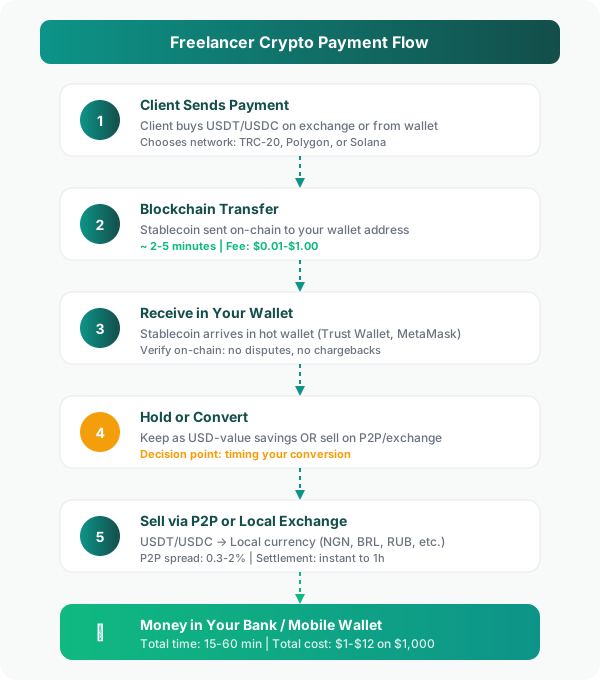
The basic workflow is simpler than most people expect. Here’s how a typical crypto-based freelance payment works, from invoice to local spending money:
Step 1: Agree on payment terms. You and your client agree to payment in a stablecoin (usually USDT or USDC). You provide your wallet address.
Step 2: Client sends stablecoin. The client purchases stablecoin on an exchange or already holds it, and sends it to your wallet address on the agreed network (TRC-20, Polygon, etc.).
Step 3: You receive the payment. The stablecoin arrives in your wallet within minutes. You verify the amount on-chain — no disputes, no chargebacks, no “payment processing.”
Step 4: Hold or convert. You can hold the stablecoin as a dollar-denominated savings (earning yield on some platforms) or convert to your local currency when you need to spend.
Step 5: Convert to local currency. When ready, sell your stablecoin via a P2P platform, local exchange, or direct merchant payment to get your local currency. See our P2P Trading Safety Guide for security best practices.
Step 6: Withdraw to bank/mobile money. Funds arrive in your bank account or mobile money wallet, ready to spend.
The entire process — from client sending to you holding local currency — typically takes 15–60 minutes, compared to 3–5 business days with traditional methods. And unlike PayPal or wire transfers, there’s no intermediary that can freeze, reverse, or delay your payment.
To understand why blockchain enables this speed, see our guide on how blockchain technology works.
Best Stablecoins for Freelancer Income
Not all stablecoins are equal for freelancer payments. The three major options each have distinct advantages:
| Feature | USDT (Tether) | USDC (Circle) | DAI (MakerDAO) |
|---|---|---|---|
| Market Cap | ~$184B | ~$79B | ~$5B |
| Backing | Reserves (Treasuries, commercial paper) | US Treasuries + bank deposits | Crypto-collateralized (over-collateralized) |
| Best chains | Tron (TRC-20), Ethereum, Polygon | Ethereum, Polygon, Solana, Base | Ethereum, Polygon |
| Transfer fee (typical) | $1 (TRC-20), $2–5 (ETH) | $0.01–0.10 (Polygon), $2–5 (ETH) | $2–5 (ETH), $0.05 (Polygon) |
| P2P liquidity | ⭐⭐⭐⭐⭐ Highest globally | ⭐⭐⭐⭐ High in US/EU | ⭐⭐ Limited |
| Regulatory clarity | Medium (some regulatory scrutiny) | High (US-regulated, transparent audits) | Medium (decentralized governance) |
| Best for | Emerging markets (NG, PK, VN, TR) | US/EU clients, regulated environments | DeFi users, decentralization purists |
My recommendation for most freelancers: Use USDT on TRC-20 if your clients and local market primarily use Tron (common in emerging markets). Use USDC on Polygon if your clients are US/EU-based or you prefer regulatory clarity and lower fees. DAI is a solid choice if you want to avoid centralized stablecoin risk, but its limited P2P liquidity makes it harder to convert in most countries.
For a deeper understanding of how stablecoins work, see our guide on what stablecoins are and why they matter.
Payment Platforms That Support Crypto
Getting clients to pay in crypto is easier than it was two years ago. Here are the main options:
Freelance Marketplaces
As of early 2026, major freelance platforms have varying levels of crypto support:
- Upwork: Does not natively support crypto payments. Freelancers receive payment via bank transfer, PayPal, or Payoneer. However, you can use Payoneer to convert to crypto through third-party services.
- Fiverr: Does not support crypto payments directly. Standard withdrawal methods apply.
- Freelancer.com: Does not natively support crypto payments or withdrawals.
For platform-based work, the crypto optimization happens after you receive payment — converting your Payoneer/bank balance to stablecoins via a local exchange to hold value or send internationally.
Direct Crypto Invoicing (Recommended for Independent Clients)
For clients outside of marketplaces, crypto invoicing tools make it easy to request and receive stablecoin payments:
| Platform | How It Works | Supported Stablecoins | Fees |
|---|---|---|---|
| Request Network | Create professional invoices paid in crypto. Client pays from any wallet. | USDT, USDC, DAI, ETH + 50 tokens | Free (network gas fees only) |
| CoinGate | Payment gateway + invoicing. Auto-converts to fiat if desired. | USDT, USDC, BTC, ETH + 70 tokens | 1% processing fee |
| Bitwage | Payroll service — employer pays in fiat, you receive in crypto. | USDT, USDC, BTC, ETH | Varies by plan |
| Gilded | Enterprise-grade crypto invoicing with accounting integration. | USDT, USDC, DAI + major tokens | Custom pricing |
| Direct wallet transfer | Share your wallet address. No intermediary needed. | Any token on any chain | Network gas fee only ($0.01–5) |
In my experience, direct wallet transfers are the simplest for recurring clients who are already crypto-literate. For clients new to crypto, Request Network provides a familiar invoice experience that guides them through the payment process.
Converting Crypto to Local Currency
This is where the rubber meets the road. Receiving stablecoins is only useful if you can efficiently convert them to your local currency when needed. The best method depends on your country:
Country-Specific Off-Ramp Guide
| Country | Best Off-Ramp Methods | Local Currency | Typical P2P Spread | Settlement |
|---|---|---|---|---|
| 🇳🇬 Nigeria | Bybit P2P, OKX P2P, Quidax, local exchangers | NGN | 0.5–2% | Instant (bank transfer/mobile) |
| 🇵🇰 Pakistan | Binance P2P, OKX P2P, local exchangers | PKR | 0.5–1.5% | JazzCash/EasyPaisa: instant; Bank: 1–24h |
| 🇵🇭 Philippines | Binance P2P, Coins.ph, PDAX | PHP | 0.3–1.5% | GCash/Maya: instant; Bank: 1h |
| 🇮🇳 India | WazirX P2P, Binance P2P (limited) | INR | 0.5–2% | UPI: instant; IMPS: 1h |
| 🇰🇪 Kenya | Binance P2P, Paxful, local dealers | KES | 1–3% | M-Pesa: instant |
| 🇧🇷 Brazil | Binance P2P, Mercado Bitcoin, Foxbit | BRL | 0.3–1% | PIX: instant |
| 🇷🇺 Russia | Bybit P2P, Garantex (limited), local exchangers | RUB | 0.5–2% | Bank transfer: instant–1h |
| 🇹🇷 Turkey | BTCTurk, Paribu, Binance P2P | TRY | 0.3–1.5% | Bank transfer: instant–1h |
| 🇻🇳 Vietnam | Binance P2P, Remitano, OKX P2P | VND | 0.5–1.5% | Bank transfer: instant–1h |
| 🇮🇩 Indonesia | Tokocrypto, Indodax, Binance P2P | IDR | 0.5–2% | Bank transfer: instant–1h |
Pro tip from my research: Always check multiple P2P platforms before selling. Spreads can vary by 1–2% between platforms on the same day. For amounts over $500, splitting across two trades often gets you a better average rate.
If you’re new to P2P trading, our P2P Trading Safety Guide covers escrow procedures, scam avoidance, and best practices for safe trades. For understanding the broader cost picture of cross-border transfers, see our Remittance Cost Comparison Guide.
Fee Comparison: Crypto vs Traditional Methods
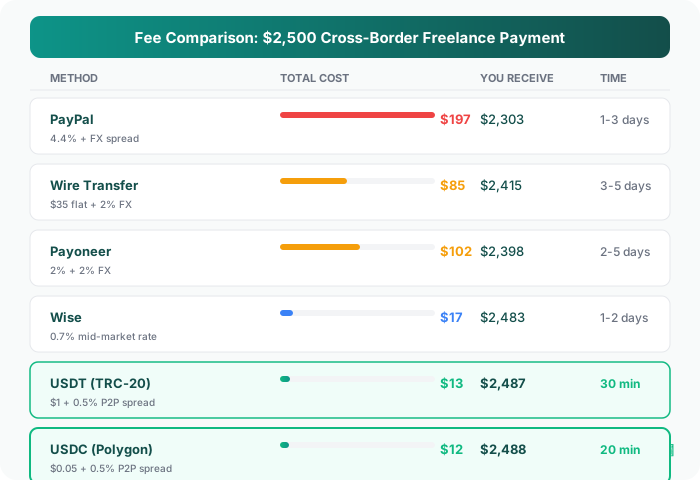
Let’s put real numbers on a common freelancer scenario. Imagine you’re a web developer in the Philippines who completes a $2,500 project for a US-based startup. Here’s what each payment method actually costs:
| Method | Platform Fee | FX Cost | Withdrawal Fee | Total Cost | You Receive | Time |
|---|---|---|---|---|---|---|
| Wire Transfer | $35 | $50 (2%) | $0 | $85 | $2,415 | 3–5 days |
| PayPal | $110 (4.4%) | $87 (3.5%) | $0 | $197 | $2,303 | 1–3 days |
| Payoneer | $50 (2%) | $50 (2%) | $2 | $102 | $2,398 | 2–5 days |
| Wise | $17 (0.7%) | Mid-market | $0 | $17 | $2,483 | 1–2 days |
| USDT (TRC-20) → P2P | $1 | $12 (0.5% P2P spread) | $0 | $13 | $2,487 | 30 min |
| USDC (Polygon) → P2P | $0.05 | $12 (0.5% P2P spread) | $0 | $12 | $2,488 | 20 min |
The savings are staggering. Switching from PayPal to USDC on Polygon saves $185 per $2,500 payment — that’s a 7.4% increase in take-home pay. Over 12 months of similar projects, a freelancer processing $30,000 annually saves approximately $2,220.
Even compared to Wise (the cheapest traditional option), crypto payments save $4–5 per transaction and settle in minutes instead of days. The advantage grows larger for freelancers in countries where Wise doesn’t support local currency withdrawal.
Tax Considerations for Crypto Freelancers
Receiving income in cryptocurrency doesn’t exempt you from taxes. In most jurisdictions, crypto received as payment for services is treated as ordinary income, valued at the market price on the date of receipt. Here are key principles that apply in most countries:
General Tax Principles
- Income recognition: When you receive USDT/USDC for freelance work, the value in your local currency at that moment is your taxable income. This is true whether or not you convert to fiat.
- Record keeping: Track every payment — date, amount in crypto, value in local currency, client name, invoice reference. This is your audit trail.
- Capital gains: If you hold stablecoins and their value changes relative to your local currency before you convert, some jurisdictions treat the difference as a capital gain or loss.
- Estimated tax payments: If freelancing is your primary income, many countries require quarterly estimated tax payments. Don’t wait until year-end.
Country-Specific Notes
| Country | Tax Treatment | Key Rules |
|---|---|---|
| Nigeria | Income tax applies; crypto not banned for individuals | Report as self-employment income. CBN restrictions apply to banks, not individuals. |
| Pakistan | Grey area — no specific crypto tax law | Income from freelancing is taxable regardless of payment method. SBP has not legalized crypto but enforcement is minimal. |
| Philippines | Income tax on crypto received as payment | BIR treats crypto income like any other freelance income. 8% flat tax for self-employed under ₱3M. |
| India | 30% flat tax on crypto gains + 1% TDS | Income received in crypto taxed as “Income from Other Sources” or business income. 1% TDS on P2P transactions via Indian exchanges. |
| Brazil | Progressive income tax (7.5–27.5%) | Crypto is declared as a digital asset. Monthly gains exceeding R$35,000 subject to capital gains tax. Freelancers as MEI have simplified tax regime. |
| Turkey | No specific crypto income tax (as of 2026) | General income tax applies. Crypto regulation bill pending. MASAK monitors transactions. |
Important: Tax laws change frequently, especially in the crypto space. Always consult a local tax professional or accountant for advice specific to your situation. This guide provides general information only.
Security Best Practices for Freelancer Wallets
When your wallet is your paycheck, security isn’t optional. Freelancers receiving regular crypto payments need a system that balances accessibility (you need to receive payments quickly) with protection (you can’t afford to lose your earnings). For a comprehensive security overview, see our Cryptocurrency Security Guide.
The Two-Wallet Strategy
I recommend every crypto freelancer use at minimum two wallets:
- Hot wallet (receiving): A software wallet (Trust Wallet, MetaMask, or exchange wallet) for receiving client payments and day-to-day transactions. Keep only what you need for the next 1–2 weeks of expenses.
- Cold wallet (savings): A hardware wallet (Ledger, Trezor) or a secure software wallet for storing the bulk of your earnings. Transfer funds here weekly or when your hot wallet balance exceeds $500.
For guidance on selecting the right wallets, see our Crypto Wallet Guide.
Freelancer-Specific Security Checklist
- Verify wallet addresses: Always double-check the first 6 and last 6 characters before sharing your address with a client. Address poisoning scams target people who copy-paste from transaction history.
- Use a dedicated freelance wallet: Separate your freelance income from personal crypto holdings. This simplifies tax reporting and limits exposure.
- Enable 2FA everywhere: Use authenticator apps (not SMS) for every exchange and wallet that supports it.
- Whitelist withdrawal addresses: On exchanges, whitelist your cold wallet address so even if someone accesses your account, they can only withdraw to your wallet.
- Back up your seed phrase: Store it offline in two separate physical locations. Never in cloud storage, email, or screenshots.
- Test with small amounts first: Before a new client sends their first payment, do a $5 test transfer to confirm the address and network are correct.
FAQ
Can I receive freelance payments in crypto if my client doesn’t use crypto?
Yes. Services like Bitwage allow clients to pay in fiat (USD, EUR, etc.) while you receive the equivalent in crypto. The conversion happens automatically. Alternatively, you can educate your client on buying stablecoin — it takes about 10 minutes for a first-time buyer on Coinbase or Binance.
What if the stablecoin price fluctuates between receiving and converting?
Major stablecoins (USDT, USDC) maintain a very tight peg to the US dollar — typically within 0.01–0.05%. The risk is minimal compared to holding volatile currencies like the Nigerian Naira or Turkish Lira, which can fluctuate 5–20% in a month. Your real currency risk comes from the local currency side, not the stablecoin side.
Is it legal to receive freelance payments in crypto?
In most countries, receiving crypto as payment for services is legal. However, regulations vary significantly. In some countries (like China), crypto trading is restricted. In others (like the Philippines, Brazil, Turkey), it’s recognized and taxable. Always check your local regulations before starting.
How do I invoice clients for crypto payments?
Use a crypto invoicing tool like Request Network (free) or CoinGate (1% fee). These generate professional invoices with a payment link. The client clicks, selects their wallet, and pays — similar to paying a PayPal invoice. For regular clients, you can simply share your wallet address and the amount.
What’s the minimum amount where crypto payments make sense?
For payments under $50, traditional methods may be comparable in cost (especially if you use free services like domestic bank transfers). Crypto payments become clearly advantageous for cross-border payments of $100 or more, where the percentage-based fees of traditional services start to add up significantly.
Do I need to report every crypto payment to tax authorities?
In most jurisdictions, yes. Crypto received as income is taxable at the market value when received. Keep detailed records of every payment including date, amount, value in local currency, and client information. Some countries have minimum reporting thresholds — consult a local tax professional for specifics.
Final Thoughts
The freelancer payment landscape is shifting. What started as a niche option for crypto enthusiasts has become a practical financial tool for millions of independent workers worldwide. The numbers don’t lie: crypto payments are faster, cheaper, and more accessible than traditional alternatives for cross-border freelance work.
The key is to approach it systematically: choose the right stablecoin for your market, set up a secure wallet system, understand your tax obligations, and start with small amounts to build confidence. You don’t need to convert your entire workflow overnight — even moving one client to crypto payments lets you experience the benefits firsthand.
For freelancers in emerging markets especially, this isn’t just an optimization — it’s a meaningful increase in take-home income. Saving 5–8% on every cross-border payment adds up to thousands of dollars per year. That’s money that stays in your pocket instead of disappearing into bank fees and currency conversion spreads.
Continue Learning
- What Is Cryptocurrency? A Complete Beginner’s Guide
- How Blockchain Works: The Technology Behind Crypto
- How to Choose a Crypto Wallet: The Complete Guide
- What Are Stablecoins? Understanding Digital Dollar Alternatives
- Cryptocurrency Security: How to Protect Your Digital Assets
- Crypto vs Bank Transfers: The True Cost of Sending Money
- Stablecoin Savings Guide: Protect Your Money from Inflation
- P2P Crypto Trading Safety Guide: How to Buy and Sell Safely
Disclaimer: This article is for educational purposes only and does not constitute financial, tax, or investment advice. Cryptocurrency payments involve risks including price volatility, regulatory changes, and counterparty risk. Tax rules vary by jurisdiction and change frequently — always consult a local tax professional. For our full disclaimer, see our Responsible Trading Disclaimer.