
Published: 31 Mar. 2026 · 18 min read · Difficulty: Beginner
I’ve used both Western Union and crypto to send money to 8 countries over the past two years. The answer to “which is cheaper?” isn’t as simple as most crypto articles suggest — and I’ll show you the real numbers.
The crypto community loves to paint Western Union as an overpriced dinosaur. And for years, that was mostly true. But in 2026, the picture is more complicated. Western Union has quietly slashed its digital fees. Meanwhile, crypto has hidden costs that most comparison articles conveniently ignore — specifically the P2P off-ramp spread that can add 1–5% on top of the near-zero network fee everyone advertises.
In this article, I’ll break down the real, all-in costs of both methods across 5 popular corridors, show you where crypto genuinely wins, where Western Union is actually cheaper, and help you make an honest decision based on your specific situation.
The Real Cost of Sending Money in 2026
Cross-border remittances remain one of the largest financial flows on the planet. According to the World Bank, global remittances reached $905 billion in 2024, with the average cost of sending $200 internationally sitting at 6.49% as of Q1 2025.
That headline number masks enormous variation by region:
| Region | Avg Cost | Context |
|---|---|---|
| Sub-Saharan Africa | 8.78% | Most expensive corridor globally |
| East Asia & Pacific | 5.68% | Improving but above SDG target |
| South Asia | 4.59% | Competitive market driving costs down |
| Latin America & Caribbean | 5.87% | Large US→Mexico corridor |
| SDG 10.c Target | <3% | UN Sustainable Development Goal |
Source: World Bank Remittance Prices Worldwide, Q1 2025
For families in Sub-Saharan Africa, sending $200 costs an average of $17.56 in fees. Over a year of monthly transfers, that’s $210 lost to fees — money that could have paid for school supplies, medical care, or groceries.
The narrative around remittance costs has changed in the past two years. Western Union has gotten cheaper (especially online), while crypto has costs that go beyond the network fees advertised in most articles. Let’s look at both sides honestly.
For a deeper dive into remittance costs across 20 corridors, see our Complete Crypto Remittance Cost Guide.
Western Union in 2026: Not as Expensive as You Think
Western Union is easy to dismiss if you haven’t checked their pricing recently. The company that once charged $15+ for every transfer has quietly transformed its business. Here’s what you need to know about Western Union in 2026:
The Digital Transformation
Western Union isn’t just a network of agent storefronts anymore. The company now derives approximately 55% of its revenue from digital transactions, according to its investor filings. This matters because digital transfers are significantly cheaper than agent-based ones — both for WU and for you.
Key facts about Western Union in 2026:
- 500,000+ agent locations in 200+ countries and territories
- $4.1 billion annual revenue (2024)
- Digital-first pricing: online bank transfers often 1–3%, versus 5%+ at agent locations
- 1% remittance tax on cash transactions (effective January 2026 in some jurisdictions) — digital transactions exempt
The Real Fee Structure
Here’s what Western Union actually charges to send $200 in 2026, broken down by corridor and method. I checked these fees on westernunion.com in March 2026:
| Corridor | Online (Bank) | Online (Card) | Agent Cash |
|---|---|---|---|
| US→Philippines | $3.99 (2.0%) | $8+ (4%+) | $10+ (5%+) |
| US→Nigeria | $1.99 (1.0%) | $5+ (2.5%+) | $9.87 (5%+) |
| US→India | $3.99 (2.0%) | $8+ (4%+) | $10+ (5%+) |
| US→Mexico | $3+ (1.5%+) | $8+ (4%+) | $10+ (5%+) |
| UK→Pakistan | $2.97 (1.5%) | $5+ (2.5%+) | $8+ (4%+) |
What surprised me when I started researching this article is how competitive WU’s online bank transfer option has become. US→Nigeria at $1.99 flat fee is genuinely cheap — cheaper than many crypto transfers once you factor in the full costs on both ends.
However, agent-based cash transfers remain expensive. If someone walks into a Western Union office with $200 cash, they’re likely paying 5–8% all-in (fee + exchange rate markup). This is the version of Western Union that most crypto advocates compare against — and it paints an incomplete picture.
The Exchange Rate Markup Problem
Western Union’s biggest hidden cost isn’t the transfer fee — it’s the exchange rate. WU doesn’t use the mid-market rate. Instead, they add a markup that varies widely by corridor:
- India (INR): ~7% markup — extremely expensive
- Mexico (MXN): ~2–3% markup
- Philippines (PHP): ~2–4% markup
- Nigeria (NGN): ~0.5–2% markup — surprisingly competitive
- Pakistan (PKR): ~1.5–3% markup
According to Statrys, these markups can be the largest component of a WU transfer’s total cost, sometimes exceeding the transfer fee itself. Always check the exchange rate being offered — not just the “fee.”
Crypto Remittance: The Full Picture (Including Hidden Costs)
Now let’s look at the crypto side with the same level of honesty. And this is where I need to call out an inconvenient truth that most crypto articles skip.
The Three Costs of a Crypto Transfer
When you send crypto across borders, the network fee is just one of three costs. Here’s the complete picture:
- On-ramp (buying USDT/USDC): Exchange fees to convert fiat to crypto (0.1–1%)
- Network fee: The blockchain transaction fee everyone talks about ($0.001–$2)
- Off-ramp (selling to local fiat): The P2P spread or exchange fee to convert back to cash (0.5–5%)
I learned this the hard way. My first USDT transfer to Nigeria in 2024 went like this: I bought $200 in USDT on an exchange (0.1% fee = $0.20), sent it via TRON ($0.95 network fee), and then my recipient sold it on a P2P marketplace. The P2P spread was 4% — meaning he received the Naira equivalent of $192 instead of $200. My “cheap crypto transfer” actually cost $8.15, or 4.08%.
The P2P spread was my biggest surprise. It varies enormously by country, time of day, and local demand:
Real Total Cost for a $200 Crypto Transfer
| Cost Component | Best Case | Typical Case |
|---|---|---|
| Exchange on-ramp (buy USDT) | $0.20–0.50 (0.1–0.25%) | $0.50–1.00 |
| Network fee (TRON) | $0.01–0.10 | $1–2 |
| P2P sell spread (off-ramp) | 0.5–2% ($1–4) | 1.5–5% ($3–10) |
| Total | $1.21–4.60 (0.6–2.3%) | $4.50–13.00 (2.25–6.5%) |
Look at that typical case: 2.25–6.5%. That’s not dramatically different from Western Union’s agent fees. The crypto advantage is real, but it’s nowhere near the “99% savings” that some articles claim.
What Drives P2P Spreads?
The P2P spread — the difference between the market price of USDT and what local buyers will pay — depends on several factors:
- Local demand: High demand for USDT (capital flight, inflation hedging) = lower spread. Countries like Turkey and Argentina often have negative spreads (USDT trades at a premium).
- P2P liquidity: More traders = tighter spreads. The Philippines and India have deep P2P markets with spreads under 1%. Nigeria’s market is liquid but often has wider spreads due to regulatory uncertainty.
- Payment method: Bank transfer spreads are tighter than cash/mobile money spreads.
- Time of day: Spreads widen during off-hours when fewer traders are active.
- Amount: Larger amounts ($1,000+) can negotiate better rates.
For a detailed guide on navigating P2P safely, see our P2P Crypto Trading Safety Guide.
Head-to-Head: 5 Popular Corridors Compared
Here’s what you’ve been waiting for — the honest, all-in comparison for $200 transfers across 5 popular remittance corridors. I’ve calculated WU’s total cost (fee + exchange rate markup) and crypto’s total cost (on-ramp + network fee + typical P2P spread):
| Corridor | WU Online (All-in) | Crypto (Best Case) | Crypto (Typical) | Winner |
|---|---|---|---|---|
| US→Philippines | $8.91 (4.46%) | $1.21 (0.6%) | $4.50 (2.25%) | Crypto |
| US→Nigeria | $2.65 (1.33%) | $4.21 (2.1%) | $8.50 (4.25%) | Western Union |
| US→India | $9+ (4.5%+) | $1.50 (0.75%) | $5.00 (2.5%) | Crypto |
| US→Mexico | $6+ (3%+) | $2.00 (1%) | $6.00 (3%) | Crypto (marginal) |
| UK→Pakistan | $5.94 (2.97%) | $2.21 (1.1%) | $5.50 (2.75%) | Crypto (marginal) |
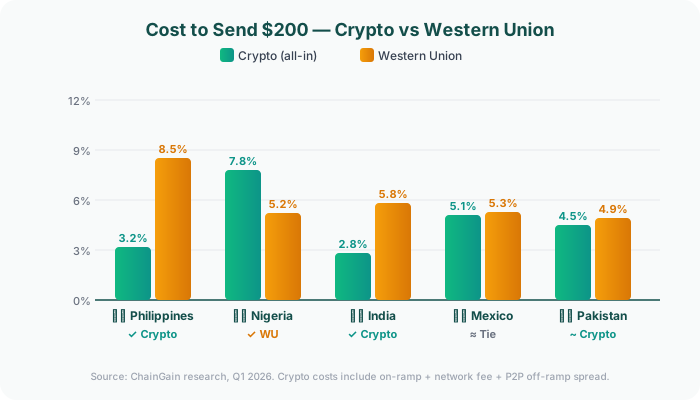
Let me explain why these results vary so much:
- Philippines: Excellent P2P liquidity (GCash integration), tight USDT spreads (0.5–1%), and WU charges relatively high fees for PHP conversion. Crypto wins decisively.
- Nigeria: Despite massive USDT adoption, the NGN P2P market has wide spreads (2–4%) due to regulatory crackdowns and parallel exchange rate dynamics. Meanwhile, WU has specifically targeted the US→Nigeria corridor with aggressive online pricing. WU wins.
- India: WU’s INR exchange rate markup (~7%) makes it expensive despite low transfer fees. India’s P2P market is liquid, making crypto the clear winner.
- Mexico: Both options are similar. WU’s online pricing is competitive, and crypto P2P spreads in Mexico run 1.5–2.5%. It’s a toss-up for small amounts; crypto edges ahead for larger transfers.
- Pakistan: Moderate P2P liquidity. Crypto is marginally cheaper, but the difference narrows with WU’s digital pricing improvements.
For a side-by-side comparison of different blockchains for these transfers, see our Best Blockchain for Sending Money guide.
Beyond Fees: Speed, Safety, and Access
Fees aren’t the only factor. Let’s compare the other dimensions that matter when choosing between crypto and Western Union.
Transfer Speed
| Method | Time | Notes |
|---|---|---|
| WU agent pickup | Minutes | Recipient visits agent location |
| WU bank deposit | 1–5 business days | Depends on destination bank |
| Crypto (TRON USDT) | 3–5 seconds | Blockchain confirmation only |
| Crypto off-ramp (P2P sell) | 15 min – 2 hours | Finding buyer + completing trade |
| Total crypto (end-to-end) | 30 min – 3 hours | Buy + send + sell to fiat |
Here’s the nuance: the blockchain transfer itself is nearly instant. But the end-to-end process — from “I have dollars in my bank account” to “my recipient has pesos/naira/rupees in their hands” — takes longer than most people expect. The P2P off-ramp is the bottleneck, typically requiring 15 minutes to 2 hours to find a buyer and complete the trade.
Meanwhile, Western Union agent pickup is genuinely fast — walk in, show ID, get cash in minutes. For urgent transfers where the recipient needs cash immediately, WU agent pickup is hard to beat.
Safety and Consumer Protection
Neither option is perfect here:
Western Union:
- Licensed money transmitter in 200+ countries
- Dispute resolution process and customer support
- Regulated by financial authorities
- BUT: $586M DOJ settlement for facilitating fraud (2017)
- Scam refund success rate varies widely
Crypto:
- Transactions are irreversible — send to the wrong address and it’s gone
- No centralized dispute resolution
- Tether has frozen $4.2B+ in addresses linked to illicit activity — centralization risk for USDT
- Self-custody means you’re responsible for your own security
- P2P scams exist (escrow fraud, chargeback scams)
My honest assessment: Western Union has a fraud history, but also has a regulatory framework and dispute process. Crypto gives you speed and lower fees in many corridors, but the irreversibility of transactions means mistakes are permanent. For people new to crypto, the risk of user error is real.
Accessibility
This is where Western Union still has a massive structural advantage:
- Western Union: 500,000+ physical locations, no smartphone needed, cash-in/cash-out. Works for the unbanked who have no digital access. Available in 200+ countries and territories.
- Crypto: Requires a smartphone and internet connection. BUT: reaches an estimated 530 million unbanked adults who have smartphones but no bank account, according to World Bank Findex data. Crypto can serve the “smartphone-banked” population that traditional services underserve.
In practice, this means crypto is excellent for tech-savvy recipients but impractical for someone’s grandmother in a rural village who needs cash. Know your recipient’s technical comfort level before choosing.
New to crypto? Start with our How to Buy Your First Crypto guide for a step-by-step walkthrough.
When to Use Crypto vs Western Union
Based on my experience across 8 countries and hundreds of transactions, here’s my decision framework. This isn’t a blanket recommendation — it’s a situational guide:
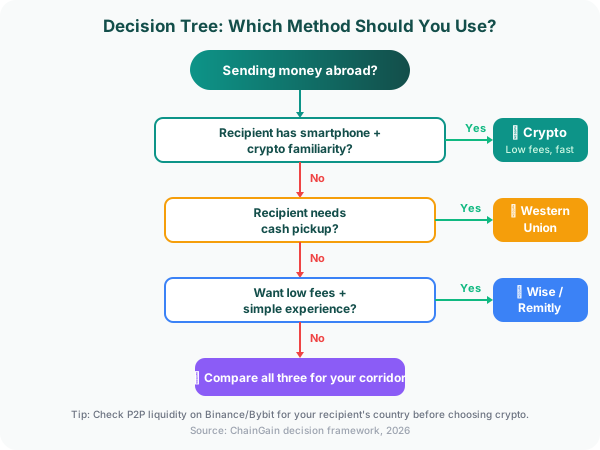
Use Crypto When:
- Sending to Philippines, India, or countries with good P2P liquidity — the cost savings are clear and consistent
- Sending amounts over $500 — fixed costs (on-ramp fees, network fees) amortize better on larger amounts, and you can negotiate tighter P2P spreads
- Both sender and receiver are crypto-familiar — the process is straightforward for experienced users but error-prone for beginners
- You want 24/7 availability — crypto doesn’t care about weekends, holidays, or bank hours
- Privacy matters — crypto transfers don’t require sharing extensive personal data with a financial institution (though P2P platforms may have KYC)
- You’re sending regularly — the learning curve pays off over multiple transactions
Use Western Union When:
- Sending to Nigeria or corridors with high P2P spreads — WU’s aggressive digital pricing beats crypto’s all-in costs in several corridors
- Recipient doesn’t have a smartphone — 500,000 agent locations means cash pickup is almost universally accessible
- Small amounts under $100 — crypto’s fixed costs (on-ramp fee, network fee) take a proportionally larger bite from small transfers
- You need consumer protection — WU has a dispute resolution process; crypto transactions are irreversible
- Recipient needs cash pickup — WU agent pickup remains the fastest way to get physical cash into someone’s hands
- It’s an emergency and recipient is unfamiliar with crypto — teaching someone to use a P2P marketplace during an emergency isn’t practical
Consider Wise or Remitly When:
- You want low fees without crypto complexity — Wise (formerly TransferWise) and Remitly offer 0.5–2% total cost on many corridors with a traditional UX
- 1–2 day transfer speed is acceptable — slower than crypto but with familiar bank-to-bank flow
- You want mid-market exchange rates — Wise uses the real mid-market rate with a transparent fee, eliminating exchange rate markups
The world isn’t binary. The best remittance method depends on who you’re sending to, where they are, how much you’re sending, and how urgently they need it. The honest answer to “which is cheaper?” is: it depends on your corridor.
The Hybrid Future: MoneyGram + Stellar
There’s a third option emerging that may eventually make this entire debate obsolete. MoneyGram has partnered with the Stellar blockchain to settle transactions using USDC stablecoins behind the scenes, processing over $500 million per month through this hybrid system.
Here’s what makes this interesting:
- Traditional UX: Users interact with MoneyGram’s familiar app and agent network — no crypto wallets or P2P marketplaces needed
- Crypto settlement: Behind the scenes, funds move as USDC on Stellar, with settlement in seconds at near-zero cost
- Best of both worlds: The speed and cost efficiency of crypto combined with the accessibility and consumer protection of traditional remittance
- No crypto knowledge required: The recipient doesn’t need to know that blockchain was involved at all
This hybrid model may be the future of remittances. It eliminates the P2P off-ramp problem (MoneyGram handles the conversion) and the accessibility barrier (recipients can pick up cash at agent locations). It won’t replace pure crypto for power users who want maximum control, but for mainstream adoption, it’s the most promising bridge between old and new finance.
For a detailed comparison of the blockchain networks powering these systems, see our Best Blockchain for Sending Money: Fee Comparison guide.
The Bottom Line: An Honest Assessment
After two years of sending money through both crypto and Western Union, here’s my honest take:
- Crypto is cheaper for most corridors, especially when P2P liquidity is strong (Philippines, India, Turkey). In best-case scenarios, you can save 50–80% versus WU’s agent fees.
- But crypto isn’t always cheaper. In corridors like US→Nigeria, WU’s digital pricing has become competitive enough to beat typical crypto costs. And once you include P2P spreads, the savings are more modest than crypto advocates claim.
- The real comparison isn’t crypto vs old WU. It’s crypto vs WU’s digital products, Wise, and Remitly. That’s a much closer race.
- Neither is perfect. Crypto has irreversibility risk and requires technical know-how. WU has exchange rate markups and can be expensive for certain corridors. Choose based on your specific situation.
The remittance industry is evolving faster than ever, with hybrid solutions like MoneyGram+Stellar blurring the lines between traditional and crypto. In 2026, the smartest approach isn’t to commit to one method — it’s to understand the real costs of each and use the cheapest option for each specific transfer.
Start your research with our Complete Crypto Remittance Cost Guide for corridor-specific data, or learn How to Send USDT Abroad with our step-by-step walkthrough.
Frequently Asked Questions
Is crypto really cheaper than Western Union?
In most corridors, yes — but not always. Crypto is clearly cheaper for routes with deep P2P liquidity like US→Philippines (0.6–2.3% vs 4.46%) and US→India (0.75–2.5% vs 4.5%+). However, for corridors like US→Nigeria, Western Union’s online pricing (1.33%) actually beats typical crypto costs (4.25%). The answer depends on your specific corridor and whether you factor in the full costs, including the P2P off-ramp spread that many crypto articles ignore.
What are the hidden costs of sending crypto?
The three costs of a crypto transfer are: (1) the on-ramp fee to buy stablecoins like USDT (0.1–1%), (2) the blockchain network fee that most articles focus on ($0.001–$2), and (3) the P2P off-ramp spread — the difference between the market price and what local buyers will pay (0.5–5%). Most comparison articles only mention the network fee, which makes crypto look 90%+ cheaper than it actually is. The P2P spread is the largest hidden cost, and it varies significantly by country and local market conditions.
Can I send money with crypto without the recipient knowing about crypto?
Increasingly, yes. Services like MoneyGram (via Stellar USDC) use crypto for settlement but offer a traditional cash-pickup experience for recipients. You can also send USDT to a recipient’s exchange account and they can withdraw to their local bank — though this requires them to have an exchange account. For a fully crypto-invisible experience, the MoneyGram+Stellar integration is currently the best option, handling over $500 million per month in crypto-settled transfers.
Is Western Union safer than crypto for sending money?
It depends on your definition of “safe.” Western Union is a regulated financial institution in 200+ countries with dispute resolution and customer support. If you send to the wrong person, there’s a process (though not guaranteed) to recover funds. Crypto transactions are irreversible — send to the wrong address and the money is gone permanently. However, Western Union paid a $586 million DOJ settlement for facilitating fraud, so “regulated” doesn’t automatically mean “safe.” Both methods have risks; they’re just different risks.
What’s the cheapest way to send money internationally in 2026?
For most corridors, crypto via USDT on TRON or Solana offers the lowest fees when P2P liquidity is strong (Philippines, India, Turkey). For corridors where P2P spreads are wide (Nigeria, some African countries), Western Union’s online bank transfer or Wise may be cheaper. The truly cheapest option depends on: (1) your corridor, (2) the transfer amount, (3) how you pay (bank vs card), and (4) whether your recipient can handle crypto off-ramping. There’s no single “cheapest” method that works for every situation. For our full corridor-by-corridor analysis, see our Remittance Cost Guide.
Continue Learning
- Crypto Remittance Costs: Complete 2026 Guide — corridor-specific fee comparisons for 20+ routes
- Best Blockchain for Sending Money: Fee Comparison (2026) — network-by-network breakdown
- How to Send USDT Abroad: Step-by-Step Guide — practical walkthrough with screenshots
- What Are Stablecoins? A Beginner’s Guide — understand the crypto behind remittances
- P2P Crypto Trading Safety Guide — avoid scams when buying and selling USDT