Disclosure: This article contains affiliate links. If you sign up through our links, we may earn a commission at no extra cost to you. We only recommend platforms we have personally tested. See our full Affiliate Disclosure and Editorial Policy for details.
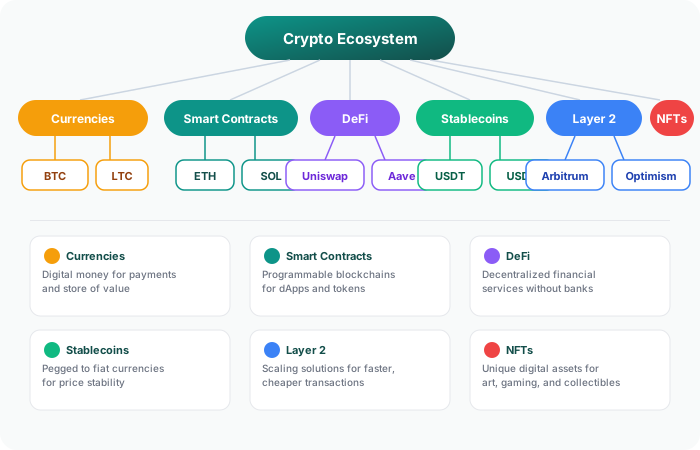
Cryptocurrency has its own language. From airdrop to zero-knowledge proof, this glossary explains 200+ crypto terms in plain English. Bookmark this page — it’s designed as a quick reference you’ll come back to as you explore the crypto ecosystem.
I update this glossary regularly as new terminology emerges in the fast-moving crypto space. Each definition is written to be understood without prior knowledge, and I link to our detailed guides where you can dive deeper.
A
- Address
- A unique string of characters (like a bank account number) where cryptocurrency can be sent and received. Bitcoin addresses start with “1,” “3,” or “bc1.” Ethereum addresses start with “0x.”
- Airdrop
- Free distribution of tokens to wallet holders, often used for marketing or to reward early adopters of a protocol. Be cautious — fake airdrops are a common scam.
- Algorithm
- A set of mathematical rules a blockchain follows to validate transactions and create new blocks. Bitcoin uses SHA-256; Ethereum uses Keccak-256.
- All-Time High (ATH)
- The highest price a cryptocurrency has ever reached. Bitcoin’s ATH exceeded $100,000 in 2024.
- Altcoin
- Any cryptocurrency other than Bitcoin. The term comes from “alternative coin.” Examples: Ethereum (ETH), Solana (SOL), Cardano (ADA).
- AML (Anti-Money Laundering)
- Regulations that require financial institutions — including crypto exchanges — to verify customer identities and report suspicious transactions.
- AMM (Automated Market Maker)
- A decentralized exchange mechanism that uses math formulas and liquidity pools instead of order books. Uniswap and PancakeSwap are AMMs.
- APR (Annual Percentage Rate)
- The yearly interest rate earned or paid, without compounding. Used in DeFi lending and staking to show expected returns.
- APY (Annual Percentage Yield)
- Similar to APR but includes compounding. A 10% APY means you earn slightly more than 10% APR because returns are reinvested.
- Arbitrage
- Buying a cryptocurrency on one exchange where the price is lower and selling it on another where the price is higher, profiting from the difference.
- Atomic Swap
- A peer-to-peer trade of cryptocurrencies between different blockchains without using a centralized exchange. Uses hash time-locked contracts (HTLCs).
B
- Bear Market
- A prolonged period of declining prices. In crypto, bear markets often see 70-90% drops from all-time highs and can last 1-2 years.
- Bitcoin (BTC)
- The first and largest cryptocurrency, created by the pseudonymous Satoshi Nakamoto in 2009. It uses Proof of Work consensus and has a maximum supply of 21 million coins. Learn more about cryptocurrency basics.
- Block
- A container of transaction data on a blockchain. Each block references the previous block’s hash, forming a chain. Bitcoin blocks are created roughly every 10 minutes.
- Block Explorer
- A website that lets you search and view all transactions, addresses, and blocks on a blockchain. Examples: Etherscan (Ethereum), Mempool.space (Bitcoin).
- Block Height
- The number of blocks in a blockchain before a given block. The genesis block has height 0. Higher block height means more transaction history.
- Block Reward
- New cryptocurrency given to miners (or validators) for successfully adding a new block. Bitcoin’s current reward is 3.125 BTC per block (after the April 2024 halving).
- Blockchain
- A distributed digital ledger that records transactions across many computers so no single entity controls it. Each block is cryptographically linked to the previous one. Read our full blockchain explainer.
- Bridge
- A protocol that connects two different blockchains, allowing assets to move between them. Example: moving ETH from Ethereum to Arbitrum via the Arbitrum Bridge.
- Bull Market
- A prolonged period of rising prices. Crypto bull markets are often triggered by Bitcoin halvings and can see 10-20x gains across the market.
- Burn
- Permanently removing tokens from circulation by sending them to an unreachable address. Ethereum burns a portion of transaction fees since EIP-1559 (August 2021).
C
- CEX (Centralized Exchange)
- A cryptocurrency exchange operated by a company that holds your funds. Examples: Margex, BloFin, Binance. Offers fiat on-ramps and customer support but requires trusting the exchange with your assets.
- Circulating Supply
- The number of coins currently available in the market. Bitcoin’s circulating supply is ~19.8 million out of 21 million maximum.
- Cloud Mining
- Renting mining hardware remotely instead of buying and running it yourself. Many cloud mining services have turned out to be scams — approach with caution.
- Coin
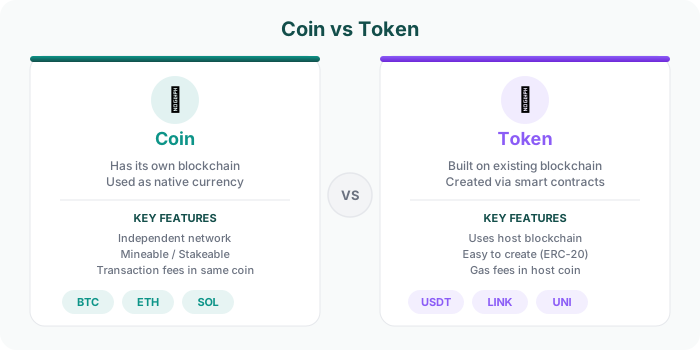
- A cryptocurrency that has its own blockchain. Bitcoin (BTC), Ethereum (ETH), and Solana (SOL) are coins. Compare with token, which runs on another blockchain.
- Cold Storage / Cold Wallet
- Storing cryptocurrency offline, disconnected from the internet. Hardware wallets (Ledger, Trezor) and paper wallets are cold storage methods. Most secure for long-term holding. See our wallet guide.
- Collateral
- Assets locked up to secure a loan. In DeFi, you might deposit $150 of ETH to borrow $100 of USDC (over-collateralization).
- Confirmation
- When a transaction is included in a block and added to the blockchain. More confirmations = more secure. Bitcoin typically needs 6 confirmations (~1 hour).
- Consensus Mechanism
- The method a blockchain uses to agree on which transactions are valid. Major types: Proof of Work (Bitcoin), Proof of Stake (Ethereum), Delegated Proof of Stake (EOS).
- Cross-Chain
- Technology that enables interaction between different blockchains. Cross-chain bridges, atomic swaps, and interoperability protocols are examples.
- Cryptocurrency
- Digital money secured by cryptography that operates on decentralized networks. Unlike traditional money, it doesn’t require banks or governments. Complete beginner’s guide here.
- Custody
- Who controls the private keys to your crypto. Self-custody means you hold your own keys; custodial services (like exchanges) hold them for you.
D
- DAO (Decentralized Autonomous Organization)
- An organization governed by smart contracts and token-holder votes, with no central leadership. MakerDAO and Uniswap governance are examples.
- dApp (Decentralized Application)
- An application built on a blockchain. Unlike regular apps, dApps run on a peer-to-peer network and can’t be controlled by a single entity.
- DeFi (Decentralized Finance)
- Financial services (lending, borrowing, trading, insurance) built on blockchain without traditional intermediaries like banks. Total DeFi TVL fluctuates between $50-200 billion.
- DEX (Decentralized Exchange)
- A cryptocurrency exchange that operates without a central authority. Users trade directly from their wallets. Examples: Uniswap, dYdX, PancakeSwap. No KYC required.
- Diamond Hands
- Slang for holding cryptocurrency through extreme price drops without selling. The opposite of “paper hands.”
- DID (Decentralized Identity)
- A system where individuals control their own digital identity without relying on centralized providers like Google or Facebook.
- Difficulty
- In Proof of Work blockchains, a measure of how hard it is to find a valid block hash. Bitcoin automatically adjusts difficulty every 2,016 blocks (~2 weeks).
- DYOR (Do Your Own Research)
- A common crypto saying reminding people to investigate before investing. Never rely solely on influencer recommendations or social media hype.
E
- EIP (Ethereum Improvement Proposal)
- A formal proposal to change Ethereum’s protocol. EIP-1559 introduced fee burning; EIP-4844 introduced blob transactions for cheaper Layer 2 fees.
- ERC-20
- The most common token standard on Ethereum. USDT, USDC, LINK, and thousands of other tokens follow ERC-20 rules, making them compatible with Ethereum wallets and DeFi protocols.
- ERC-721
- The token standard for NFTs (non-fungible tokens) on Ethereum. Each ERC-721 token is unique, unlike ERC-20 tokens which are interchangeable.
- Escrow
- A trusted third party that holds funds during a transaction. In P2P crypto trading, escrow smart contracts hold the seller’s crypto until the buyer confirms payment. Learn about P2P safety.
- Ethereum (ETH)
- The second-largest cryptocurrency, launched by Vitalik Buterin on July 30, 2015. Ethereum introduced smart contracts and transitioned from Proof of Work to Proof of Stake in September 2022 (The Merge).
- Exchange
- A platform for buying, selling, and trading cryptocurrency. Can be centralized (CEX) or decentralized (DEX). How to buy crypto guide.
F
- Faucet
- A website or app that gives out small amounts of cryptocurrency for free, usually for completing simple tasks. Useful for getting testnet tokens.
- Fear and Greed Index
- A market sentiment indicator (0-100) based on volatility, volume, social media, and surveys. 0 = Extreme Fear; 100 = Extreme Greed.
- Fiat Currency
- Government-issued money that isn’t backed by a physical commodity. USD, EUR, JPY, and BRL are fiat currencies. “Fiat” comes from Latin meaning “let it be done.”
- Flash Loan
- A DeFi loan that must be borrowed and repaid within a single blockchain transaction. No collateral required. Used for arbitrage and often exploited in DeFi attacks.
- FOMO (Fear of Missing Out)
- The anxiety of missing a profitable investment. FOMO drives people to buy at market peaks. It’s one of the biggest reasons new investors lose money.
- Fork
- A change to a blockchain’s rules. A soft fork is backward-compatible; a hard fork creates a new blockchain (e.g., Bitcoin Cash forked from Bitcoin in 2017).
- FUD (Fear, Uncertainty, and Doubt)
- Negative information — sometimes true, sometimes exaggerated — spread to cause panic selling. “Don’t fall for FUD” is common crypto advice.
- Full Node
- A computer that stores the entire blockchain and validates all transactions independently. Running a full node helps decentralize the network.
- Fungible
- Interchangeable and identical. One Bitcoin equals any other Bitcoin (fungible). An NFT is non-fungible — each one is unique.
G
- Gas
- The fee paid to execute transactions on Ethereum and similar blockchains. Gas prices fluctuate based on network demand. Measured in “gwei” (1 gwei = 0.000000001 ETH).
- Gas Limit
- The maximum amount of gas you’re willing to spend on a transaction. Simple transfers need ~21,000 gas; smart contract interactions need more.
- Genesis Block
- The first block ever created on a blockchain. Bitcoin’s genesis block was mined on January 3, 2009, containing the text “Chancellor on brink of second bailout for banks.”
- Governance Token
- A token that gives holders voting rights on protocol decisions. UNI (Uniswap), AAVE, and COMP are governance tokens.
H
- Halving
- A programmed event that cuts the block reward for Bitcoin miners in half, occurring every 210,000 blocks (~4 years). The most recent halving was in April 2024, reducing the reward to 3.125 BTC. Next halving expected ~2028.
- Hardware Wallet
- A physical device that stores cryptocurrency private keys offline. Popular brands: Ledger and Trezor. Recommended for holding more than $500 in crypto. Wallet comparison guide.
- Hash
- A fixed-length string of characters produced by a mathematical function. Any input produces a unique hash. Blockchains use hashing to secure data — changing even one character completely changes the hash. How hashing secures blockchain.
- Hash Rate
- The total computational power of a Proof of Work network, measured in hashes per second. Higher hash rate = more secure network. Bitcoin’s hash rate exceeds 700 EH/s (exahashes per second).
- HODL
- Crypto slang for “hold” — originally a typo in a 2013 Bitcoin forum post. Means holding cryptocurrency long-term regardless of price volatility.
- Hot Wallet
- A cryptocurrency wallet connected to the internet (mobile app, browser extension, exchange wallet). Convenient but less secure than cold storage. Security best practices.
I
- ICO (Initial Coin Offering)
- A fundraising method where a project sells tokens to early investors. Popular in 2017-2018 but largely replaced by IDOs and launchpads due to regulatory concerns.
- IDO (Initial DEX Offering)
- A token sale conducted through a decentralized exchange instead of a centralized platform, giving more people access and reducing fraud risk.
- Immutable
- Cannot be changed or altered. Blockchain data is immutable — once a transaction is confirmed, it cannot be reversed or modified.
- Impermanent Loss
- A risk for liquidity providers in AMMs. When the price of deposited tokens changes relative to when you deposited them, you may have less value than simply holding the tokens.
- Inflation (in Crypto)
- The rate at which new tokens are created. Bitcoin has decreasing inflation (halving every 4 years). Stablecoins as an inflation hedge.
- Interoperability
- The ability of different blockchains to communicate and share data. Protocols like Cosmos (IBC) and Polkadot (XCMP) focus on cross-chain interoperability.
J-K
- Jager
- The smallest unit of Binance Coin (BNB), similar to how a satoshi is the smallest unit of Bitcoin. 1 BNB = 100,000,000 jager.
- KYC (Know Your Customer)
- Identity verification required by regulated exchanges. You submit ID, selfie, and proof of address. Some exchanges like Margex and BloFin offer trading without KYC for basic accounts.
L
- Launchpad
- A platform that helps new crypto projects raise funds and distribute tokens. Examples: Binance Launchpad, Coinlist.
- Layer 1 (L1)
- The base blockchain that processes and finalizes transactions on its own. Bitcoin, Ethereum, Solana, and Avalanche are Layer 1 blockchains.
- Layer 2 (L2)
- A secondary network built on top of a Layer 1 to improve speed and reduce costs. Arbitrum, Optimism, and zkSync are Ethereum L2s. L2s now process 11-12x more transactions than Ethereum L1 itself.
- Ledger
- A record of all transactions. In crypto, the blockchain itself is a public ledger. Also the brand name of a popular hardware wallet manufacturer.
- Leverage
- Borrowing funds to increase your trading position. 10x leverage means $100 controls $1,000 worth of crypto. Amplifies both profits and losses — extremely risky for beginners.
- Lightning Network
- A Layer 2 solution for Bitcoin that enables instant, low-cost payments by creating off-chain payment channels. Used for everyday Bitcoin transactions. Remittance cost comparison.
- Limit Order
- An order to buy or sell cryptocurrency at a specific price or better. Unlike market orders, limit orders only execute when the price reaches your target.
- Liquidity
- How easily an asset can be bought or sold without affecting its price. Bitcoin has high liquidity; small altcoins have low liquidity.
- Liquidity Pool
- A collection of tokens locked in a smart contract that provides liquidity for decentralized trading. Liquidity providers earn fees in return.
M
- Mainnet
- The live, production version of a blockchain where real transactions occur. The opposite of testnet, which uses worthless test tokens.
- Maker / Taker
- In exchange trading: a maker adds liquidity with limit orders; a taker removes liquidity with market orders. Makers usually pay lower fees.
- Market Cap
- The total value of a cryptocurrency: price × circulating supply. Bitcoin’s market cap exceeds $1 trillion. Used to rank cryptocurrencies by size.
- Market Order
- An order to buy or sell cryptocurrency immediately at the current best price. Fast execution but you might get a slightly different price than expected (slippage).
- Memecoin
- A cryptocurrency created as a joke or based on internet memes. Dogecoin (DOGE) and Shiba Inu (SHIB) are examples. Highly speculative with extreme price volatility.
- Mempool
- The waiting area for unconfirmed transactions before they’re included in a block. When the mempool is full, transaction fees increase.
- Merkle Tree
- A data structure used in blockchains to efficiently verify transaction data. Each leaf is a transaction hash, and paired hashes are combined up to a single root hash.
- Miner
- A participant in a Proof of Work network who uses computational power to validate transactions and create new blocks, earning block rewards and fees.
- Mining
- The process of using computational power to validate transactions and add new blocks to a Proof of Work blockchain. Bitcoin mining consumes significant electricity.
- Minting
- Creating new tokens or NFTs on a blockchain. When you “mint” an NFT, you create it for the first time on-chain.
- Multi-Sig (Multi-Signature)
- A wallet that requires multiple private keys to authorize a transaction. A 2-of-3 multi-sig needs 2 out of 3 keyholders to approve. Used for added security by DAOs and teams.
N-O
- NFT (Non-Fungible Token)
- A unique digital asset on a blockchain — unlike Bitcoin where each coin is identical. NFTs can represent art, music, real estate, or any unique item.
- Node
- A computer connected to a blockchain network that helps validate and relay transactions. More nodes = more decentralized and resilient network.
- Nonce
- A number used once. In mining, miners change the nonce to find a valid block hash. In transactions, the nonce prevents replay attacks by ensuring each transaction is unique.
- Off-Chain
- Transactions or data processed outside the main blockchain. Lightning Network payments are off-chain. Faster and cheaper but relies on the main chain for final settlement.
- On-Chain
- Transactions recorded directly on the blockchain. On-chain data is transparent, immutable, and verifiable by anyone.
- Oracle
- A service that feeds real-world data (prices, weather, sports scores) to smart contracts. Chainlink is the largest oracle network.
- Order Book
- A list of all buy and sell orders on an exchange, organized by price. Deep order books indicate high liquidity.
- OTC (Over-the-Counter)
- Trading directly between two parties without using a public exchange. Used for large trades to avoid market impact.
P
- Paper Wallet
- A printed piece of paper containing your cryptocurrency public and private keys. A form of cold storage, but vulnerable to physical damage or loss.
- P2P (Peer-to-Peer)
- Direct transactions between individuals without intermediaries. P2P crypto trading lets you buy Bitcoin directly from another person using local payment methods. P2P trading safety guide.
- Phishing
- A scam where attackers create fake websites or emails to steal your login credentials or private keys. Always verify URLs character by character. Scam prevention guide.
- Ponzi Scheme
- A fraudulent investment scheme that pays returns to earlier investors using new investors’ money. Many collapsed crypto projects (BitConnect, OneCoin) were Ponzi schemes.
- Private Key
- A secret cryptographic code that proves ownership and allows you to spend your cryptocurrency. Never share your private key. Losing it means losing access to your crypto permanently. Security best practices.
- Proof of Reserves
- An audit that proves a crypto exchange actually holds the assets it claims. Became important after the FTX collapse in November 2022.
- Proof of Stake (PoS)
- A consensus mechanism where validators lock up (“stake”) cryptocurrency to validate transactions. Ethereum switched to PoS in September 2022. More energy-efficient than PoW. Learn about consensus mechanisms.
- Proof of Work (PoW)
- A consensus mechanism where miners compete to solve math puzzles to validate transactions. Bitcoin uses PoW. Secure but energy-intensive.
- Protocol
- A set of rules governing how data is transmitted on a blockchain. Bitcoin protocol, Ethereum protocol, and DeFi protocols (Aave, Compound) are examples.
- Public Key
- A cryptographic code derived from your private key that serves as your receiving address. Safe to share with others. Think of it as your email address, while the private key is your password.
Q-R
- QR Code
- A scannable code that encodes a crypto wallet address, making it easy to send payments without typing long address strings.
- Rug Pull
- A scam where developers create a token, attract investors, then suddenly withdraw all liquidity and disappear. Common in DeFi and memecoin projects.
- Remittance
- Money sent across borders, typically by migrant workers to family in their home country. Crypto can reduce remittance costs from 6-10% to under 1%. Full remittance cost comparison.
- Replay Attack
- An attack where a valid transaction on one blockchain is maliciously repeated on another. Nonces and chain IDs prevent replay attacks.
- RPC (Remote Procedure Call)
- A protocol that allows applications to communicate with a blockchain node. MetaMask connects to Ethereum via RPC endpoints.
S
- Satoshi
- The smallest unit of Bitcoin, named after its creator. 1 BTC = 100,000,000 satoshis (sats). You can buy fractions of a Bitcoin.
- Satoshi Nakamoto
- The pseudonymous creator of Bitcoin who published the whitepaper in October 2008 and launched the network in January 2009. Their true identity remains unknown.
- Scalability
- A blockchain’s ability to handle increasing transactions. Bitcoin processes ~7 TPS; Ethereum ~30 TPS; Solana claims 65,000 TPS. Layer 2 solutions address scalability.
- Seed Phrase (Recovery Phrase)
- A list of 12 or 24 words that backs up your entire wallet. Anyone with your seed phrase can access all your crypto. Store it offline, never digitally. Security guide.
- Sharding
- Splitting a blockchain into smaller pieces (shards) to process transactions in parallel. Ethereum’s roadmap includes danksharding for scalability.
- Slippage
- The difference between the expected price and the actual execution price. High slippage occurs in low-liquidity markets or during volatile periods.
- Smart Contract
- Self-executing code stored on a blockchain that automatically enforces agreements when conditions are met. “If X happens, then do Y.” Ethereum pioneered smart contracts.
- Stablecoin
- A cryptocurrency designed to maintain a stable value, usually pegged to a fiat currency like the US dollar. USDT, USDC, and DAI are popular stablecoins. Complete stablecoin guide.
- Staking
- Locking up cryptocurrency to support a Proof of Stake network and earn rewards. Similar to earning interest on a savings account, but with risk.
- Supply (Max / Total / Circulating)
- Max supply: the absolute limit (Bitcoin: 21M). Total supply: all tokens created minus burned. Circulating supply: tokens currently available for trading.
- Swap
- Exchanging one cryptocurrency for another, usually on a decentralized exchange. “Swapping ETH for USDC on Uniswap.”
T
- Testnet
- A testing version of a blockchain where developers can experiment without using real money. Tokens on testnet have no value.
- Token
- A digital asset built on an existing blockchain (unlike a coin, which has its own blockchain). USDT is a token on Ethereum; BTC is a coin on the Bitcoin blockchain.
- Tokenomics
- The economics of a token: supply, distribution, inflation rate, utility, and burn mechanisms. Good tokenomics are essential for long-term value.
- TPS (Transactions Per Second)
- A measure of blockchain speed. Visa: ~24,000 TPS. Bitcoin: ~7 TPS. Ethereum: ~30 TPS. Solana: claims up to 65,000 TPS.
- TVL (Total Value Locked)
- The total amount of cryptocurrency deposited in DeFi protocols. A key metric for measuring DeFi growth. Track at DefiLlama.
- Two-Factor Authentication (2FA)
- An extra security layer requiring both your password and a code from an authenticator app (Google Authenticator, Authy). Essential for exchange accounts. Security setup guide.
U-V
- UTXO (Unspent Transaction Output)
- Bitcoin’s method of tracking balances. Instead of account balances, Bitcoin tracks unspent outputs from previous transactions. Each UTXO can only be spent once.
- Validator
- A participant in a Proof of Stake network who validates transactions and proposes new blocks. Validators stake cryptocurrency as collateral and earn rewards.
- Volatility
- How much a price fluctuates. Crypto is highly volatile — Bitcoin can move 5-10% in a single day. Stablecoins are designed to minimize volatility.
- Volume
- The total amount of cryptocurrency traded in a given period (usually 24 hours). Higher volume indicates more active trading and better liquidity.
- Vesting
- A schedule that gradually releases tokens to team members, investors, or community over time. Prevents large dumps on the market.
W-Z
- Wallet
- Software or hardware that stores your cryptocurrency private keys and lets you send, receive, and manage your crypto. Types: hot (online), cold (offline), hardware, paper. Complete wallet guide.
- Wei
- The smallest unit of Ether (ETH). 1 ETH = 1,000,000,000,000,000,000 wei (10^18). Gas prices are measured in gwei (1 gwei = 1 billion wei).
- Whale
- An individual or entity holding a very large amount of cryptocurrency. Whale movements can significantly impact market prices.
- Whitepaper
- A technical document describing a crypto project’s technology, purpose, and roadmap. Satoshi Nakamoto’s Bitcoin whitepaper (2008) started the cryptocurrency revolution.
- Wrapped Token
- A token that represents a cryptocurrency from another blockchain. Wrapped Bitcoin (WBTC) is an ERC-20 token on Ethereum backed 1:1 by real Bitcoin, letting you use BTC in Ethereum’s DeFi ecosystem.
- Yield
- The return earned on cryptocurrency through staking, lending, or providing liquidity. Expressed as APR or APY. Higher yields usually mean higher risk.
- Yield Farming
- Moving crypto between DeFi protocols to maximize returns. Can be profitable but comes with impermanent loss, smart contract risk, and gas costs.
- Zero-Knowledge Proof (ZKP)
- A cryptographic method that lets you prove something is true without revealing the underlying data. Used in privacy coins (Zcash) and ZK-rollup Layer 2s (zkSync, StarkNet) for faster, cheaper transactions.
How to Use This Glossary
This glossary is a living document. Here’s how to get the most from it:
- Bookmark this page — come back whenever you encounter an unfamiliar term
- Follow the links — each linked term connects to a detailed guide on ChainGain
- Start with the basics — if you’re new, begin with What Is Cryptocurrency? and How Blockchain Works
- Use Ctrl+F — quickly search for any term on this page
Missing a term?
The crypto vocabulary grows every month. If you can’t find what you’re looking for, check back soon — I add new terms regularly. You can also explore our full library of guides below.
FAQ
How many crypto terms are there?
The crypto ecosystem has over 500 commonly used terms, growing as new technology (DeFi, NFTs, Layer 2s, ZK proofs) emerges. This glossary covers the 200+ most essential ones.
What’s the difference between a coin and a token?
A coin operates on its own blockchain (Bitcoin, Ethereum, Solana). A token is built on top of an existing blockchain (USDC on Ethereum, CAKE on BNB Chain). All coins are crypto, but not all crypto are coins.
What does HODL mean?
HODL originated from a misspelling of “hold” in a 2013 Bitcoin forum post. It’s now an acronym for “Hold On for Dear Life” and means holding crypto long-term despite price volatility.
What’s the most important crypto term for beginners?
Private key and seed phrase — because losing them means losing your crypto permanently. Understanding these concepts before investing any money is critical. Read our security guide first.
What does gas mean in crypto?
Gas is the fee you pay to use the Ethereum network (and similar blockchains). Every transaction costs gas, measured in gwei. When the network is busy, gas prices spike. Layer 2 solutions like Arbitrum dramatically reduce gas costs.
Continue Learning
About the Author: Alex Mercer is a crypto analyst at ChainGain with 5+ years of experience covering digital assets, DeFi protocols, and blockchain technology. Full bio →
Disclaimer: This article is for educational purposes only. It does not constitute financial, legal, or investment advice. Cryptocurrency investments carry significant risk. Always do your own research before making financial decisions.