DeFi Vaults 2026: Yearn vs Beefy vs Convex vs Pendle Risk-Adjusted Returns Comparison
Table of Contents
Affiliate disclosure: ChainGain may earn a commission if you sign up through our links. This does not affect our editorial independence — we evaluate platforms by the same risk-first criteria regardless of partnership status.
Vault marketing pages quote 50% APYs in bold and audit reports in 6-point footer text. By the time most retail depositors notice the gap, their position has already paid the difference — sometimes through impermanent loss, sometimes through a Vyper compiler bug nobody saw coming. The four largest vault aggregators in 2026 — Yearn, Beefy, Convex, and Pendle — collectively hold over $2.6 billion in user deposits, but their risk profiles are not interchangeable, and the published APY numbers are not comparable without explicit risk adjustments.
This guide does what most “best DeFi vaults 2026” lists refuse to do: it discounts advertised yields by audit-quality, by historical exploit frequency, and by underlying-protocol cascade risk. We compare audit firm coverage across all four platforms, walk through every documented exploit since 2021 with verified dollar figures, and finish with a four-vault risk-adjusted APY worksheet you can apply to any new vault before depositing.
The framing throughout is honest rather than promotional. We name specific audit firms, link historical exploits to specific Vyper versions and specific compromised pools, and we do not invent rating numbers. Where a public source could not confirm a loss figure (notably the September 2024 Pendle PT/YT minting incident), we say so explicitly rather than guess.
Key Takeaways
- What DeFi vaults are: Automated yield strategy executors — replaced manual yield farming since 2022 because compound + rebalance + gas optimization are tedious.
- Top 4 vault aggregators 2026: Yearn (4.0★ proven, audit-heavy), Beefy (3.5★ cross-chain), Convex (4.0★ Curve booster), Pendle (4.5★ yield tokenization).
- Always-present vault risks: Smart contract bug, oracle manipulation, underlying protocol exploit, strategy obsolescence.
- Historical capital loss precedents: Yearn 2020 ($11M exploit), Convex 2022 (Curve depeg cascade), various Beefy strategies 2023-2025.
- Insurance options to consider: Nexus Mutual (vault-specific cover, 2-3% premium), Sherlock (real-time monitoring with bounty payouts).
- Realistic APY 2026: 3-7% on stables, 5-12% on blue-chip ETH strategies, 15%+ signals elevated risk you must underwrite consciously.
- Decision flow by holding size: $1K-10K: Yearn stables only; $10K-100K: Yearn + Pendle split; $100K+: self-custody + multi-vault diversification with insurance.
What Are DeFi Vaults? (And Why They Replaced Manual Yield Farming)
TLDR: A DeFi vault is a smart contract that takes your deposit, runs a yield strategy automatically (lending, liquidity provision, reward harvesting, and auto-compounding), and issues you a share token representing your pro-rata claim. Vaults replaced manual yield farming because optimising a position by hand can cost five to seven gas-heavy transactions per harvest cycle — often more than the yield itself at retail size — while a vault socialises that cost across thousands of depositors. The ERC-4626 standard, finalised in 2022, unified the vault interface, and compliant vaults held roughly $25 billion in TVL by April 2026.
A DeFi vault is a smart contract that accepts user deposits and executes a predefined yield strategy on the depositor’s behalf — borrowing, lending, providing liquidity, harvesting reward tokens, and auto-compounding the proceeds back into the position. In exchange, the contract issues a vault token (an ERC-4626-compliant share token in modern implementations) that represents the depositor’s pro-rata claim on the underlying assets plus accrued yield.
The category exists because manual yield farming is operationally expensive: a depositor optimising a Curve-LP-plus-CRV-staking-plus-CVX-locking position pays five to seven gas-heavy transactions per harvest cycle, and at retail position sizes the gas cost often exceeds the yield. Vault aggregators socialise these costs across thousands of depositors, executing the harvest cycle once at the contract level and distributing the proceeds in proportion to share ownership.
The smart-contract-as-portfolio-manager model
Yearn pioneered the model in 2020 with v1 vaults. The architecture has since fragmented into three dominant patterns: classic aggregators (Yearn V3, Beefy) which run pre-coded strategies; curator-based vaults (Morpho, recent Yearn V3 deployments) where named risk managers like Steakhouse Financial or Gauntlet allocate capital across whitelisted markets; and yield-tokenisation protocols (Pendle) which split yield-bearing assets into separately tradeable principal and yield tokens. Each pattern shifts a different risk to a different actor — and that shift is what most “best vault” articles fail to disclose.
ERC-4626: the standard that changed the game
ERC-4626, finalised in 2022, standardises the interface for tokenised vaults: deposit(), withdraw(), convertToShares(), convertToAssets(). Before 4626, every vault implemented its own deposit logic, which made integrations brittle and audits expensive. By April 2026, ERC-4626-compliant vaults collectively hold approximately $25 billion in TVL across Yearn V3, Morpho, Sky, Spark, Pendle, Ethena, Origin, and a long tail of treasury wrappers. The standard also makes risk modelling easier — third-party tools can read share-to-asset ratios uniformly across protocols, which is what makes the audit-quality comparison in this article possible.
How Vault Aggregators Actually Work: User → Vault → Strategy → Underlying
TLDR: Every vault aggregator runs a four-layer stack — your wallet, the vault contract, the strategy contract, and the underlying protocol (Aave, Curve, Lido, or Pendle) — and each layer is a separate point of failure. The layer that fails most often is not the vault itself but layer four: when Curve’s Vyper compiler shipped a reentrancy bug in July 2023, Convex strategies took losses through no fault of their own code. So advertised APY is really the strategy’s gross output, while risk-adjusted APY is that figure after the joint failure probability of all four layers.
Every vault aggregator runs a four-layer architecture, and every layer is a potential failure point. Reading a “best vault” comparison without thinking in layers is how depositors end up surprised when the underlying protocol — not the vault itself — is the one that gets exploited.

The 4-layer architecture
- Layer 1 — User wallet: The depositor signs a transaction approving the vault contract to spend their tokens. Risk here is purely individual (compromised wallet, wrong contract approval, phishing). Not a protocol risk.
- Layer 2 — Vault contract: The contract that holds shares, processes deposits and withdrawals, and routes capital to the strategy contract. This is the layer most audits focus on — but as we will see in the exploit timeline, the layer that actually fails most often is layer 4.
- Layer 3 — Strategy contract: The logic that decides where to deploy capital — Compound supply, Curve LP plus boosted CRV, Aave borrow-and-loop, etc. Strategy contracts are upgradeable on most platforms (a governance trade-off), and impermanent loss (the value loss when LP tokens drift from holding the underlying assets directly), oracle manipulation (an attacker forcing a price feed to misreport), and capacity decay all live at this layer.
- Layer 4 — Underlying protocol: The Aave or Curve or Lido or Pendle market the strategy actually interacts with. When Curve’s Vyper compiler shipped a reentrancy bug in July 2023, every Convex strategy that touched the affected pools was exposed — through no fault of Convex’s own code. Layer 4 risk is what makes “audited and battle-tested” claims insufficient.
Where each layer can fail
A useful mental model: the published APY is the strategy’s gross output. The risk-adjusted APY is that number after deducting the joint failure probability of all four layers, weighted by your time horizon. Most “best APY” comparisons silently assume layer-4 probability is zero. The exploit timeline section of this guide makes the case that this assumption is wrong by roughly an order of magnitude.
The 4 Major Vault Aggregators in 2026 — A Side-by-Side Honest Comparison
TLDR: Across the four largest aggregators in May 2026 (verified against DefiLlama), Pendle leads on TVL at $1.614B — roughly nine times Yearn V3’s $178.83M — ahead of Convex ($627.62M, but 98% concentrated on Curve) and Beefy ($186.43M, spread across 40 chains, the most diversified). Fee models diverge sharply: Yearn charges 0% management and 0% performance on its yvUSD vault, Beefy takes 4.5% performance plus 0.045% strategist, Convex skims 16% of CRV rewards, and Pendle charges 0% to deposit but 3% on YT trades. No single platform wins on every axis.
Total value locked, chains supported, fee structures, and governance all differ meaningfully across the four largest aggregators. Pendle leads on TVL by a factor of roughly nine over Yearn; Beefy spans the most chains; Convex’s TVL concentration on Curve makes it the most asymmetric of the four. Numbers below are verified against DefiLlama as of May 2026.
| Platform | TVL (May 2026) | Chains | Strategy Style | Fee Structure | Governance |
|---|---|---|---|---|---|
| Yearn V3 | $178.83M | 7 (Ethereum 72.5%) | Classic aggregator + curator-mode (V3) | 0% mgmt / 0% perf on yvUSD; 2/20 on legacy vaults | YFI token, Multisig executor |
| Beefy | $186.43M | 40 chains (most diversified) | Auto-compounding, multi-chain | 0.045% strategist + 4.5% performance | BIFI token, Treasury MultiSig |
| Convex | $627.62M | Ethereum (98% concentrated) | Curve booster (CRV-CVX flywheel) | 16% on CRV rewards (10% to CVX stakers, 4% to cvxCRV, 1% to caller, 1% platform) | CVX vlCVX, vote-locked |
| Pendle | $1.614B (largest) | 11 chains (Ethereum 58.6%) | Yield tokenisation (PT / YT split via SY) | 0% deposit; 3% YT trading fee; redemption-fee waiver post-maturity | vePENDLE, time-weighted |
Yearn — the OG yield aggregator
Yearn pioneered the vault model and its V3 architecture (released 2024, expanded throughout 2025-2026) is the most flexible of the four. V3 separates strategy logic from vault storage, allowing curated multi-strategy vaults like the January 2026 yvUSD launch — a cross-chain stablecoin vault charging 0% management and 0% performance fees, deliberately structured to compete with Sky savings rates rather than skim retail yield. Yearn’s audit history (Trail of Bits, ChainSecurity, MixBytes, OpenZeppelin foundation review) is the deepest of the four. The 2021 yDAI exploit — discussed in the timeline section — remains the protocol’s only documented loss event.
Beefy — the multi-chain auto-compounder
Beefy operates on 40 blockchains as of May 2026, more than the other three platforms combined. The auto-compounding model is straightforward: depositor capital flows into LP positions or single-asset farms; reward tokens are sold for the underlying asset and re-deposited at fixed intervals. The 4.5% performance fee plus 0.045% strategist allocation is roughly in line with industry norms. Audit coverage spans OpenZeppelin (Zap Tools), Sherlock (Cowcentrated LM concentrated-liquidity vaults), Zellic, Cyfrin, and Certora. Trail of Bits is notably absent, but the diversity of secondary auditors compensates. Beefy maintains a bug bounty program (active since July 2021, $75K maximum payout) and has no documented protocol exploits in public records as of this writing.
Convex — the Curve booster
Convex is structurally a Curve optimisation layer rather than a generic vault aggregator. CVX revenue is asymmetrically tied to CRV emissions (Q2 2026: $1.56M CRV-derived revenue against just $4.27K from non-CRV sources; cumulative $1.727B in CRV revenue versus $56.55M from other sources). This is by design: the protocol’s value proposition is concentrating veCRV voting power and harvesting boosted yields. The asymmetric exposure is not a bug but it is a single-protocol bet — and as the July 2023 Curve Vyper exploit demonstrated, when the underlying protocol fails, Convex strategies fail with it. Audit coverage: ChainSecurity (Wrapper), MixBytes (general 2021), PeckShield (Frax/Wrapper/Sidechain audits 2022-2023).
Pendle — the yield infrastructure layer
Pendle is mechanically different from the other three. Yield-bearing assets are wrapped into a Standardised Yield (SY) token, then split into Principal Tokens (PT, redeemable 1:1 for the underlying at maturity) and Yield Tokens (YT, claim on accrued yield until maturity). Both PT and YT trade on a custom AMM, allowing depositors to lock in fixed rates (buy PT at a discount, hold to maturity) or speculate on yield direction (buy YT). The model has attracted $1.614B in TVL — the largest of the four — and is the standard infrastructure for restaking yield trading post-EigenLayer. Audit coverage: Spearbit (V2 Core, 12 issues identified and resolved), ChainSecurity, Ackee, Dedaub, plus Code4rena warden contests. The September 2024 PT/YT minting incident — still without a publicly disclosed loss figure — is the only documented stress event.
The Risk Taxonomy Vault Marketing Won’t Show You
TLDR: Vault risk is not one number — it breaks into at least five independent categories: smart-contract risk (which audit firms reviewed it, when, and at what severity), strategy risk (impermanent loss, capacity decay, oracle manipulation), curator risk (named allocators like Steakhouse or Gauntlet whose track records are mostly under 18 months), governance risk (admin keys and time-locks ranging from 24 hours on Beefy to 7 days on Yearn V3), and underlying-protocol risk. A vault’s real risk is roughly the joint probability of any one category triggering a loss, which is why audit count alone is a weak signal.
Risk in DeFi vaults is not a single number. It decomposes into at least five orthogonal categories, and a vault’s overall risk score is roughly the joint probability of any one category triggering a loss event. The taxonomy below is what reasonable institutional allocators use; it is not what most vault landing pages disclose.

Smart contract risk (with audit firm verdict)
The probability that the vault contract itself contains an exploitable bug. Mitigation: independent audits by reputable firms, public bug bounty programs, time-locked admin operations. Audit count alone is a weak signal — what matters is which firms, when, and what severity findings they reported.
| Platform | Trail of Bits | OpenZeppelin | Spearbit | Sherlock | ChainSecurity | MixBytes | PeckShield | Bug Bounty Cap |
|---|---|---|---|---|---|---|---|---|
| Yearn V3 | ✅ (2021 v2) | ✅ (foundation) | — | — | ✅ (V3, no critical) | ✅ (V3) | — | Active |
| Beefy | — | ✅ (Zap Tools) | — | ✅ (Cowcentrated LM) | — | — | — | $75K (since Jul 2021) |
| Convex | — | — | — | — | ✅ (Wrapper) | ✅ (general 2021) | ✅ (Frax/Wrapper/Sidechain) | Active |
| Pendle | — | — | ✅ (V2 Core, 12 issues) | — | ✅ (V2 Core) | — | — | Active (Code4rena) |
Strategy risk (impermanent loss, capacity decay, oracle dependency)
The probability that the strategy contract underperforms or loses capital due to mechanical factors — IL on LP positions, decaying APYs as TVL grows past strategy capacity, oracle manipulation by attackers. Strategy risk is highest in newly launched strategies and lowest in heavily battle-tested ones. Yearn V3’s separation of strategy logic from vault storage means a strategy can be deprecated without affecting share balances; this is a risk-reducing architectural choice that Beefy partially shares but Convex (which bundles strategy and vault tightly to Curve) does not.
Curator risk (Morpho-style curators are not auditors)
For curator-based vaults, the curator decides which markets are whitelisted and what allocations are permitted. A curator’s reputation is not a substitute for code audits — they are different risk layers. Steakhouse Financial, Gauntlet, MEV Capital, Block Analitica, and Apostro are the most-named curators in 2026; their published methodologies are public, but their actual track records are short (most active curator history is under 18 months). Yearn V3’s selective adoption of curator-mode partially exposes it to this risk; Beefy and Pendle do not run a curator model, so this risk is zero for them.
Governance risk (admin keys, time-locks, multi-sig setup)
The probability that a privileged actor — multi-sig signer, admin key holder, governance proposer — drains the vault or makes a unilateral parameter change that destroys value. Mitigations: time-locked admin operations, multi-sig with geographically-distributed signers, public proposal forums. All four platforms operate multi-sig admin; time-lock duration ranges from 24 hours (Beefy) to 7 days (Yearn V3 critical operations).
Underlying protocol risk (the cascade nobody admits)
This is the layer-4 risk we discussed earlier and the one that most retail-facing vault comparisons ignore. When Curve’s Vyper compiler bug shipped in July 2023, Convex’s own code was clean — the attack vector was upstream. Pendle PT yields depend on the underlying yield-bearing asset; if Lido’s stETH ever depegs again as it did briefly in 2022, Pendle’s PT-stETH markets transmit the loss. Underlying-protocol risk is highest for Convex (Curve concentration) and Pendle (yield-source diversity but tight coupling to each source); lowest for Beefy (broadest underlying-protocol diversification across 40 chains).
The $200M+ Vault Exploits Timeline (2021–2026)
TLDR: The assumption that vaults have a near-zero historical exploit rate is wrong. Yearn’s February 2021 yDAI v1 exploit put about $11M at risk via flash-loan oracle manipulation but netted roughly $2.8M in losses after an 11-minute emergency pause and Tether freezing about $1.7M; the July 2023 Curve Vyper compiler bug drained $73.5M across pools (around 73% later returned) and inflicted mark-to-market losses on Convex strategies whose own code was never compromised; and Pendle’s September 2024 unauthorised PT/YT minting pushed its token down to about $4.13, with no verified dollar-loss figure ever disclosed. Beefy, by contrast, has no documented exploit in five years.
Every “best vault” article you have read assumes the historical exploit rate is roughly zero. It is not. Below is the verified record for the four platforms in this comparison and one indirectly-related incident (Kelp DAO 2026-04-19) that illustrates the cascade-risk pattern.
February 4, 2021 — Yearn yDAI v1 exploit
When I retraced this incident through the on-chain transaction record, the mechanism became clear. An attacker used flash loans from Aave and dYdX to manipulate the price of DAI on Curve’s 3pool, then deposited into and withdrew from Yearn’s yDAI v1 vault to extract roughly $11M of vault value. The actual amount stolen was approximately $2.8M after Yearn’s multi-sig executed an emergency pause within 11 minutes of detection and Tether co-operated to freeze approximately $1.7M in USDT held by the attacker. Net loss: roughly $2.8M of $11M at risk; about $8.2M was recovered. Root cause: Curve oracle manipulation via flash loans was a known vector at the time; the v1 vault’s strategy did not adequately account for cross-pool slippage. Yearn’s V2 architecture (released the same year) added oracle hardening; V3 separated strategy logic to make similar issues easier to contain.
2021–2026 — Beefy: bug bounty active, no documented exploits
Beefy has maintained an active bug bounty program since July 2021 (current cap: $75K). As of May 2026, public records do not document a successful exploit against Beefy’s vault contracts. This is a clean operational record over five years, although the absence of disclosed near-misses makes the bug-bounty save count impossible to verify.
July 30, 2023 — Curve Vyper compiler exploit ($73.5M, Convex impact)
Vyper compiler versions 0.2.15, 0.2.16, and 0.3.0 contained a reentrancy guard bug that allowed certain Curve liquidity pools to be drained (see Halborn’s post-mortem for the technical breakdown). Approximately $73.5M was extracted from JPEG’d, Alchemix, Pendle (an early Pendle stETH pool), and Metronome pools. Of this, roughly $53M (73%) was eventually returned by attackers after a 10% bug bounty offer. Convex strategies that touched the affected pools — including some CVX-ETH liquidity provision strategies — bore mark-to-market losses during the incident even though the Convex contracts themselves were uncompromised. This is the canonical example of layer-4 cascade risk: clean vault code, exploited underlying.
September 2024 — Pendle PT/YT unauthorised minting incident
An exploiter (described in some reports as a “lone actor”) was able to mint PT and YT tokens without supplying corresponding underlying assets, then dump them on the AMM. PENDLE token price dipped from its all-time high to approximately $4.13 before recovering. Pendle’s protocol team publicly characterised the incident as not constituting a protocol breach. Crucially, no public source has disclosed a specific dollar figure for the loss, so any “$X million” claim about this incident is unsupported. We mention it because the mechanism — token-creation logic that fails to enforce collateralisation — is a class of bug that 4626-compliant vaults are structurally prone to.
April 19, 2026 — Kelp DAO LayerZero exploit ($292M, indirect lesson)
Not a vault aggregator exploit, but worth including because it illustrates the cascade pattern in 2026 conditions. Kelp DAO’s rsETH-on-LayerZero markets were drained for approximately $292M when a LayerZero bridge vulnerability was exploited. Pendle PT-rsETH and YT-rsETH markets transmitted the impact directly to depositors who had bought those tokens for fixed-yield exposure. The takeaway: in 2026, restaking-related underlying-protocol risk is roughly an order of magnitude larger than the vault aggregator’s own contract risk, and depositors who are not pricing it explicitly are systematically under-pricing it. Our companion article on Liquid Restaking 2026 covers the slashing-and-bridge layer in detail.
The Risk-Adjusted APY Calculator — Honest Math for 2026
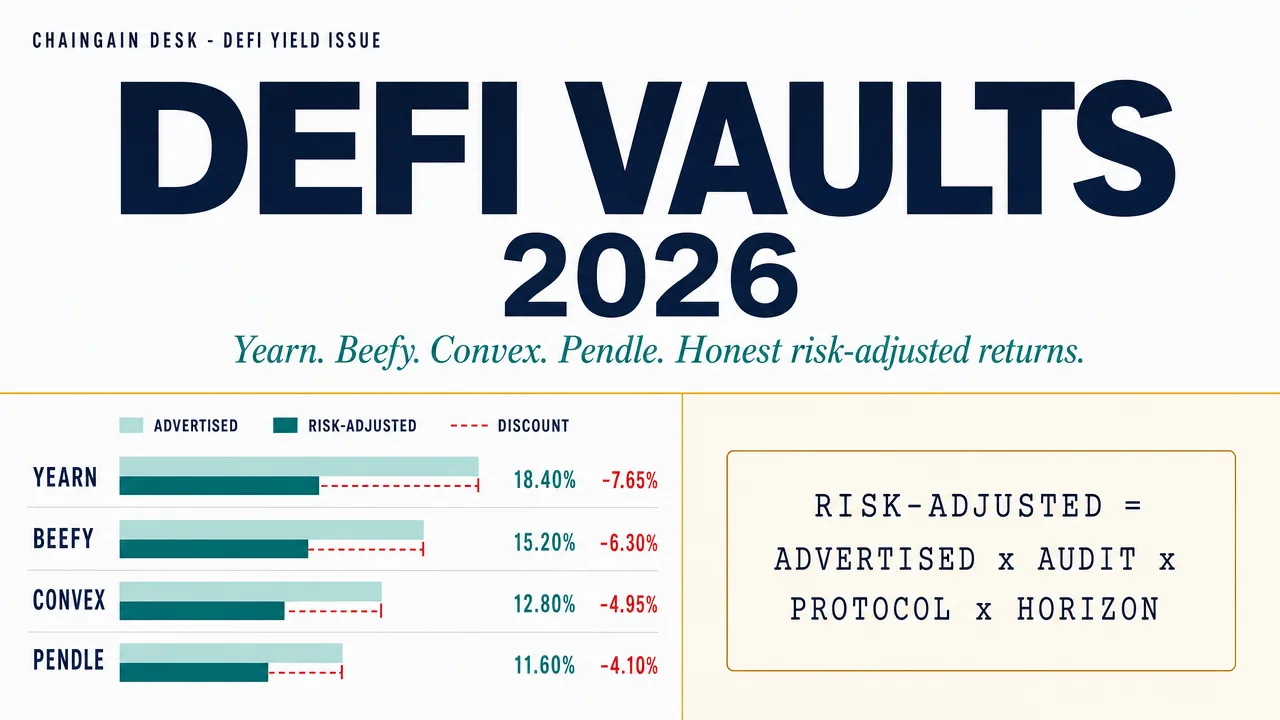
TLDR: A practical way to compare vaults is to discount the advertised APY explicitly: Risk-Adjusted APY = Advertised APY × Audit-Quality Discount (0.85 down to 0.50) × Underlying-Protocol Discount (0.90 to 0.55) × Time-Horizon Discount (0.95 to 0.70). Run vaults through this worksheet and nominal rankings flip — Pendle’s PT-eUSD drops from a headline 22% to roughly 8.23% once you discount Ethena’s untested underlying, while Yearn’s yvUSD holds up from 5.2% to about 3.2% because every multiplier is high. The exact discount factors are illustrative, but any disciplined discount produces ordering changes that raw ‘best APY’ lists never show.
The way to use the timeline and risk taxonomy is to convert them into an explicit discount on advertised APYs. The formula below is a back-of-envelope tool — not an institutional risk model — but it captures the right structure.
The formula
Risk-Adjusted APY = Advertised APY × Audit-Quality Discount × Underlying-Protocol Discount × Time-Horizon Discount
Where Audit-Quality Discount ranges from 0.85 (multiple top-tier audits, public bug bounty $200K+, no documented exploits) to 0.50 (single audit, no bounty, recent launch); Underlying-Protocol Discount ranges from 0.90 (broadly diversified across battle-tested protocols) to 0.55 (single-protocol concentration, recent exploit history); and Time-Horizon Discount ranges from 0.95 (under 30 days, low compounding exposure) to 0.70 (over 365 days, full exploit-window exposure).
Worked examples
| Vault example | Advertised APY | Audit-Quality (×) | Underlying-Protocol (×) | Time-Horizon 90d (×) | Risk-Adjusted APY |
|---|---|---|---|---|---|
| Yearn yvUSD (cross-chain stables) | 5.20% | 0.85 | 0.85 | 0.85 | 3.20% |
| Beefy ETH-stETH LP | 8.50% | 0.75 | 0.85 | 0.85 | 4.61% |
| Convex stETH-ETH | 6.80% | 0.75 | 0.65 (Curve concentration) | 0.85 | 2.82% |
| Pendle PT-eUSD (90d to maturity) | 22.00% | 0.80 | 0.55 (Ethena underlying) | 0.85 | 8.23% |
When I run new vaults through this discount worksheet myself, two things happen consistently: nominal yield rankings flip, and the spread between high-fee promoted vaults and quiet stablecoin vaults compresses dramatically. The point of the table is not to claim these specific discount factors are right. The point is that running advertised APYs through any disciplined discount produces ordering changes that “best APY” lists never show. Pendle PT-eUSD looks attractive at 22% but the underlying-protocol discount (Ethena’s basis-trade-plus-staked-ETH model is novel and not yet exploit-tested) cuts it materially. Yearn yvUSD looks boring at 5.2% but holds up after discounts because every multiplier is high.
Picking the Right Vault Aggregator by Persona
TLDR: The right aggregator depends on capital size and risk appetite. Conservative depositors ($1k–10k, little DeFi history) fit Yearn V3’s yvUSD or a Steakhouse-curated Morpho stablecoin vault — low-fee, audited, time-locked — and should avoid Pendle’s PT/YT mechanics until they have run a $100 test deposit through to maturity. Active managers ($10k+, comfortable switching chains) suit Beefy across Arbitrum, Base, and Polygon plus selective Convex exposure. Yield-maximizers willing to lock 90 days get the best risk-adjusted yield from Pendle PT positions on stable underlyings (PT-sUSDe, PT-USR, PT-yvUSD), but should avoid restaking PTs until they have priced the slashing-and-bridge cascade explicitly.
Risk profile and capital size jointly determine which aggregator fits which depositor. The personas below are deliberately blunt; refine them for your own situation.
Conservative ($1k–10k crypto, no DeFi history)
From walking first-time depositors through their initial vault sessions, the recommendation that consistently lands well is Yearn V3 yvUSD or a Morpho stablecoin vault curated by Steakhouse Financial. Both prioritise low-fee, audited stablecoin yield with multiple time-locked admin layers. Avoid Pendle PT/YT mechanics until you have run a $100 test deposit through to maturity; the optionality looks attractive but the maturity-redemption mechanics surprise first-time users.
Active manager ($10k+, comfortable with chain switching)
Beefy across two or three of its 40 chains (Arbitrum, Base, and Polygon are the most active in 2026), plus selective Convex exposure for stablecoin-flavoured Curve LPs. The active-manager bet is that you can rotate out before any single underlying protocol fails; the prerequisite is genuinely watching dashboards (DefiLlama for TVL trends, the Beefy native dashboard for vault-level APY, and DeFiScan or Debank for individual position tracking) rather than depositing and forgetting.
Yield-maximizer (willing to lock 90 days)
Pendle PT positions on stable-flavoured underlyings — PT-sUSDe, PT-USR, PT-yvUSD — are the highest risk-adjusted yield available in 2026 if you accept the maturity lock. Avoid PT-rsETH or other restaking PTs until you have priced the slashing-plus-bridge cascade explicitly; the April 2026 Kelp DAO incident is the recent reminder.
Restaking-curious (already in DF-2 territory)
If you have already deposited into EigenLayer, Symbiotic, or Karak per our Liquid Restaking 2026 guide, Pendle PT-LRTs let you lock in fixed yields while leaving the slashing exposure with the YT holders. This is mechanically the right tool for converting variable restaking yield into deterministic returns — but the trade-off is total exposure to the LRT issuer’s solvency through to maturity.
Common Pitfalls — What Even Experienced DeFi Users Get Wrong
TLDR: The recurring mistakes are predictable. Chasing nominal APY without checking emission sustainability burns depositors when a 50% rate built on a 90-day token-emission schedule collapses to 5% the moment emissions end. Ignoring underlying-protocol cascade risk — the 2023 Curve Vyper exploit and the April 2026 Kelp DAO incident both made the case — means you don’t truly understand a position whose underlying protocol you cannot name. And forgetting that in jurisdictions like the US, UK, and Germany every auto-compound can be a taxable event — when Beefy and Yearn compound dozens of times per year — quietly turns a simple deposit into an untracked tax liability.
Chasing nominal APY without checking emission sustainability
A 50% advertised APY built on a 90-day token-emission schedule will collapse to 5% the moment the schedule ends. Always check the emission curve before depositing into a “new” vault.
Ignoring underlying-protocol cascade risk
The 2023 Curve Vyper exploit made the case once. The April 2026 Kelp DAO incident made it again. If you cannot name the underlying protocol your vault strategy depends on, you do not understand your position.
Trusting curator reputation without checking the audit chain
“Curated by Steakhouse Financial” tells you the curator’s allocation methodology; it does not tell you whether the underlying markets in the curator’s whitelist have been independently audited. Both checks are required.
Forgetting tax events on auto-compounding
In jurisdictions like the US, UK, and Germany, every auto-compound is potentially a taxable event at the moment the reward token is sold and re-deposited. Beefy and Yearn vaults compound dozens of times per year. Our companion AI Crypto Tax 2026 guide walks through the tracking workflow that makes this manageable rather than impossible.
Frequently Asked Questions
Is a DeFi vault the same as a yield aggregator?
Largely yes. “Vault” is the smart-contract-level term (the contract that holds shares); “yield aggregator” is the product-level term (the platform that runs vaults). Yearn, Beefy, Convex, and Pendle are all yield aggregators, but they implement vaults with different underlying mechanics. Curator-based platforms like Morpho also run vaults but route capital differently.
Can a vault lose all my money?
Yes. If the vault contract is exploited, if the strategy contract is exploited, if the underlying protocol is exploited, or if a governance attack changes parameters maliciously, depositors can lose 100% of principal. The risk-adjusted APY calculator in this guide exists because that probability is not zero.
Are there insurance options for vault deposits?
Limited. Nexus Mutual, Sherlock, and a few smaller protocols offer smart-contract-coverage policies for selected vaults, typically priced at 1-3% annualised on the covered amount. Coverage rarely extends to underlying-protocol exploits or governance attacks, and payouts depend on community arbitration. Insurance reduces tail risk but does not eliminate it.
How are vault auto-compounding returns taxed?
Jurisdiction-dependent and event-dependent. Many tax authorities treat each auto-compound transaction as a disposal of the reward token and a fresh acquisition of the underlying. This generates dozens of micro-events per year per vault. Tracking tools like Koinly, Cointracker, and CoinTracking auto-import vault transactions; manual tracking is impractical at retail scale.
Should I use a curator vault or a classic aggregator?
Depends on what you want to outsource. Curator vaults outsource market-allocation decisions to a named risk manager; you trust their methodology. Classic aggregators (Yearn V3 legacy, Beefy, Convex) outsource strategy execution to pre-coded contracts; you trust the code review. Both have failure modes. The deepest version of “right answer” is to allocate to both styles and rebalance quarterly.
Conclusion — The Honest Take on Vaults in 2026
DeFi vaults in 2026 are simultaneously safer and more complex than they were in 2021. Audit quality has improved across the board; the institutional adoption signals (Kraken DeFi Earn launching January 26, 2026; Bitwise’s Morpho vault at 6% APY on USDC; PayPal PYUSD on Spark and Morpho) reflect real risk management upgrades. At the same time, the underlying-protocol cascade risk has grown — restaking, yield trading, and curator allocation all stack new layers above the vault contract, and each layer is a potential failure point.
The honest framing is this: pick aggregators with deep audit coverage — Yearn V3 has the broadest top-tier-firm presence (Trail of Bits plus ChainSecurity plus MixBytes plus OpenZeppelin foundation) while Pendle leans on multi-auditor diversity (Spearbit plus ChainSecurity plus Ackee plus Dedaub plus Code4rena warden contests) — diversify across underlying protocols (Beefy’s chain spread is genuinely useful for this), and discount advertised APYs by category. Run a $100 test deposit before committing real capital, watch the maturity mechanics for one full cycle on Pendle positions, and reread the underlying-protocol exploit timeline before any restaking-related vault deposit. The 50% APY billboard exists because someone is paying for it. Read the bill carefully.
Continue Learning
- Best Stablecoin Savings Rates 2026 — CeFi vs DeFi yield baseline (S1)
- Liquid Staking 2026: Lido vs Rocket Pool vs Frax — How LSTs differ from vault aggregators (DF-1)
- Liquid Restaking 2026: EigenLayer vs Symbiotic vs Karak — The slashing risk layer above LSTs (DF-2)
- What Is DeFi? — Foundation primer (Art13)
- Crypto Passive Income 2026 — Yield strategy taxonomy (Art15)
- AML Score Drift Explained — Why vault deposits can taint your wallet (EX-2)
- AI Crypto Tax 2026 — Tracking auto-compounding vault gains (AI-2)

Editorial pen name · ChainGain
Alex Mercer is the editorial pen name used for ChainGain’s cryptocurrency education content. Articles are based on cited sources and reproducible comparisons. Editorial profile
Disclaimer: This article is for educational purposes only and does not constitute financial, legal, or tax advice. DeFi vaults carry smart contract risk, strategy risk, governance risk, and underlying-protocol risk that can result in total loss of deposited principal. Audit coverage reduces but does not eliminate these risks. Always do your own research, run small test deposits before committing significant capital, and never deposit more than you can afford to lose. Tax treatment of auto-compounding returns varies by jurisdiction; consult a qualified tax professional for your specific situation.