Liquid Staking 2026: Lido, Rocket Pool, Frax Compared
Table of Contents
Intermediate
Familiarity with Ethereum staking and DeFi basics is helpful.
This article is educational. ChainGain does not currently earn affiliate revenue from Lido, Rocket Pool, or Frax. We earn from a small number of exchange partners (disclosed in our affiliate disclosure) and that does not change our protocol comparisons.
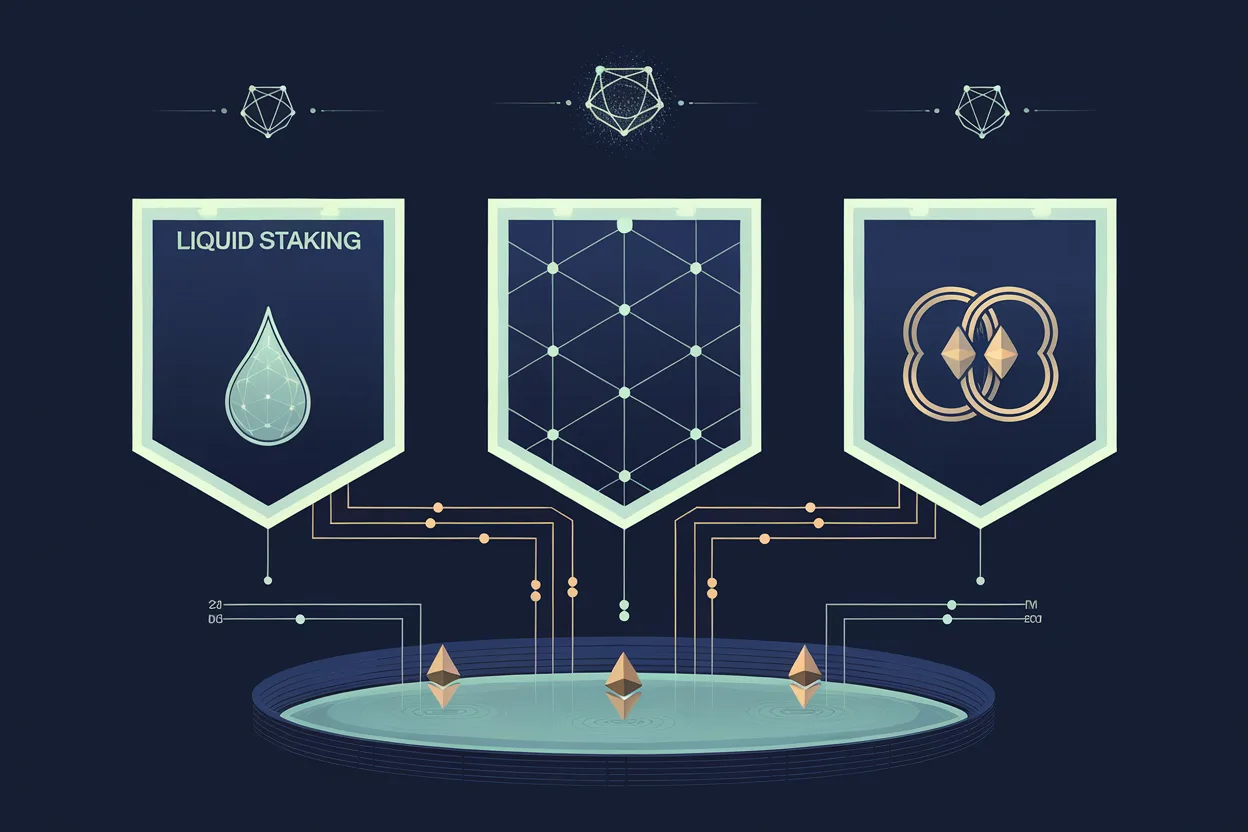
Liquid staking lets you earn Ethereum staking rewards without locking 32 ETH or running a validator — and without giving up the ability to use your ETH in DeFi. Lido, Rocket Pool, and Frax are the three protocols that dominate this category in 2026, but they make very different trade-offs on decentralization, withdrawal mechanics, and risk.
This guide is the comparison most listicles skip. I focus on the three protocols you’ll actually choose between (not a 10-token roll-up), and I spend most of the article on the four hidden risks every liquid-staking holder needs to understand: slashing, smart-contract failure, depeg events, and regulatory whiplash. I also cover the 2022 stETH depeg in detail (because the lessons still apply — I watched it play out in real time on Curve), what changed after the August 2025 SEC clarification, and how the EigenLayer slashing era (live since April 2026) reshapes the yield-stack.
By the end you’ll have a concrete decision framework — which protocol to pick at $1k, $10k, $100k, and beyond — and the three patterns I’ve watched experienced DeFi users still walk into.
Key Takeaways
- Top 3 protocols by 2026 TVL: Lido (~$25B), Rocket Pool (~$2.5B), Frax (~$1.5B) — Lido has 70%+ market share but raises decentralization concerns.
- APY ranges 2026: Lido 3.0-3.5%, Rocket Pool 3.2-3.8%, Frax 4.0-5.5% (higher via MEV-Boost integration).
- Four hidden risks (always): Smart contract bug, validator slashing transferring to LST holders, depeg (stETH lost 6% in June 2022), regulatory (SEC 2025-08-05 Howey Test ruling).
- Restaking amplifies risk: EigenLayer adds AVS slashing on top of base staking — Kelp DAO confirmed cascade scenarios since April 2026.
- Tax verification needed (5 steps): Receipt date, valuation source, jurisdiction rules, slashing event treatment, exit conversion taxation.
- Decision by holding size: <1 ETH: skip LST (gas not worth it); 1-32 ETH: Lido or Rocket Pool; 32+ ETH: run own validator + LST optional for spare capital.
- Three patterns to avoid: Leveraged LST loops, restaking with low-AVS-count protocols, ignoring documented depeg event history.
Quick Verdict (TL;DR)
If you only read one paragraph: Lido is the deepest liquidity and the safest exit, Rocket Pool is the most decentralized validator set and the cleanest tax treatment, and Frax Ether targets the highest yield by routing yield through a more aggressive two-token design. Each one is the right answer in different scenarios — and “Coinbase cbETH” is a fourth option if you want a custodial path that puts a US-regulated entity between you and the smart contracts.
| Dimension | Lido (stETH) | Rocket Pool (rETH) | Frax Ether (frxETH/sfrxETH) |
|---|---|---|---|
| Approx. TVL (2026-04) | ~$28-30B (largest DeFi protocol) | Mid-billions, distant #2 in pure LST | Sub-billion, smaller but growing |
| Token mechanics | Daily rebase — stETH balance grows | Value accrual — rETH price grows vs ETH | Two-token: frxETH (1:1 peg) + sfrxETH (yield) |
| Validator set | ~36 curated node operators | Permissionless: anyone with 8 or 16 ETH + RPL | Smaller curated set |
| Withdrawal time | Typically 1-5 days, worst case ~8 days | Variable — depends on Ethereum exit queue | Variable — depends on Ethereum exit queue |
| Centralization concern | ~28% of all staked ETH (concentration risk) | One of the most decentralized validator sets | Smaller set, but two-token design adds complexity |
| Best fit for | Liquidity-first users, DeFi composability | Decentralization purists, simpler tax events | Yield-maximizers comfortable with extra moving parts |
TVL figures fluctuate with ETH price; check DeFiLlama’s Liquid Staking category for the live snapshot.
What Is Liquid Staking, and Why Does It Exist?
Native Ethereum staking — the kind built into the protocol after the 2022 Merge — has two friction points. You need 32 ETH to run a validator, and once you stake, your ETH is locked at the consensus layer. Before the Shapella upgrade on April 12, 2023, you couldn’t even withdraw it; today you can, but only after a queue.
Liquid staking solves both problems with a simple trade. You deposit ETH into a smart contract; the protocol stakes it on your behalf using its own validator set; you receive a tradable token (a “liquid staking token” or LST) that represents your stake plus accumulated rewards. You can hold the LST, sell it on Uniswap, post it as collateral on Aave, or pair it in a Curve pool — all while the underlying ETH keeps earning ~3-4% staking yield from the network.
That tradable wrapper is the entire value proposition. It’s also the source of every risk we cover in this guide. The LST is a financial claim on staked ETH; whenever it stops being treated as a 1:1 substitute, the depeg cascades downstream.
If you’re new to the broader category, start with our DeFi basics guide — liquid staking sits in the “yield” branch alongside lending and yield farming, and many of the same composability risks apply.
Lido vs Rocket Pool vs Frax: How Each One Actually Works
Lido (stETH) — Deepest Liquidity, Highest Concentration
Lido is the largest DeFi protocol by TVL — roughly $28-30 billion at current ETH prices, and consistently ranked #1 across DeFi-wide leaderboards. About 28% of all staked ETH on the Ethereum network flows through Lido validators. That dominance is what makes stETH so liquid (you can move millions in and out without serious slippage) and what makes Lido a frequent target of decentralization debates.
The validator set is “curated.” As of late 2025 / early 2026, Lido uses approximately 36 node operators, each running validators on behalf of the protocol. Curators are vetted, can be added or removed by Lido governance, and each runs only a slice of the total stake. This is meaningfully more decentralized than a single custodian, but less decentralized than Rocket Pool’s permissionless model.
The token mechanic is a rebase. Your stETH balance grows daily as rewards accrue. If you held 1 stETH today, you’d hold something like 1.0001 stETH tomorrow. The wrapped version — wstETH — replaces this rebase with a value-accrual design (the wstETH/stETH ratio increases instead), which is what most DeFi protocols actually use as collateral because rebasing tokens break a lot of contracts.
Rocket Pool (rETH) — Decentralization-First, Cleaner Taxes
Rocket Pool takes the opposite design philosophy. Instead of curating operators, it makes validator slots permissionless. Anyone willing to put up 8 or 16 ETH plus RPL collateral can run a Rocket Pool validator. (The 8-ETH “LEB8” minipools became standard after the Atlas update in April 2023; the original design was 16 ETH.) The result is one of the most distributed validator sets in liquid staking, with thousands of independent operators.
The token, rETH, uses value accrual instead of rebasing. Your rETH balance never changes. The rETH/ETH exchange rate slowly increases as staking rewards arrive — so 1 rETH that bought 1.00 ETH at issuance might redeem for 1.12 ETH a year later. This has two practical implications. First, rETH plays nicely with every DeFi protocol because it behaves like a normal ERC-20 token. Second, in tax jurisdictions like the United States, you generally have a single capital event when you sell or redeem rETH, not a stream of daily income events the way Lido’s rebase produces.
The trade-off is liquidity depth. rETH is well-supported but doesn’t have the order-book and DEX depth of stETH, so very large exits are slower and more expensive.
Frax Ether (frxETH / sfrxETH) — Two Tokens, More Aggressive Yield
Frax Ether is built around a two-token model. frxETH is meant to track ETH 1:1 — it’s the “transactional” token, used for trading and DeFi exposure. sfrxETH is the wrapped, yield-bearing version: when you wrap frxETH into sfrxETH, you start earning Ethereum staking rewards plus a share of any yield Frax routes from frxETH-pair liquidity (notably the Curve frxETH/ETH pool incentives).
That extra layer is why sfrxETH historically prints a higher headline APY than stETH or rETH — sometimes meaningfully higher when Curve incentives are heavy. It’s also why the APY is highly variable: it depends on the ratio of frxETH-staked-to-frxETH-loose at any given time, plus the gauge incentives. Don’t lock in a number; check DeFiLlama’s sfrxETH yield page before committing.
The complexity is the cost. You’re not just trusting Lido’s smart contracts and node operators; you’re trusting Frax’s two-token peg mechanism, the Curve pool that anchors it, and the gauge incentive structure. Each new layer is another way the headline yield can break.
Origin Ether (OETH) — Onchain-Verified Yield, Much Smaller Pool
A fourth name worth knowing — not as a replacement for the three above, but because it makes a genuinely different design trade-off. OETH (Origin Ether) is a rebasing LST like stETH: hold it and your balance grows in your wallet as rewards accrue. What sets it apart is how it proves its backing. Instead of relying on an off-chain committee or oracle to report what its validators are doing, Origin verifies validator balances onchain, using Merkle proofs against Ethereum’s beacon chain (via the EIP-4788 beacon-block-root mechanism added in the Dencun upgrade). In plain terms: the protocol can demonstrate trustlessly that the ETH backing your OETH actually exists and is staked, rather than asking you to trust a reported number. For users who care about verifiable accounting, that is a real differentiator, and it puts OETH in a small group of LSTs that have moved off oracle-based reporting.
The honest counterweight is size and cost. OETH is tiny next to the majors — on the order of ~$34M in TVL (DeFiLlama, mid-2026; roughly 20,000 ETH) against Lido’s $25B+. A small pool means thinner liquidity, slower and more expensive large exits, and redemptions that route through the validator exit queue rather than a deep secondary market. The fee is also higher: Origin takes a 20% performance fee on yield, double Lido’s ~10%. That fee is part of why the net APY (~2.2% at the time of writing) lands at or below the larger protocols rather than above them — you are not being paid extra yield to compensate for the smaller-pool risk.
So the case for OETH is trust-minimization, not yield or liquidity. OETH itself has been audited several times (OpenZeppelin, Narya, Sigma Prime and others), part of a broader Origin Protocol security history of 40+ audit reports across its products, published at github.com/OriginProtocol/security; it also integrates with DeFi via Curve and Morpho. If you specifically value onchain-verifiable validator accounting and are comfortable holding a smaller protocol, it is a reasonable informed choice. For most beginners — the readers this guide is written for — the depth, liquidity and battle-testing of the big three still matter more than the verification mechanism. Treat OETH as a smaller-pool alternative to understand, not a default to switch to.
The Four Hidden Risks of Liquid Staking
Here is the comparison most “Top 7 LST” listicles don’t make. Liquid staking yield isn’t a free 3-5% — it’s compensation for four distinct risks, and each protocol exposes you to them differently.
| Risk axis | Lido | Rocket Pool | Frax Ether |
|---|---|---|---|
| Slashing (validator misbehavior) | Distributed across ~36 curated operators; protocol absorbs first-loss in some cases | Per-operator RPL collateral acts as insurance; bad operators get slashed individually | Smaller validator set; less diversification per dollar staked |
| Smart contract failure | Deeply audited (ChainSecurity, Sigma Prime, MixBytes); largest bug-bounty surface but most battle-tested | Audited (Trail of Bits, Sigma Prime); simpler contract surface | More moving parts: frxETH peg + sfrxETH wrapper + Curve gauge dependency |
| Depeg (LST trades below ETH) | History of 5%+ depeg in 2022; deepest liquidity also makes recovery fastest | Built-in redemption mechanism limits sustained depeg; less liquid in stress | Indirect exposure: if Curve frxETH/ETH peg breaks, sfrxETH yield assumptions break |
| Regulatory (which jurisdictions allow it) | Largest target by TVL; benefited from August 2025 SEC clarification | Same SEC tailwind; permissionless model harder for regulators to “shut off” | US-affiliated team; same regulatory umbrella as broader Frax stack |
Risk 1 — Slashing
If a validator running your stake double-signs, goes offline for too long, or commits another consensus-layer offense, Ethereum slashes a portion of the staked balance. In native solo staking, that loss is yours alone. In liquid staking, the loss is socialized across all stakers in the pool — but the design of “socialized” varies. Rocket Pool’s RPL collateral acts as a per-node operator insurance buffer, which is one of the cleanest designs in production. Lido’s curated set means slashing risk is concentrated in fewer parties, but those parties are vetted and well-monitored.
Risk 2 — Smart Contract
Every liquid staking protocol is a smart-contract layer between you and your ETH. Bugs in that layer can be catastrophic — and unlike validator slashing, smart contract losses are not socialized at the consensus layer. The protocols listed here have strong audit histories, but no audit eliminates all risk. The 2022 stETH depeg wasn’t a smart contract bug, but the 2024-2026 stretch of restaking exploits (more on EigenLayer below) is a reminder that the moment you stack DeFi protocols, you stack their failure modes too. We cover the broader pattern in our piece on how DeFi exposure can lead to your funds being frozen or lost.
Risk 3 — Depeg
An LST is supposed to trade at parity with the ETH it represents. When it doesn’t, you face a forced choice: accept the discount and exit, or hold and wait for re-peg. The 2022 stETH event (covered in detail in the next section) is the canonical example, and it’s why depeg is on this list as a separate risk axis — it’s not a smart contract failure, not a slashing event, but it can still cost you 3-8% of your principal during a bad week.
Risk 4 — Regulatory
For most of 2024 and the first half of 2025, “are LSTs securities under the Howey test?” was an open SEC question, and Lido and Rocket Pool were named in academic papers and regulatory commentary. That changed on August 5, 2025, when the SEC published guidance clarifying that liquid staking tokens, in most current implementations, are not securities. The cluster’s regulatory cloud lifted considerably — but it didn’t disappear. Different jurisdictions still take different positions: EU MiCA Title V rules for crypto-asset service providers became fully applicable on December 30, 2024, and any platform offering staking-as-a-service to EU users now needs CASP authorization. UK FCA guidance is in flux, and several Asian regulators have not weighed in.
For tax-side regulatory considerations, see our guide on how AI tax tools handle liquid staking and DeFi — it covers exactly which events the IRS, HMRC, and EU tax authorities expect you to report, and where the AI tools quietly miss things.

Depeg History: How stETH Lost Its Peg in June 2022 (and What Almost Happened in March 2023)
The single most important week in liquid staking history is June 11-13, 2022. Going into it, stETH had traded at near-parity with ETH for over a year. Coming out of it, stETH bottomed at roughly 0.94 ETH — a 6% discount to the asset it was supposed to represent.
The mechanics matter. stETH at the time was not redeemable on-chain (Ethereum withdrawals didn’t exist until Shapella in April 2023). The only way to convert stETH back to ETH was to sell it on a secondary market — the Curve stETH/ETH pool, primarily. Several large positions were over-leveraged on stETH used as Aave collateral. When Terra collapsed in early May, then Celsius froze withdrawals on June 12, the largest stETH holders (Celsius itself, Three Arrows Capital, and others) had to dump into Curve to meet liquidations. The pool tilted, the price gapped down, and a forced-selling cascade played out over a few days.
None of that was Lido’s fault in a smart-contract sense. The contracts behaved exactly as designed. But the episode taught the cluster two durable lessons:
- Liquid does not mean redeemable. Until Shapella, stETH was tradable but not directly convertible. Today every major LST has a withdrawal path, but during stress those paths are queues, not instant exits.
- Composability concentrates risk. The depeg was triggered by leveraged positions outside Lido — but every stETH holder felt the price impact.
The runner-up event was March 11, 2023, when Circle’s USDC briefly depegged to about $0.88 after Silicon Valley Bank’s collapse exposed Circle’s reserves. stETH-backed positions used USDC as a quote currency in many DeFi venues, and stETH faced collateral pressure as overall DeFi positions unwound. The chain reaction was milder than 2022 — withdrawals were live by the next month — but it’s a reminder that LST depegs don’t always start in the LST itself.
Restaking (EigenLayer) and the New Slashing Layer in 2026
Restaking is now a required topic for any 2026 liquid staking guide. The basic idea: instead of letting your stETH or rETH sit and earn ~3-4% Ethereum staking yield, you deposit it into EigenLayer (or a competitor) and let it secure additional services — “Actively Validated Services” or AVS — for additional yield. (For the underlying mechanics of how validator slashing works at the consensus layer, the Ethereum Foundation’s staking documentation is the authoritative reference.)
The version that mattered through most of 2024-2025 was the “points era,” where users deposited LSTs without slashing actually being live. That changed materially in April 2026, when EigenLayer shipped its slashing upgrade. Slashing is now active at the AVS layer, AVSs can redistribute slashed stake to harmed parties, and the yield-vs-risk math is no longer abstract.
Two competitors have emerged. Symbiotic, backed by Paradigm, takes a more permissionless approach to AVS curation. Karak has grown to roughly $740M in TVL and positions itself as the second-largest restaking layer. Both have meaningful design differences from EigenLayer, and the cluster as a whole is in active flux.
The new risk pattern is chained slashing. If you stake ETH → mint stETH → restake stETH on EigenLayer → AVS misbehaves → AVS slashing fires, you can lose principal at the AVS layer even though your validator behaved perfectly. The base-layer slashing risk and the AVS-layer slashing risk are additive, not alternatives.
The fresh data point is April 19, 2026: Kelp DAO, one of the larger liquid restaking protocols building on EigenLayer, suffered a security incident. The exact attribution is still being analyzed, but it’s the first material restaking-layer breach since slashing went live, and it underscores that “audited and live” doesn’t mean “safe.” If you’re not ready to track AVS-by-AVS risk and read post-mortems, consider keeping your liquid staking exposure at the base layer (just stETH or rETH, not restaked) until the cluster matures.
How Liquid Staking Affects Your Taxes (5-Step Verification)
The token mechanic that distinguishes Lido (rebase), Rocket Pool (value accrual), and Frax (two-token wrap) isn’t just a technical curiosity — it changes the tax events your software has to track. Most popular tax tools handle the obvious cases reasonably well; they miss the edge cases consistently. Here is the five-step manual check we recommend before filing.
- Categorize each LST correctly. A Lido daily rebase is, in many jurisdictions including the US, treated as ongoing income at fair market value on the day received. A Rocket Pool rETH appreciation is generally a capital event only when you sell or redeem. Don’t assume your tax tool is making the right call by default — open the per-transaction view and confirm.
- Reconcile every wrap and unwrap. Wrapping stETH to wstETH, or frxETH to sfrxETH, is treated differently across jurisdictions. Some treat it as a non-taxable transformation; others treat it as a disposal. Confirm with your local guidance, not just your software’s default.
- Bridge transactions are not new cost basis. If you bridge wstETH from Ethereum mainnet to Arbitrum, the bridged token is the same economic exposure. Some tax tools incorrectly mark this as a new acquisition. Check the bridge events manually.
- Flag every restaking deposit. Depositing stETH into EigenLayer or Karak isn’t a sale, but the points or token claims you receive in return are taxable on receipt at fair market value (where guidance exists). This is where almost every tool quietly under-reports.
- Cross-check with your broader crypto tax workflow. Our crypto tax basics guide covers the country-by-country approach, and our deep dive on AI tax tools lists exactly which events Koinly, CoinTracker, and CoinLedger get wrong on liquid staking.
Decision Flow: Which Protocol for Which Holding Size?
Liquid staking is not always the right answer. At small position sizes, the gas cost of entering and exiting eats most of the yield. Here’s the framework we’d give a friend.

| Holding | Recommendation | Why |
|---|---|---|
| $100 – $1,000 | Skip liquid staking; earn yield via stablecoin savings or hold spot ETH | Gas costs (deposit + exit) consume most of the yield. Stablecoin savings are a better fit at this size |
| $1,000 – $10,000 | Lido (stETH) or Coinbase cbETH | You want maximum liquidity and a simple exit path. cbETH is the choice if you want a US-regulated entity in the chain of custody |
| $10,000 – $100,000 | Rocket Pool (rETH) for decentralization, Lido for liquidity, or split | At this size you can afford slightly worse exit liquidity in exchange for cleaner tax treatment and decentralization. Splitting reduces single-protocol risk |
| $100,000+ | Diversify across two protocols; consider running your own validator at $200k+ | Single-protocol exposure becomes a concentration risk. At $200,000+ (32 ETH for solo + buffer), running a validator yourself eliminates the LST counterparty entirely |
One additional layer applies regardless of size: pick a wallet that handles staking interactions cleanly. We cover the trade-offs in our 2026 EVM browser-wallet comparison — Rabby’s transaction simulation in particular is useful for catching malicious “Permit2” approvals on liquid-staking-themed phishing pages.
Three Patterns to Avoid (Even Experienced DeFi Users Fall Into These)
Pattern 1 — The USD-LST Yield Loop
The setup looks innocent: deposit stETH or wstETH into a Curve or Uniswap LP paired with a stablecoin or another LST, and farm trading fees plus liquidity-mining incentives. The headline APY can hit 8-15% in a strong gauge week. The hidden risk is impermanent loss tied to a depeg event. If stETH drops 5% against ETH while you’re in a stETH/ETH pool, you don’t just absorb the price move — you absorb it through the IL math, which can amplify the loss. Several of the largest 2022 stETH depeg losses came not from holders but from LP positions.
Pattern 2 — Liquid Staking Plus Leverage
Borrow ETH against stETH on Aave, swap the borrowed ETH back into stETH, deposit again. You’ve now levered your liquid staking yield 2x or 3x. In a steady market this prints money. In June 2022, this exact pattern liquidated millions of dollars within hours when the stETH/ETH ratio gapped down and Aave health factors collapsed — I watched several positions go from “fine” to “fully liquidated” in under 90 minutes that week. If you don’t have a clear plan for what happens at a 0.95 stETH/ETH ratio (closing positions, paying down debt, accepting the loss), don’t run the leverage.
Pattern 3 — “Risk-Free 5% APY” Marketing
This is the easy one to dismiss in writing and the easy one to fall for in practice. Any platform marketing liquid staking returns as “risk-free” or “guaranteed” is either misunderstanding the product or misrepresenting it. The four risks in this guide are real; the yield is the compensation; if a campaign hides the risks, treat it the same way you’d treat any other crypto scam pattern.
Frequently Asked Questions
Is liquid staking safer than running my own validator?
Different risk profile, not strictly safer. A solo validator eliminates smart-contract and protocol-counterparty risk but exposes you to the full slashing risk if you misconfigure your node. Liquid staking offloads slashing risk to a vetted operator set in exchange for smart-contract and depeg risk. For most holders under $200k, the trade is favorable; above that, running your own validator removes a layer of trust.
Can I lose all my ETH in liquid staking?
Total loss is unlikely but not zero. The realistic worst-case scenarios are: a critical smart-contract bug that drains the protocol’s contracts (no major LST has experienced this, but it’s the tail risk that justifies audits and bug bounties), or a coordinated slashing event that exceeds the protocol’s insurance buffer. Partial losses of 3-10% from depeg events are more common and have happened on stETH at least once.
What’s the difference between stETH and wstETH?
stETH rebases — your balance grows daily. wstETH wraps that into a non-rebasing token; the wstETH/stETH exchange rate increases instead. Most DeFi protocols use wstETH because rebasing tokens break a lot of contract logic. They represent the same underlying claim.
Do I have to pay taxes on Lido rebases even if I don’t sell?
In most jurisdictions with explicit guidance — including the US and UK — yes. Each rebase is treated as ongoing income at fair market value on the day received. Rocket Pool’s value-accrual design generally produces a single capital event on disposal instead, which many holders find easier to track. Confirm with local guidance and see our tax basics guide for jurisdiction-specific notes.
Should I use EigenLayer or stick to plain liquid staking?
Until the restaking cluster has more post-slashing operating history (slashing only went live in April 2026), the conservative answer is “stick to base-layer LSTs.” The April 2026 Kelp DAO incident is a reminder that adding restaking layers compounds risk. If you do venture into restaking, treat it as a separate risk budget — not a free yield boost on top of your LST.
Conclusion: Pick the Protocol, Not the Yield Number
The marketing for every LST leads with APY. The decision should lead with which risks you’re comfortable holding for that yield. Lido’s deepest liquidity is the right answer when liquidity is your top need. Rocket Pool’s permissionless validator set is the right answer when decentralization and tax simplicity matter more. Frax Ether’s two-token model is the right answer when you want yield maximization and you understand the extra moving parts.
Beyond that, the four risks — slashing, smart contract, depeg, regulatory — apply to all of them. The 2022 stETH depeg, the 2023-03 USDC chain reaction, and the April 2026 Kelp DAO incident are all reminders that “live and audited” doesn’t mean “safe.” Size your position so a 5-10% drawdown doesn’t change your life, avoid the three patterns we listed, and keep your tax tracking honest from day one.
Continue Learning
- Crypto Passive Income: Staking, Lending, and Yield (2026)
- What Is DeFi? Decentralized Finance for Beginners
- AI Crypto Tax: Tracking DeFi, Liquid Staking, and Bot Trades
- Crypto Tax Basics: What Every Holder Should Know
- Best EVM Browser Wallets 2026
- Why Your Crypto Got Frozen: AML Score Drift
- Centralized Stablecoins 2026: USDT vs USDC vs DAI vs USDS Risk

Disclaimer: This article is for educational purposes only and does not constitute financial, tax, or legal advice. Liquid staking involves smart contract, slashing, depeg, and regulatory risks that vary by protocol and jurisdiction. Yield figures are variable and subject to change. Always do your own research and consult a qualified advisor before deploying capital. ChainGain may receive affiliate compensation from exchange partners disclosed in our affiliate disclosure; we do not currently earn affiliate revenue from Lido, Rocket Pool, or Frax.