What Are Crypto Airdrops? How to Earn Free Tokens Safely (2026)

Editorial pen name · ChainGain
Alex Mercer is the editorial pen name used for ChainGain’s cryptocurrency education content. Articles are based on cited sources and reproducible comparisons. Editorial profile
Beginner
This article may contain affiliate links. We may receive a commission at no extra cost to you if you sign up through our links. See our editorial policy.
I’ve claimed over 15 crypto airdrops since 2021 — from Uniswap’s legendary 400 UNI to Arbitrum’s ARB distribution. Some earned me thousands; others were scams I narrowly avoided. This guide teaches you exactly how airdrops work, which ones are legitimate, and how to protect yourself.
A crypto airdrop is a distribution of free cryptocurrency tokens directly to wallet holders, usually to bootstrap adoption, distribute governance rights, or reward early users of a protocol. While the word “free” sounds enticing, airdrops come with real risks, tax obligations, and time investment that every participant should understand before claiming.
Whether you’re completely new to crypto or looking to optimize your airdrop strategy for 2026, this guide covers the five types of airdrops, the biggest distributions in history, how to find legitimate ones, how to avoid scams, and the tax rules you need to know.
What Is a Crypto Airdrop?
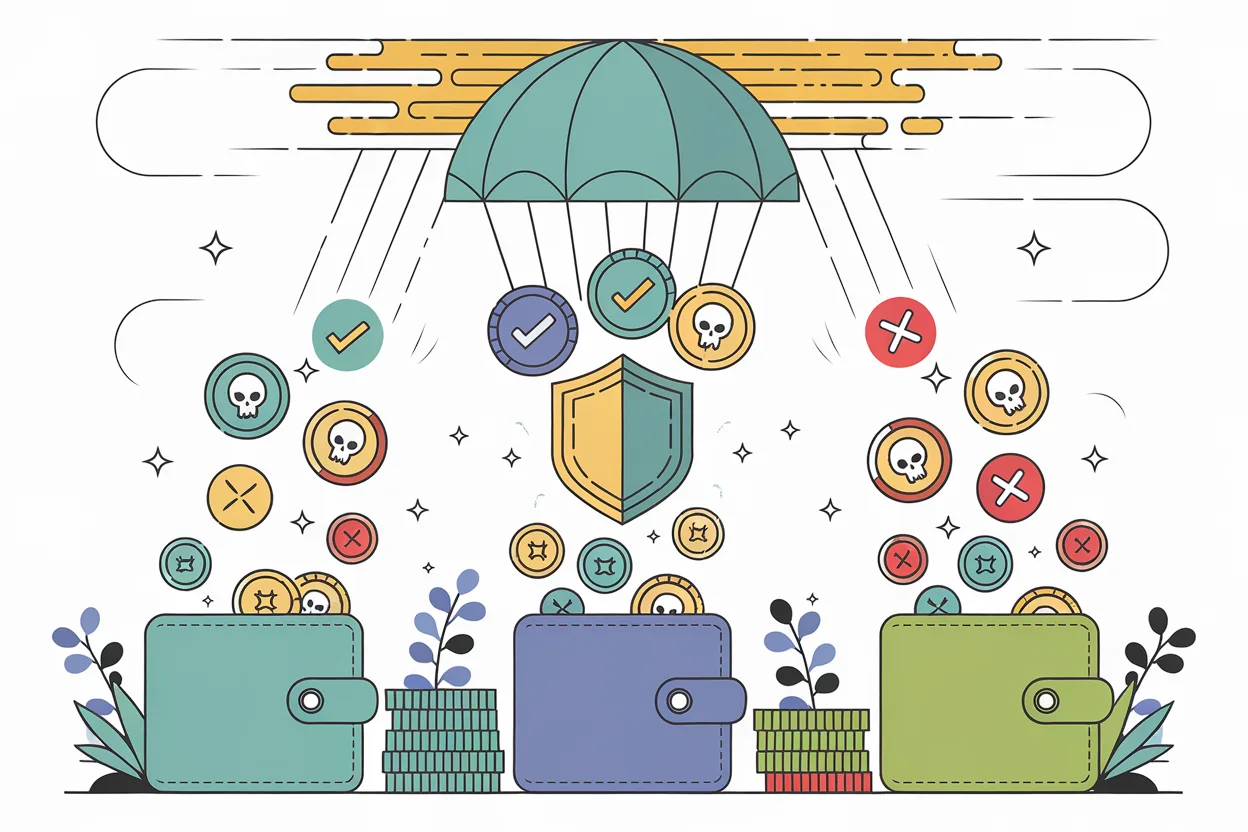
A crypto airdrop is a method used by blockchain projects to distribute tokens directly to users’ wallets — typically at no direct cost to the recipient. Think of it as a promotional giveaway, but with real financial implications.
Projects use airdrops for several strategic reasons:
- Bootstrap liquidity — distributing tokens to thousands of wallets creates immediate trading activity and market depth
- Distribute governance — decentralized protocols need token holders to vote on proposals, and airdrops spread voting power widely
- Reward early users — retroactive airdrops thank people who used the protocol before it had a token
- Generate awareness — free tokens create buzz, media coverage, and social media discussion
The Moment That Changed Everything
On September 17, 2020, Uniswap airdropped 400 UNI tokens to every wallet that had ever used the protocol. At the time, those tokens were worth about $1,200. Within months, the same tokens peaked at over $12,000 in value. That single event turned “airdrop farming” from a niche hobby into a full-blown industry.
By 2024, airdrops had delivered an estimated $19 billion in value at peak token prices, according to data compiled by DeFi Llama.
What Airdrops Are NOT
Let me be clear about what airdrops aren’t: they are not free money with zero strings attached. In my experience, every airdrop involves at least one of the following:
- Time investment — you need to use protocols for weeks or months before qualifying
- Transaction costs — gas fees for on-chain interactions add up, especially on Ethereum mainnet
- Tax liability — most jurisdictions treat airdropped tokens as taxable income at receipt
- Risk exposure — interacting with new protocols means smart contract risk and potential scams
5 Types of Crypto Airdrops
Not all airdrops work the same way. Understanding the five main types helps you focus your effort where it matters most.
1. Retroactive Airdrops (Most Valuable)
Retroactive airdrops reward users who interacted with a protocol before the airdrop was announced. You cannot qualify after the announcement — that’s the entire point. The protocol takes a snapshot of past activity and distributes tokens based on how much you used it.
Examples:
- Uniswap (UNI) — September 2020, 400 UNI per wallet (~$1,200)
- Arbitrum (ARB) — March 2023, 625-10,250 ARB based on activity level
- Optimism (OP) — June 2022, ~777 OP average per qualifying wallet
The most lucrative type by far. I earned $3,200 from the Arbitrum airdrop just for using the bridge and making a handful of swaps over several months. The key lesson: use protocols you genuinely find useful, and if they don’t have a token yet, you might be rewarded later.
2. Holder/Snapshot Airdrops
These airdrops reward users who hold a specific token at a precise moment (the “snapshot”). If you hold Token X at the snapshot block, you automatically receive Token Y.
Examples:
- Bitcoin Cash (BCH) — August 2017, Bitcoin holders received an equal amount of BCH
- Stellar Lumens (XLM) — November 2018, 500 million XLM distributed to Bitcoin holders
The main challenge is knowing when snapshots happen. Most projects announce them a few days in advance through official channels, so following project communications is essential.
3. Task-Based/Testnet Airdrops
Task-based airdrops require completing specific on-chain actions: bridging funds between networks, swapping tokens, providing liquidity, or participating in testnets.
In 2026, this category has evolved significantly. Protocols now track “genuine engagement” rather than just raw transaction count. A user who provides liquidity for three months and makes regular swaps will typically receive more than someone who crammed 50 meaningless transactions into a single day.
Examples:
- Jupiter (JUP) — January 2024, distributed to active Solana DEX users
- Jito (JTO) — December 2023, rewarded SOL stakers who used Jito’s MEV-protected staking
4. Community/Social Airdrops
These require social media actions: following accounts, retweeting posts, joining Discord servers, or sharing referral links. They’re the easiest to participate in but typically offer the smallest rewards.
Important warning: Social airdrops have the highest scam risk of any category. Fraudsters routinely create fake social campaigns that mimic legitimate projects to steal wallet credentials. I only participate in social airdrops from projects I already follow and can verify through official channels.
5. Hard Fork Airdrops
When a blockchain splits into two separate chains (a “hard fork”), holders of the original token automatically receive an equal amount of the new token on the forked chain.
Examples:
- Bitcoin Cash (BCH) from Bitcoin — August 2017
- Ethereum Classic (ETC) from Ethereum — July 2016
Hard fork airdrops are rare and entirely passive — you don’t need to do anything other than hold the original token. However, the forked tokens often lose significant value over time relative to the original chain.
The Biggest Airdrops in History
To put the opportunity in perspective, here are the most valuable airdrops ever distributed:
| Airdrop | Year | Per Wallet | Total Value | Requirements |
|---|---|---|---|---|
| Uniswap (UNI) | 2020 | 400 UNI (~$1,200) | $6.4B total | Used Uniswap before Sept 2020 |
| Arbitrum (ARB) | 2023 | 625–10,250 ARB | $1.5B+ | Bridge/trade on Arbitrum |
| Optimism (OP) | 2022 | ~777 OP avg | $1.5B+ | Used Optimism bridge/dApps |
| Jupiter (JUP) | 2024 | Variable | ~$700M | Used Jupiter DEX on Solana |
| Jito (JTO) | 2023 | Variable | ~$600M | Staked SOL via Jito |
These numbers represent peak valuations. In practice, many recipients sold immediately at lower prices, and 88% of airdropped tokens lose value within three months of distribution, according to research by 6th Man Ventures. Timing your claim and sale matters enormously.
How to Find Legitimate Airdrops in 2026
The airdrop landscape has matured significantly. Here are the most reliable sources for finding real opportunities:
| Source | What It Tracks | Best For |
|---|---|---|
| DeFi Llama Airdrops | 200+ tokenless protocols | Finding pre-token DeFi projects |
| CoinMarketCap Airdrops | Verified airdrops calendar | Established project airdrops |
| Airdrops.io | Curated airdrop database | Task-based airdrops |
| Protocol Discord/Twitter | Official announcements | Snapshot dates, eligibility |
My 5-Step Process to Qualify for Airdrops
Based on my experience claiming 15+ airdrops, here’s the systematic approach that works best in 2026:
- Find tokenless protocols on DeFi Llama — filter by TVL and user growth. Protocols with strong traction but no token are the most likely to airdrop
- Use the protocol genuinely — bridge assets, make swaps, provide liquidity, or stake. Do what the protocol is designed for, not artificial activity
- Follow official channels — join the project’s Discord and follow their Twitter/X account for snapshot announcements and eligibility criteria
- Maintain activity across multiple weeks — in 2026, most protocols analyze consistency. Interacting once a week for two months is far better than 50 transactions in one day
- When the airdrop launches, claim from the OFFICIAL site only — bookmark the real URL and never click claim links from emails, DMs, or social media ads
Airdrop Scams — How to Protect Yourself
This is the most critical section of this guide. Airdrop scams are the single largest source of crypto phishing losses.
The numbers are sobering:
- 42% of crypto phishing losses in 2025 came from fake airdrop claim sites, according to ScamSniffer
- Average time from wallet approval to drain: 32 seconds
- The FBI issued an alert in March 2026 about a fake “FBI Token” circulating on the Tron network
- Over 737,000 wallets were targeted with fake ApeCoin and Pepe airdrop tokens designed to trick users into connecting to malicious sites
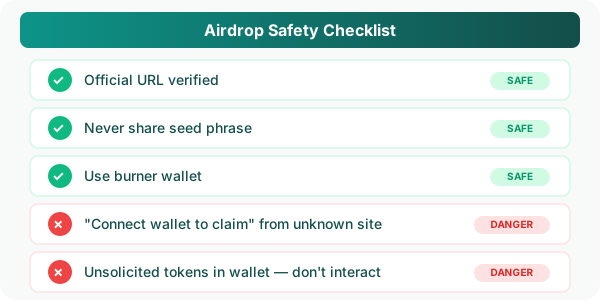
5 Red Flags of Fake Airdrops
If you see any of these signs, do not interact:
- “Connect wallet to claim” from an unofficial URL — legitimate airdrops use the protocol’s official domain, never a third-party site
- Asks for your seed phrase or private key — no legitimate project will EVER request these. If someone asks, it is a scam, no exceptions
- Unsolicited tokens appearing in your wallet — this is a “dust attack.” Scammers send worthless tokens with names like “$5,000 Reward” that link to phishing sites when you try to swap them. Never interact with unknown tokens
- Grammar errors and suspicious domain names — look for subtle misspellings like “uniswapp.org” or “arbitrurn.io”
- No official announcement from the protocol team — always verify through the project’s official Twitter/X, Discord, or blog before claiming anything
For a comprehensive deep-dive into every type of crypto scam, see our complete guide: How to Spot and Avoid Crypto Scams (2026).
How to Claim Airdrops Safely
Here’s the exact process I follow every time I claim an airdrop:
- Go directly to the protocol’s official website — type the URL manually or use a bookmark you saved previously. Never follow links from emails, DMs, or social media
- Use a dedicated “claim wallet” — never connect your main holdings wallet to claim sites. Create a separate wallet specifically for airdrop claims, and transfer tokens out immediately after claiming
- Check token approvals on Revoke.cash — after claiming, review what permissions you’ve granted and revoke any unlimited approvals
- Verify the contract address — cross-check the airdropped token’s contract address on Etherscan or the relevant block explorer against the official announcement
- Never rush — scammers create urgency (“claim in 24 hours or lose your tokens!”). Legitimate airdrops typically have claim windows of weeks or months
For wallet security best practices, including how to set up a burner wallet, read our Cryptocurrency Security Guide.
Airdrop Farming in 2026 — Is It Still Worth It?
Airdrop farming — the practice of systematically using protocols to qualify for future token distributions — has changed dramatically. Here’s the honest assessment.
The Death of Multi-Wallet Farming
In the early days, farmers would create dozens or hundreds of wallets, run identical transactions on each, and multiply their airdrop rewards. That strategy is effectively dead in 2026.
85% of major airdrops now implement Sybil detection — algorithms designed to identify and exclude wallets controlled by the same person. The consequences are real:
- Linea filtered 40% of eligible wallets (517,000 out of 1.3 million) as suspected Sybil accounts during their 2025 distribution
- LayerZero required self-reporting of Sybil wallets, then permanently blacklisted addresses that didn’t comply
- zkSync used cluster analysis to group wallets by behavior patterns, funding sources, and timing
I stopped farming with multiple wallets in early 2025 after two projects blacklisted all my addresses simultaneously. The risk-reward calculation no longer makes sense. Now I use one wallet and engage genuinely with protocols I actually find useful.
What Actually Works in 2026
The strategy shift is clear: consistency over volume, genuine use over manufactured activity.
- Weeks of activity beat one-day blitzes — protocols measure the time span of your interactions, not just the count
- Diverse actions matter — bridging, swapping, providing liquidity, and governance participation across multiple features shows genuine usage
- Meaningful amounts count — many airdrops now weight distribution by transaction value, not just frequency
- Testnet participation is underrated — testing new features before mainnet launch demonstrates genuine interest and often qualifies for bonus allocations
The Uncomfortable Truth About Airdrop Value
Even when you qualify, the financial outcome is uncertain. Research shows that 88% of airdropped tokens lose value within 3 months of distribution. The tokens that held or gained value — UNI, ARB, OP — are exceptions, not the rule.
My adjusted strategy: claim immediately, sell 50-70% within the first week if there’s decent liquidity, and hold the rest only if I believe in the project’s long-term fundamentals.
Tax Implications of Crypto Airdrops
Airdrops are not tax-free in most jurisdictions. Understanding your obligations prevents costly surprises.
General Tax Treatment
In most countries, airdropped tokens are treated as ordinary income at the moment you receive them (or gain the ability to claim them). The taxable amount is the fair market value (FMV) of the tokens at the time of receipt.
When you later sell or trade the tokens, you may owe capital gains or losses based on the difference between the sale price and the FMV at receipt.
What You Need to Record
For every airdrop you claim, document:
- Date received — the exact date and time the tokens appeared in your wallet or you claimed them
- Fair market value at receipt — the price of the token at the moment of receipt, using a reputable source like CoinGecko or CoinMarketCap
- Amount of tokens — the exact quantity you received
- Transaction hash — the on-chain proof of the distribution
Tax software like TokenTax, Koinly, or CoinTracker can automatically detect and categorize airdrop income from your wallet activity.
For country-specific tax rules, rates, and reporting deadlines, see our comprehensive guide: Crypto Tax Basics: What Every Holder Should Know (2026).
Frequently Asked Questions
Are crypto airdrops really free?
Technically yes — you don’t pay for the tokens directly. However, airdrops involve indirect costs: gas fees for qualifying transactions, time spent interacting with protocols, and tax obligations on the received tokens. Think of them as “earned” rather than “free.”
How much can you earn from airdrops?
It varies enormously. The Uniswap airdrop was worth $1,200-$12,000+ per wallet depending on when you sold. The Arbitrum airdrop ranged from a few hundred to over $10,000 for highly active users. Most smaller airdrops are worth $10-$100. The average across all airdrops is modest, but the outliers can be life-changing.
Can airdrops be scams?
Absolutely. Fake airdrop claim sites are the #1 crypto phishing vector, responsible for 42% of phishing losses in 2025. Never connect your wallet to unofficial sites, never share your seed phrase, and always verify announcements through official project channels. See our scam prevention guide for detailed protection strategies.
Do I need to pay taxes on airdrops?
In most jurisdictions, yes. Airdropped tokens are typically treated as ordinary income, taxed at the fair market value when received. You’ll also owe capital gains tax if you sell them at a higher price. Consult a tax professional familiar with crypto in your country, or see our crypto tax guide.
What is the best strategy for airdrop farming in 2026?
Focus on genuine, consistent use of tokenless protocols rather than multi-wallet farming (which is now detected and penalized by 85% of major projects). Use one wallet, interact with protocols weekly over months, participate in testnets, and diversify across different actions like bridging, swapping, and providing liquidity. Quality engagement beats quantity every time.
Continue Learning
- How to Spot and Avoid Crypto Scams (2026) — protect yourself from the most common crypto fraud tactics
- Cryptocurrency Security: Complete Protection Guide — secure your wallets, accounts, and private keys
- Crypto Tax Basics: What Every Holder Should Know (2026) — country-specific tax rules and filing strategies
- What Is DeFi? Decentralized Finance for Beginners (2026) — understand the protocols that power most airdrops
- How to Choose a Crypto Wallet — pick the right wallet for airdrop farming and daily use