Crypto Tax Basics: What Every Holder Should Know (2026)

Editorial pen name · ChainGain
Alex Mercer is the editorial pen name used for ChainGain’s cryptocurrency education content. Articles are based on cited sources and reproducible comparisons. Editorial profile
Intermediate
This article may contain affiliate links. We may receive a commission at no extra cost to you if you sign up through our links. See our editorial policy.
Understanding crypto tax rules isn’t optional anymore; in 2026, governments worldwide are closing enforcement gaps. This guide covers exactly what you owe, country by country.
Crypto tax is the obligation to report and pay taxes on cryptocurrency transactions such as selling, trading, staking rewards, and airdrops. Different countries apply different rules — from zero tax in the UAE to 45% in Japan — and the penalties for non-compliance are rising sharply.
Whether you’re a casual holder or an active trader, this guide walks you through 20+ country-specific rules, calculation methods, and the software tools that make filing manageable.
Why Crypto Taxes Matter More Than Ever in 2026
If you think you can quietly hold crypto without telling your tax authority, that window is closing fast. Here’s what changed:
IRS Form 1099-DA is now fully implemented for the 2026 tax year. Every US-based exchange must report your transactions directly to the IRS. That means the government already knows what you traded before you even file.
OECD Crypto-Asset Reporting Framework (CARF) takes effect in 2027, with 50+ countries committed to automatic cross-border data sharing. If you hold crypto on any reporting exchange, your home country’s tax authority will receive that data — even if the exchange is overseas. The OECD framework mirrors what FATCA did for bank accounts.
Nigeria’s NTAA 2025 now requires TIN and NIN linking from January 2026 for all Virtual Asset Service Providers. Monthly reporting is mandatory. Non-compliance carries a ₦10 million penalty.
India’s penalty regime added a ₹50,000 fine for failure to report crypto income, effective April 2026, on top of the existing 30% flat tax.
In 2026, ignoring crypto taxes isn’t just risky — it’s impossible.
What’s Taxable and What’s Not
Before diving into country-specific rules, here’s a universal framework. Most jurisdictions agree on these classifications:
| Event | Taxable? | Tax Type |
|---|---|---|
| Buying crypto with fiat | No | — |
| Holding (HODLing) | No | — |
| Transferring between own wallets | No | — |
| Selling crypto for fiat | Yes | Capital Gains |
| Trading crypto for crypto | Yes | Capital Gains |
| Spending crypto on goods/services | Yes | Capital Gains |
| Receiving staking rewards | Yes | Income (at receipt) |
| Receiving airdrops | Yes | Income (at receipt) |
| Mining rewards | Yes | Income (at receipt) |
| Receiving crypto as salary | Yes | Income |
The most common mistake I see is assuming that swapping one crypto for another isn’t taxable. It is. Every trade from ETH to BTC, every DeFi swap, every NFT purchase with crypto triggers a taxable event in most countries.
Crypto Tax by Country — Your Complete Guide
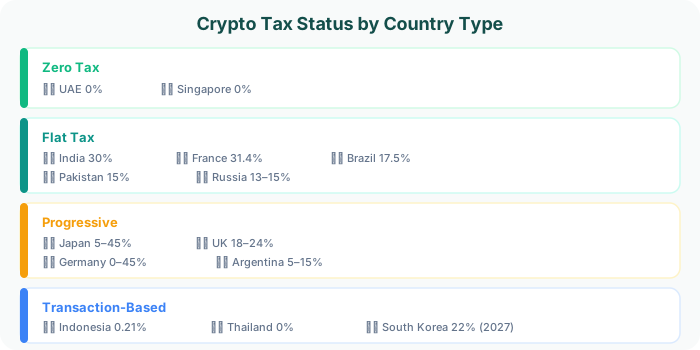
Tax rules vary wildly across borders. I’ve organized countries by their tax structure to help you find yours quickly. All rates reflect 2026 rules unless noted.
Zero-Tax Countries
| Country | Tax Rate | Notes |
|---|---|---|
| UAE | 0% personal | 9% corporate on profits above AED 375K. No personal income tax on crypto gains. UAE Federal Tax Authority |
| Singapore | 0% capital gains | No capital gains tax. However, if crypto trading/mining/staking is deemed a business activity, it’s taxed as income (up to 22%). IRAS guidelines |
Zero tax doesn’t mean zero reporting. Singapore still requires disclosure of crypto holdings in certain circumstances, and UAE corporate entities must report. If you’re considering relocation for tax purposes, consult a qualified advisor — residency rules matter enormously.
Flat Tax Countries
| Country | Rate | Key Rules |
|---|---|---|
| India | 30% flat + 1% TDS | No loss offset allowed. No deductions permitted. ₹50,000 penalty for non-reporting (effective April 2026). Income Tax India |
| France | 31.4% PFU (up from 30% in 2025) | 12.8% income tax + 18.6% social contributions. Progressive scale option available if it results in a lower rate. Direction Générale des Finances Publiques |
| Brazil | 17.5% flat (changed June 2026) | Previous: 15-22.5% progressive with R$35K monthly exemption. Now: flat 17.5% on all gains regardless of amount. Receita Federal |
| Pakistan | 15% CGT | Virtual Assets Act 2026. PKR 500,000 annual exemption. Mining taxed as income. FBR Pakistan |
| Russia | 13-15% | 13% on income up to 2.4M RUB, 15% above. Applies to both mining and trading. Federal Tax Service |
India’s regime is notably harsh. That’s a rule worth knowing before you trade.
Progressive Tax Countries
| Country | Rate Range | Key Rules |
|---|---|---|
| Japan | 5-45% misc income (+ ~10% local) | 2026 reform: 20% flat rate for specified assets (BTC, ETH on FSA-approved platforms). Other crypto assets remain at 5-45% miscellaneous income rates. National Tax Agency |
| UK | 18-24% CGT | £3,000 annual tax-free allowance. Staking and mining rewards treated as income tax (0-45%). HMRC guidance |
| Germany | 0-45% (but 1-year exemption!) | Hold for more than 12 months = 0% tax. Under 12 months = income tax rate. €1,000 annual threshold for short-term gains. Bundesministerium der Finanzen |
| Argentina | 5-15% | 5% for sales in Argentine pesos, 15% for foreign currency proceeds. Mining: 0.5-1.75% tax on holdings value. |
| Ukraine | 23% total | 18% personal income tax + 5% military levy. Transitional rate of 10% applies for pre-existing assets in 2026. State Tax Service of Ukraine |
| Nigeria | Progressive (NTAA 2025) | First ₦800,000 exempt. TIN and NIN linking required. VASPs must file monthly reports. ₦10 million penalty for non-compliance. FIRS Nigeria |
Germany’s 1-year holding exemption is the single best tax benefit for crypto holders in any major economy. If you buy Bitcoin and hold it for 366 days, your gain is completely tax-free — no matter how large.
Transaction-Based Tax Countries
| Country | Rate | Structure |
|---|---|---|
| Indonesia | 0.21% income tax (domestic) | 1% income tax for transactions on foreign exchanges. 0% VAT on crypto purchases (updated August 2025). Direktorat Jenderal Pajak |
| Thailand | 0% (licensed platforms!) | SEC-approved platforms: 0% capital gains tax through 2029. Unlicensed platforms: 15% withholding tax. Thailand Revenue Department |
| South Korea | 20% + 2% local = 22% | Implementation delayed to January 2027. Not yet in effect. ₩2.5 million annual exemption when it starts. |
| Turkey | 10% proposed | Not yet law — pending parliament approval. 0.03% transaction tax also proposed. Currently no specific crypto tax. |
Thailand’s approach is interesting and worth watching. By making licensed platforms tax-free, they’re incentivizing traders to use regulated exchanges — a smart enforcement strategy. If you trade on an SEC-approved Thai exchange, you pay zero capital gains through 2029.
Countries Without Specific Crypto Tax Laws
Some countries haven’t passed dedicated crypto tax legislation but still expect taxes to be paid under existing rules:
- Philippines: Income tax rates of 0-35% apply to crypto gains. 15% capital gains tax for assets held less than 12 months. No dedicated crypto tax law exists, so general income rules apply.
- Vietnam: A 0.1% personal tax on crypto transactions was proposed with an effective date of July 2026. Previously, there was no law specifically addressing crypto taxation.
The absence of specific crypto tax legislation doesn’t mean absence of obligation. In most jurisdictions, crypto gains fall under existing income or capital gains categories. When in doubt, report.
How to Calculate Your Crypto Tax (Step by Step)
Regardless of where you live, the calculation process follows a similar pattern.
- List all transactions — Every trade, sale, staking reward, airdrop, and crypto-to-crypto swap. Export CSVs from every exchange you used during the tax year.
- Determine cost basis — The cost basis is what you originally paid for the asset, including any transaction fees. If you bought 1 ETH at $2,000 and paid a $5 fee, your cost basis is $2,005.
- Calculate gain or loss for each disposal — Subtract cost basis from sale price. Selling that ETH at $3,500 means a gain of $1,495 ($3,500 – $2,005).
- Identify holding period — In countries like Germany (1 year) or the UK (different rates for short/long term), how long you held matters. Track your purchase dates carefully.
- Choose your cost basis method — Most countries allow FIFO (first in, first out), and some allow LIFO or specific identification. FIFO is the most common default. Stick with one method consistently.
- Sum total gains and apply your country’s rate — Add all gains, subtract allowable losses (where permitted), and apply the appropriate tax rate from the tables above.
- File on time with required forms — Deadlines vary by country. Missing a deadline often triggers automatic penalties, even if you owe nothing.
Example: You buy 1 ETH at $2,000 on January 15. You sell it at $3,500 on August 20. Your capital gain is $1,500. In the UK, that falls under your £3,000 annual allowance — so no tax owed. In India, you’d owe 30% = $450 (plus 4% cess). In Germany, since you held for less than 12 months, it’s taxed at your income tax rate.
The same gain, three completely different outcomes. That’s why knowing your country’s rules matters.
Record-Keeping Best Practices
Good records are your best defense in an audit. They’re also the only way to accurately calculate what you owe.
Keep records for 3-7 years depending on your jurisdiction. The IRS requires 3 years minimum (6 years if income is underreported by 25%+). HMRC requires 5 years. When in doubt, keep everything for 7 years.
For every transaction, record:
- Date and time of the transaction
- Amount of crypto involved
- Price in your local currency at the time of transaction
- Transaction fees paid
- Counterparty or exchange used
- Type of transaction (buy, sell, swap, stake, airdrop)
- Wallet addresses (for DeFi transactions)
Exchanges close, get hacked, or change their export formats without warning.
Screenshot DeFi transactions. On-chain swaps through Uniswap or other DEXs don’t always generate clean reports. Keep screenshots of confirmations and use a block explorer to verify.
Separate your wallets by purpose. Having one wallet for trading and another for long-term holding simplifies tracking enormously. Mixing everything into one wallet creates a record-keeping nightmare.
Crypto Tax Software Compared
Manually tracking hundreds of transactions across multiple exchanges is impractical. These tools automate the process:
| Software | Price | Exchanges Supported | Tax Reports | Best For |
|---|---|---|---|---|
| Koinly | $49-199/year | 800+ | US, UK, AU, CA + 20 more | Most countries, DeFi users |
| CoinLedger | $49-199/year | 400+ | US focus, 1099-DA ready | US-based traders |
| CoinTracker | $59-599/year | 500+ | US, UK, CA | Portfolio tracking + taxes |
It handles multi-country reporting well and automatically categorizes DeFi transactions — which saved me hours of manual work. The free tier lets you import transactions and preview your tax report before paying, which I recommend doing first.
All three tools support CSV imports from major exchanges and can connect via API for automatic syncing. If you trade on more than two exchanges, automated software pays for itself in time saved.
Common Mistakes That Trigger Audits
Tax authorities are getting smarter about crypto enforcement. These are the mistakes that most commonly draw attention:
- Not reporting crypto-to-crypto trades. Every swap — ETH to USDT, BTC to SOL, any token to any token — is a taxable disposal in most countries. This is the single most common error, and exchanges now report these transactions directly to authorities.
- Ignoring staking and airdrop income. Staking rewards and airdrops are taxable as income at the moment you receive them, based on fair market value at receipt. Many holders forget to report these because they never “sold” anything.
- Using the wrong cost basis method. Switching between FIFO and LIFO mid-year, or using specific identification without proper documentation, creates inconsistencies that auditors flag.
- Not declaring foreign exchange holdings. In the US, FBAR reporting requirements may apply to crypto held on foreign exchanges if the aggregate value exceeds $10,000 at any point during the year. Similar rules exist in other countries.
- Assuming “I didn’t cash out, so I don’t owe tax.” Cashing out to fiat is not the trigger — disposal is. Trading crypto for crypto, spending crypto, and even some DeFi operations are disposals. The tax event happens at the swap, not at the bank withdrawal.
One more mistake worth mentioning: using a hardware wallet and assuming it’s “invisible.” On-chain data is permanent and public. Blockchain analytics firms like Chainalysis work directly with tax authorities in 30+ countries. Moving crypto to a hardware wallet doesn’t hide anything — it just means you need to track those transactions too.
DeFi and NFT Tax Considerations
Decentralized finance adds complexity that most tax software is still catching up with:
Liquidity pool deposits: Adding tokens to a liquidity pool may be treated as a disposal in some jurisdictions. When you deposit ETH and USDC into a Uniswap pool and receive LP tokens, that could be a taxable event. The IRS hasn’t issued definitive guidance, but the conservative approach is to treat it as one.
Yield farming rewards: Similar to staking — taxed as income at the time of receipt. If you then sell those reward tokens, that’s a separate capital gains event.
NFT transactions: Buying an NFT with crypto is a disposal of that crypto (capital gains). Selling an NFT is also a taxable event. Creating (minting) an NFT and selling it is typically treated as income, not capital gains.
Wrapped tokens: Wrapping ETH to WETH may or may not be taxable depending on jurisdiction. The IRS has signaled that wrapping could be a non-taxable like-kind exchange, but this isn’t settled law.
If you’re active in DeFi, a tool like Koinly that auto-imports on-chain data is almost essential.
Tax-Loss Harvesting: A Legal Strategy to Reduce Your Bill
Tax-loss harvesting means intentionally selling assets at a loss to offset gains. It’s legal in most jurisdictions and can significantly reduce your tax bill.
How it works: If you have $5,000 in gains from selling Bitcoin and $3,000 in losses from selling a token that dropped, you can use the loss to offset the gain — paying tax on only $2,000 net.
Important limitations:
- India: Does not allow loss offset at all. Gains and losses cannot be netted.
- US wash sale rule: The IRS may apply wash sale rules to crypto starting in 2026, preventing you from selling at a loss and immediately repurchasing the same asset.
- UK bed-and-breakfasting: HMRC applies a 30-day rule — if you repurchase the same asset within 30 days, the loss may be disallowed.
- Germany: Losses can only offset gains from the same category (private disposal transactions).
Frequently Asked Questions
Do I owe tax if I haven’t sold my crypto?
Generally no. Simply holding cryptocurrency is not a taxable event in most countries. Tax is typically triggered when you dispose of the asset — by selling, trading, spending, or in some cases transferring it. However, receiving crypto through staking, airdrops, or as payment is usually taxable at the time of receipt, even if you haven’t sold it yet.
Is transferring crypto between my own wallets taxable?
No. Moving crypto between wallets you own (e.g., from Coinbase to a hardware wallet) is not a taxable event. There’s no change in ownership, so no gain or loss is realized. However, you should still record these transfers to maintain accurate records and avoid confusing them with sales during tax filing.
How are staking rewards taxed?
In most countries, staking rewards are taxed as ordinary income at the fair market value when you receive them. For example, if you receive 0.1 ETH as a staking reward when ETH is worth $3,000, you owe income tax on $300. If you later sell that ETH for $400, you’d owe additional capital gains tax on the $100 gain.
What happens if I don’t report my crypto taxes?
Penalties vary by country but are increasing everywhere. In the US, failure to report can result in penalties of 20-75% of the underpaid tax plus interest. India charges ₹50,000. Nigeria imposes up to ₦10 million. With OECD CARF launching in 2027, exchanges worldwide will automatically share your data with tax authorities, making non-reporting a matter of when — not if — you get caught.
Which country has the best crypto tax laws?
It depends on your situation. For zero tax on personal gains: UAE and Singapore. For long-term holders: Germany (0% after 1 year). For low transaction taxes: Indonesia (0.21%) and Thailand (0% on licensed platforms through 2029). For traders, Portugal used to be zero-tax but now taxes crypto gains. There’s no single “best” — the right answer depends on your trading activity, holding period, and residency status.
Continue Learning
Explore more guides to strengthen your crypto knowledge:
Disclaimer: This guide is for educational purposes only and does not constitute tax, legal, or financial advice. Tax laws change frequently and vary by jurisdiction. Always consult a qualified tax professional in your country before making tax-related decisions. ChainGain and its authors are not responsible for any actions taken based on this information.