Crypto Passive Income: Staking, Lending, and Yield (2026)
Table of Contents

Editorial pen name · ChainGain
Alex Mercer is the editorial pen name used for ChainGain’s cryptocurrency education content. Articles are based on cited sources and reproducible comparisons. Editorial profile
This guide shares what actually works in 2026, what doesn’t, and how to avoid the mistakes that cost investors billions.
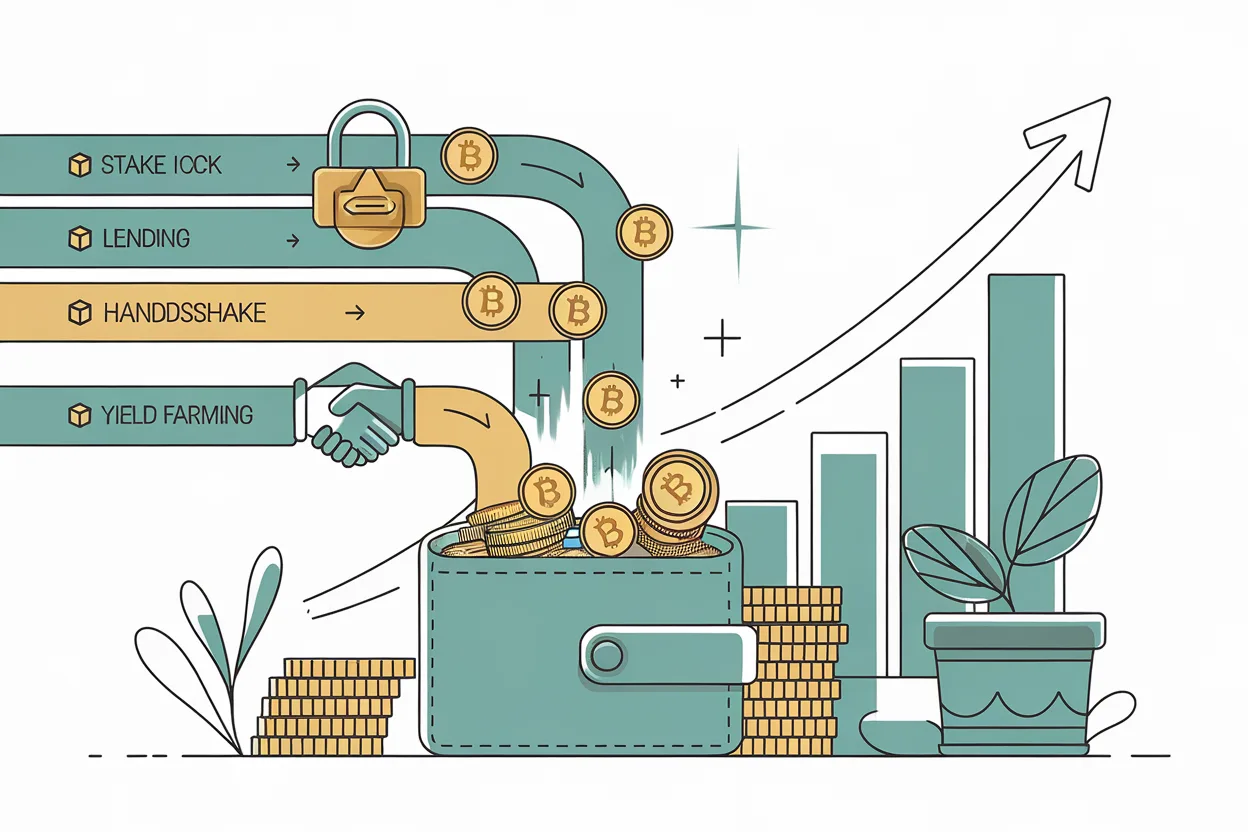
The promise of “earning money while you sleep” drew millions into crypto yield products during the DeFi Summer of 2021. Many lost everything when centralized platforms collapsed in 2022. But the underlying mechanisms — staking, lending, and providing liquidity — still work. The difference in 2026 is that yields are lower, but the ones that remain are driven by real economic activity rather than unsustainable token emissions.
In this guide, you’ll learn exactly how each passive income method works, what realistic returns look like today, which platforms I trust (and which I avoid), and how to get started with as little as $50.
The State of Crypto Passive Income in 2026
To understand where we are today, you need to understand where we’ve been. The crypto yield landscape has gone through three distinct phases.
During DeFi Summer 2021, yields of 100–1,000%+ APY were common. New protocols launched daily, each offering sky-high rewards in their native tokens to attract liquidity. The math seemed too good to be true — and it was. Most of those yields were subsidized by token inflation, not actual revenue.
Then came the 2022–2023 collapse. Centralized lending platforms — Celsius, BlockFi, Voyager, and FTX — imploded one after another, wiping out an estimated $60 billion or more in user funds. The common thread: opaque operations, excessive risk-taking with customer deposits, and in some cases outright fraud.
In 2026, the landscape is fundamentally different. Sustainable yields range from 3–15%, driven by real demand for block space, borrowing, and trading. Liquid staking alone accounts for over $42 billion in total value locked (TVL), according to DeFiLlama. Regulation has caught up, and users are more cautious about where they park their funds.
| Factor | 2021 (DeFi Summer) | 2026 (Current) |
|---|---|---|
| Typical APY | 100–1,000%+ | 3–15% |
| Yield source | Token emissions (inflationary) | Real economic activity |
| CeFi trust level | High (misplaced) | Low (post-Celsius caution) |
| Liquid staking TVL | <$5B | $42B+ |
| Regulation | Almost none | EU MiCA, US 1099-DA, global frameworks |
| Primary risk | Rug pulls, token collapse | Smart contract bugs, regulatory shifts |
The good news: the opportunities that remain are built on stronger foundations. The bad news: you won’t get rich overnight. But consistent, risk-adjusted returns of 4–10% on crypto assets — with yields paid in stablecoins or the staked asset itself — are genuinely achievable.
Method 1 — Staking: Earning by Securing the Network
What Is Staking?
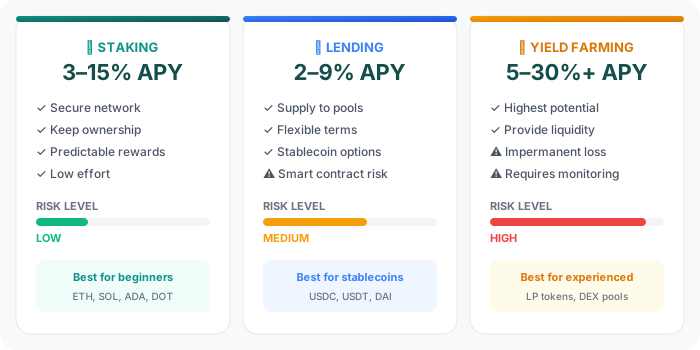
Staking is the process of locking your cryptocurrency to help validate transactions on a Proof of Stake (PoS) blockchain. In return, the network pays you rewards — similar to earning interest, but fundamentally different from lending.
When you stake, you maintain ownership of your tokens. You’re not lending them to anyone. Your tokens are locked (or delegated) to a validator node that processes transactions and secures the network. The rewards come from newly minted tokens and transaction fees — not from someone borrowing your funds.
This distinction matters. When a lending platform collapses, your funds are gone. When a staking validator goes offline, you might miss some rewards, but your principal is typically safe (with the exception of slashing penalties for validator misbehavior, which are rare for delegators).
Staking Yields by Chain (2026)
Different blockchains offer different staking rewards, reflecting their inflation rates, network activity, and economic design. Here’s what you can expect as of March 2026, based on data from StakingRewards:
| Chain | APY Range | Min Stake | Lock Period | Notes |
|---|---|---|---|---|
| Ethereum | 3.5–4.8% | 32 ETH (solo) / Any (liquid) | None (liquid) | Lido stETH: 2.8–3.4% |
| Solana | 5.9–7.5% | Any | None | Sanctum INF: ~8.5% |
| Cosmos (ATOM) | 14–19.5% | Any | 21-day unbond | High yield but volatile token |
| Polkadot | 8–15% | Variable | 28-day unbond | Validator-dependent |
| Cardano | 2–4.5% | Any | None | Low risk, low reward |
Cosmos offers 14–19.5% APY, but ATOM’s inflation rate is also high, which can erode the real value of your rewards. Ethereum’s 3.5–4.8% looks modest, but ETH has periods of deflationary supply (thanks to EIP-1559), making the real yield potentially higher.
Liquid Staking — The Best of Both Worlds
Traditional staking locks your tokens. Liquid staking solves this by giving you a receipt token (like stETH or rETH) that represents your staked position. You can use this receipt token in DeFi while still earning staking rewards.
Lido dominates the liquid staking market with approximately $19.4 billion in TVL. When you deposit ETH into Lido, you receive stETH, which earns 2.8–3.4% APY and can be used as collateral in Aave, traded on decentralized exchanges, or held in your wallet.
Rocket Pool offers a more decentralized alternative with rETH, though with slightly different yield characteristics. For those who value decentralization, Rocket Pool’s node operator network is more distributed than Lido’s.
Liquid staking tokens (LSTs) now represent over 51% of all DeFi TVL, making them the backbone of decentralized finance. If you want to learn more about the DeFi ecosystem these tokens operate in, see our complete DeFi guide. For an advanced extension of this strategy that stacks additional yield on top of staked ETH, see liquid restaking (EigenLayer, Symbiotic, Karak).
Exchange Staking
Not everyone wants to interact with DeFi protocols directly. Several centralized exchanges offer staking services that are simpler to use, though they come with custodial risk.
Margex offers staking at up to 5% APY on USDT, USDC, ETH, and DAI with no lock-up period and daily payouts. This is one of the simplest ways to earn yield because there’s nothing to configure — you deposit and start earning immediately.
For a trader, this flexibility matters — your capital earns yield when you’re not actively using it, and you can pull it out the moment an opportunity arises.
Other exchanges like Binance, Bybit, and OKX also offer staking products with varying terms and rates. Always compare the lock-up requirements, minimum amounts, and withdrawal conditions before committing.
Method 2 — Lending: Earning Interest on Your Crypto
DeFi Lending (Aave, Compound)
DeFi lending protocols allow you to supply your crypto to a pool that borrowers draw from. You earn interest based on supply and demand — when borrowing demand is high, rates go up.
As of March 2026, Aave supply rates are approximately:
- USDT: 1.84% APY
- USDC: 2.33% APY
- ETH: 2.19% APY
Compound offers an average of about 4.54% APY across its markets, though rates fluctuate with utilization.
Pros: Non-custodial (you interact with smart contracts, not a company), transparent on-chain rates, withdraw anytime.
Cons: Smart contract risk (bugs could drain funds), gas fees on Ethereum mainnet can eat into returns on small amounts, rates are variable and can drop near zero during low-demand periods.
CeFi Lending (Nexo, Ledn, YouHodler)
Centralized finance (CeFi) lending platforms offer higher headline rates because they pool funds and lend them to institutional borrowers, market makers, or use them in trading strategies.
- Nexo: Up to 18.9% APR (requires holding NEXO tokens and VIP tiers)
- Ledn: Up to 8.5% APR on USDC/USDT
- YouHodler: Up to 18% APY (higher rates on less liquid assets)
These rates look attractive, but I need to be blunt: CeFi lending means trusting a company with your funds. You are giving up custody. If the company makes bad trades, gets hacked, or commits fraud, your funds may be unrecoverable. This isn’t theoretical — it happened to millions of people in 2022.
If you do use CeFi platforms, only deposit what you can afford to lose, and prefer platforms that publish proof of reserves audits.
The CeFi Graveyard: Lessons from 2022
Before you trust any platform with your crypto, study what happened to those who came before:
| Platform | Collapsed | Est. Losses | Key Lesson |
|---|---|---|---|
| Celsius Network | June 2022 | $4.7B+ | Not your keys, not your crypto |
| BlockFi | Nov 2022 | $1B+ | FTX contagion can take down “safe” platforms |
| Voyager Digital | July 2022 | $1.3B+ | Exposure to Three Arrows Capital |
| FTX | Nov 2022 | $10–50B | Fraud and mismanagement of customer funds |
| Terra/Luna | May 2022 | $40–50B | Algorithmic stablecoins ≠ stable |
The total losses from these collapses exceeded $60 billion. Every one of these platforms promised safety, high yields, and transparency. Every one failed. The lesson is not that earning yield is impossible — it’s that you must understand where the yield comes from and who holds your funds.
For more on protecting your assets, see our cryptocurrency security guide.
Method 3 — Yield Farming: High Risk, High Reward
Yield farming (also called liquidity mining) involves providing liquidity to decentralized exchange (DEX) pools and earning a share of trading fees plus bonus token rewards.
How It Works
When you provide liquidity to a DEX like Uniswap or Curve, you deposit two tokens in equal value (e.g., $500 of ETH + $500 of USDC). Traders swap between these tokens and pay fees, a portion of which go to you as a liquidity provider (LP). Many protocols also distribute their governance tokens as additional incentives.
APY vs APR: Understanding the Numbers
Yield farming platforms often display APY (Annual Percentage Yield) rather than APR (Annual Percentage Rate). The difference matters:
- APR: Simple interest. 100% APR means you earn 100% of your deposit over a year without compounding.
- APY: Compound interest. 100% APR with daily compounding equals approximately 171% APY.
When you see a pool advertising 200% APY, the actual APR may be significantly lower. Always check which metric is displayed.
Impermanent Loss: The Hidden Cost
Impermanent loss is the difference between holding tokens in a liquidity pool versus simply holding them in your wallet. It occurs when the price ratio of the paired tokens changes.
Example: You deposit $1,000 of ETH and $1,000 of USDC into a pool. If ETH doubles in price, your pool position is worth approximately $2,828 — but if you had simply held the tokens, they’d be worth $3,000. That $172 difference is impermanent loss (~5.7% of the held value).
The farming rewards didn’t cover the loss. Now I only farm stablecoin pairs (USDT/USDC, DAI/USDC) where impermanent loss is minimal because both tokens track the same value. The yields are lower (5–15%), but they’re real.
Realistic Yields in 2026
Current yield farming returns depend heavily on the pair and protocol:
- Stablecoin pairs (USDT/USDC, DAI/USDC): 5–15% APY
- Blue-chip pairs (ETH/USDT, BTC/ETH): 10–30% APY (with impermanent loss risk)
- Volatile/new token pairs: 30–100%+ APY (extremely high risk — many tokens go to zero)
If a yield seems too good to be true, investigate what’s generating it. If the answer is “token emissions” without real revenue, the yield is being paid by diluting the token’s value — you’re essentially paying yourself.
How Much Can You Actually Earn? (Realistic Calculator)
Let’s put real numbers on this. The table below shows annual earnings at three risk levels, excluding token price changes:
| Starting Amount | Low-Risk: Staking (4%) | Medium: Lending (8%) | High-Risk: Farming (20%) |
|---|---|---|---|
| $50 | $2/year | $4/year | $10/year |
| $500 | $20/year | $40/year | $100/year |
| $5,000 | $200/year | $400/year | $1,000/year |
| $25,000 | $1,000/year | $2,000/year | $5,000/year |
| $100,000 | $4,000/year | $8,000/year | $20,000/year |
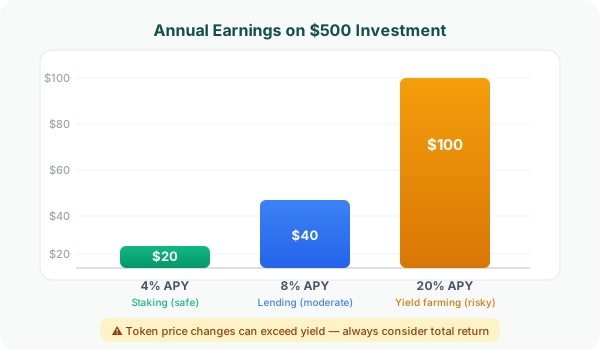
Important caveat: These figures exclude token price changes. A 20% farming yield means nothing if the token you’re farming drops 50%. Conversely, staking ETH at 4% while ETH appreciates 30% gives you a total return of 34%. Always consider total return, not just yield.
Also note: at $50, the actual dollar returns are minimal. Passive income strategies become meaningfully impactful starting around $1,000–$5,000, depending on your cost of living and financial goals.
5 Rules for Safe Passive Income
- Never put all funds in one platform. Diversify across at least 2–3 protocols or platforms. Even well-audited smart contracts can have vulnerabilities. Even “safe” CeFi platforms can collapse overnight. Spreading your risk is non-negotiable.
- Prefer non-custodial (DeFi) over custodial (CeFi). When you use Aave or stake directly, you interact with transparent smart contracts — not a company that can mismanage your funds behind closed doors. DeFi has smart contract risk; CeFi has all of that plus human risk.
- If the yield seems too high, it probably is. Anything consistently above 20% APY is a red flag. Ask yourself: who is paying this yield, and why? If you can’t identify the source of the revenue, you are likely the yield (your deposited capital is being used in ways you don’t understand).
- Start small: test with $50 before committing more. Every new protocol, every new platform — test it with an amount you can afford to lose. Verify withdrawals work. Understand the fees. Only scale up after you’re comfortable with the mechanics.
- Understand what generates the yield. Staking yields come from block rewards and transaction fees. Lending yields come from borrower interest. Trading fee yields come from DEX volume. If you can’t explain where the money comes from in one sentence, don’t invest.
Getting Started: Your First $50 in Passive Income
If you’re new to crypto passive income, here’s a step-by-step path to earning your first yield. You don’t need thousands of dollars — $50 is enough to learn the mechanics.
Option A: Exchange Staking (Simplest)
- Buy $50 of USDT on any exchange. If you haven’t bought crypto before, follow our step-by-step guide to buying your first crypto.
- Deposit to Margex and enable staking. You’ll earn approximately 5% APY with no lock-up period.
- Watch your rewards accumulate daily in your account dashboard.
- Reinvest monthly by adding your earnings back to the staking pool. Over time, compounding turns small amounts into meaningful returns.
At 5% APY, your $50 earns about $2.50 in the first year. That’s not life-changing money — but it teaches you the mechanics risk-free (relative to other methods). As your confidence and capital grow, you can diversify into other strategies.
Option B: DeFi Lending (More Control)
- Set up a self-custody wallet — see our crypto wallet guide for choosing one.
- Bridge USDT or USDC to a Layer 2 network (Arbitrum or Base) to minimize gas fees.
- Supply to Aave on L2 — deposit your stablecoins and start earning 2–4% APY.
- Monitor your position through Aave’s dashboard or a portfolio tracker like Zapper.
This option requires more technical knowledge but keeps you in full control of your funds. No company can freeze your withdrawal or deny you access.
Tax Implications of Crypto Passive Income
Earning passive income on crypto creates tax obligations in most jurisdictions. Here’s what you need to know:
General Tax Treatment
- Staking rewards: Typically taxable as ordinary income at the fair market value when received.
- Lending interest: Same treatment as staking — income when received.
- Yield farming rewards: Often taxable both when received (income) and when sold (capital gains if the token appreciated).
Record Keeping
For every reward you receive, record:
- Date and time received
- Amount of tokens received
- Fair market value in your local currency at the time of receipt
- The platform or protocol that paid the reward
In the United States, Form 1099-DA (Digital Asset reporting) reached full implementation in January 2026, meaning exchanges now report your crypto transactions to the IRS. Tools like CoinLedger and Koinly can help automate tax calculations across multiple platforms.
Important: Tax treatment varies significantly by country. What’s taxable in the US may be treated differently in Portugal, Singapore, or the UAE. Always consult a tax professional in your jurisdiction before making investment decisions based on tax assumptions.
Frequently Asked Questions
What is the safest way to earn passive income with crypto?
Staking established Proof of Stake tokens (ETH, SOL, ADA) through liquid staking protocols like Lido is generally considered the lowest-risk method. You maintain exposure to the underlying token, earn 3–5% APY, and don’t rely on any company to hold your funds. Stablecoin staking on reputable exchanges (like Margex at 5% APY with no lock-up) is another low-risk option if you prefer simplicity. To learn more about stablecoins, see our guide to stablecoins.
How much can I earn staking $100 in crypto?
At a typical staking rate of 4–5% APY, $100 would earn approximately $4–$5 per year. With higher-yield chains like Cosmos (14–19.5% APY), you could earn $14–$19.50 per year, but these tokens tend to be more volatile. The dollar amount of your earnings also depends on whether the token’s price rises or falls during the staking period.
Is crypto staking better than a savings account?
In terms of raw yield, crypto staking often outperforms traditional savings accounts, which offer 0.5–5% APY depending on your country and bank. However, crypto staking carries risks that savings accounts don’t: token price volatility, smart contract risk, and no deposit insurance. A traditional savings account is federally insured (up to $250,000 in the US via FDIC). Crypto staking is not. The comparison makes sense only if you already hold crypto and want to put it to work.
Can I lose money with crypto staking?
Yes. While staking itself doesn’t reduce the number of tokens you hold (except in rare slashing events), the dollar value of your staked tokens can drop. If you stake ETH at 4% APY but ETH drops 40% in price, your net position is down 36%. Additionally, some staking has unbonding periods (e.g., 21 days for Cosmos) during which you cannot sell, potentially locking you into a declining position.
What happened to Celsius and why does it matter?
Celsius Network was a centralized crypto lending platform that promised high yields (up to 18% APY) and attracted billions in customer deposits. In June 2022, Celsius froze all withdrawals, revealing that it had been using customer funds for risky, illiquid investments. The company filed for bankruptcy, and customers lost approximately $4.7 billion. Celsius matters because it demonstrates the danger of trusting a centralized entity with your crypto just for higher yields. The lesson: if the yield seems too good to be true, investigate where it comes from before depositing.
Continue Learning
- What Is DeFi? Decentralized Finance for Beginners (2026)
- What Are Stablecoins? Types, Uses, and Risks Explained
- Stablecoin Savings Guide: Protect Your Money from Inflation
- Cryptocurrency Security: How to Protect Your Digital Assets
- How to Buy Your First Crypto: Step-by-Step Guide
- How to Choose a Crypto Wallet (2026)