What Is DeFi? Decentralized Finance Explained for Beginners (2026)
Table of Contents

Editorial pen name · ChainGain
Alex Mercer is the editorial pen name used for ChainGain’s cryptocurrency education content. Articles are based on cited sources and reproducible comparisons. Editorial profile
Disclosure: This article contains affiliate links. If you sign up through our links, we may earn a commission at no extra cost to you. See our full Affiliate Disclosure and Editorial Policy for details.
DeFi — short for Decentralized Finance — is a system of financial services built on blockchain technology that operates without banks, brokers, or middlemen. Instead of trusting a bank with your money, you interact directly with smart contracts: self-executing code that enforces rules automatically.
DeFi by the Numbers (2026)
| Metric | Value | Source |
|---|---|---|
| Total Value Locked (TVL) | ~$95–130 billion | DefiLlama |
| Number of DeFi protocols | 4,000+ | DefiLlama |
| Ethereum’s share of DeFi TVL | 55–60% | DefiLlama |
| DeFi hack losses (2024) | $730 million+ | Hacken |
| Largest DeFi protocol (by TVL) | Lido ($10B+) | DefiLlama |
How Traditional Finance vs DeFi Works
To understand DeFi, compare it with the banking system you already know:
| Feature | Traditional Finance (TradFi) | DeFi |
|---|---|---|
| Who controls your money | Banks, brokers | You (via your wallet) |
| Operating hours | Business hours (Mon–Fri) | 24/7/365 |
| Who can participate | Must pass KYC, credit checks | Anyone with a wallet |
| Transparency | Closed books | All transactions are public on-chain |
| Transfer speed | 1–5 business days | Seconds to minutes |
| Savings interest | 0.01–5% APY | 2–15% APY (higher risk) |
| Insurance | Government-backed (FDIC, etc.) | No government protection |
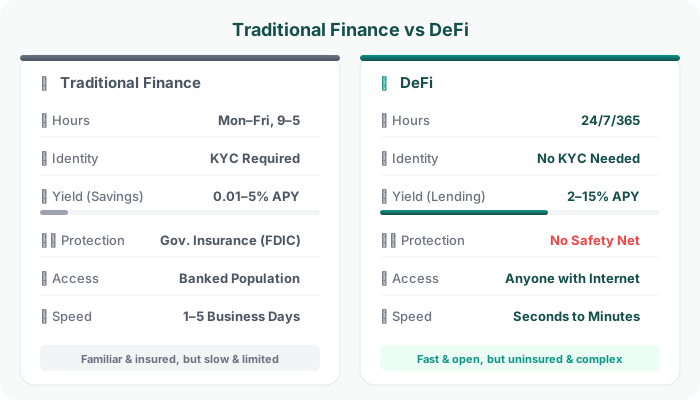
The key trade-off: DeFi gives you more control and higher potential returns, but you take on more risk and responsibility. There’s no “forgot password” button and no customer support phone number.
The 5 Main Types of DeFi
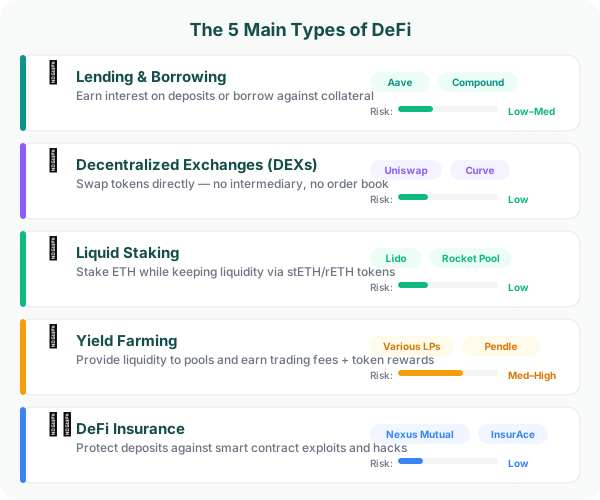
1. Lending and Borrowing
DeFi lending works like a bank savings account and loan — but without the bank. You deposit crypto to earn interest, or borrow crypto by providing collateral.
- How it works: Deposit USDC → earn 3–8% APY. Deposit ETH as collateral → borrow up to 75% of its value in stablecoins.
- Top protocols: Aave ($10B+ TVL), Compound, Sky (formerly MakerDAO)
- Risk level: Medium — smart contract risk + liquidation risk if collateral drops
2. Decentralized Exchanges (DEXs)
DEXs let you swap one cryptocurrency for another directly from your wallet, without an intermediary holding your funds.
- How it works: Connect wallet → select tokens → swap. Liquidity comes from pools funded by other users, not a centralized order book.
- Top protocols: Uniswap, Curve ($2.25B TVL), PancakeSwap, dYdX (perpetual futures)
- Risk level: Low to Medium — price slippage on large trades, possible front-running
3. Liquid Staking
Staking normally locks your crypto. Liquid staking lets you stake and still use your assets in DeFi.
- How it works: Deposit ETH into Lido → receive stETH (a receipt token). Earn ~3–4% staking rewards while using stETH as collateral in Aave or other protocols.
- Top protocol: Lido ($10B+ TVL, #1 DeFi protocol by TVL)
- Risk level: Low to Medium — stETH can temporarily de-peg from ETH price
4. Yield Farming
Yield farming means moving your crypto between protocols to maximize returns. It’s like shopping for the best savings rate — but automated and riskier.
- How it works: Provide liquidity to a pool (e.g., ETH/USDC on Uniswap) → earn trading fees + bonus governance tokens.
- Returns: Can range from 5% to 100%+ APY, but high returns typically indicate high risk
- Risk level: High — impermanent loss, smart contract bugs, rewards can drop suddenly
5. DeFi Insurance
DeFi insurance protocols let you buy coverage against smart contract failures, exchange hacks, or stablecoin de-pegging.
- How it works: Pay a premium (2–15% per year) → get compensated if a covered protocol gets hacked or exploited.
- Top protocols: Nexus Mutual, InsurAce
- Risk level: Low (for the buyer) — the insurance protocol itself could fail, though
Top DeFi Protocols You Should Know
| Protocol | Category | TVL | What It Does |
|---|---|---|---|
| Lido | Liquid Staking | $10B+ | Stake ETH without locking it. Receive stETH. |
| Aave | Lending | $10B+ | Deposit to earn interest or borrow with collateral. Invented flash loans. |
| Uniswap | DEX | $5B+ | Swap any ERC-20 token. Largest DEX by volume. |
| Sky (MakerDAO) | Stablecoin | $5B+ | Issues DAI/USDS stablecoins backed by crypto collateral. |
| Curve | DEX | $2.25B | Optimized for stablecoin swaps with minimal slippage. |
| Compound | Lending | $2B+ | Earn interest on deposits. Algorithmic interest rates. |
| dYdX | Perpetual DEX | $300M+ | Trade crypto perpetual futures with up to 50x leverage. No KYC. |
The Risks of DeFi (Don’t Skip This)
DeFi offers exciting opportunities, but it’s important to understand the risks before putting any money in. Over $730 million was lost to DeFi hacks in 2024 alone (Hacken 2024 Report), and losses accelerated in 2025.
1. Smart Contract Risk
Every DeFi protocol is controlled by code. If there’s a bug, hackers can drain funds. Even audited protocols have been exploited — Euler Finance lost $197 million in 2023 despite multiple audits.
2. Impermanent Loss
When you provide liquidity to a DEX pool, price changes between the two tokens can reduce your holdings compared to simply holding them. The loss becomes “permanent” if you withdraw at the wrong time.
3. Rug Pulls
Developers create a token, attract liquidity, then drain the pool and disappear. This is especially common with new, unaudited protocols. Learn how to spot scams.
4. Oracle Manipulation
DeFi protocols rely on price feeds (oracles) to function. Attackers can manipulate these price feeds — often using flash loans — to trick protocols into bad trades. Over $500 million has been lost to oracle-related attacks.
5. No Safety Net
Unlike bank deposits, DeFi has no government insurance (FDIC, etc.). If a protocol fails, your money is likely gone. There’s no customer support to call.
Golden Rule of DeFi
Never invest more than you can afford to lose completely. Start with small amounts ($20–50) and learn how each protocol works before committing larger sums.
How to Get Started with DeFi (5 Steps)
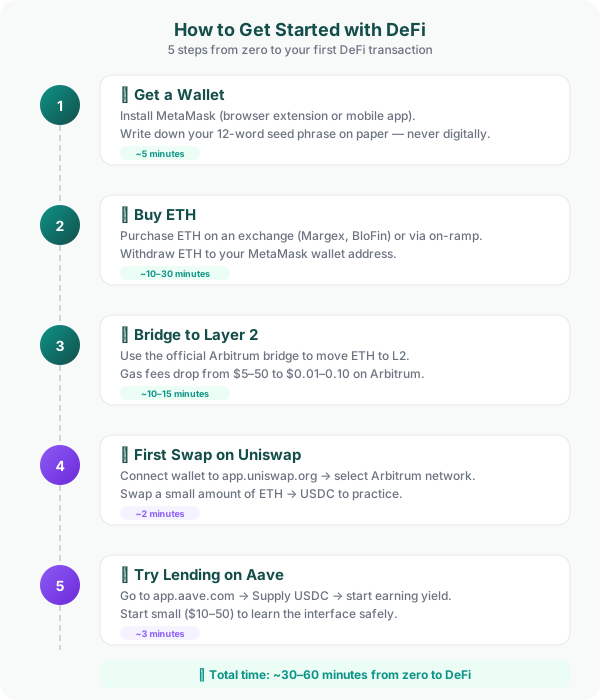
- Get a non-custodial wallet — MetaMask (browser) or Trust Wallet (mobile). This is your key to DeFi. Wallet guide here.
- Buy some ETH — You need ETH for gas fees on Ethereum. For lower fees, use Layer 2 networks like Arbitrum or Base. Buying guide.
- Bridge to a Layer 2 — Send your ETH to Arbitrum or Optimism for 90% lower fees. Use the official bridge or a service like Hop Protocol.
- Try a simple swap — Go to Uniswap, connect your wallet, and swap a small amount of ETH for USDC. This is your first DeFi transaction.
- Explore lending — Deposit your USDC into Aave on Arbitrum. Watch interest accrue in real time. Withdraw anytime.
My advice: spend your first week just doing small test transactions. The gas fees on Layer 2 are under $0.10, so experimenting is cheap.
Which Blockchain for DeFi?
| Blockchain | DeFi TVL Share | Gas Fees | Best For |
|---|---|---|---|
| Ethereum | 55–60% | $1–20 | Largest selection, most secure, highest liquidity |
| Arbitrum (L2) | ~5% | $0.01–0.10 | Beginners — same protocols, 99% lower fees |
| Solana | ~9% | $0.001 | Fast trading, memecoin DeFi |
| BNB Chain | ~8% | $0.05–0.30 | PancakeSwap ecosystem, low fees |
| Base (L2) | ~4% | $0.01 | Growing ecosystem, Coinbase-backed |
Beginner recommendation: Start on Arbitrum. It has the same major protocols as Ethereum (Aave, Uniswap, GMX) but with gas fees under $0.10.
DeFi and Regulation
DeFi regulation is evolving rapidly:
- EU (MiCA): The Markets in Crypto-Assets regulation took effect December 30, 2024. Fully decentralized protocols are currently exempt, but any project with an identifiable intermediary must comply.
- United States: No comprehensive DeFi framework yet. The SEC has taken enforcement actions against some protocols.
- Emerging markets: Regulation varies widely. Many countries where DeFi is most useful (Nigeria, Indonesia, Brazil) have limited or unclear DeFi-specific rules.
The general trend: regulators are focusing on centralized access points (on-ramps, exchanges) rather than trying to regulate decentralized protocols directly.
DeFi Glossary (Quick Reference)
| Term | Definition |
|---|---|
| TVL | Total Value Locked — total crypto deposited in a protocol |
| APY | Annual Percentage Yield — your expected yearly return including compounding |
| LP | Liquidity Provider — someone who deposits tokens into a pool |
| AMM | Automated Market Maker — algorithm that prices tokens in a pool |
| Flash Loan | Uncollateralized loan repaid in the same transaction |
| Impermanent Loss | Value loss from providing liquidity when token prices diverge |
| Gas | Fee paid to execute transactions on blockchain |
| Governance Token | Token that gives voting rights on protocol decisions |
For a complete list of 150+ crypto terms, see our Crypto Glossary.
FAQ
Is DeFi safe for beginners?
DeFi involves real risks including loss of funds from hacks, bugs, and user errors. Start with small amounts ($20–50) on reputable protocols like Aave and Uniswap on Layer 2 networks. Never invest more than you can afford to lose.
How much money do I need to start with DeFi?
On Layer 2 networks like Arbitrum, you can start with as little as $10–20. Gas fees are under $0.10 per transaction, making it practical to experiment with small amounts.
Can I lose all my money in DeFi?
Yes. Smart contract exploits, rug pulls, and stablecoin de-pegging can result in total loss. There is no government insurance or safety net in DeFi. Diversify across protocols and never put all your funds in one place.
What’s the difference between DeFi and a crypto exchange?
A centralized exchange (like Margex or BloFin) holds your funds and manages trading on your behalf. DeFi lets you trade, lend, and earn directly from your own wallet — you maintain full control of your private keys.
Do I need to pay taxes on DeFi?
In most countries, yes. Swapping tokens, earning yield, and providing liquidity are typically taxable events. Record-keeping is crucial. Consult a tax professional familiar with crypto in your country.
Continue Learning
Disclaimer: This article is for educational purposes only. It does not constitute financial, legal, or investment advice. Cryptocurrency and DeFi investments carry significant risk, including total loss of principal. Always do your own research before making financial decisions.
The Complete DeFi & Yield Guide Series
Our full DeFi and yield education series:
- Crypto Passive Income: Staking, Lending, and Yield (2026)
- AI Crypto Tax 2026: Tracking DeFi, Liquid Staking, and Bot Trades — Honest Capabilities and Limits
- Liquid Staking 2026: Lido, Rocket Pool, Frax Compared
- Liquid Restaking 2026: EigenLayer vs Symbiotic vs Karak — Honest Risk Comparison
- DeFi Vaults 2026: Yearn vs Beefy vs Convex vs Pendle Risk-Adjusted Returns Comparison
- What Is DeFi? 2026 Complete Beginner’s Guide (Real Examples, Real Risks, Real Yields)